🌌 Aurora AI
A Commercial Agentic Platform for the Intention Economy
🚀 What Inspired the Project
Aurora AI was inspired by a simple but powerful observation: today’s digital marketplace is driven more by attention than by value.
In the current attention economy, visibility is often determined by advertising budgets rather than product quality. Businesses compete for clicks. Consumers are overwhelmed with sponsored results, biased reviews, and endless comparisons.
We asked:
What if commerce were based on intention instead of attention?
Instead of competing for visibility, businesses should compete on outcomes and quality. Instead of browsing through noise, consumers should simply express their intention — and let intelligent systems handle the rest.
That idea became Aurora AI.
🧠 The Core Idea
Aurora AI is a commercial agentic system built around the Intention Economy and Outcome-Driven Commerce.
Rather than pushing ads, Aurora AI deploys intelligent agents that:
- Understand user budgets
- Learn preferences and behavior
- Adapt to personality traits
- Incorporate personal and community feedback
- Optimize for real-world outcomes
Instead of:
[ \text{Visibility} \propto \text{Ad Spend} ]
Aurora AI aims for:
[ \text{Opportunity Match} = f(\text{Intent}, \text{Quality}, \text{Fit}) ]
Where:
- Intent = what the user truly wants
- Quality = measurable product/service value
- Fit = alignment with user profile and goals
🏗️ How We Built It
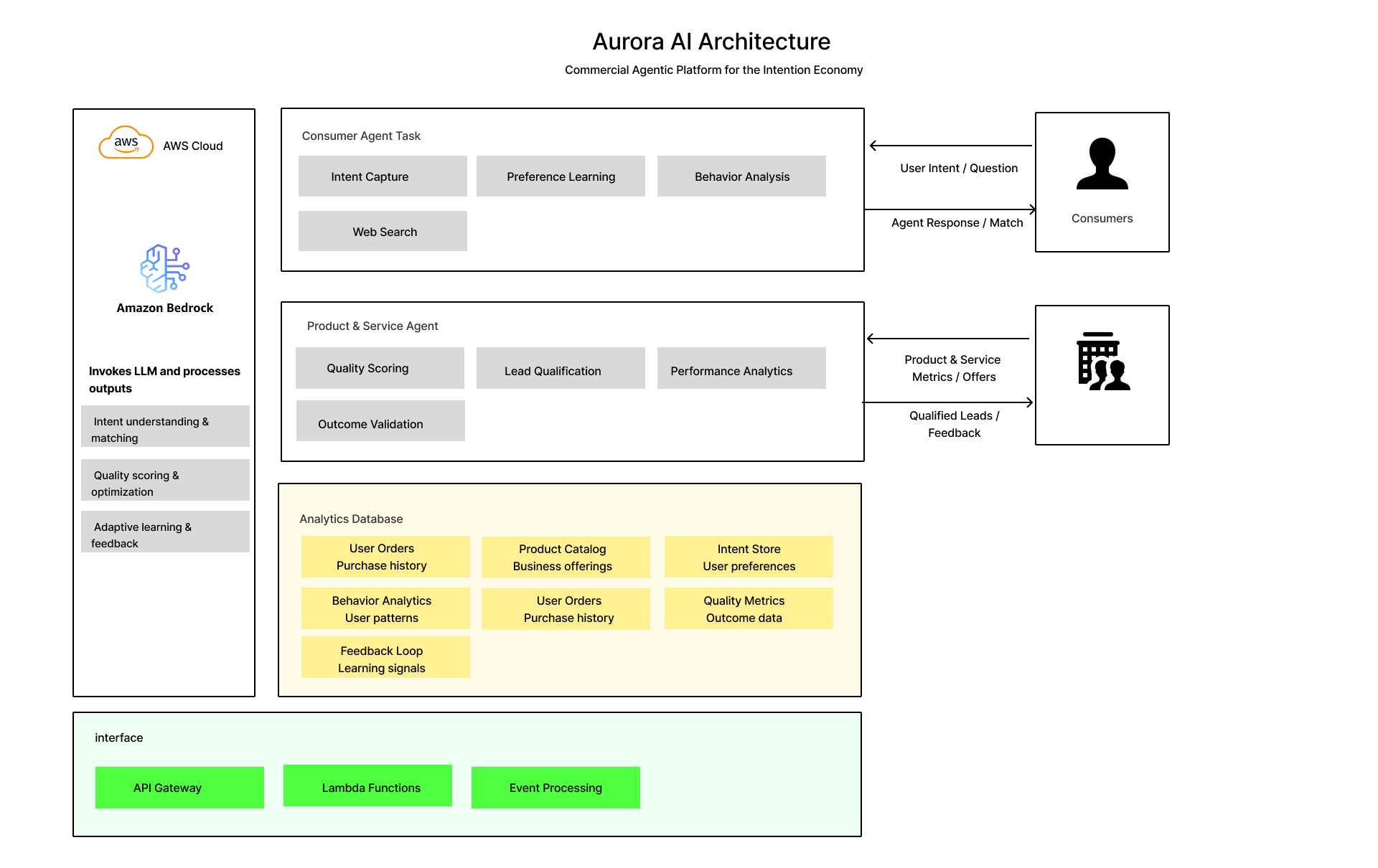
Aurora AI was built as a modular agent-based system composed of:
1️⃣ Consumer Agents
- Capture user intent explicitly
- Learn from behavioral signals
- Continuously refine preference models
- Optimize recommendations over time
2️⃣ Business Quality Scoring Layer
- Evaluates offerings based on measurable outcomes
- Filters out noise-based promotion
- Ranks providers based on relevance and performance
3️⃣ Matching & Outcome Engine
- Uses machine learning models to score compatibility
- Prioritizes qualified leads over mass exposure
- Creates a two-sided value exchange
4️⃣ Feedback Loop
Agents evolve through reinforcement mechanisms:
[ \text{Agent Learning} = \text{Intent Feedback} + \text{Outcome Validation} + \text{Community Signal} ]
This allows the ecosystem to self-improve over time.
📚 What We Learned
Building Aurora AI taught us several key lessons:
- Intent is more powerful than behavior alone. Explicit intention reduces ambiguity.
- Trust requires transparency. Users must understand why recommendations are made.
- Businesses prefer qualified demand over mass traffic.
- Agent autonomy must be balanced with user control.
- Personalization without privacy protection destroys credibility.
We also learned that replacing ads is not just a technical challenge — it’s a structural shift in how digital commerce operates.
⚔️ Challenges We Faced
1️⃣ Breaking the Ad-Driven Model
The digital ecosystem is deeply optimized for advertising revenue. Building an alternative requires rethinking incentives.
2️⃣ Modeling Human Intent
Human intentions are nuanced and sometimes contradictory. Capturing them accurately required iterative experimentation.
3️⃣ Cold Start Problem
Without historical data, intelligent matching is difficult. We addressed this using hybrid profiling and adaptive learning loops.
4️⃣ Trust & Fairness
Ensuring the system prioritizes quality over hidden bias required designing transparent scoring mechanisms.
5️⃣ Balancing Personalization and Privacy
We had to design agents that learn deeply while protecting user autonomy and data ownership.
🌍 The Vision
Aurora AI represents a shift from:
- Attention → Intention
- Ads → Qualified Matches
- Noise → Outcome
- Volume → Quality
We believe commerce should be:
- Faster
- Smarter
- Fairer
- Outcome-driven
Aurora AI is not just a recommendation engine. It is an agentic commercial infrastructure designed for the next generation of digital markets.
If the attention economy optimized for clicks, Aurora AI optimizes for results.

Log in or sign up for Devpost to join the conversation.