-
-
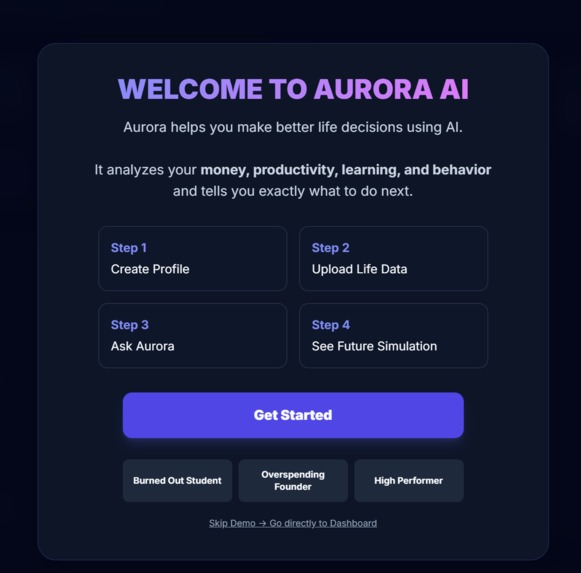
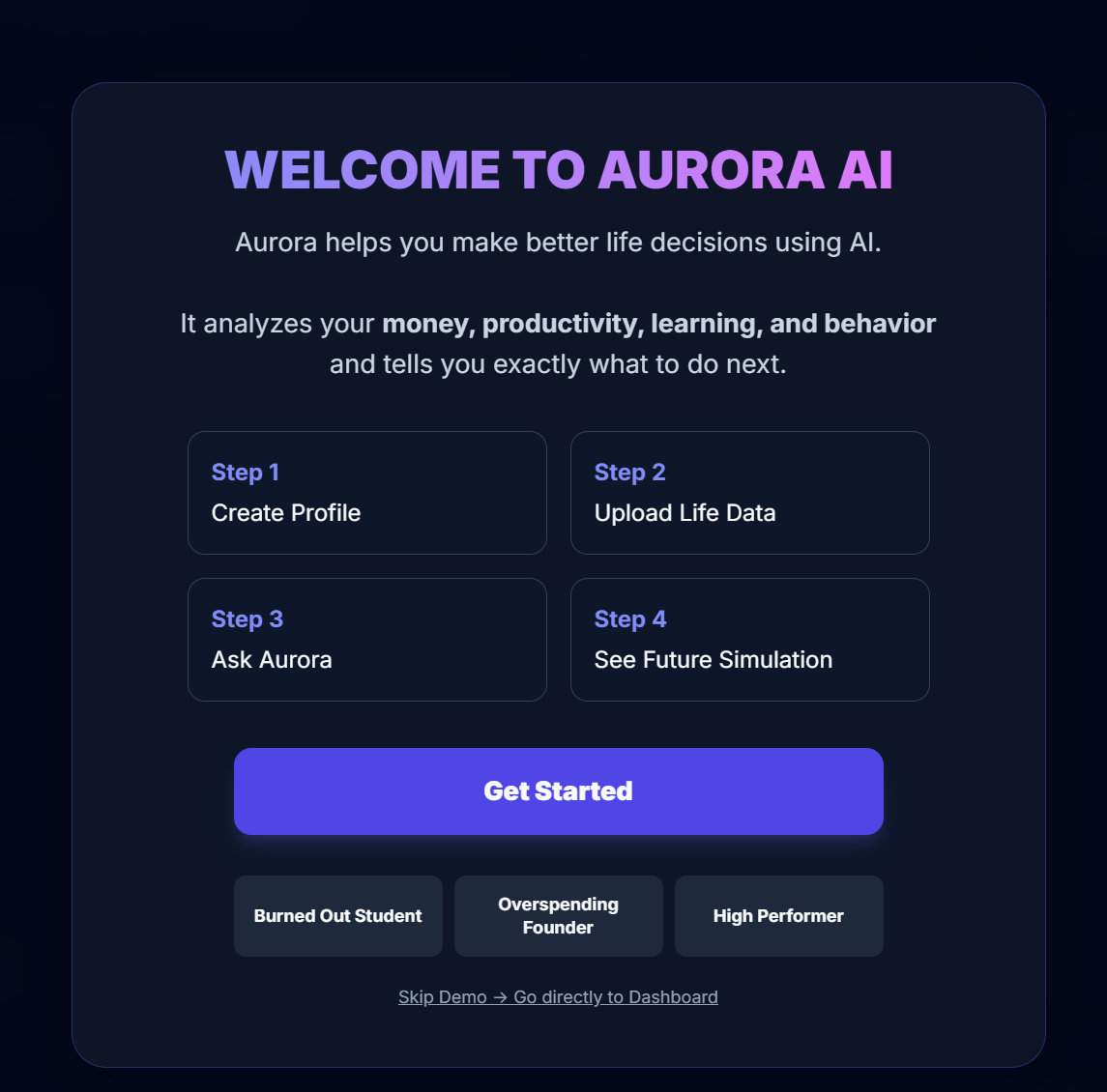
AURORA AI home screen for AI-powered life decision making.
Inspiration
AURORA AI started from the idea that people already have access to a lot of information about their lives, but still struggle to turn that into good decisions. Whether it’s money, habits, productivity, or learning, everything is usually tracked separately and doesn’t connect in a meaningful way. I wanted to build something that feels less like a dashboard and more like a thinking tool, something that helps you figure out what you should do next in real life.
What it does
AURORA AI is a system that looks at different parts of a person’s life like spending patterns, productivity, learning progress, and daily habits, and combines them into one clear, practical decision. Instead of just showing charts or data, it helps users decide what to do next, whether that is studying, taking a break, adjusting spending, or improving habits. It focuses on turning personal data into clear, actionable guidance.
Aurora can also ask follow-up clarification questions when user input is incomplete, helping improve decision quality and making the system feel more like real-world reasoning.
How I built it
I built AURORA AI as a full-stack web application using Next.js for the frontend and FastAPI for the backend. Behind the scenes, it uses a multi-agent style AI system where different components focus on areas like finance, productivity, learning, and behavior. A central orchestrator combines these insights and produces a final decision with reasoning, risk analysis, and predicted outcomes in a structured format.
Challenges we ran into
One of the hardest parts was making the AI feel genuinely useful instead of just summarizing data. Early versions mostly described what was happening, which did not feel meaningful. I had to redesign the system to focus on decision-making by connecting multiple areas of a person’s life instead of treating them separately. Another challenge was balancing complexity with the hackathon timeline while still building something that feels complete and polished.
Accomplishments that I'm proud of
I’m proud that I was able to build a working multi-agent AI system that reasons across multiple life domains instead of focusing on just one. I also turned it into a clean, usable web application that feels like a real product rather than just a prototype. Most importantly, I created something that does more than display information and instead helps users make better decisions.
What I learned
I learned that the real value of AI is not just generating answers, but connecting different signals to help people think more clearly. I also learned that system design matters more than complexity, and that clear, structured outputs make AI far more useful. More broadly, I realized that strong AI products are defined by how well they support decision-making, not how many features they include.
What's next for AURORA AI
Next, I want to expand AURORA AI by connecting it to real-world data sources like calendars, financial accounts, and wearable devices. I also want to improve prediction accuracy and make the system more personalized over time. The long-term goal is to build a personal system that quietly helps people make better decisions every day without feeling overwhelming or complicated.

Log in or sign up for Devpost to join the conversation.