-
-
logo
-
project idea pitch
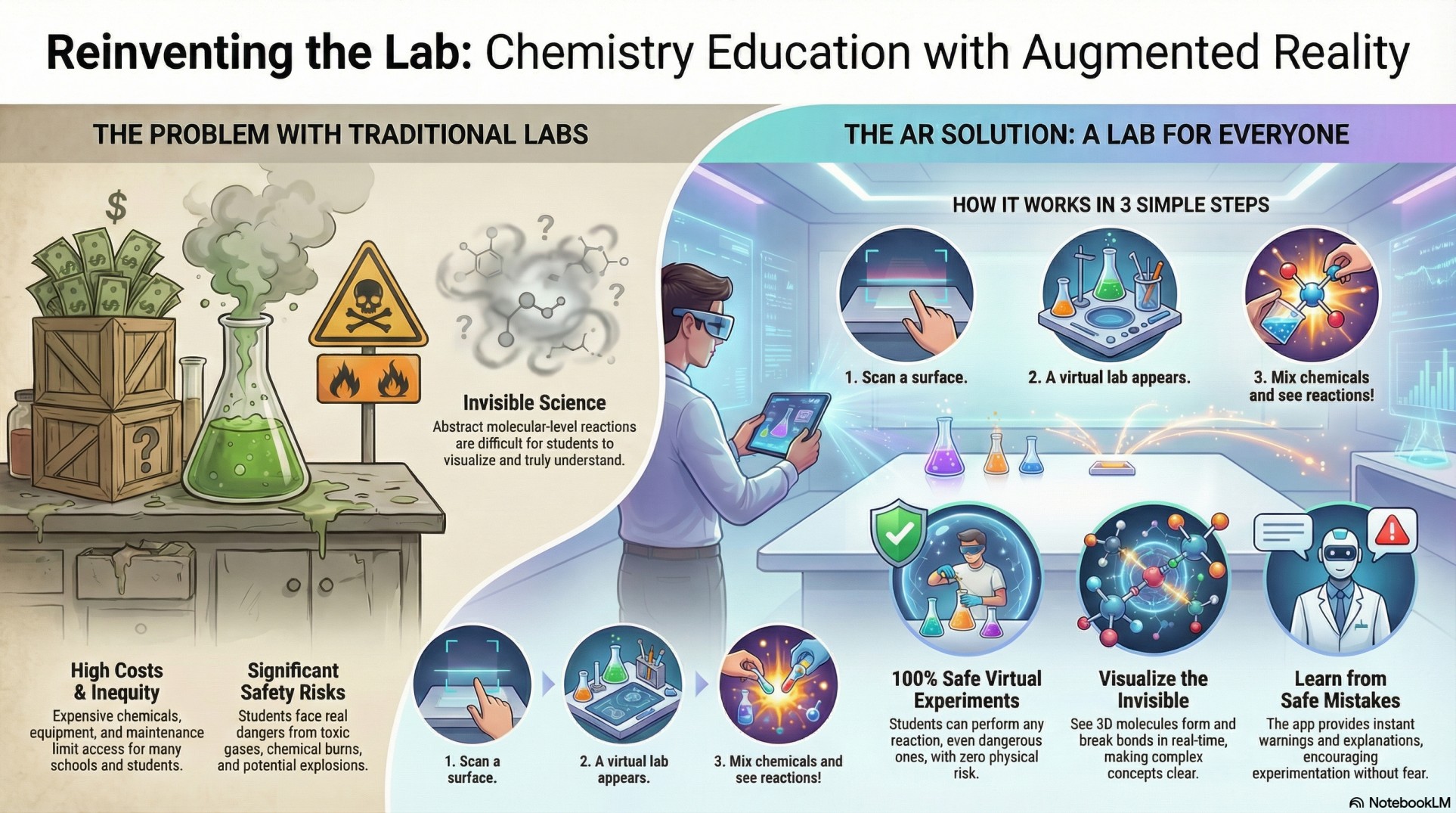
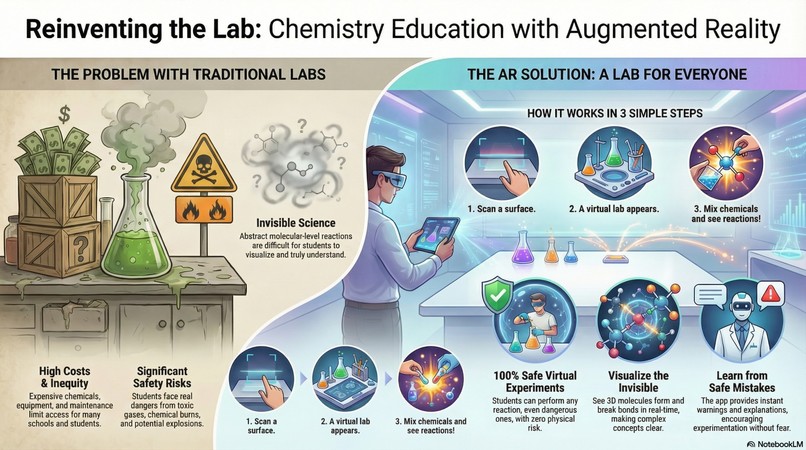
Fear to Fascination Remember the high school chemistry lab? For many, it was a mix of mild panic and abstract confusion. The fear of mixing the wrong chemicals, the inability to see what was really happening inside the beaker, and the limited chances to experiment made learning a challenge. It was a world of memorizing equations rather than truly understanding reactions. But what if you could conduct any experiment without fear? What if you could shrink down and watch molecules collide, break apart, and form new bonds in real-time, right on your desk? An innovative new concept, the "AR Chemistry Lab," offers a revolutionary answer. It's a tool that brings the lab to the student, not the other way around, transforming a subject of fear into one of fascination.
- You Don't Just Learn Chemistry—You See It Happen The biggest hurdle for many chemistry students is visualizing the invisible. An AR Chemistry Lab’s "Molecular Visualization" feature tackles this head-on. The application uses a phone or tablet camera to project 3D atoms and molecules into your physical space, allowing you to see bond formation and breaking in real-time as you mix virtual chemicals. This is a game-changer. Instead of trying to decipher flat, static diagrams in a textbook, students can now visualize complex processes like acid-base titrations or redox reactions. This technology directly solves the "I can’t imagine what’s happening inside the reaction" problem, making abstract concepts tangible and intuitive.
- It Makes It Safe to Fail In a traditional lab, mistakes can be costly or dangerous. In an AR lab, they are the best teachers. A "Smart Error Detection" system is built into the experience to guide learning. If a user adds the wrong chemical or uses an incorrect quantity, the app doesn't just stop the experiment; it provides a warning, explains the mistake, and details what the real-world consequences would have been. This shifts the entire pedagogical model. The app supports this by offering a structured "Guided Mode" for step-by-step learning and a "Free Experiment Mode" that encourages open-ended discovery. Instead of avoiding errors, students are encouraged to experiment and learn from them in a 100% safe environment. The system is designed to build conceptual clarity, not fear, turning every misstep into a powerful and memorable learning moment.
- It Democratizes Science Education Traditional chemistry labs have always been gated by significant barriers. The high cost of equipment and chemicals, inherent safety risks, and the physical space required mean that many schools, especially in rural or underfunded areas, simply cannot offer a robust hands-on experience. This problem is even more acute for the growing population of online learners. The AR lab eliminates these walls. By requiring no physical chemicals or expensive equipment, it makes interactive experiments accessible to anyone with a smartphone or tablet using standard augmented reality frameworks like ARKit and ARCore. The core mission is simple but profound: “Bring the chemistry lab to the student, safely and affordably.” This technology makes high-quality, hands-on science education a reality for K-12 students, college learners, teachers seeking powerful demo tools, and even coaching institutes, breaking down economic and geographical barriers to learning. Conclusion: A New Reality for Learning By making the invisible visible, turning failure into a safe and effective teacher, and removing the physical and financial walls of a traditional laboratory, the AR Chemistry Lab points to a powerful new future for education. It’s more than just a novelty; it’s a tool that makes science more intuitive, engaging, and accessible for everyone. If we can simulate a chemistry lab on a kitchen table, what other parts of education are ready for their own augmented reality revolution?


Log in or sign up for Devpost to join the conversation.