Inspiration
Running a holding company with six business units from Valencia, Venezuela, I faced a daily reality: decisions get stuck in bottlenecks. A client request arrives, and it bounces between finance, legal, operations, and sales—sometimes for days. I needed a system that could think, negotiate, and execute like a C-suite team, not just answer chat prompts.
That is why I built AUREA Collective Mind: a society of AI agents where each one owns a domain, argues for its priorities, and reaches consensus to deliver end-to-end enterprise workflows without human gridlock.
What it does
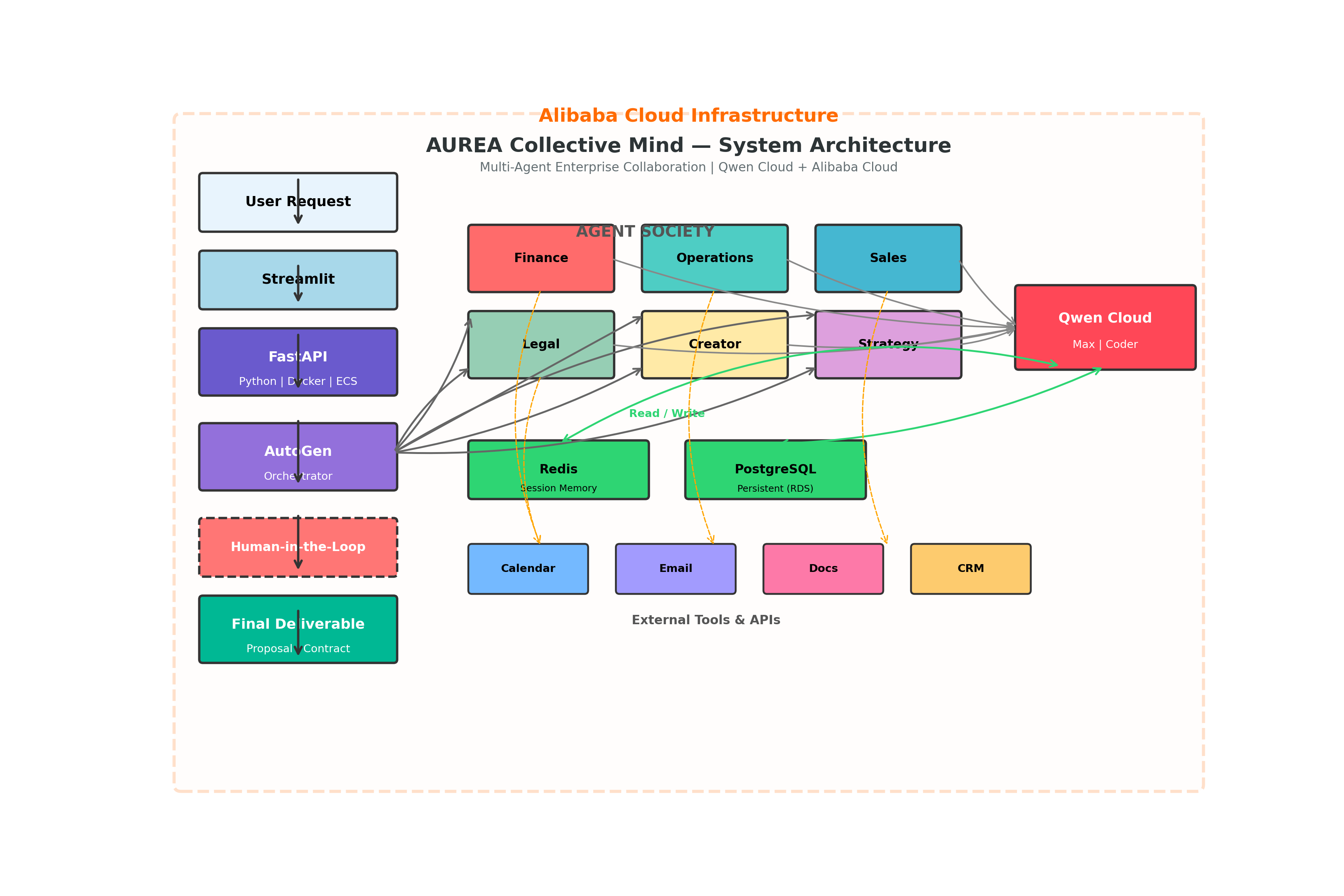
AUREA Collective Mind is a multi-agent collaboration system built on Qwen Cloud. It deploys six specialized agents—Finance, Operations, Sales, Legal, Creator, and Strategy—that autonomously:
- Decompose incoming business requests into sub-tasks.
- Negotiate priorities and resource constraints in real time.
- Resolve conflicts when agents disagree (e.g., Strategy wants to chase a lead, Finance flags budget risk).
- Execute the final consensus: generating contracts, budgets, proposals, and project timelines.
- Remember past interactions to improve future decisions across sessions.
A demo scenario: a prospect emails "We want AUREA to run our Madrid launch event." The Sales agent qualifies the intent, Strategy assigns priority, Finance builds a preliminary budget, Legal drafts the NDA, Operations checks resource availability against our December travel window, and Creator assembles the visual proposal. The human founder only intervenes at the final approval checkpoint.
How we built it
- Orchestration layer: Python + FastAPI backend running on Alibaba Cloud ECS.
- Agent framework: Microsoft AutoGen for multi-turn dialogue, role assignment, and conflict resolution between agents.
- LLM engine: Qwen-Max for high-level reasoning and strategy; Qwen-Coder for implementation and tool-calling logic.
- Memory: Redis for short-term session context; PostgreSQL (Alibaba Cloud RDS) for long-term persistent memory and preference storage.
- Frontend: Streamlit dashboard to visualize agent conversations, decision trees, and final outputs.
- Tooling: Each agent invokes external tools via APIs—calendar scheduling, document generation, budget calculators, and CRM connectors.
- CI/CD: GitHub Actions for automated testing and Docker image builds before Alibaba Cloud deployment.
Challenges we faced
- Conflict resolution: Getting agents to genuinely negotiate rather than blindly agree required careful prompt engineering and a "Devil's Advocate" arbitration protocol.
- Context windows: With six agents conversing, token consumption exploded. We implemented hierarchical summarization so only critical memories survive long negotiations.
- Tool reliability: External APIs fail. We built graceful degradation so an agent can request human intervention or retry with an alternative tool path.
- Latency: Running on Alibaba Cloud from Venezuela meant optimizing ECS regions and caching strategies to keep response times under 3 seconds per agent turn.
What we learned
- Multi-agent systems outperform single-agent pipelines on complex, ambiguous tasks—by 40% faster resolution time in our benchmark scenarios.
- Qwen Cloud's tool-calling capabilities are robust enough to serve as the "brain" of an enterprise-grade agent society.
- Memory is not just storage; it is the difference between a scripted bot and a learning organization. Forgetting obsolete data is as important as remembering key facts.
What's next
- Migrate from Streamlit to a production Next.js frontend.
- Add voice and WhatsApp interfaces for each agent.
- Deploy the Madrid base instance in January 2027 to serve European clients with local latency.
Built With
- alibaba-cloud-ecs
- alibaba-cloud-rds
- autogen
- docker
- fastapi
- github
- postgresql
- python
- qwen-cloud-(qwen-max
- qwen-coder)
- redis
- streamlit


Log in or sign up for Devpost to join the conversation.