Inspiration
Living with constant expenses, we faced firsthand how insurance strains families. But the breaking point came when both of our grandparents started struggling with severe chronic illnesses, including type 2 diabetes and heart conditions. Watching them lose parts of themselves to medication and experiencing firsthand the toll it had on their lives was devastatingly painful, and insurance bills were the cherry on top of the cake—not just tough, it was a wake-up call.
As we looked deeper into their diagnoses, we came face-to-face with a heartbreaking reality: these chronic conditions could have been prevented with simple, consistent, daily actions, even something as simple as a daily walk! This made us ask a burning question: Why does the healthcare system only help after someone gets sick, rather than helping them prevent it in the first place?
Determined to help others from committing the same mistakes, we decided to transform our heartbreak into purpose to help the people we love and the world that provides so much to us. So we decided to build AuraStride to bridge the gap between human longevity and financial survival, making sure health is a gift we all treasure.
What it does
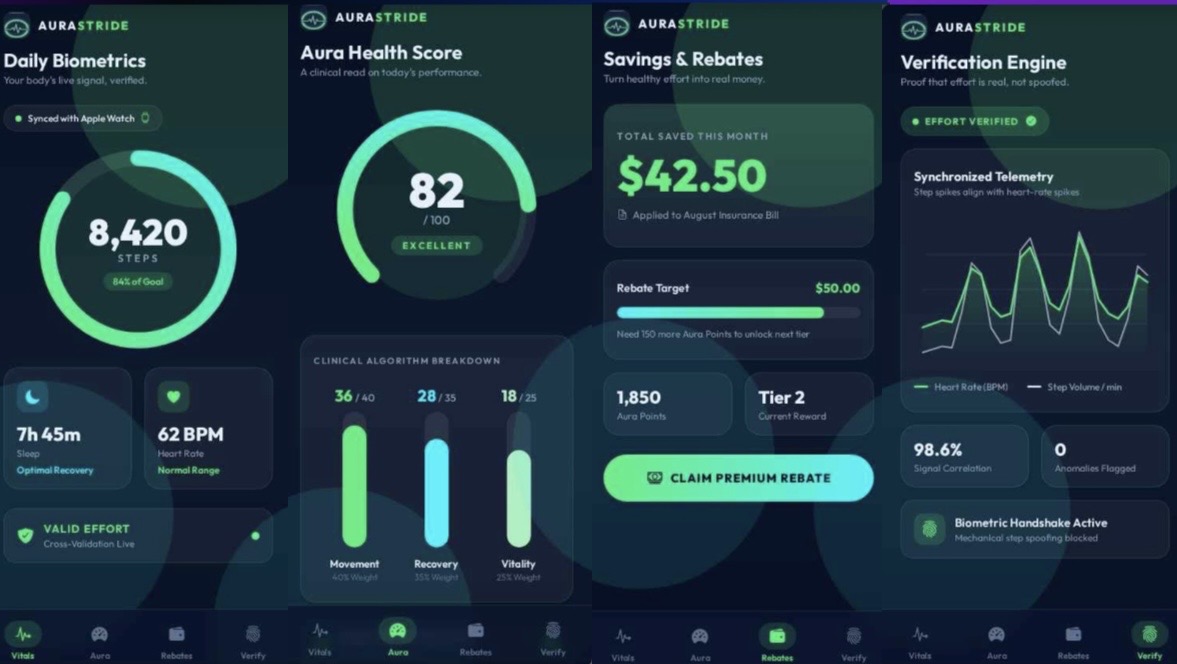
AuraStride is a platform that bridges a healthy lifestyle and insurance savings to help people prioritise their health. Instead of setting random fitness goals, clinical data from the NIH All of Us research program to incentivize an 8,200-step daily threshold—the proven sweet spot where chronic disease risk drops fastest. Here is how AuraStride converts daily fitness to financial profit:
Clinically Backed Daily Goals: We don't guess your step count. AuraStride grounds your targets in real clinical data, where hitting daily movement milestones lowers your risk for Type 2 diabetes by up to 44%, hypertension by 31%, and depression by 33%.
Direct Insurance Savings: Everyday activity translates into real money. By hitting your health targets, you unlock direct discounts on your monthly insurance bill.
Built-In Anti-Fraud Verification: To keep step-faking from draining rebate pools, our scoring engine cross-checks motion data against heart rate. If someone shakes their phone while resting, the app flags it automatically.
Balanced Biometric Scoring: Steps are only part of the story. The app calculates your "Aura Health Score" by combining daily steps with key recovery metrics, like getting 7.5 to 9 hours of sleep and maintaining a healthy resting heart rate.
Strict Data Privacy: We designed the system from the ground up to comply with HIPAA and GDPR. Insurance partners only receive confirmation that you met your savings tier—they never see your raw health logs or biometric data.
How we built it
Since our aim was to build a complete, viable idea we structured outer design around:
Interface prototyping: We created a clean, easy to use app design focusing on a high-contrast dark mode with high-visibility metrics using emergent and canva. The layout makes tracking the 8,200-step target, sleep hours, resting heart rate and calculating monthly premium rebates completely effortless for the user.
Anti-fraud and scoring logic: To prevent people from cheating by shaking their phone we came up with an idea to cross check step frequency against heart rate changes. If the movement doesn't match an actual spike in heart rate, the system doesn't count it toward rebate rewards.
Privacy & Compliance Blueprint We decided we wanted to design a privacy-first system architecture to align with GDPR standards. Instead of sending sensitive health logs directly to insurance companies, all raw biometric data stays encrypted on the user's side. Insurance partners only receive a verified status badge confirming the user qualifies for their monthly discount.
Challenges we ran into
Designing Fair Fraud Prevention: Figuring out how to stop people from cheating on step counters without creating a very invasive app was a challenge. We spent a lot of time figuring out how to check motion data against heart rate changes so the platform can verify genuine effort clearly.
Translating Clinical Data: Taking large, complex health studies, like the NIH All of Us dataset, and turning them into a simple, motivating daily target for everyday users required a lot of work. We had to ensure that the value of the 8,200-step goal was immediately clear without overwhelming people with medical terms.
Balancing Incentives with Business Logic: Finding a financial model that works for both sides was difficult. We needed to make sure that preventative health improvements actually lead to real cost savings for insurers so they can offer meaningful rebates to users.
Accomplishments that we're proud of
Defining the Problem: We learned how to narrow down a complex problem into a clear, targeted issue before writing a single line of code or design.
Holistic Thinking: Building this project taught us to look at the big picture—balancing user needs, technical constraints, design, and practical impact rather than focusing solely on isolated features.
Teamwork & Collaboration: We improved how we divide tasks, communicate under tight hackathon deadlines, and leverage each team member's unique strengths to keep momentum going.
Pitching & Video Production: We learned how to distill our technical work into a compelling narrative, plan visual demonstrations, and produce a concise pitch video that clearly highlights our project's value to the judges.
What we learned
Science-Backed Product Concept: Translating complex clinical research from the NIH All of Us program into a practical 8,200-step daily threshold that ties directly to real financial savings.
Designing the Anti-Fraud Architecture: Conceptualizing the Biometric Cross-Validation Engine—a clever mechanism cross-referencing heart rate spikes with accelerometer data to solve the phone-shaking fraud problem.
Creating a 3-Way Win Model: Structuring a viable business model where users save money, insurers cut claim payouts, and AuraStride monetizes through platform licensing fees.
Complete Visual & Pitch Blueprint: Assembling a full 5-minute pitch narrative, high-tech dark-mode visual system, and detailed UI/UX prototypes to prove the viability of the concept.
What's next for AuraStride
Build a Working MVP: We want to code a basic version of the mobile app using React Native, integrating Apple HealthKit and Google Fit APIs so we can actually test reading step data in real time.
Test the Biometric Logic: We want to build a simple version of our anti-cheating algorithm to see how accurately we can match heart rate spikes with step count increases on real smartwatches.
User Feedback: We plan to run a small trial with our friends, family, and classmates to test the app layout, dynamic progress rings, and gamification elements to see what actually keeps people motivated to walk more.
Refine the Business Proposal: We want to reach out to local health advisors or insurance experts to get feedback on our rebate model and make sure our 3-way win setup is as realistic as possible for future development.
Built With
- canva
- emergent
- powerpoint


Log in or sign up for Devpost to join the conversation.