🔮 Inspiration: The Broken Cloud Analytics Paradox
Traditional cloud business intelligence requires piping sensitive customer records, financial logs, and transaction streams to remote third-party databases. When analysts consult AI, language models frequently hallucinate arithmetic calculations on large datasets.
We built AuraQL to completely invert this paradigm:
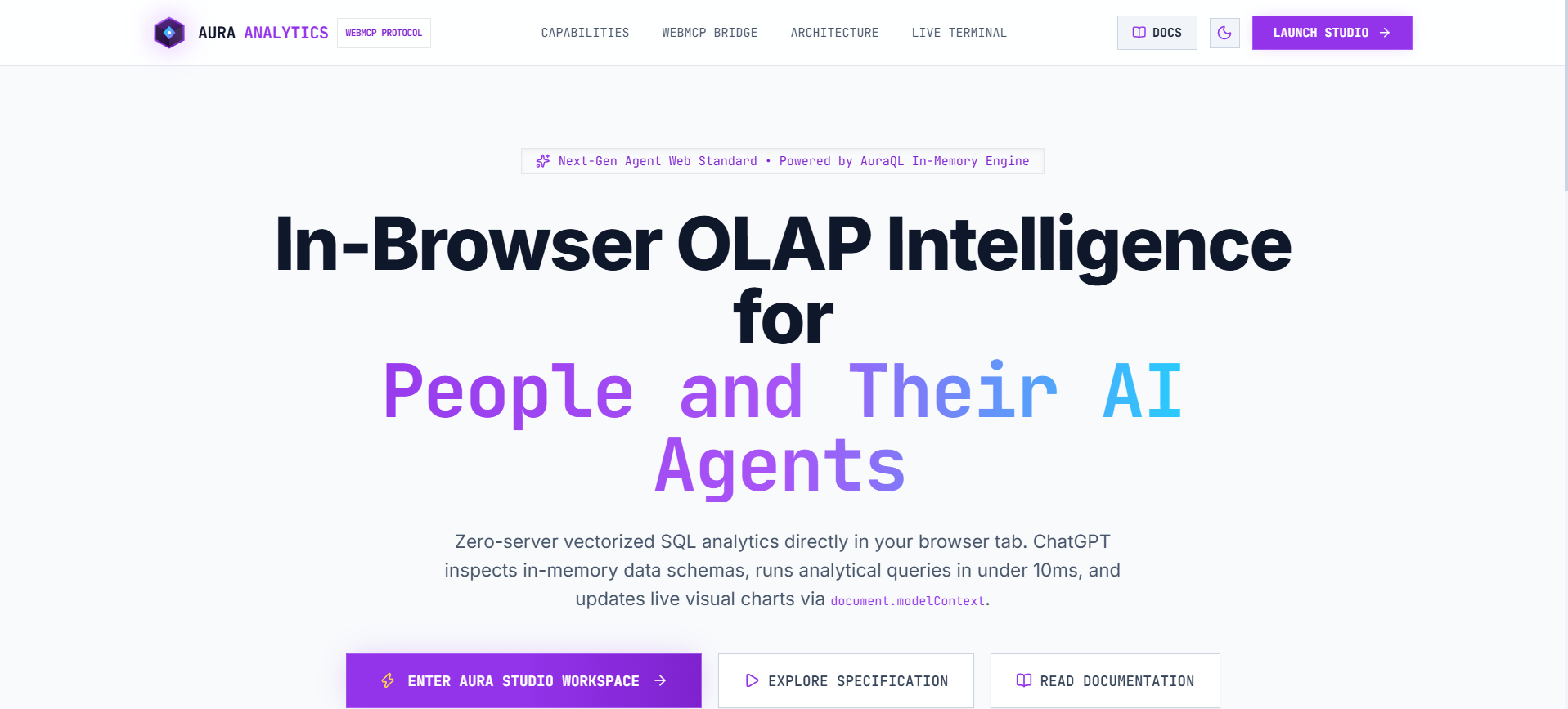
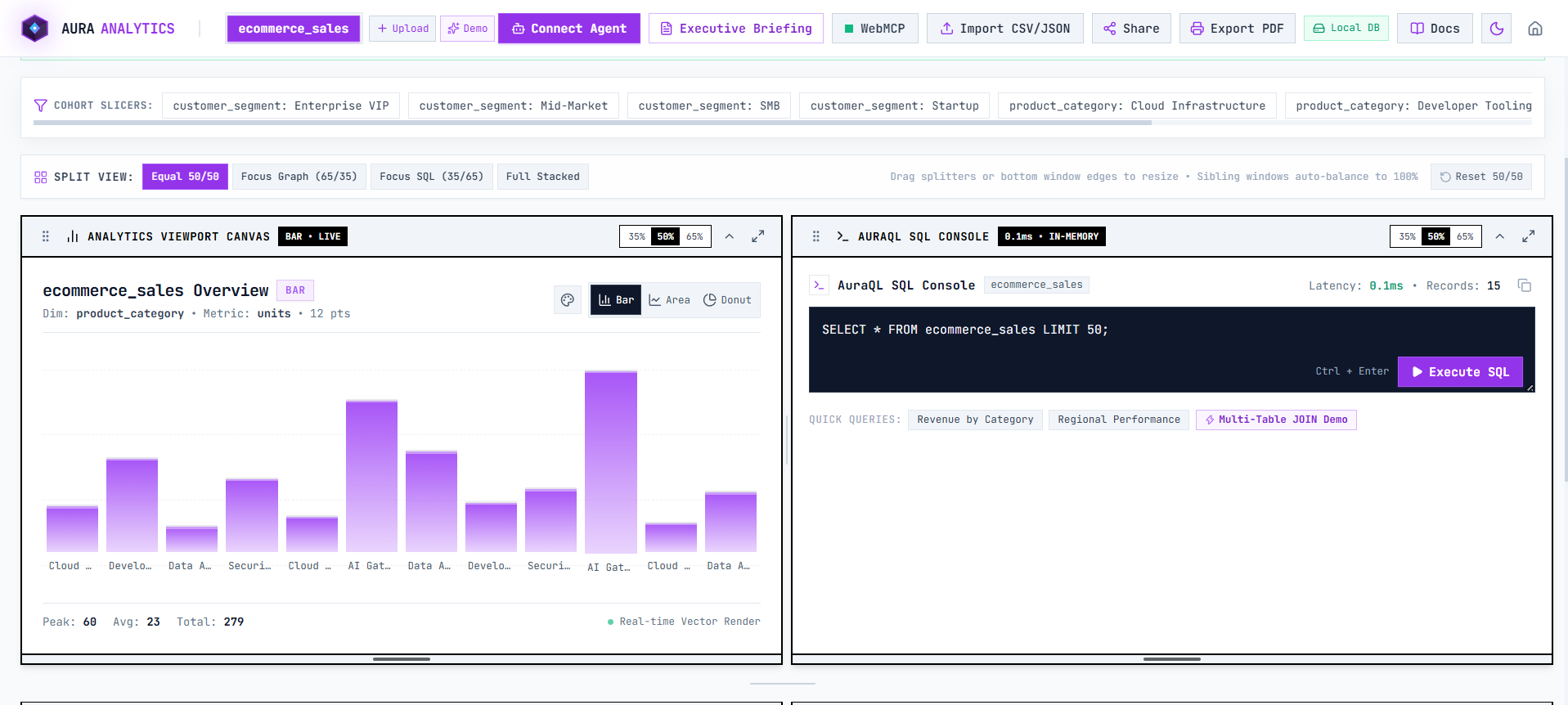
- Zero-Server In-Browser OLAP: The columnar database and vectorized SQL evaluator run 100% inside your client-side browser tab memory.
- Deterministic AI Math: The AI agent writes the SQL query, but the in-browser engine evaluates aggregations (SUM, AVG, COUNT, STDDEV) in under 10 milliseconds with mathematical accuracy.
- WebMCP Dual-Control Canvas: Both the human user and AI agent collaborate simultaneously on the same dashboard canvas via the emerging open standard
document.modelContext.
⚡ Why Our Use Case is a Strong Fit for WebMCP
Analytics dashboards are notoriously difficult for computer-vision and click-based agents: DOM selectors break, dynamic canvas elements cannot be inspected, and SVG splines are opaque to LLMs.
WebMCP provides the ideal interface:
- Instead of brittle DOM scraping, AuraQL exposes structured analytical primitives directly to the agent.
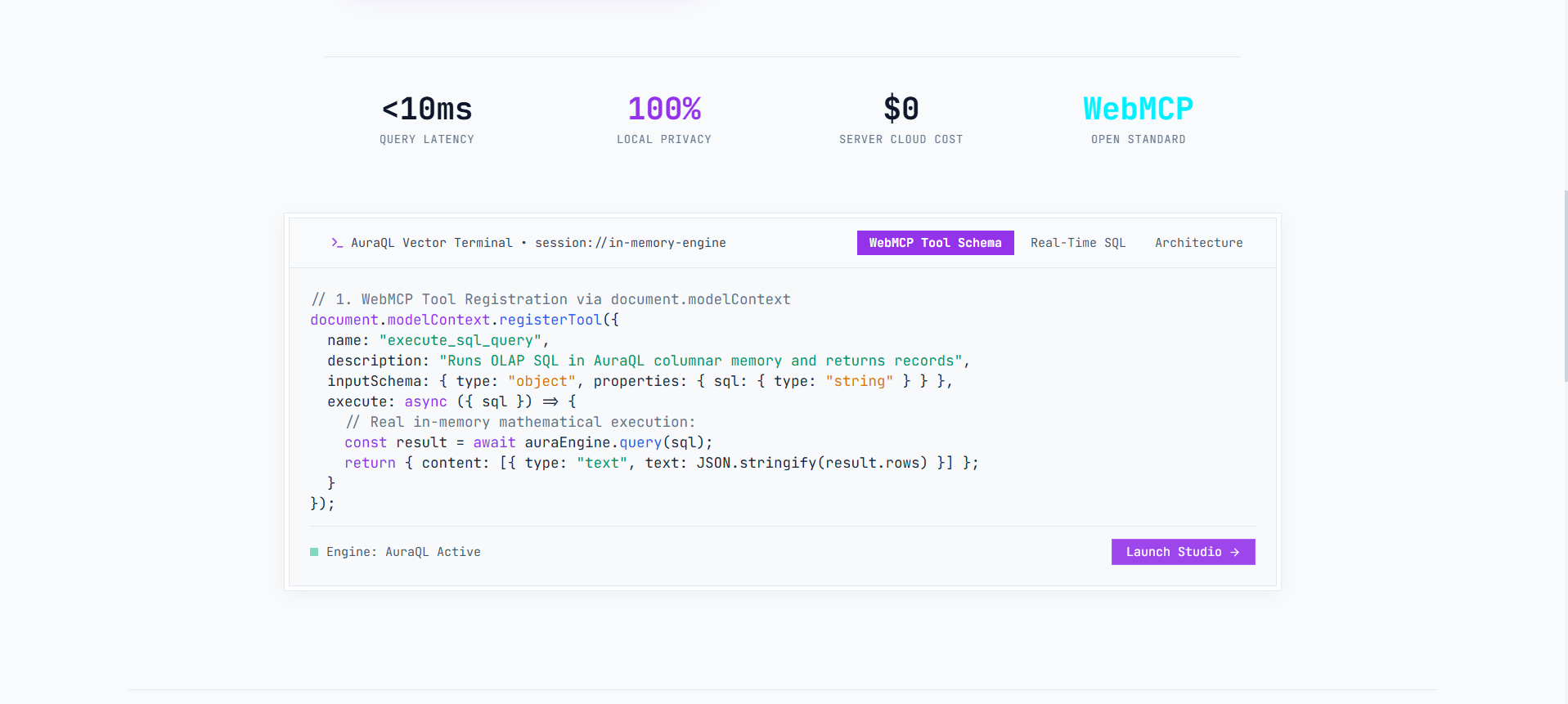
- The agent calls
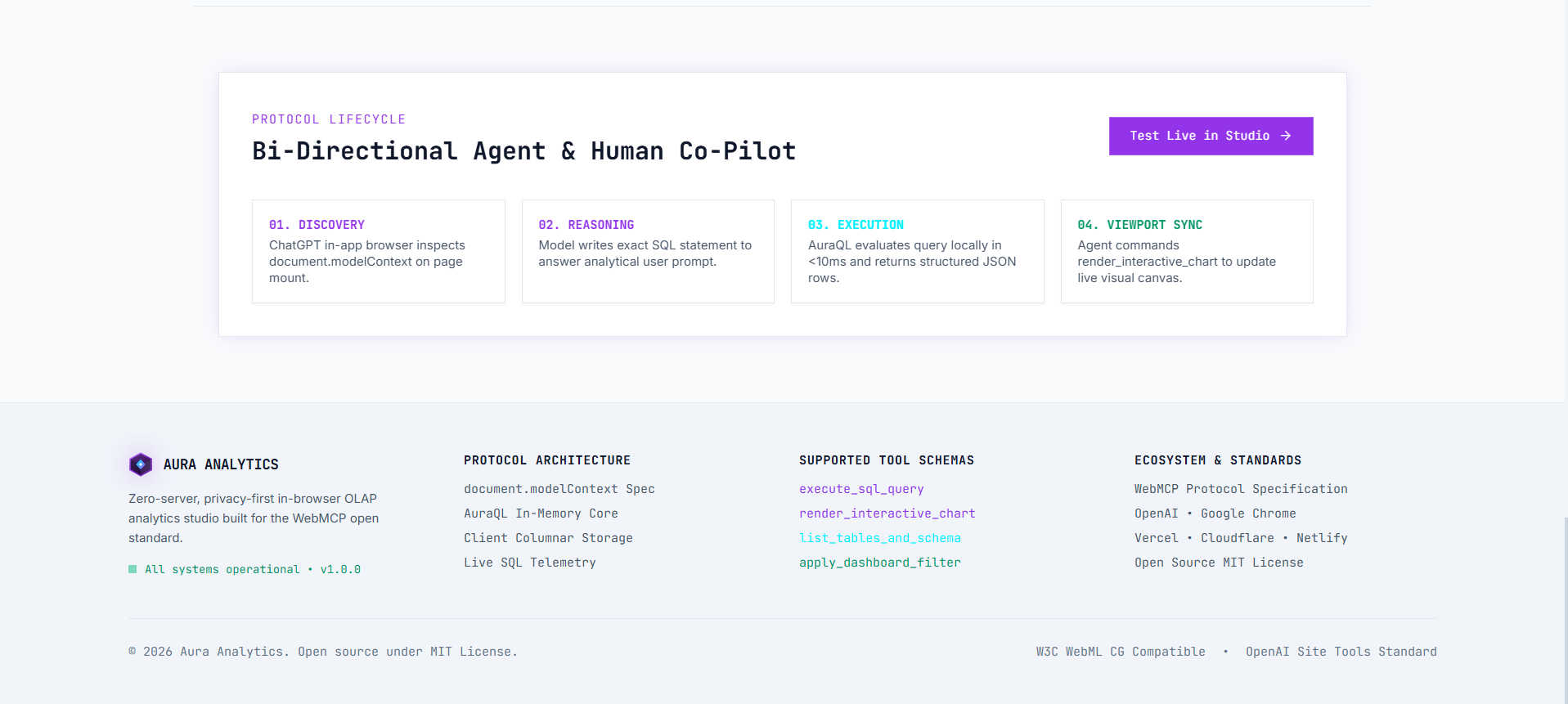
list_tables_and_schemato discover table schemas and column datatypes. - It evaluates relational SQL via
execute_sql_query. - It commands the user's viewport directly via
render_interactive_chartandapply_dashboard_filter.
🚀 How It Creates a Better User Experience
- 100% Client-Side Privacy: Financial data and customer churn metrics never leave the user's browser RAM. Zero cloud data storage costs, zero telemetry tracking, and zero database credentials to expose.
- Sub-10ms Latency: Queries against columnar memory buffers execute faster than a network roundtrip to a cloud data warehouse.
- Co-Pilot Simultaneous Vision: When you ask the agent a question like "Show quarterly revenue breakdown by region as a bar chart", the dashboard mutates in real time before your eyes while the agent explains the business takeaways.
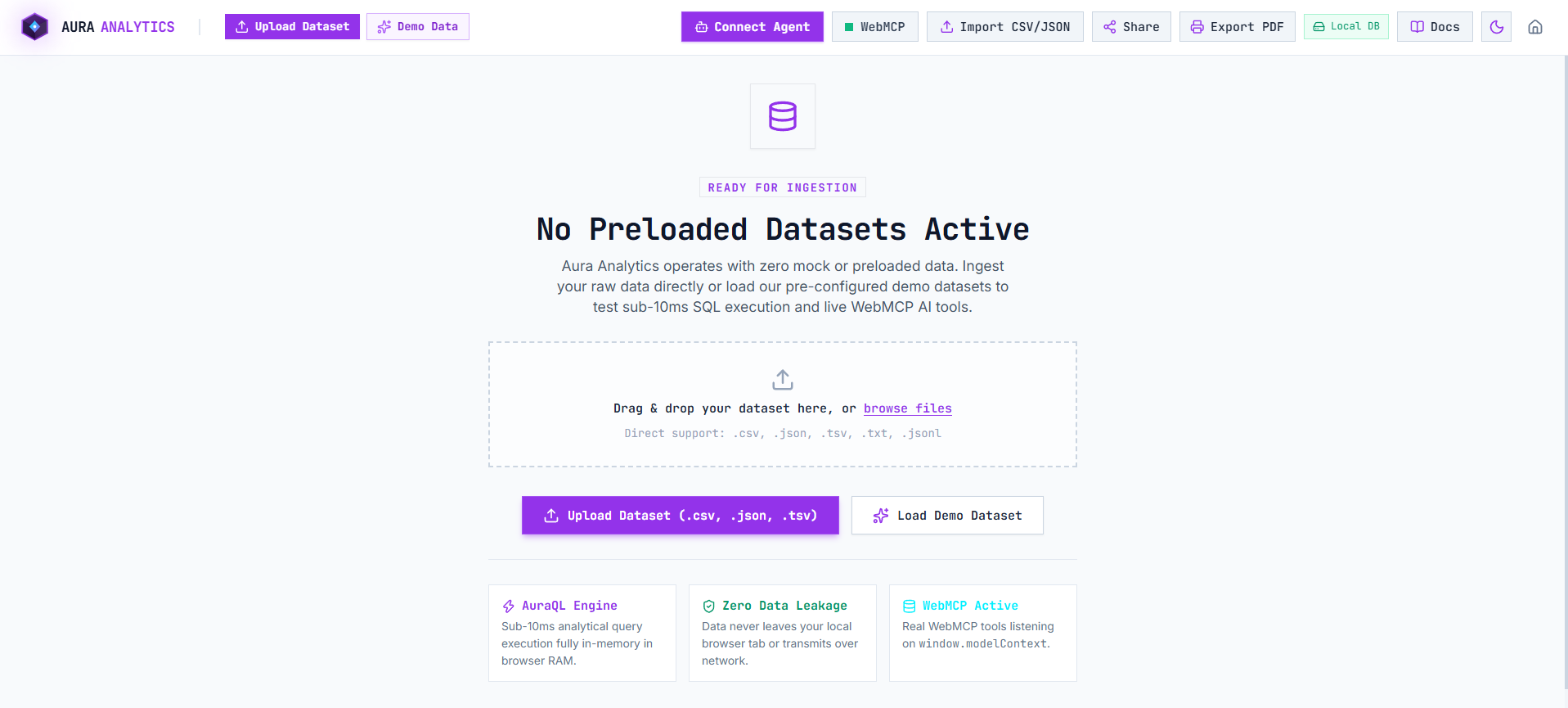
- Pro Studio Interface: Dual-axis resizable grid windows, high-contrast borders (black in light mode, neon purple in dark mode), and drag-and-drop CSV/JSON ingestion.
🤝 What People and Agents Can Do Together That Was Impossible Before
- Natural Language Scenario Simulation: Humans specify hypothetical business conditions ("What if critical churn accounts decrease 25% and MRR increases 15%?"). The agent calls
simulate_forecast_scenarioto execute in-memory adjustments and render baseline vs. projected variance charts immediately. - Instant Statistical Anomaly Isolation: The agent uses
detect_anomaliesto calculate Z-scores ($|Z| \ge 1.85$) and Interquartile Ranges (IQR) directly in browser memory, isolating revenue spikes or margin compression without needing Python or external Jupyter notebooks. - True Cross-Platform Agent Access: The exact same WebMCP tools are available inside:
- ChatGPT’s native in-app browser (
document.modelContext) - Desktop ChatGPT & Claude Desktop via Server-Sent Events (
/sse) - OpenAI Codex CLI over Stdio JSON-RPC 2.0
- ChatGPT’s native in-app browser (
🛠️ How We Implemented WebMCP
AuraQL implements the official W3C WebMCP specification:
Native Browser Standard: Inspects
document.modelContexton mount and registers 6 analytical tools:list_tables_and_schema(Schema & metadata discovery)execute_sql_query(Columnar SQL aggregations)render_interactive_chart(Viewport visualization mutation)apply_dashboard_filter(Cohort isolation)simulate_forecast_scenario(What-if financial modeling)detect_anomalies(Statistical anomaly detection)
Universal Polyfill & Bridge:
- If running in standard Chrome or without native browser flags, AuraQL binds a spec-compliant fallback to
document.modelContextandwindow.modelContext. - An external Node.js WebMCP bridge deployed on Render (
scripts/mcp-bridge.mjs) synchronizes with the active browser tab via Server-Sent Events (/api/bridge/events) with 25-second keepalive heartbeats, allowing desktop clients (Codex CLI, Claude Desktop, ChatGPT Desktop) to steer the live web app remotely.
- If running in standard Chrome or without native browser flags, AuraQL binds a spec-compliant fallback to
💻 Built With
- WebMCP (
document.modelContext) - TypeScript & React
- In-Memory Columnar OLAP Engine
- Vite & Tailwind CSS
- Node.js MCP Bridge (SSE + Stdio)
- Vercel (Frontend Hosting)
- Render (WebMCP Server Hosting)

Log in or sign up for Devpost to join the conversation.