-
-
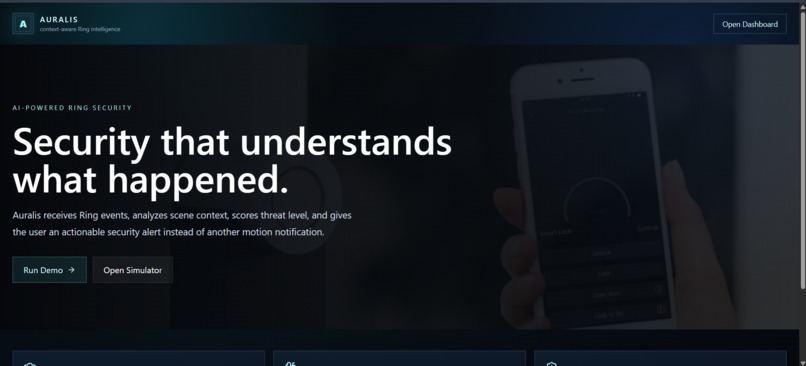
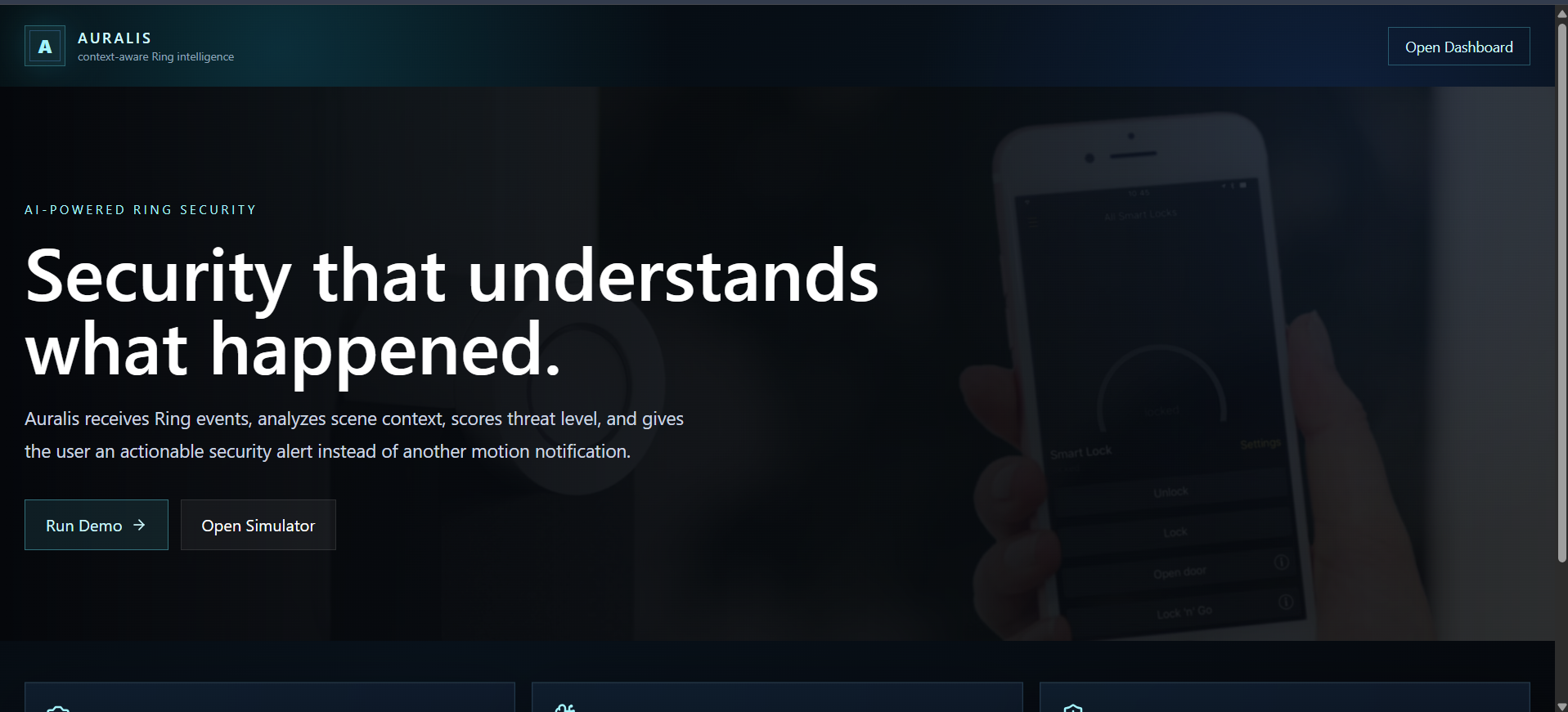
Front Page
-
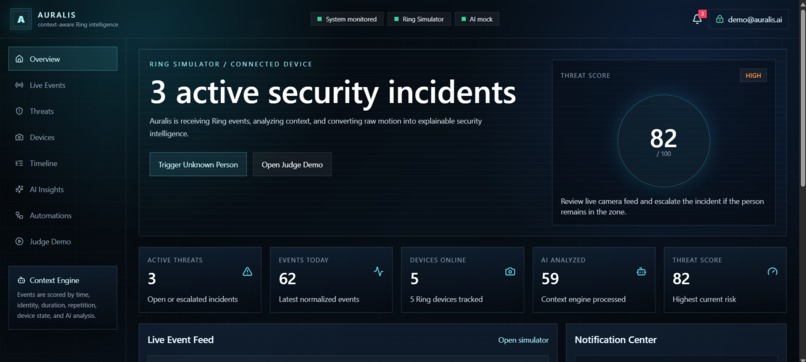
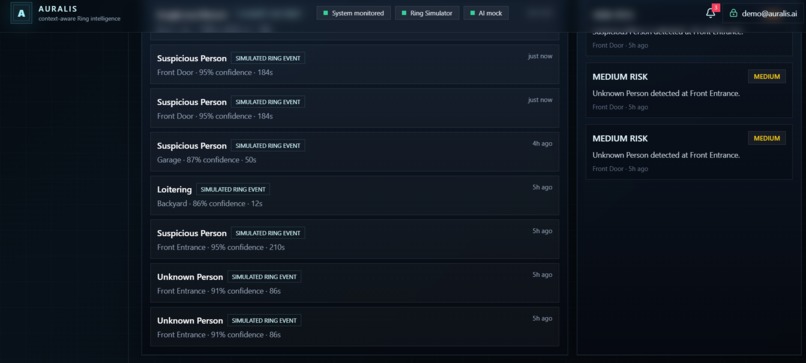
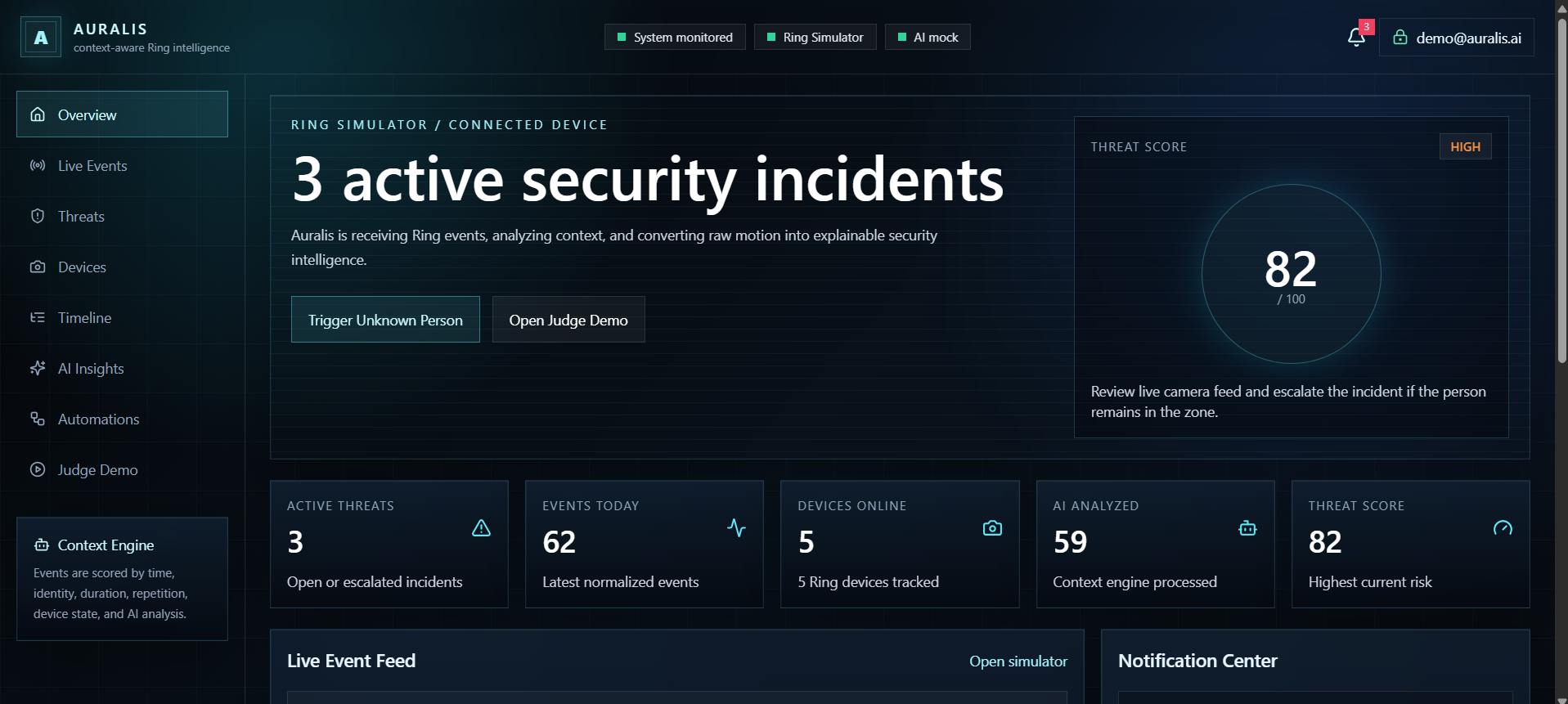
Dashboard
-
-
-
-
-
-
-
Auralis: AI-Powered Security That Understands Context
Inspiration
Traditional security systems are good at detecting events, but detection alone does not explain what an event means. A motion alert could be harmless, or it could be the first signal of a security incident.
We wanted to go beyond the traditional “Motion detected” notification and answer three important questions: What is happening? Why might it matter? What should I investigate next?
That idea led to Auralis, an AI-powered security intelligence platform designed around Ring security events. By combining event information with contextual signals such as time, location, duration, repeated activity, and historical patterns, Auralis aims to transform isolated detections into contextual, explainable security insights.
Our vision is simple: make security systems more useful by helping people understand events, not just receive notifications.
What it does
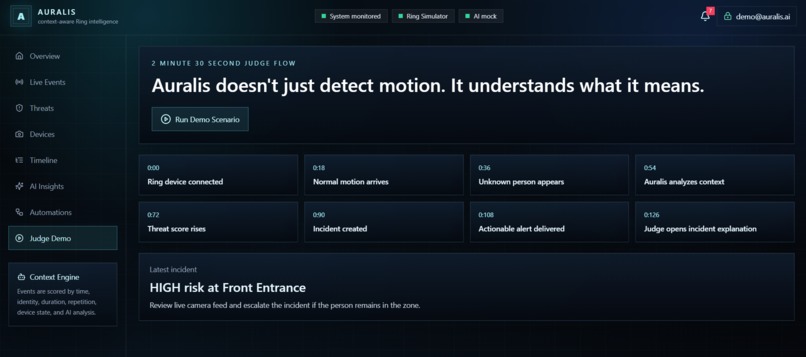
Auralis transforms security events into structured threat assessments that help users investigate potentially suspicious activity.
The platform is designed to support:
- Context-aware threat analysis: Evaluate event metadata, timing, duration, repeated activity, and other available signals.
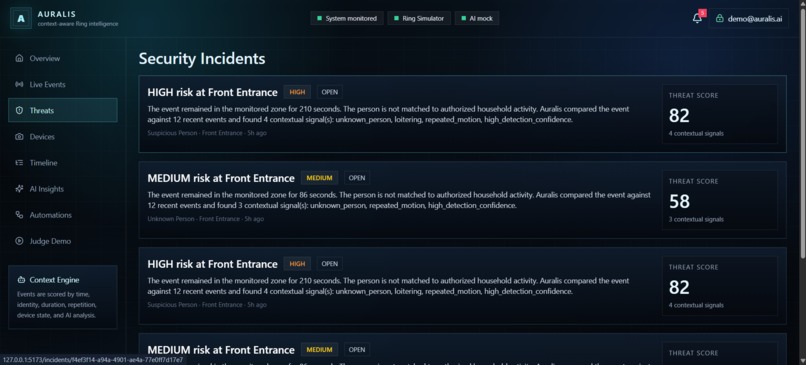
- Threat scoring: Produce a 0–100 risk score when supported by the configured assessment logic.
- Severity classification: Organize incidents into Low, Medium, High, and Critical categories.
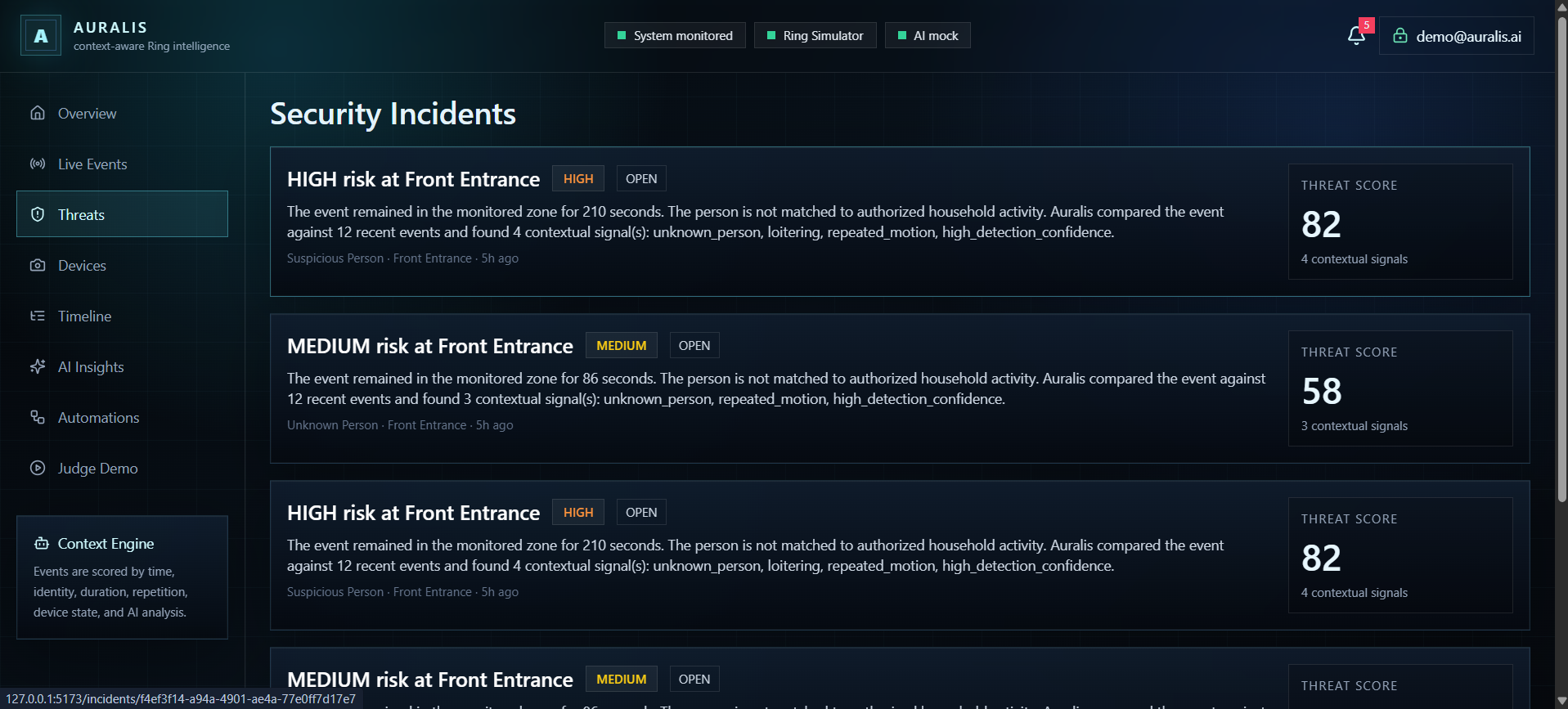
- Explainable assessments: Show the signals and reasoning that contributed to an assessment.
- Incident management: Create structured incidents with severity, contextual details, timelines, and recommended actions.
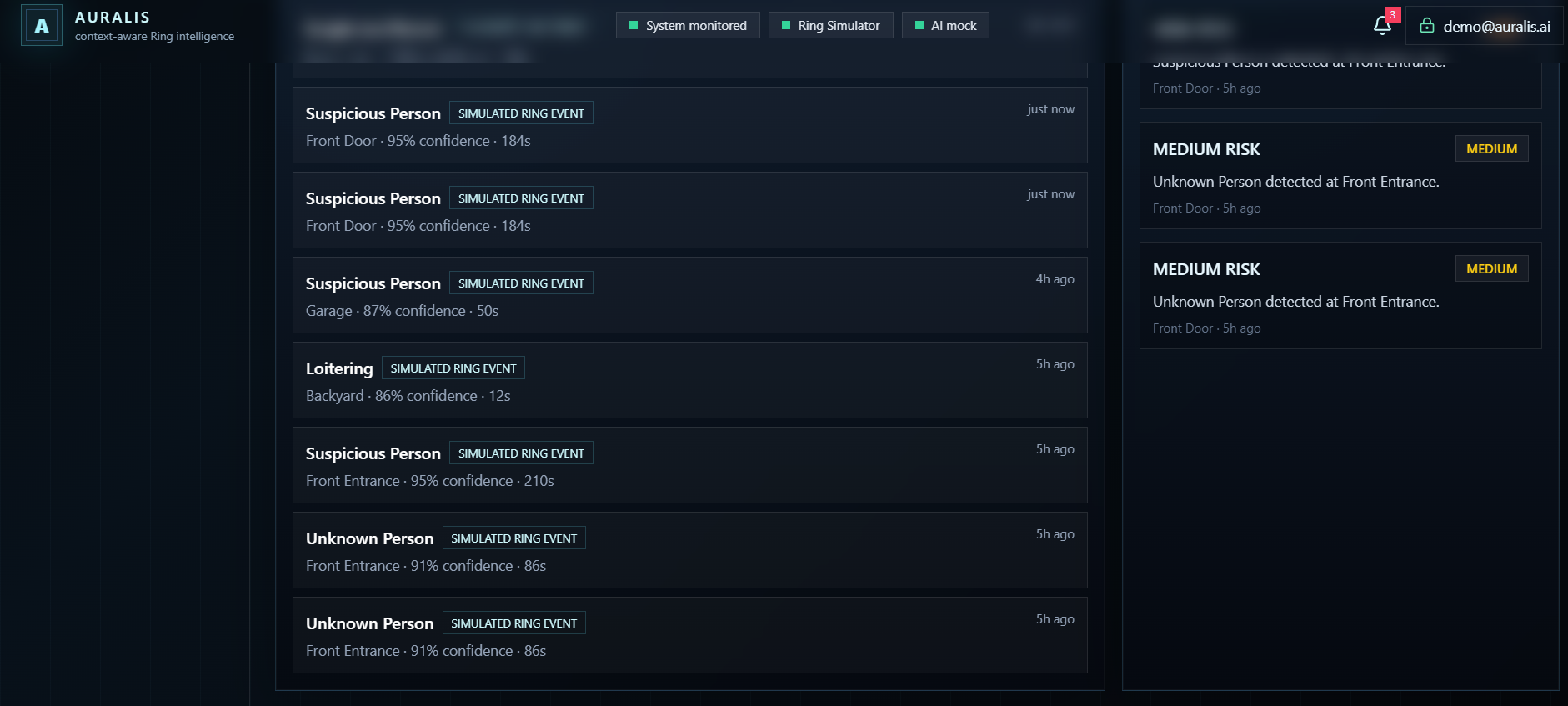
- Real-time updates: Stream events and incident updates to the dashboard using WebSockets.
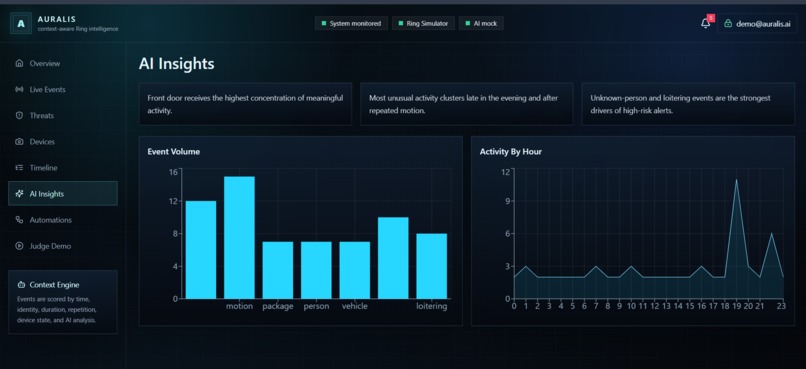
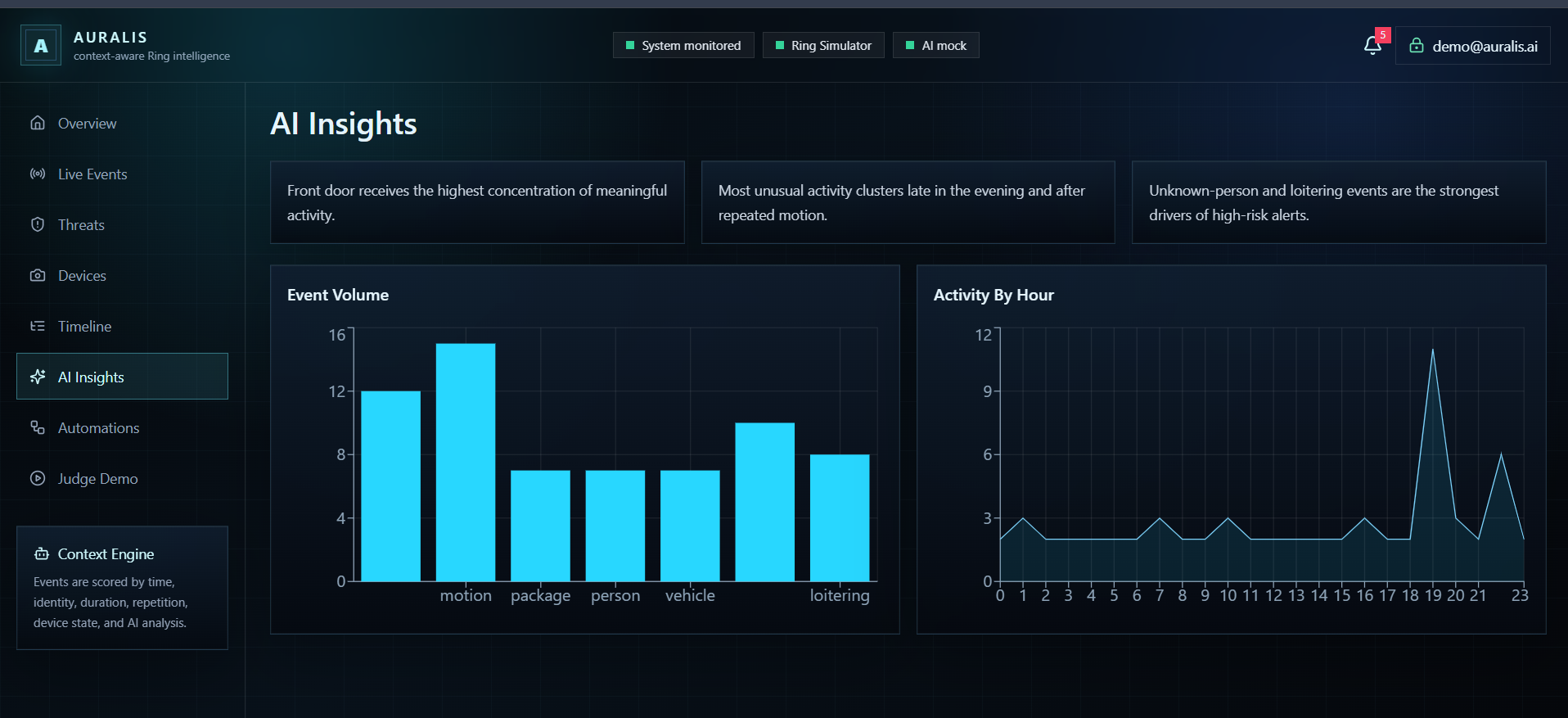
- Security insights: Surface potentially meaningful activity patterns and unusual event frequencies.
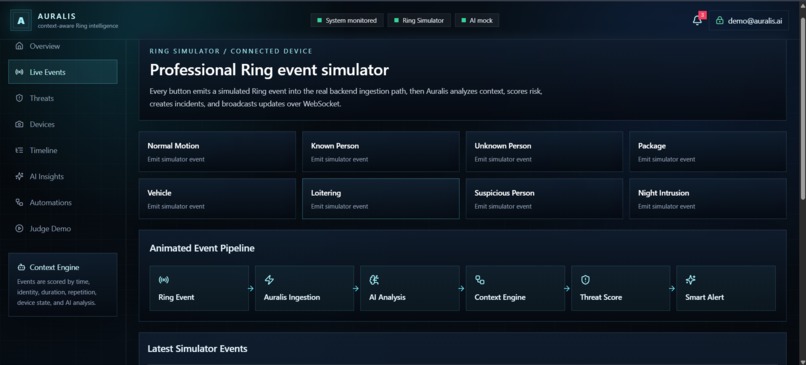
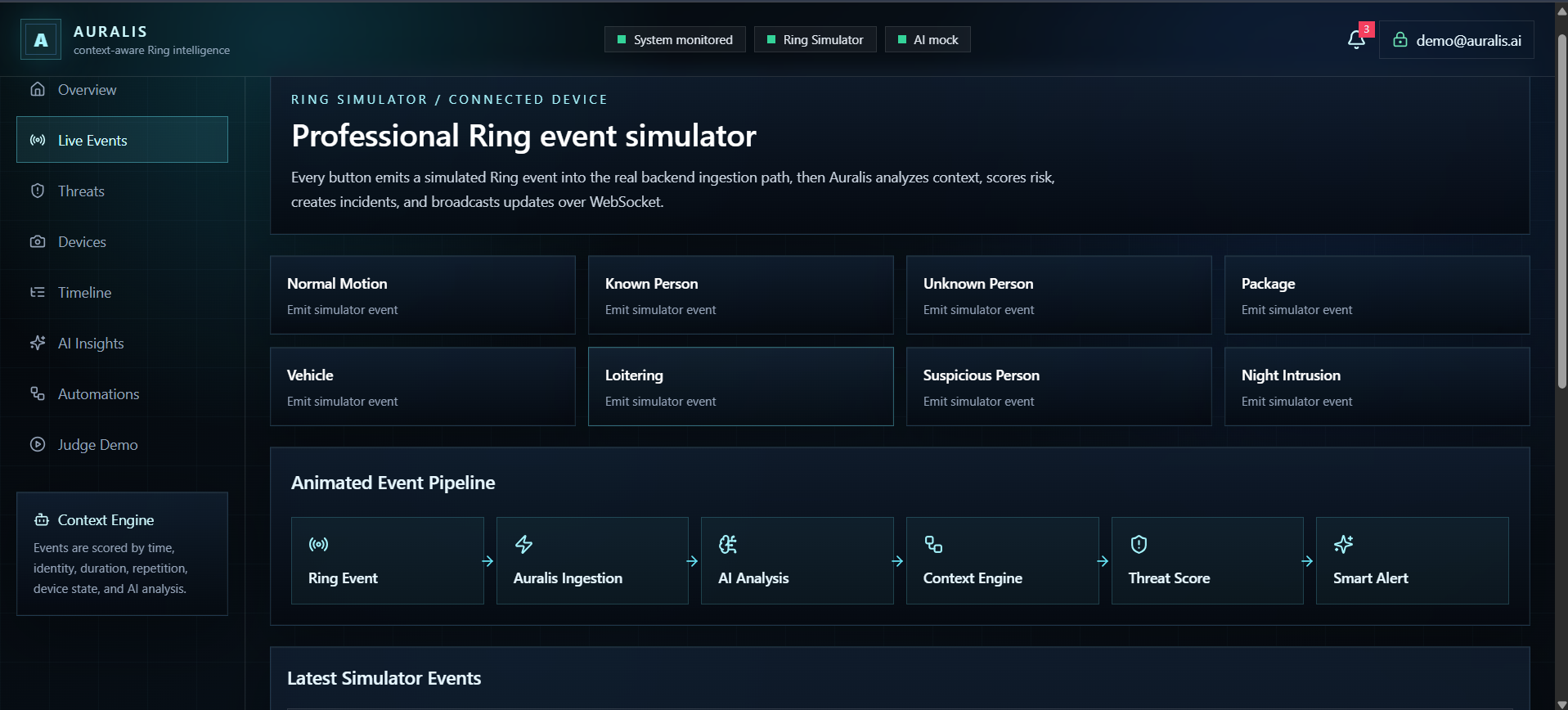
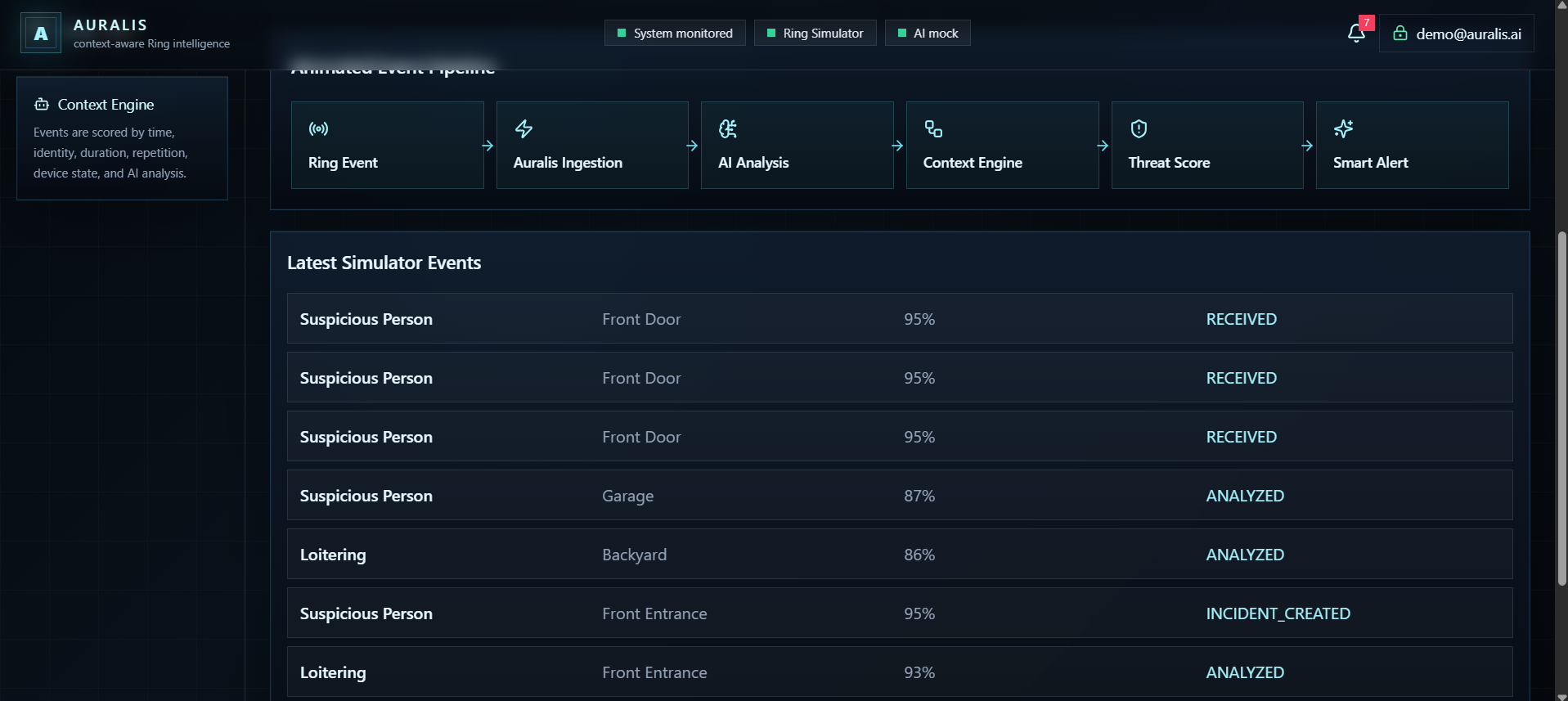
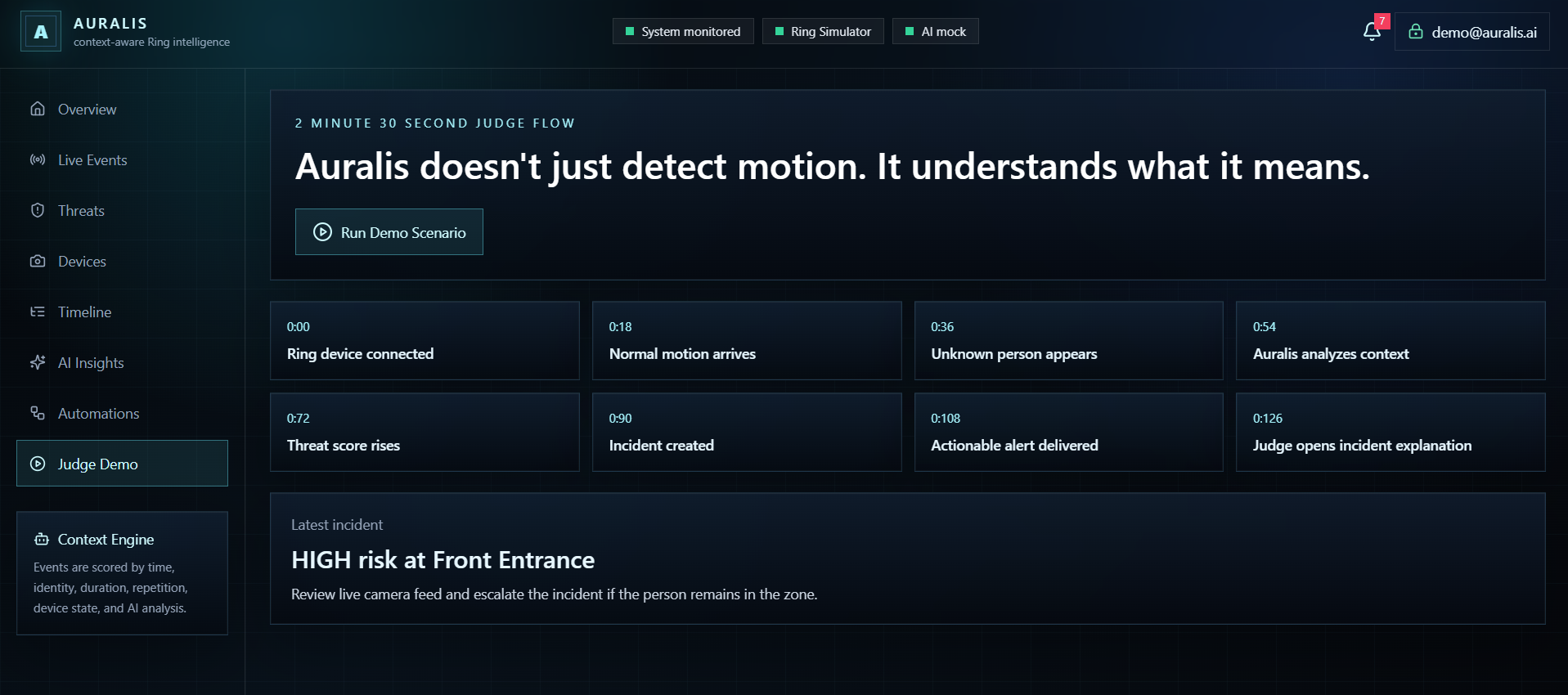
- Development simulation: Generate test scenarios such as normal motion, unfamiliar-person detections, loitering, and nighttime activity.
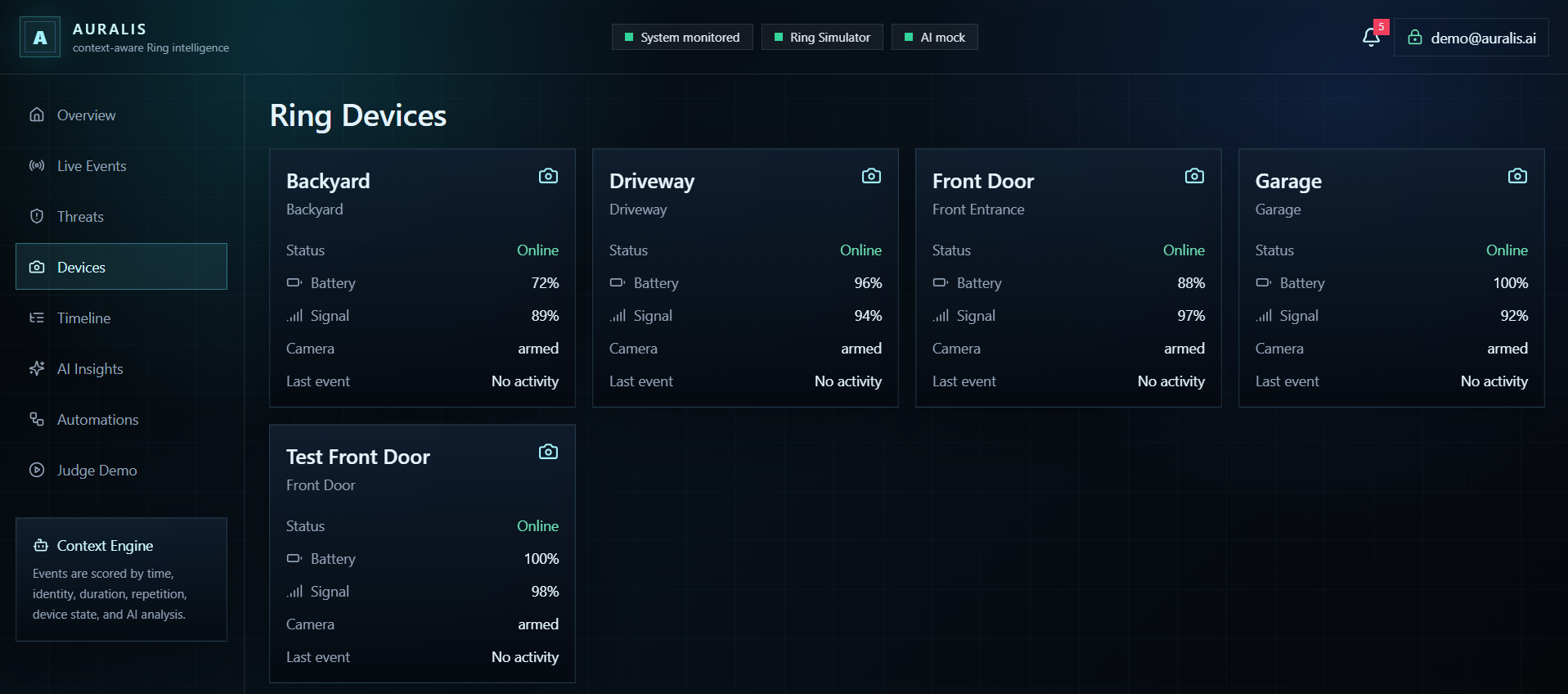
- Extensible integrations: Separate device-specific event handling from the core intelligence pipeline.
Where the necessary event data and integrations are available, the architecture can be extended to support additional object categories, smart automations, and external AI services.
Instead of stopping at:
Motion detected.
Auralis aims to provide a more useful explanation:
Elevated risk: repeated activity and prolonged presence were detected at an unusual time. Review the event timeline and verify the activity.
This is an illustrative example, not a claim that every running configuration currently generates this exact message. Auralis is designed to support human investigation, not to treat an AI assessment as proof of wrongdoing.
How we built it
We built Auralis as a modular, full-stack application with separate frontend, backend, event-processing, and AI-provider components.
Frontend
- React
- TypeScript
- Vite
- Tailwind CSS
- Framer Motion
- Recharts
The frontend provides the security command center, event activity, incident details, assessment explanations, and visualization of available security information.
Backend
- Python
- FastAPI
- Pydantic
- SQLAlchemy
- PostgreSQL
- Redis
- WebSockets
The backend provides API endpoints, event processing, structured data validation, incident management, and real-time communication with connected dashboard clients.
AI and threat analysis
Auralis uses a provider-oriented architecture to separate threat-assessment logic from the underlying AI implementation.
The design supports:
- Contextual threat analysis.
- Structured risk assessments.
- Explainable contributing signals.
- Recommended investigation steps.
- A development or mock provider for local testing.
- An Amazon Bedrock integration path where configured and operational.
We distinguish the development provider from a live Bedrock integration. A cloud integration is considered active only when the running application successfully invokes the service and processes its responses.
Ring integration
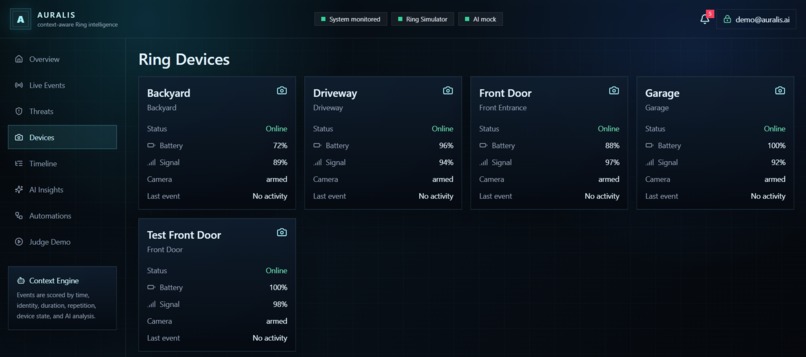
Auralis separates Ring-specific event handling from its core intelligence pipeline through an integration layer.
This allows events to be normalized into a consistent format before contextual analysis. A development simulator supports repeatable demonstrations without requiring live device events.
For the Ring hackathon track, the final implementation must demonstrate the eligible Ring API, SDK, device, or simulator required by the official rules. The exact integration and its runtime behavior should be documented according to the implementation being submitted.
Event pipeline
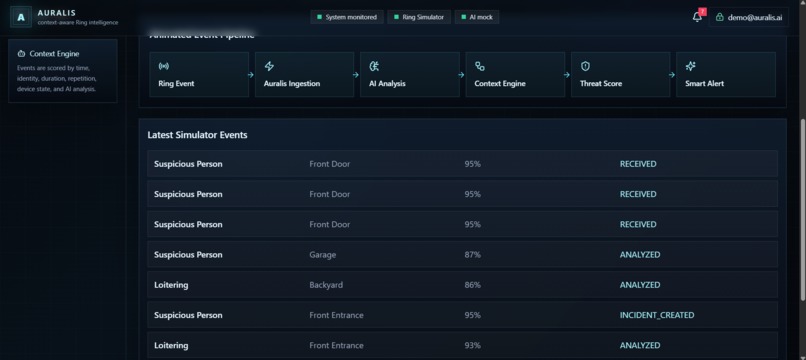
The intended end-to-end workflow is:
Ring Event or Development Simulator → Event Gateway → Context Engine → AI Analysis → Threat Assessment → Incident Creation → Real-Time Dashboard Update
This modular design makes the system easier to test, extend, and integrate with additional data sources.
Challenges we ran into
One of our biggest challenges was designing a security system that evaluates context rather than treating every detection as an independent event.
For example, motion during a normal period may not be particularly significant. Repeated movement, prolonged presence, an unusual time, and other supporting signals could justify closer investigation.
We had to consider how to combine these signals without turning uncertain observations into definitive accusations.
Other challenges included:
- Designing a consistent event abstraction for Ring-related data.
- Separating deterministic rules from AI-generated reasoning.
- Making threat assessments explainable rather than presenting unexplained scores.
- Delivering real-time updates between the backend and frontend.
- Designing severity categories and risk-scoring logic.
- Supporting local development without requiring cloud credentials.
- Distinguishing simulated activity from real security events.
- Balancing a detailed security dashboard with a clear, understandable user experience.
- Building a coherent end-to-end demonstration within the constraints of a hackathon.
These challenges reinforced the importance of reliability, transparency, and careful handling of uncertainty in AI-powered security applications.
Accomplishments that we're proud of
We are proud of designing Auralis as a complete security intelligence workflow rather than simply a dashboard displaying notifications.
The project brings together event ingestion, contextual analysis, threat assessment, incident investigation, and real-time dashboard delivery in one architecture.
Key areas we are proud of include:
- A modular security event-processing pipeline.
- Context-aware threat-assessment architecture.
- Explanations that identify contributing signals.
- Real-time event and incident updates.
- Structured incident investigation and timelines.
- A dedicated Ring integration layer.
- An AI-provider abstraction for development and cloud integration.
- A simulator for repeatable development and demonstration scenarios.
- A security-focused command center designed around investigation and decision-making.
Our central accomplishment is the product direction: moving from isolated notifications toward contextual, explainable security intelligence.
What we learned
We learned that building an AI-powered security product involves much more than adding a language model to an application.
The quality of an assessment depends on the relevance and reliability of the context supplied to the system, the rules used to interpret that context, and the way uncertainty is communicated to the user.
We learned to:
- Combine deterministic rules with AI reasoning where appropriate.
- Make assessments explainable and easier to investigate.
- Treat real-time event processing as a core architectural requirement.
- Separate device integrations from business logic.
- Design local development and fallback paths for external dependencies.
- Organize the user experience around decisions rather than raw data.
- Consider privacy, security, false positives, and human oversight from the beginning.
- Clearly distinguish demonstrated capabilities from planned integrations.
Most importantly, we learned that an effective security assistant should help people understand why an event matters without pretending that uncertain information is always correct.
What's next for Auralis
Our next goal is to evolve Auralis from a hackathon prototype into a more reliable and privacy-conscious security intelligence platform.
Planned improvements include:
Deeper Ring integration
Expand supported Ring integrations, validate event delivery with eligible interfaces and devices, and improve cross-device event correlation.
More capable AI analysis
Evaluate multimodal analysis where supported, improve contextual explanations, and make uncertainty more transparent.
Fewer false positives
Improve deterministic scoring, introduce configurable thresholds, and explore household-specific activity baselines with appropriate privacy safeguards.
Better incident investigation
Develop richer timelines, correlate related events, and provide more useful historical comparisons.
Privacy-focused processing
Explore on-device processing where feasible and minimize unnecessary retention or exposure of sensitive security data.
Smarter automation
Introduce configurable workflows with appropriate permissions, safeguards, and human confirmation for consequential actions.
Scalable infrastructure
Evaluate AWS deployment, improve observability, and strengthen reliability, access controls, and security auditing.
These are future directions rather than claims that all of these capabilities are already implemented.
Closing
Auralis is built around one simple idea:
Security shouldn't just tell you that something happened. It should help you understand what it means.
By combining contextual event analysis, explainable assessments, and incident investigation, we aim to make security information more useful, transparent, and actionable.
Built With
- ai-agents
- amazon-bedrock
- amazon-ring
- amazon-web-services
- artificial-intelligence
- cloud
- computer-vision
- computing
- data-analytics
- docker
- fastapi
- iot
- machine-learning
- postgresql
- python
- react
- real-time-analytics
- redis
- security
- tailwind-css
- threat-detection
- typescript
- vite
- websockets


Log in or sign up for Devpost to join the conversation.