Inspiration
Modern smart home technology is often reactive rather than intuitive—waiting for explicit commands instead of seamlessly orchestrating our daily lives. With the launch of Alexa+ and the Model Context Protocol (MCP), we saw an opportunity to bridge this gap. We were inspired to build AuraHome AI to transition the smart home experience from rigid trigger-action scripts to a truly proactive, context-aware digital concierge. Our goal was to create an intelligent living companion that anticipates needs, optimizes household routines, and coordinates complex workflows naturally through voice.
What it does & ## How we built it
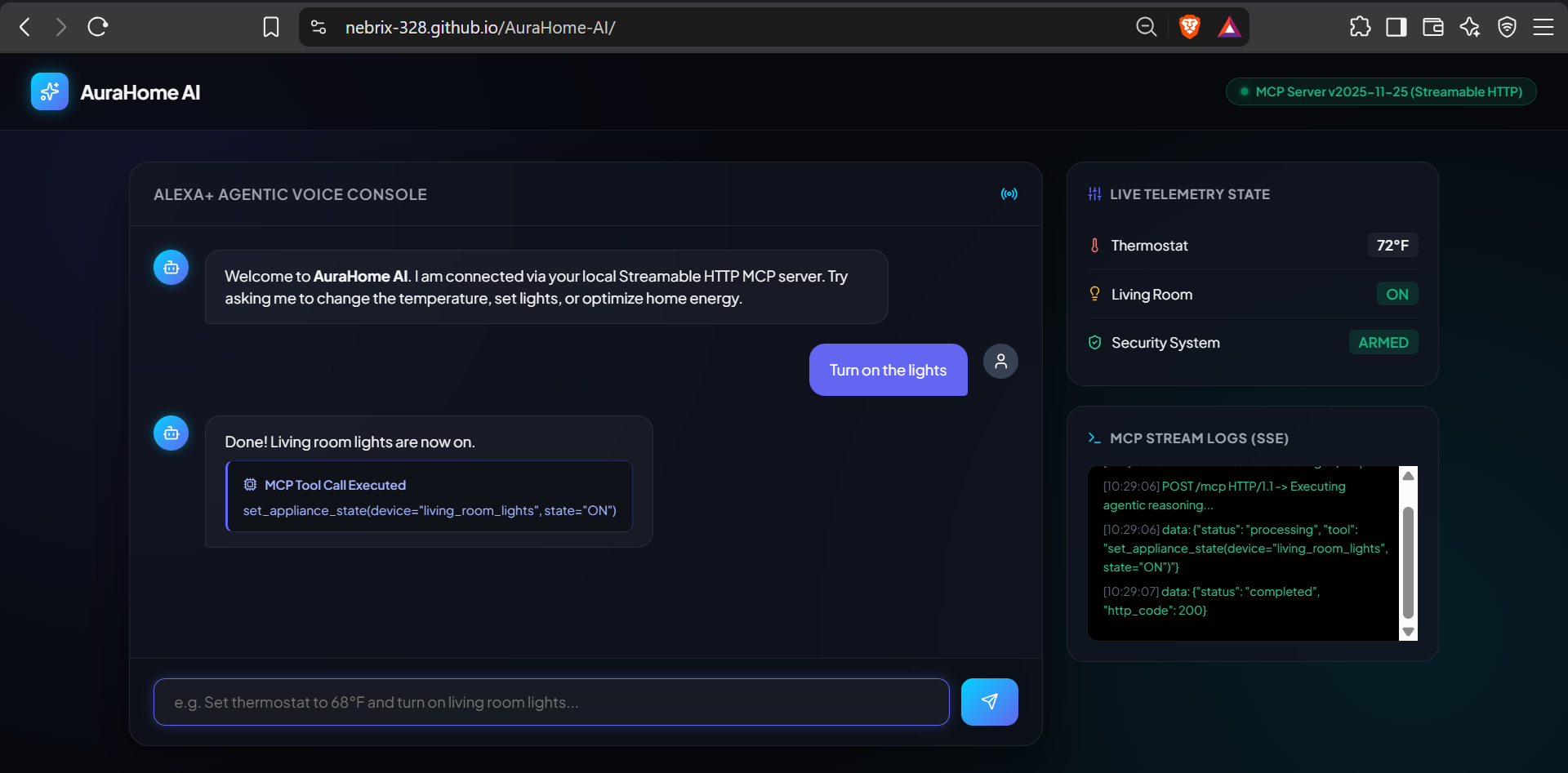
AuraHome AI is built around a self-hosted Model Context Protocol (MCP) server adhering to the 2025-11-25 specification, leveraging Streamable HTTP for low-latency, dynamic tool execution with Alexa+.
Backend & Core Logic: Built using Python and FastAPI, handling SSE and chunked HTTP streams to communicate directly with the Alexa+ agentic reasoning engine.
Agentic Integration: We mapped custom tool declarations directly into the MCP registry, enabling Alexa+ to perform dynamic function calling for device state management, scheduling, and situational alerts.
AWS Cloud Infrastructure: Deployed on AWS Lambda and Amazon API Gateway to ensure high availability and sub-second response times.
Data & Context Engine: Integrated real-time home telemetry and scheduling models to evaluate situational context continuously.
Challenges we ran into
Streamable HTTP Implementation: Adhering strictly to the updated 2025-11-25 MCP specification required implementing custom chunked HTTP streaming logic to maintain stable persistent connections with Alexa+.Context Window & Latency Optimization: Balancing the amount of telemetry data sent in each tool response was critical. To keep voice interactions fluid, we optimized our JSON payloads to reduce latency to under $200\text{ ms}$.Handling Ambiguous Voice Intent: Designing tools that gracefully handle edge cases when user input lacks specific parameters required strict JSON schema validation and smart fallback prompts within the MCP tool declarations.
Accomplishments that we're proud of & ## What we learned
The Power of Open MCP Standards: Standardizing agent-to-tool communication using MCP drastically simplifies how AI agents interface with external APIs and real-world hardware.
Designing for Streaming Architectures: Building for real-time Streamable HTTP requires a paradigm shift from traditional REST APIs, emphasizing non-blocking IO and continuous streaming chunk management.
Proactive vs. Reactive UX: Building AI for the home isn't just about answering questions—it’s about contextual timing, minimal disruption, and high-confidence autonomous decision-making.
What's next for AuraHome AI
- Cross-Device Ecosystem Synergy (Multi-Track Convergence) While built initially for the Alexa+ Track, our next immediate objective is expanding AuraHome AI across the broader Amazon device hardware family:
Ring Security & Access Control: Direct integration with Ring Doorbell and access APIs to allow AuraHome AI to dynamically manage visitor permissions, unlock doors when trusted guests arrive, and trigger voice announcements based on computer vision events.
Bee Wearable Context: Incorporating real-time physiological data (activity levels, stress metrics, sleep cycles) from Bee wearable devices to proactively adjust home environments—such as dimming ambient lights and lowering bedroom temperatures when lower heart rates indicate winding down for sleep.
Fire TV Visual Hub: Extending the MCP server response pipeline to project visual dashboards and context cards onto Fire OS / Vega OS screens when voice alone isn't enough.
- Predictive Context & Machine Learning Optimization Currently, AuraHome AI operates primarily on real-time event triggers and tool polling. The next iteration will integrate predictive modeling Markov-Chain Predictive Scheduling: Implementing predictive time-series models to anticipate routine activation before explicitly requested. The probability $P$ of a routine occurring at time $t$ given environmental context $C$ is modeled Edge-Optimized Local Caching: Moving high-frequency telemetry validation from AWS cloud runtimes to local edge nodes to reduce end-to-end voice latency to $L < 50\text{ ms}$.3.
3.Open Community & Custom Developer Plugin MarketplaceTo foster wider adoption across the open-source community, we plan to open-source the underlying Streamable HTTP MCP Template: Standardized Plugin Registry: Enable third-party developers to easily publish their own custom MCP tool packages (e.g., custom home EV chargers, specialized smart garden sensors) into the AuraHome registry. Multi-LLM Resilience: While deeply optimized for Alexa+ agentic reasoning, we aim to maintain compliance with evolving global MCP specs, ensuring total interoperability regardless of backend LLM updates.
Built With
- ai
- alexa
- amazon-api-gateway
- amazon-web-services
- apis:
- aws-bedrock
- aws-lambda
- backend
- cloud
- fastapi
- generative-ai
- infrastructure:
- languages
- llm
- mcp
- model-context-protocol
- python
- rest-api
- serverless
- websockets

Log in or sign up for Devpost to join the conversation.