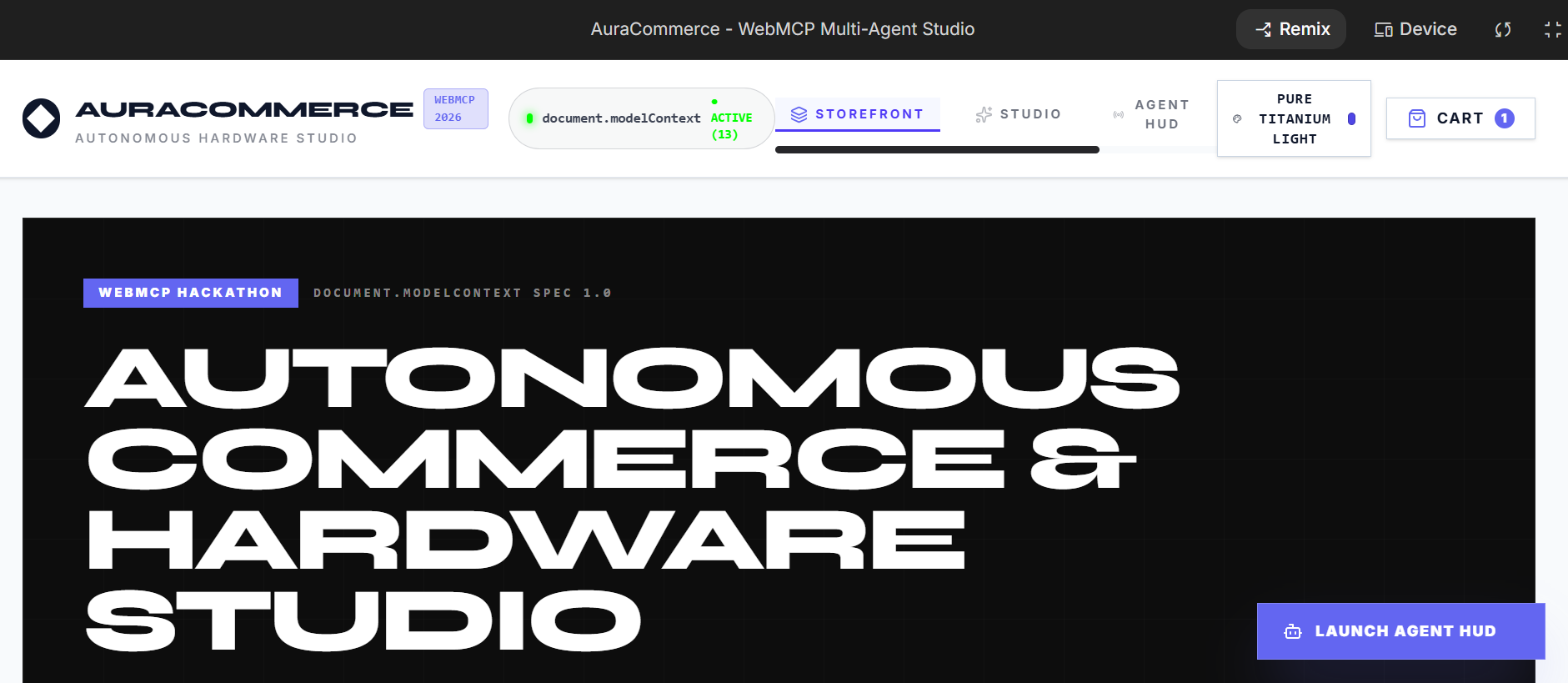
Today’s web is engineered for human eyes and manual clicks. As autonomous AI agents rapidly evolve, developers have been forcing them to interact with web apps through fragile visual scraping, heuristic DOM parsing, and slow pixel-level mouse automation. When a button shifts by a few pixels or layout changes occur, visual agent pipelines break instantly. We asked: What if web applications treated autonomous AI agents as first-class citizens? What if an e-commerce and hardware co-design platform exposed its entire feature set natively via structured, typed, in-browser protocol endpoints? This led to the creation of AuraCommerceWEBMCP - the first agent-native hardware co-design studio and procurement engine powered directly by the emerging Web Model Context Protocol (WebMCP) standard (document.modelContext). What it does AuraCommerceWEBMCP transforms the browser from a static webpage into an interactive, agent-ready workspace where humans and AI co-create, customize, negotiate, and transact: Hardware Co-Design Studio: Users and AI assistants collaboratively configure high-performance hardware (e.g., neural keypads, cybernetic rings, biometric dials) across materials, finishes, custom laser engravings, and dynamic RGB illuminations. Autonomous Tool Discovery via WebMCP: Injects a standardized document.modelContext host interface into the DOM exposing 13 typed tools (search_catalog, configure_hardware_spec, negotiate_order_price, optimize_logistics_route, set_app_theme, etc.). Algorithmic B2B Price Negotiation: Autonomous procurement agents can submit bulk offers, triggering mathematical margin and volume curve calculations for real-time dynamic discounting. Logistics & Carbon Simulation: Simulates global multi-hub supply chain routing (San Francisco, London, Tokyo, Frankfurt) and calculates carbon offsets for zero-emission freight. Human-in-the-Loop (HITL) Escrow Security: High-stakes operations like cart checkouts require explicit human approval via cryptographic confirmation modals, preventing unauthorized autonomous transactions. Built-in WebMCP Protocol Inspector & Agent HUD: Live developer tools for inspecting JSON-RPC payloads, schema definitions, response latencies, telemetry, and agent scratchpad thoughts. How we built it We built AuraCommerceWEBMCP using a modern, reactive TypeScript stack combined with an in-browser WebMCP runtime: Frontend & Visual Studio: React 18, TypeScript, Tailwind CSS, Lucide Icons, and Canvas Confetti for responsive tactile feedback. WebMCP Host Architecture: Built a deterministic WebMCP runtime that binds directly to window.document.modelContext. It handles tool registration, argument schema validation, execution dispatching, and bidirectional UI event streaming. Dynamic Pricing Math Engine: Implemented volume-discount logarithmic curves with hard retail margin constraints:
Where is quantity, is the target bid, is base price, and serves as the store’s margin ceiling. Adaptive Visual Atmosphere System: Engineered 4 high-contrast UI visibility modes (Obsidian Stealth, Pure Titanium Light, Cyber Neon HUD, and Warm Editorial), switchable via header controls or programmatically via the set_app_theme WebMCP tool. Verification Gate: Secure cryptographic token signing to ensure irreversible actions cannot execute without human oversight: Challenges we ran into Deterministic State Synchronization: Ensuring that asynchronous tool invocations from AI agents instantly and reliably update React UI state, trigger visual highlight spotlights (triggerSpotlight), and update the canvas customizer without race conditions. Safe Autonomous Execution: Preventing malformed or hallucinated tool parameters by enforcing strict runtime JSON-schema validation before mutating application state. Dual-Audience UX: Designing an interface that is visually compelling for human shoppers while simultaneously providing transparent telemetry and protocol debugging for AI engineers. Accomplishments that we're proud of True In-Browser WebMCP Implementation: Successfully implemented 13 fully functional WebMCP tools registered under document.modelContext that can be queried and executed in real time. Seamless Human-Agent Symbiosis: Created an experience where an AI agent can customize hardware in the 3D studio, negotiate discounts, optimize logistics, and present the finished bundle for instant one-click human approval. Zero-Latency Protocol Inspector: Built a developer tool right inside the app to inspect JSON schemas, simulate agent payloads, and observe execution latency in milliseconds. What we learned WebMCP is the future of web agents: Moving from visual screen-scraping to structured in-browser protocol endpoints reduces execution latency from seconds to milliseconds while achieving near 100% deterministic reliability. Guardrails empower trust: Mathematical margin floors and Human-in-the-Loop escrow dialogs give users the confidence to delegate complex shopping and procurement tasks to autonomous agents. Accessible multi-theme design matters: Supporting high-contrast daylight and dark themes programmatically enables agents to adapt the visual interface to any operating environment. What's next for AuraCommerceWEBMCP Multi-Agent B2B Auctions: Enabling multiple buyer and supplier agents to negotiate concurrent bulk orders via decentralized WebMCP bidding channels. Parametric WebAssembly CAD: Integrating in-browser WebGL/WASM CAD kernels to allow agents to generate custom CNC toolpaths and 3D print ready files directly in the browser session. Chrome Extension / WebMCP Browser Agent Bridge: Connecting standard browser extensions to auto-detect and interact with any WebMCP-compatible site automatically. Inspiration


Log in or sign up for Devpost to join the conversation.