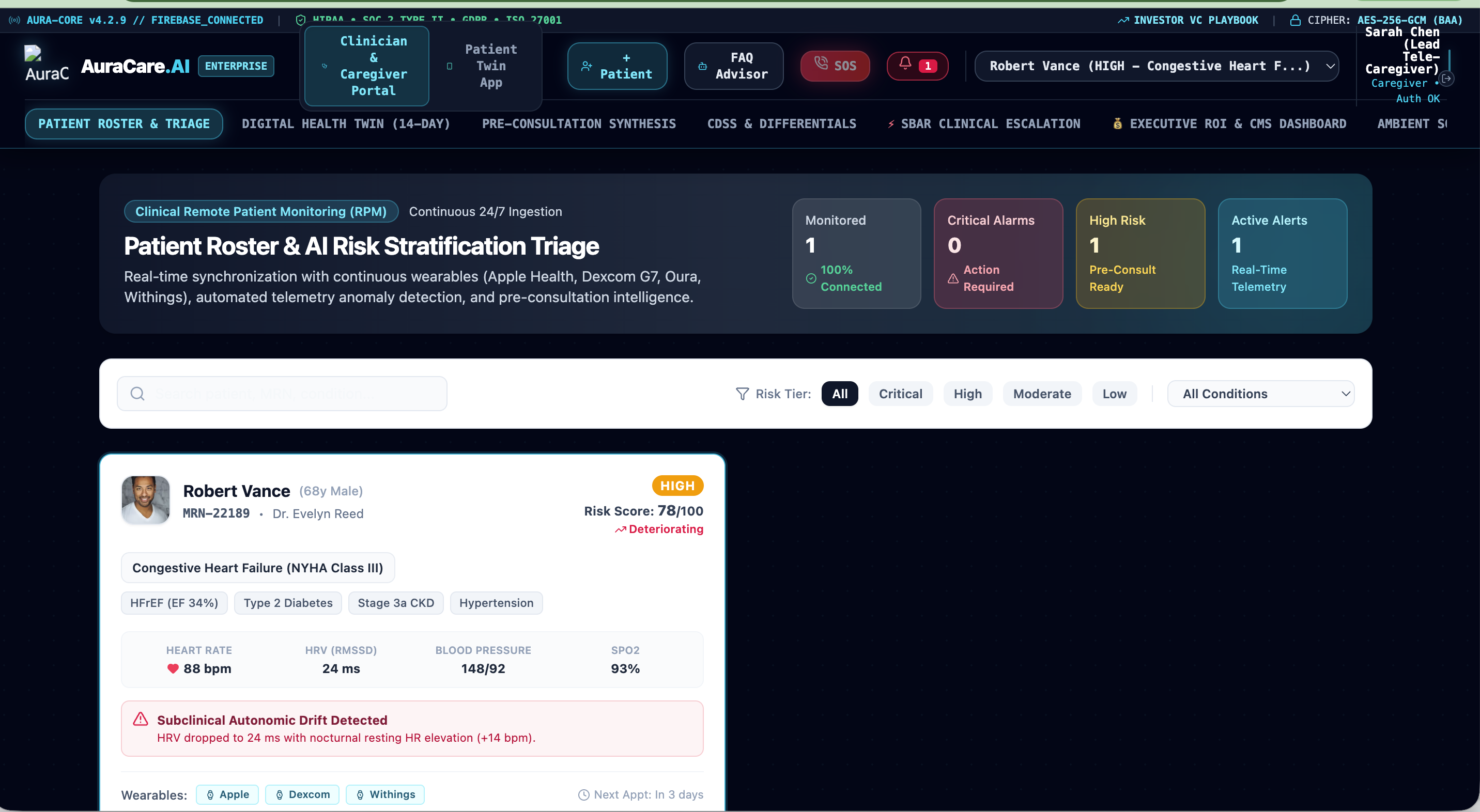
AuraCare AI: Engineering a Predictive Physiological Digital Twin and Ambient Clinical Copilot. 1. Inspiration: The 48-Hour Invisible Window In modern cardiopulmonary chronic care (Chronic Obstructive Pulmonary Disease, Congestive Heart Failure, Chronic Kidney Disease), clinical intervention remains tragically reactive. By the time a patient experiences overt dyspnea or acute peripheral edema and calls emergency services, their pulmonary capillary wedge pressure or airway inflammation has already been cascading out of control for two to three days. Hospital readmission penalties exceed billions annually, while clinicians spend over two hours wrestling with fragmented electronic health records (EHRs) for every single hour spent examining patients. Wearable sensors produce vast oceans of unstructured telemetry, yet care teams suffer from severe alert fatigue because raw sensor spikes lack clinical context and longitudinal trajectory modeling. We asked a fundamental question: What if we could construct an autonomous, mathematical digital twin for high-risk patients that synthesizes continuous biometrics, environmental exposome stress, and ambient clinical dialogues to forecast acute decompensation 48 hours before clinical symptoms manifest? This inspired the creation of AuraCare AI.┌──────────────────────────────────────────────────────────────────────────┐ │ Multimodal Data Ingestion │ ├────────────────────────────┬─────────────────────────────┬───────────────┤ │ 1. Real-time Telemetry │ 2. Environmental Exposome │ 3. Ambient │ │ • PPG, ECG (100Hz) │ • PM2.5, AQI │ Clinical │ │ • SpO2, Respiration Rate│ • Temperature, Humidity │ Audio │ │ • HRV (SDNN, RMSSD) │ • Barometric Pressure │ Dialogues │ └─────────────┬──────────────┴──────────────┬──────────────┴───────┬───────┘ │ │ │ ▼ ▼ ▼ ┌──────────────────────────────────────────────────────────────────────────┐ │ AuraCare AI Multimodal Fusion & Predictive Core │ │ │ │ ┌─────────────────────────────────┐ ┌──────────────────────────────┐ │ │ │ Physiological Digital Twin │ │ Gemini Multimodal Engine │ │ │ │ State-Space Degradation Engine │ │ • Ambient Audio Scribe │ │ │ │ $S(t) = \mathbf{A}S(t-1) + ...$ │ │ • Contextual SBAR Generator │ │ │ └────────────────┬────────────────┘ └──────────────┬───────────────┘ │ │ │ │ │ │ ▼ ▼ │ │ ┌─────────────────────────────────────────────────────┐ │ │ │ Multi-Factor Decompensation Risk Scoring: $\mathcal{R}(t)$ │ │ │ └──────────────────────────┬──────────────────────────┘ │ └─────────────────────────────────────┼────────────────────────────────────┘ │ ▼ ┌──────────────────────────────────────────────────────────────────────────┐ │ Clinical Decision & Action │ ├────────────────────────────┬─────────────────────────────┬───────────────┤ │ Autonomous Triage Radar │ Audit-Ready SOAP & FHIR │ Remote Care │ │ 48-Hour Early Warning SBAR │ Auto-Generated EHR Updates │ CPT Billing │ └────────────────────────────┴─────────────────────────────┴───────────────┘A. Mathematical Modeling of the Physiological Digital Twin AuraCare AI models each patient as a continuous non-linear dynamical system. The patient's underlying physiological state vector at time is represented by: where is Pulse Wave Velocity derived from the photoplethysmogram (PPG) pulse transit time, and is continuous respiration rate derived from respiratory sinus arrhythmia.1. Environmental Exposome Degradation Index ( ) External stressors (particulate matter , ozone , and thermal heat index ) exacerbate microvascular and pulmonary resistance: where are individualized sensitivity weights determined by prior diagnostic history (e.g., severe GOLD-stage COPD increases ).
- 48-Hour Decompensation Probability ( ) The dynamic risk of acute cardiopulmonary exacerbation over a forecast horizon is calculated using an attention-weighted multi-kernel risk function: where: is the logistic sigmoid activation. is an exponential temporal decay kernel capturing acute cumulative volatility. is the qualitative clinical risk embedding generated by Gemini from longitudinal notes and recent symptoms. B. The Ambient Clinical Copilot & Agentic Escalation Multimodal Audio Processing: Utilizes low-latency Gemini multimodal audio processing to ingest live doctor-patient consultations, isolating clinical terminology (symptoms, medication adjustments, social determinants) from conversational dialogue. Autonomous SOAP & SBAR Generation: Automatically synthesizes dialogues into structured SOAP (Subjective, Objective, Assessment, Plan) records and formats proactive SBAR (Situation, Background, Assessment, Recommendation) alerts when . FHIR / HL7 Standardization: All generated clinical entities are mapped directly to standard LOINC codes and FHIR JSON schemas for seamless EHR interoperability.
- Engineering Challenges & Solutions Challenge 1: Motion Artifacts & Telemetry Signal-to-Noise Ratio (SNR) Problem: Ambulatory wrist PPG signals suffer from severe motion artifacts during daily activities, generating false-positive tachycardia or desaturation alerts. Solution: Implemented an adaptive recursive Normalized Least Mean Squares (NLMS) filtering pipeline cross-referenced against 3-axis accelerometer signals, paired with a signal quality index ( ). Predictions are only evaluated when . Challenge 2: Eliminating Hallucinations in Clinical Decision Support Problem: Large Language Models can inadvertently invent clinical measurements or misinterpret medication dosages if unconstrained. Solution: Built a deterministic dual-validation layer. The Gemini-generated clinical plans are verified against a local rule engine encoding standard clinical guidelines (GOLD COPD guidelines and AHA Heart Failure criteria) prior to physician sign-off. Challenge 3: Asynchronous Multimodal Telemetry Synchronization Problem: Aligning millisecond-level biometric streams ( ECG/PPG) with episodic lab results, hourly environmental telemetry, and ad-hoc ambient audio sessions. Solution: Developed a unified time-series vector bus using windowed temporal bucketing and unified event clocks, standardizing all modalities into a consistent state representation.
- Key Learnings Clinicians Need Decisions, Not Dashboards: Providing raw charts increases cognitive load. Clinicians responded enthusiastically when shown prioritized, pre-synthesized SBAR recommendations with explicit confidence intervals and causal factor breakdowns. Context Modulates Physiology: A heart rate spike of during low AQI and normal temperature indicates physical exertion; the exact same spike during elevated and dropping signals incipient airway hyper-reactivity. Multimodal context is essential for accurate clinical risk prediction. Doctor-in-the-Loop Preserves Trust: Autonomous AI agents must remain assistive. Providing editable, audit-ready clinical notes where every recommendation requires a single clinician click to approve ensures safety, compliance, and clinical adoption.
- What's Next for AuraCare AI Edge Deployment: Compiling physiological digital twin inference to run directly on-device for offline patient monitoring. Prospective Clinical Trials: Expanding pilot programs across tertiary hospital networks to measure empirical reductions in 30-day all-cause readmission rates. ABDM & Global EHR Integration: Expanding out-of-the-box bidirectional integrations for EPIC, Cerner, and India's Ayushman Bharat Digital Mission (ABDM).
Built With
- ai-agents
- ambient-ai
- biometrics
- clinical-decision-support
- cloud-run
- digital-twins
- fhir
- firebase
- firestore
- gemini-api
- generative-ai
- google-cloud
- healthtech
- multimodal-ai
- natural-language-processing
- node.js
- predictive-analytics
- react
- remote-patient-monitoring
- tailwind-css
- time-series
- typescript
- vertex-ai
- vite

Log in or sign up for Devpost to join the conversation.