-
-
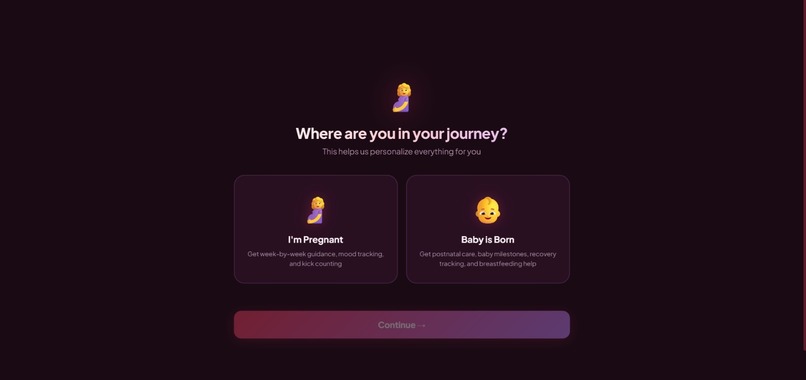
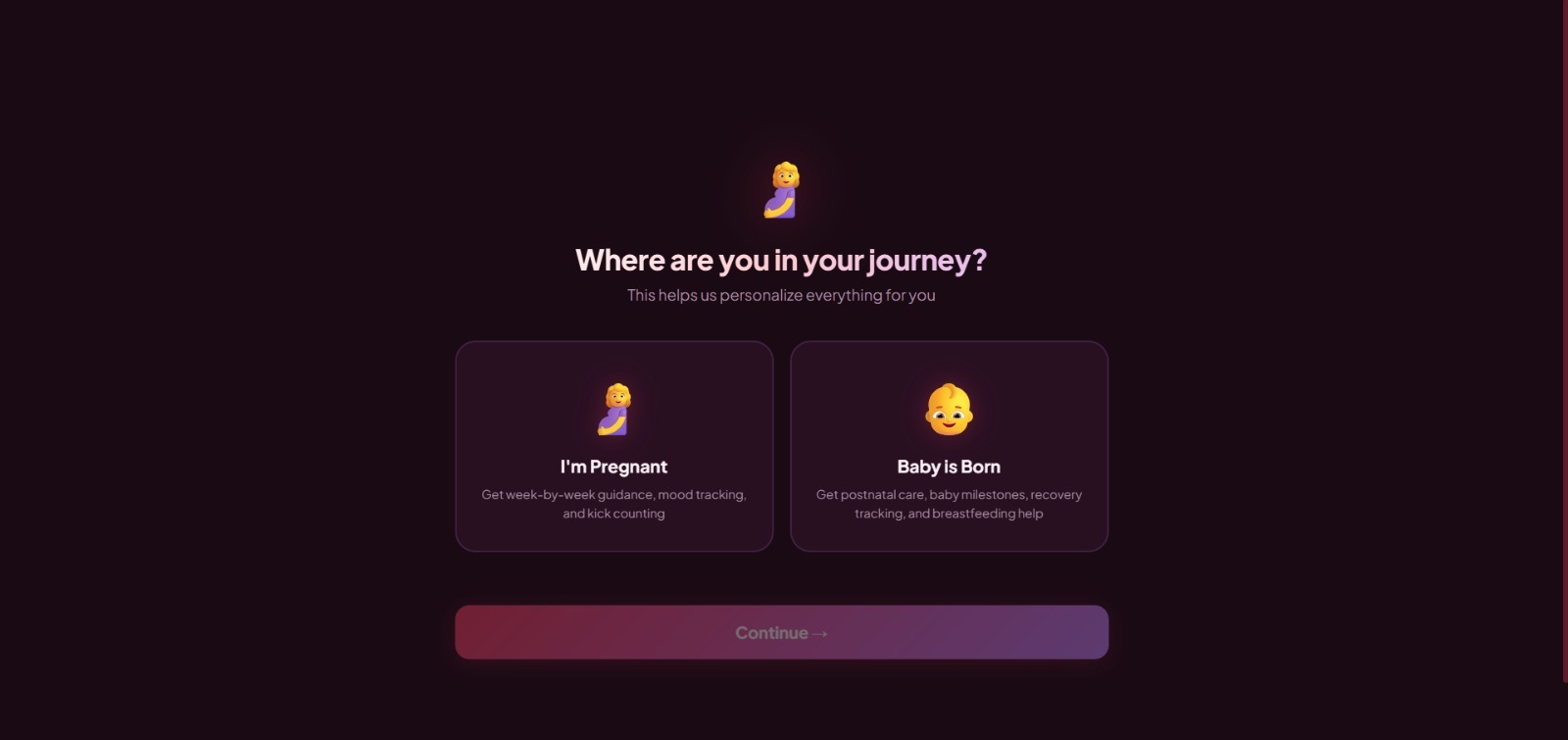
Select your stage to receive personalized guidance tailored to your pregnancy journey.
-
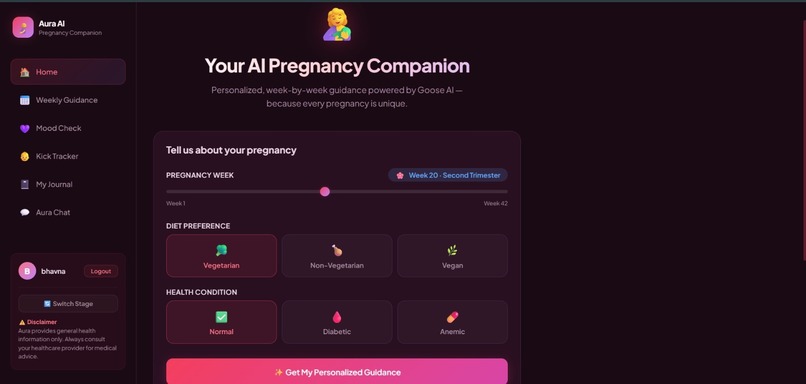
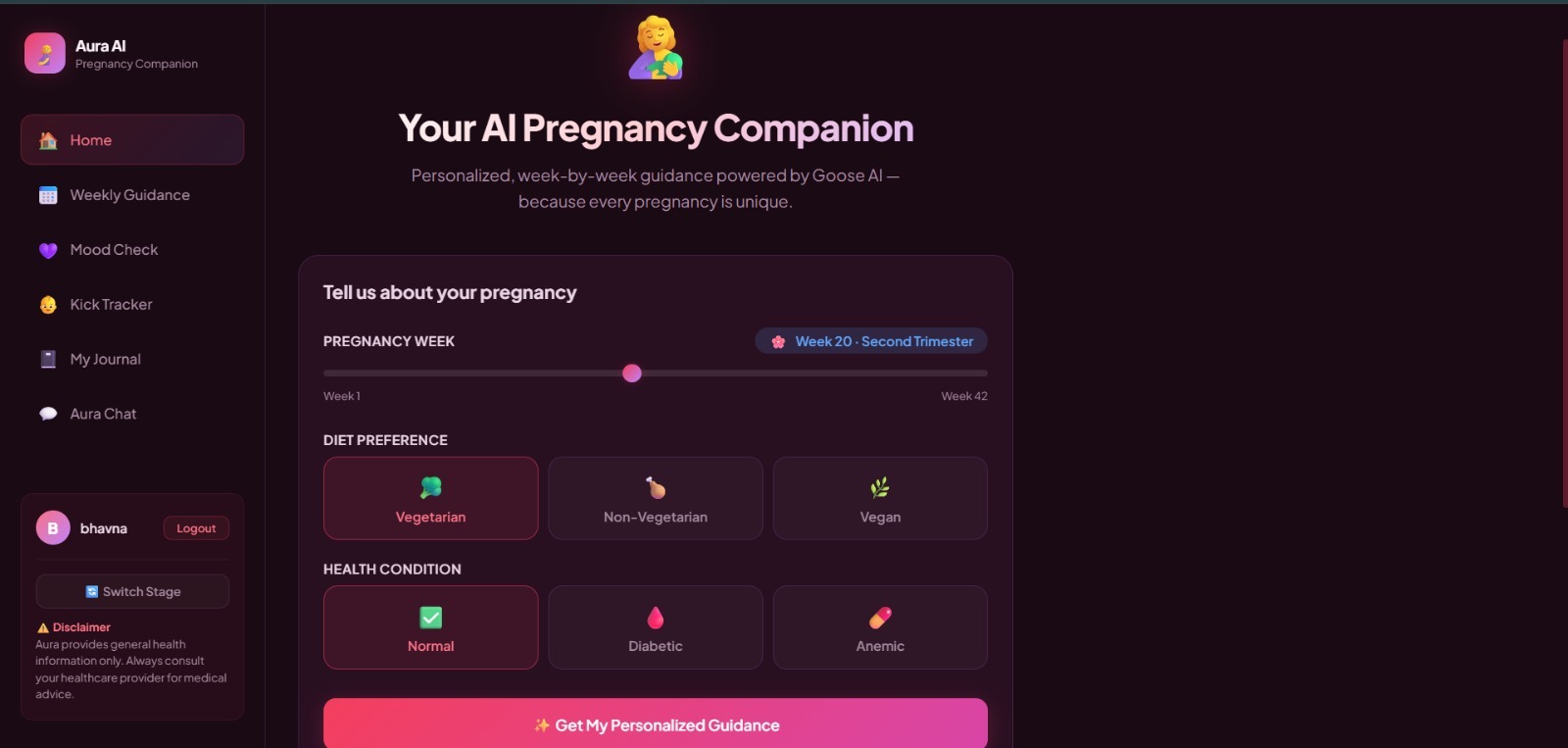
Aura AI provides personalized guidance, mood insights, and health tracking to support every step of your pregnancy journey.
-
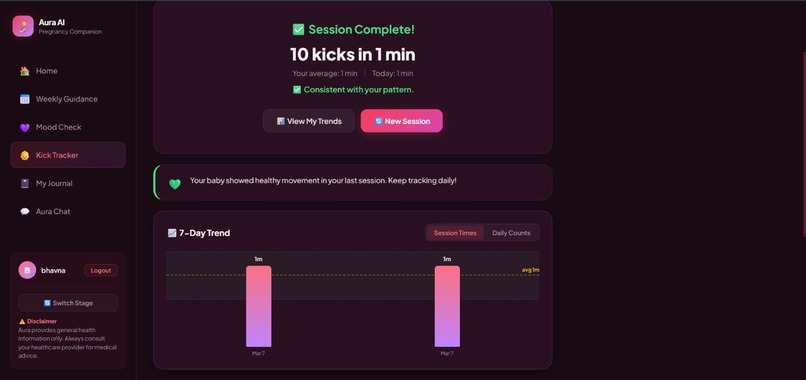
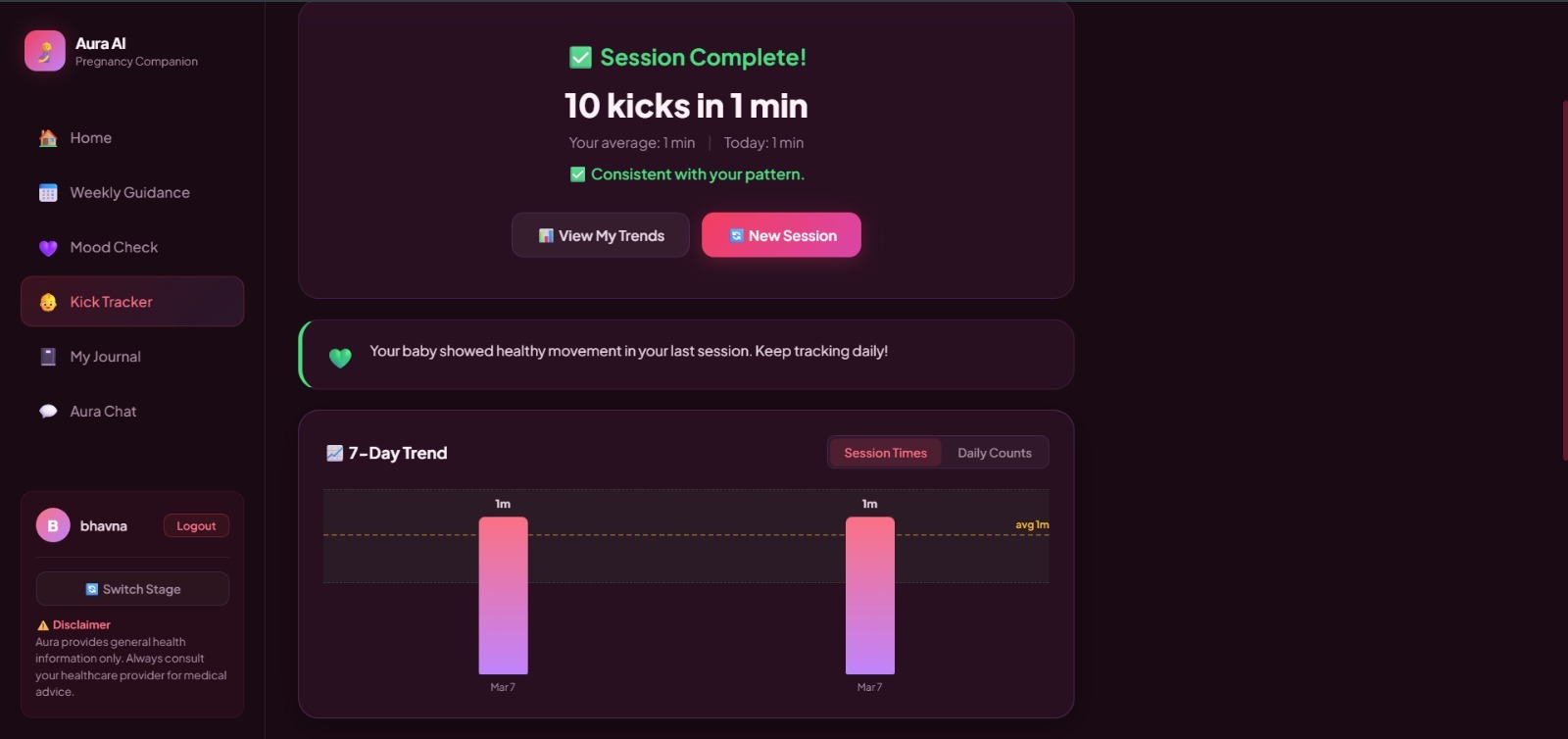
Track your baby’s kicks in real time and monitor healthy movement patterns with Aura AI.
-
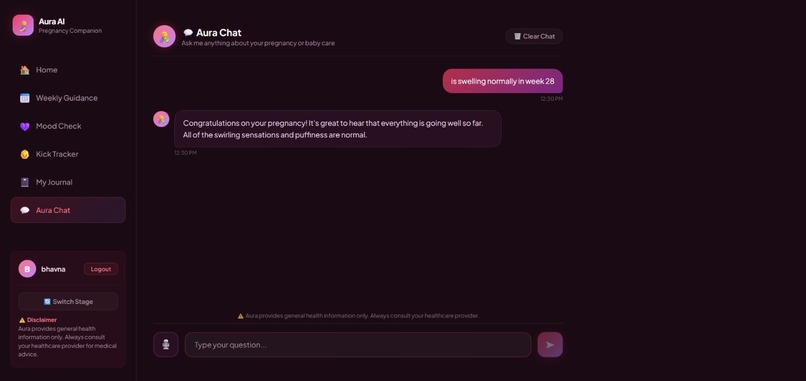
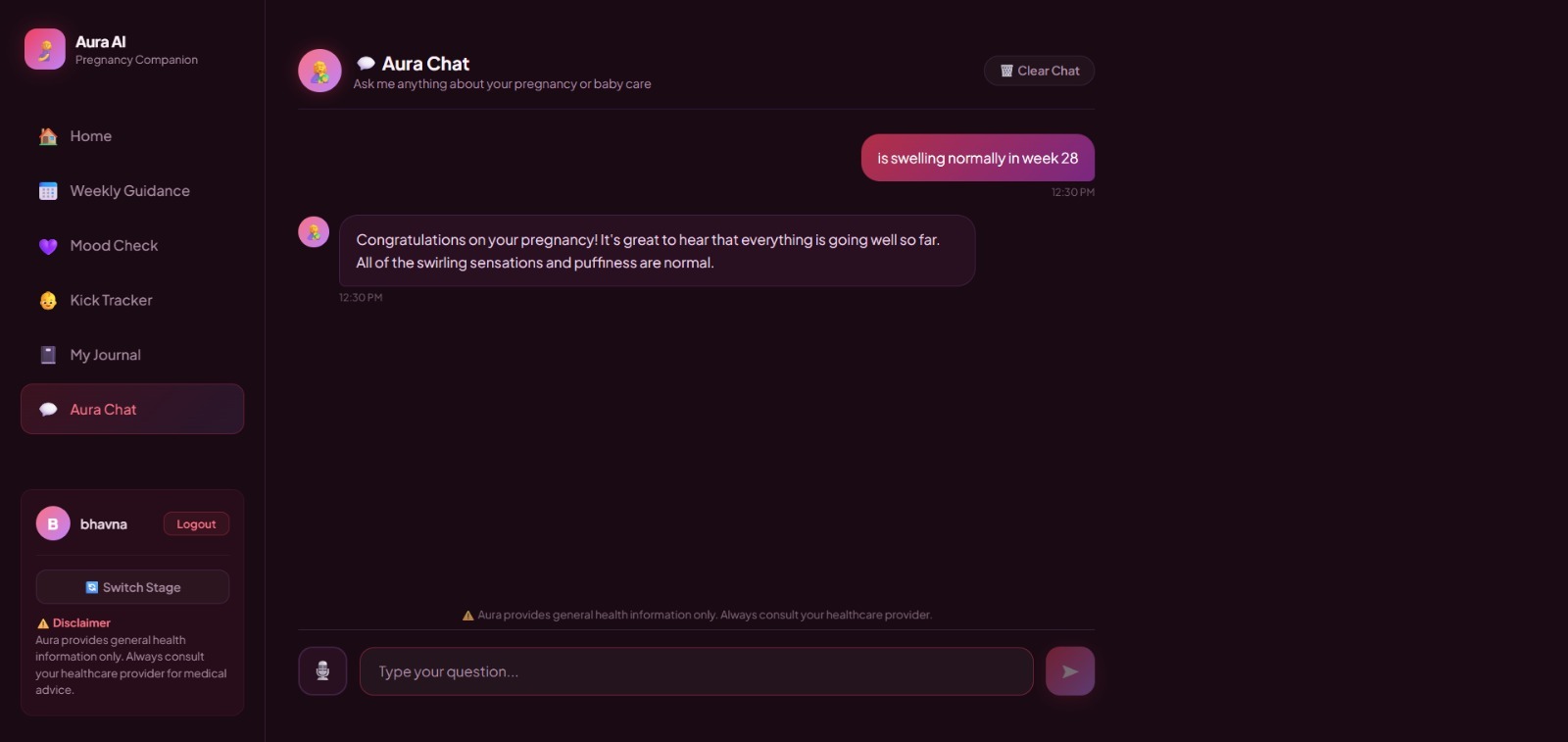
Chat with Aura AI for personalized pregnancy guidance, support, and answers anytime.
-
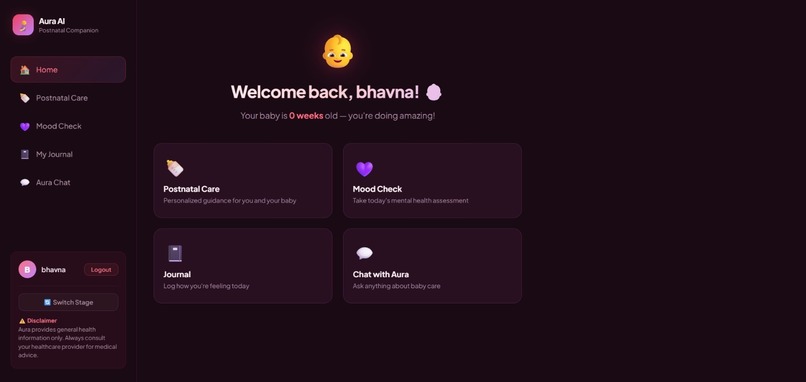
Your personalized dashboard to track care, mood, and guidance throughout your pregnancy journey.
-
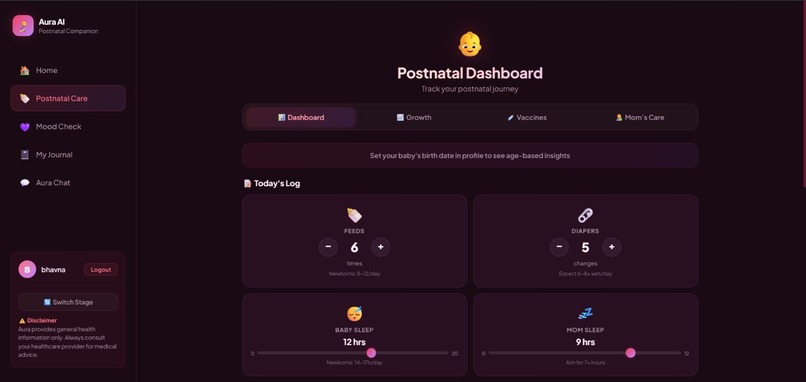
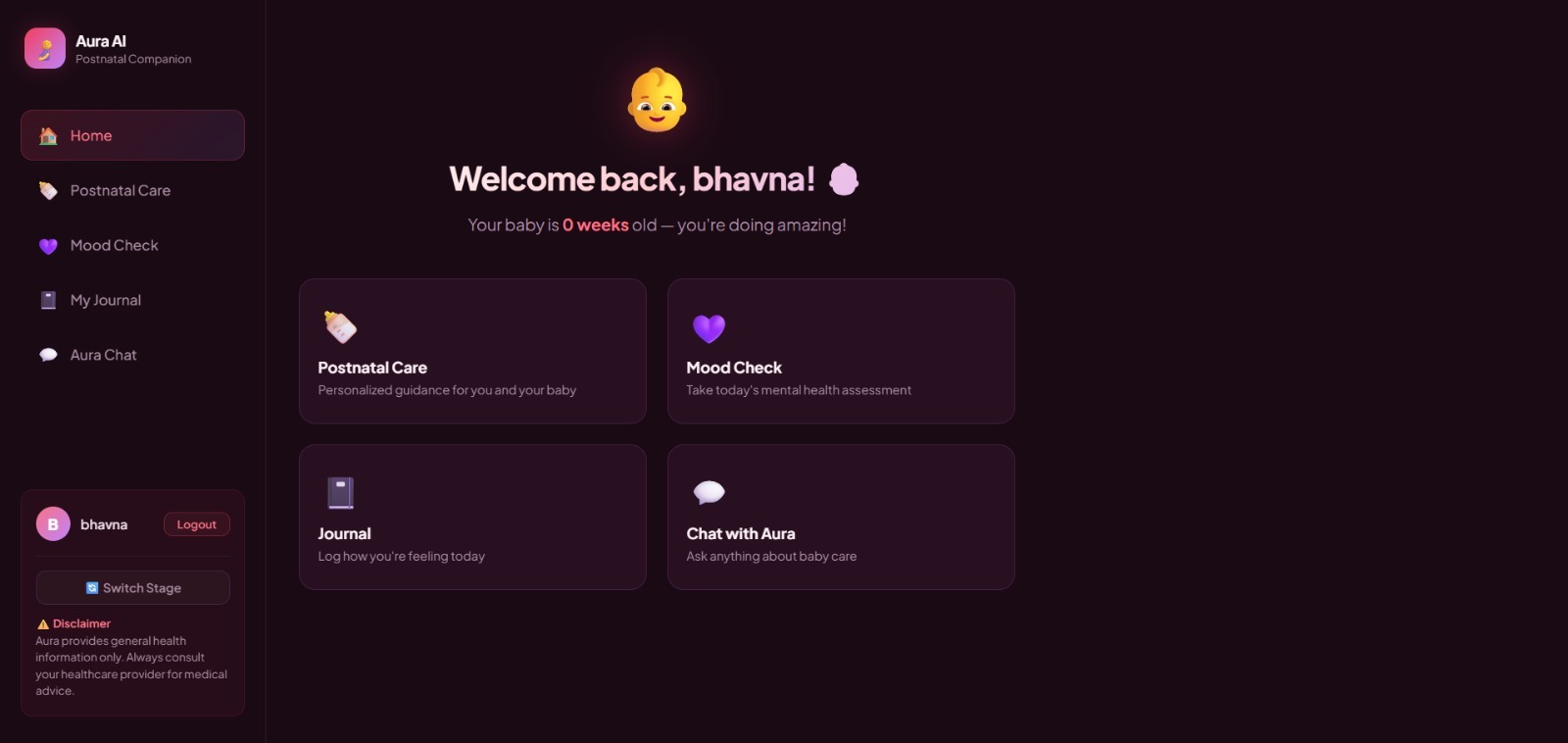
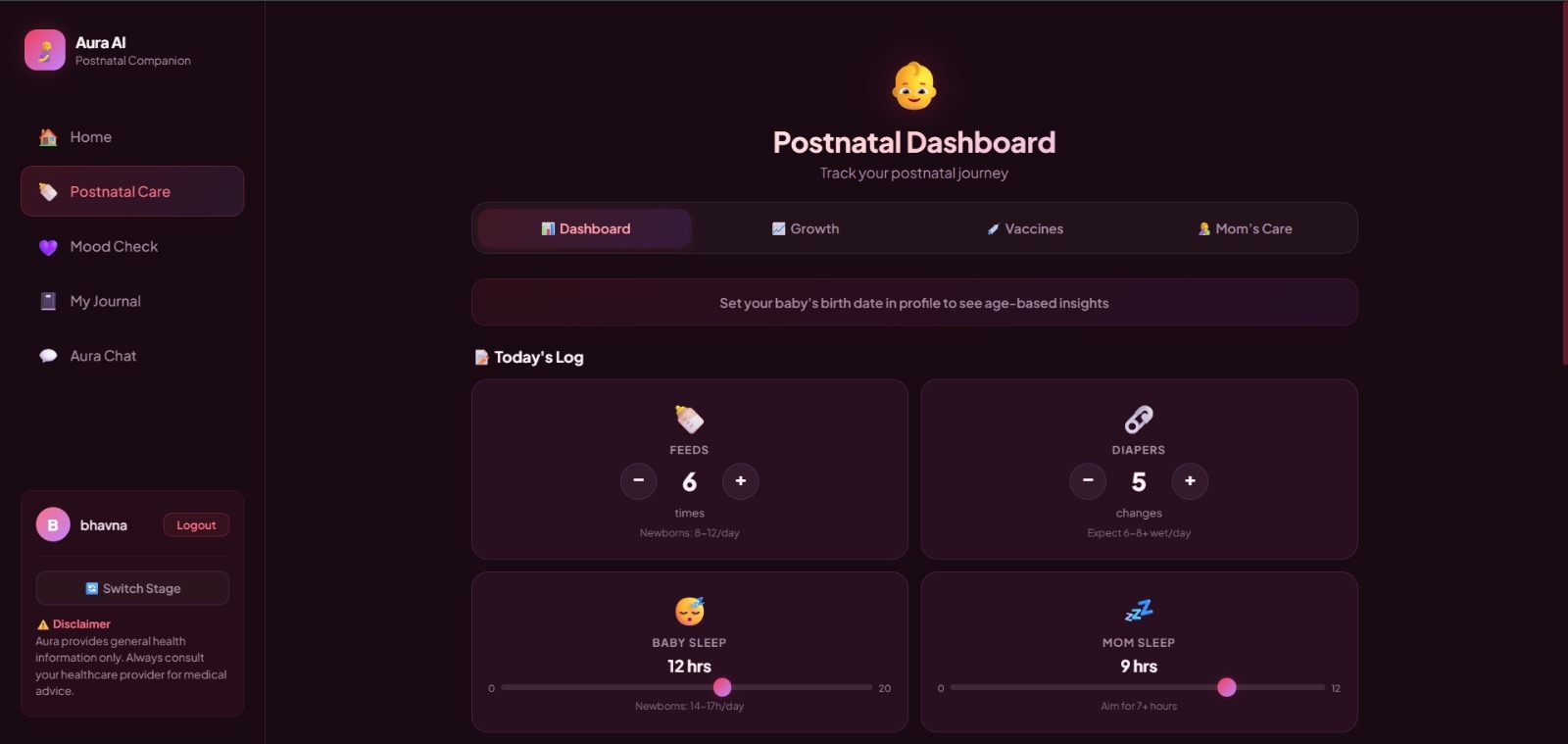
Monitor recovery, mood, and daily wellbeing with your personalized postnatal dashboard.
About the Project
Inspiration
Pregnancy can be an exciting but also overwhelming journey, especially for first-time mothers. While many pregnancy apps exist, most of them provide generic advice that does not adapt to a woman's specific health conditions, emotional state, or pregnancy stage.
Our team was inspired by the idea that every pregnancy is unique, and mothers deserve guidance that reflects their personal situation rather than static articles. We wanted to build a tool that could provide personalized support, emotional reassurance, and early warning signals using artificial intelligence.
Aura AI is created to act as a digital companion for maternal health, helping mothers stay informed, confident, and supported throughout pregnancy.
What We Learned
Working on Aura AI helped us explore several interdisciplinary areas: Machine Learning in healthcare Natural Language Processing for symptom detection Large Language Model integration Human-centered AI design
We learned how AI can assist in preventive healthcare by identifying patterns and potential risks early. At the same time, we also understood the importance of ethical AI usage, including transparency, disclaimers, and responsible data handling. One key insight was that technology should support decision-making rather than replace medical professionals, which is why Aura AI always encourages users to consult healthcare providers when necessary.
How We Built It
Aura AI is built using a full-stack architecture combining modern web technologies with AI and machine learning models. Frontend
The user interface was built with React and Vite, creating a fast and responsive single-page application where users can: Receive personalized pregnancy guidance Track mood and emotional wellbeing Monitor fetal kick counts Log daily symptoms through a health journal Backend
The backend is powered by FastAPI, which handles API requests, integrates AI services, and processes data from the frontend. The backend manages several services: Guidance generation Mood assessment Kick anomaly detection Journal symptom tagging Machine Learning Model For mood assessment, we implemented a Random Forest classifier trained on synthetic PHQ-style mood data. The model predicts risk levels based on responses to emotional wellbeing questions.
Mathematically, the prediction can be represented as:
- Q represents mood questionnaire responses
- Sleep represents average hours of sleep
- Energy represents reported daily energy levels $$Risk=f(Q1,Q2,Q3,Q4,Q5,Q6,Q7,Sleep,Energy)$$ The model classifies users into three categories: Low Risk, Moderate Risk, High Risk LLM Integration
Aura AI integrates Goose AI (LLM) to generate personalized pregnancy guidance. The model takes inputs such as: Pregnancy week Diet preference Health conditions and produces recommendations related to: Nutrition Exercise Medical checkups Additional AI Components Aura AI also includes lightweight AI-driven features: Kick Tracker: Detects anomalies when fetal movement falls below 60% of a user's baseline average. Symptom Journal: Uses keyword-based NLP to tag potential concerns like pain, bleeding, or reduced fetal movement.
Challenges We Faced
Building Aura AI involved several technical and ethical challenges.
- Working with Limited Medical Data Real healthcare datasets are often restricted due to privacy concerns. To address this, we trained our mood classification model on synthetic data based on PHQ-style scoring systems while clearly documenting this limitation.
- Ensuring Responsible AI Output AI-generated medical advice must be handled carefully. We implemented safeguards such as: Medical disclaimers Neutral guidance language Encouraging consultation with healthcare professionals
- Building Reliable Anomaly Detection Detecting meaningful changes in fetal movement required designing a system that adapts to each user's baseline rather than relying on a fixed threshold.
- Balancing Simplicity and Functionality Since pregnant users may experience physical or emotional stress, the interface had to remain simple, fast, and easy to use while still providing meaningful insights. Looking Ahead
Aura AI is currently a prototype built for the #75HER Challenge, but we believe it has strong potential for real-world impact. Future improvements could include: Clinical validation with real healthcare datasets Integration with wearable devices Voice-based support for accessibility Secure multi-user authentication Partnerships with healthcare providers Our vision is to create a platform that empowers mothers with accessible, AI-assisted prenatal care while always keeping human medical expertise at the center.
Built With
- 18
- aiosqlite
- fastapi
- git
- github
- goose
- html
- javascript
- natural-language-processing
- python
- react
- scikit-learn
- sqlite
- tools
- uvicorn
- vite


Log in or sign up for Devpost to join the conversation.