-
-
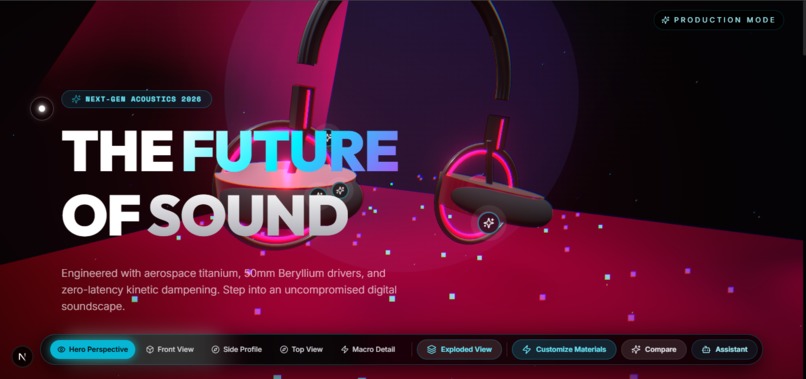
Landing page
-
-
Inspiration
AURA ZERO was inspired by a simple question: What if a product website could feel as immersive as the product itself?
Most product websites present products through static images, videos, specifications, and basic interactions. The goal behind AURA ZERO was to move beyond that traditional experience and create a digital showroom where users can explore the product in 3D, customize it in real time, and understand its technology through cinematic storytelling.
The inspiration came from premium product experiences such as Apple, Tesla, Porsche, and other immersive digital experiences that make technology feel emotional, interactive, and memorable.
What it does
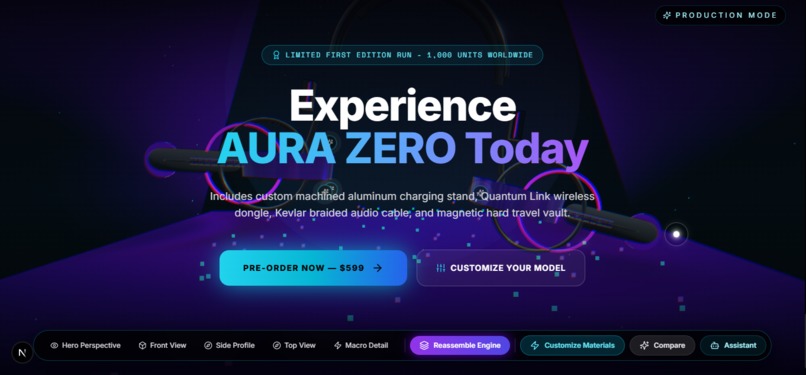
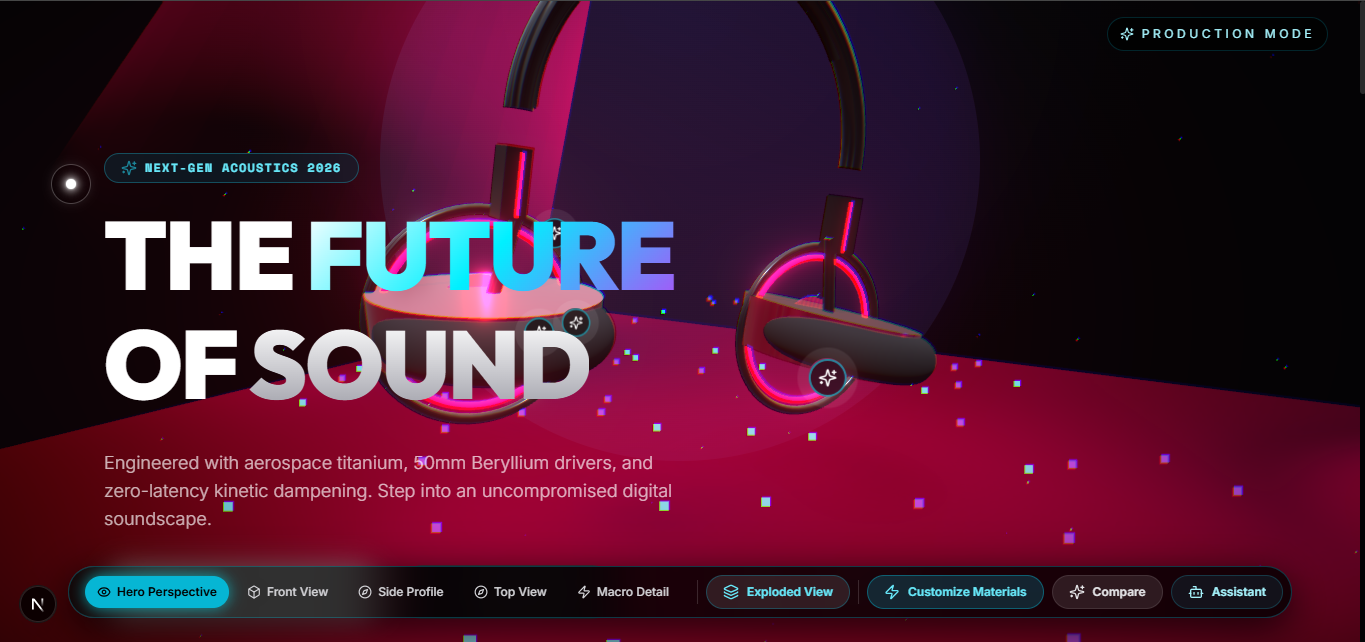
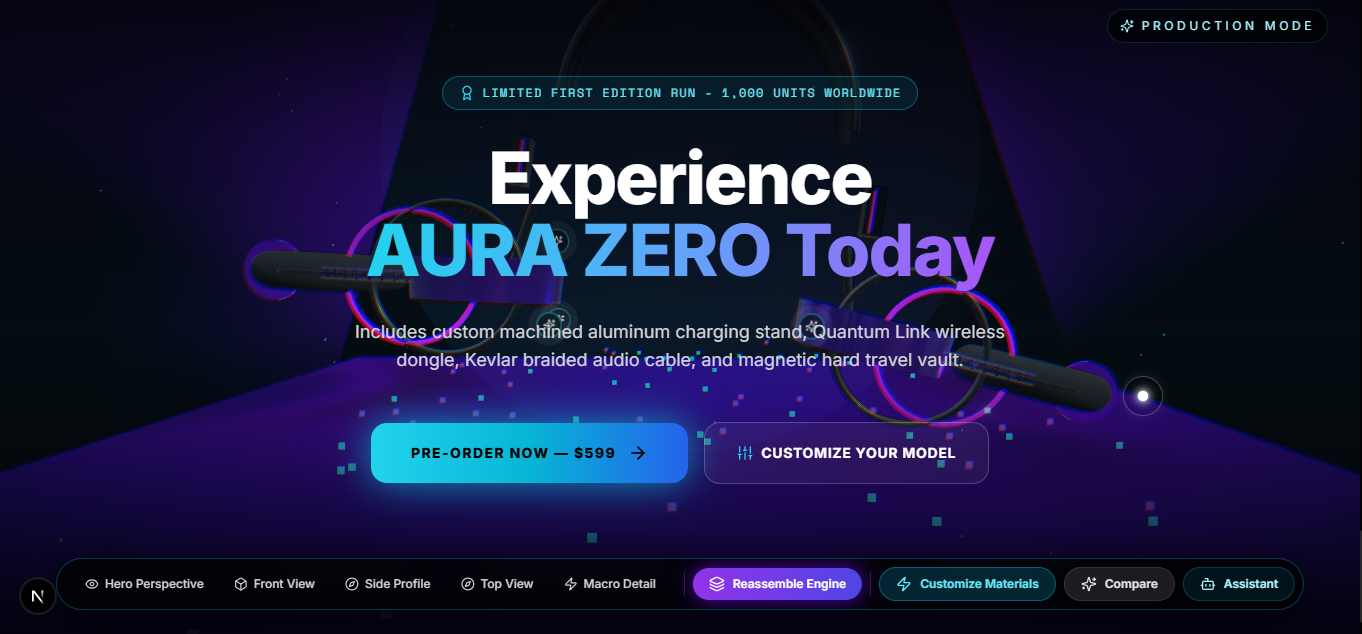
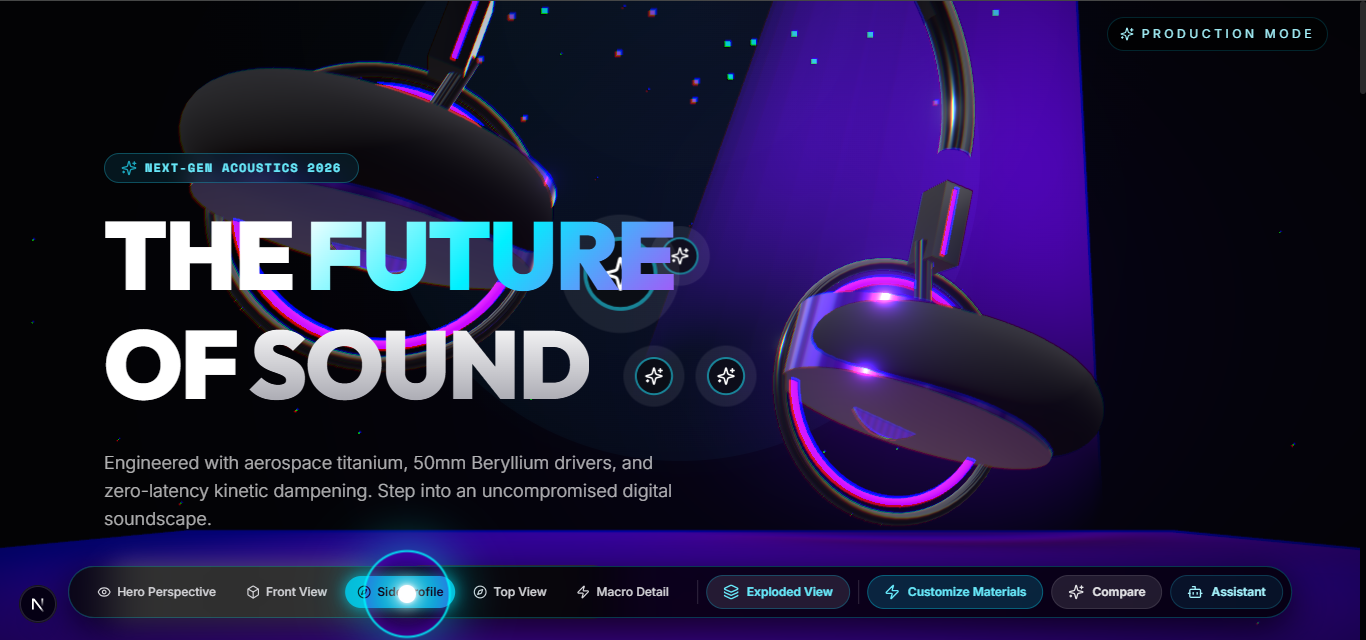
AURA ZERO – 3D Web is an immersive 3D product showcase and interactive configurator designed around a premium headphone experience.
Users can:
- Explore a realistic 3D headphone model.
- Rotate and inspect the product interactively.
- Change colors and materials in real time.
- Switch between finishes such as matte, gloss, metallic, chrome, titanium, carbon fiber, leather, and glass.
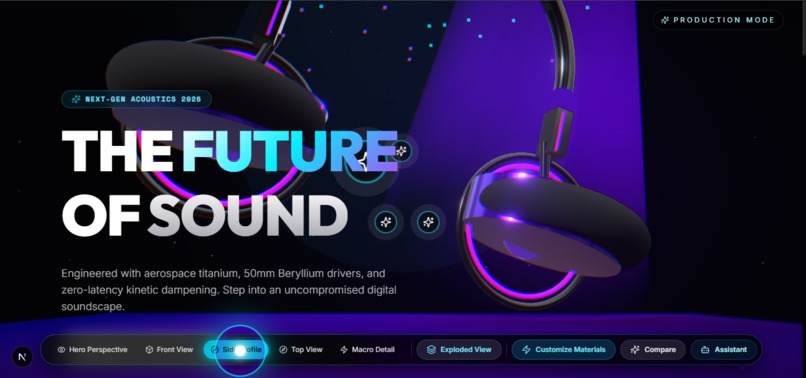
- Use cinematic camera presets such as front, side, top, perspective, close-up, and detail views.
- Activate an exploded view to inspect internal product components.
- Click interactive 3D hotspots to learn about important components.
- Experience scroll-controlled product storytelling.
- Explore technical specifications and product features through animated sections.
The objective is to make visitors experience the product instead of simply viewing a product page.
How we built it
AURA ZERO was developed using a modern web and 3D technology stack.
Next.js, React, and TypeScript form the application foundation, while Three.js, React Three Fiber, and Drei power the real-time 3D experience.
For animation and interaction, the project uses GSAP, ScrollTrigger, Framer Motion, and Lenis to create smooth camera transitions, scroll-based storytelling, micro-interactions, and cinematic motion.
The product configurator uses dynamically controlled physically based rendering (PBR) properties such as color, metalness, roughness, clearcoat, transmission, and reflections. Material changes are interpolated smoothly so that the product does not visually "pop" between configurations.
The exploded-view system separates multiple product components using animated positional offsets, allowing users to inspect the internal architecture. Interactive Drei hotspots are positioned directly inside the 3D environment and connected to information panels.
The interface combines dark luxury aesthetics, glassmorphism, dynamic lighting, particles, bloom, responsive layouts, and cinematic typography to create a premium digital showroom.
Performance was considered throughout development using techniques such as lazy loading, Suspense, optimized 3D assets, adaptive rendering, and controlled visual effects.
Challenges we ran into
One of the biggest challenges was maintaining compatibility across the Next.js, React, Three.js, React Three Fiber, Drei, and post-processing ecosystem. Dependency mismatches initially caused runtime errors involving React internals.
Another major challenge was handling the performance cost of a highly interactive 3D website. Real-time models, lighting, particles, shaders, post-processing, and animation systems can place significant load on both the CPU and GPU. The experience therefore required careful optimization and responsible use of visual effects.
Building a reliable exploded-view engine was also challenging because multiple components needed to separate and reassemble smoothly while maintaining correct materials, lighting, camera positioning, and user interaction.
The project also required careful coordination between GSAP, React state, Three.js animation loops, and UI interactions. Making these systems work together without creating animation conflicts or unnecessary React re-renders required extensive debugging and testing.
Another unexpected challenge involved the custom cursor. Hiding the native cursor while relying on a custom animated cursor created usability issues when the custom cursor became unavailable. This led to a more robust approach where cursor enhancement should never compromise basic browser interaction.
Accomplishments that we're proud of
The biggest accomplishment is transforming a conventional product webpage concept into a fully interactive 3D product experience.
The project successfully combines:
- Real-time 3D rendering.
- Live material and color customization.
- Multi-part exploded views.
- Interactive 3D hotspots.
- Cinematic camera presets.
- GSAP ScrollTrigger storytelling.
- Dynamic lighting and visual effects.
- Responsive configurator interfaces.
- Premium micro-interactions.
- Performance-conscious rendering.
Another achievement was building the experience with a modular and scalable architecture, making it possible to add new product components, materials, interactions, and visual effects without rebuilding the entire application.
The project also reached a stable production-build stage with successful TypeScript and build verification during development.
Most importantly, AURA ZERO achieves the original goal: **making users curious enough to explore the product rather than simply scroll past it.
What we learned
AURA ZERO provided practical experience across both frontend engineering and creative development.
The project strengthened understanding of:
- Three.js and real-time WebGL rendering.
- React Three Fiber and 3D scene architecture.
- Physically based materials and lighting.
- GSAP and ScrollTrigger animation systems.
- Scroll-driven storytelling.
- Interactive 3D UX design.
- Performance optimization for WebGL.
- Responsive 3D experiences.
- Component architecture in Next.js.
- Debugging complex dependency and runtime issues.
One of the most important lessons was that visual quality and technical performance must be designed together. Adding more effects does not automatically create a better experience. The strongest result comes from using animation, lighting, interaction, and visual effects with purpose.
What's next for Aura Zero - 3D Web
The next stage is to evolve AURA ZERO from an immersive product showcase into a more complete interactive product platform.
Future improvements include:
- AI-powered product assistant.
- Shareable product configurations.
- Advanced product comparison.
- Saved/favorite configurations.
- AR/WebXR product visualization.
- More advanced GLSL shaders.
- Improved mobile 3D performance.
- Additional products and configurable components.
- Real-time product recommendations.
- Advanced analytics for understanding user interactions.
- Further accessibility and performance optimization.
The long-term vision is to make AURA ZERO a next-generation digital showroom where users can discover, customize, understand, and experience products in an entirely interactive 3D environment.


Log in or sign up for Devpost to join the conversation.