-
-
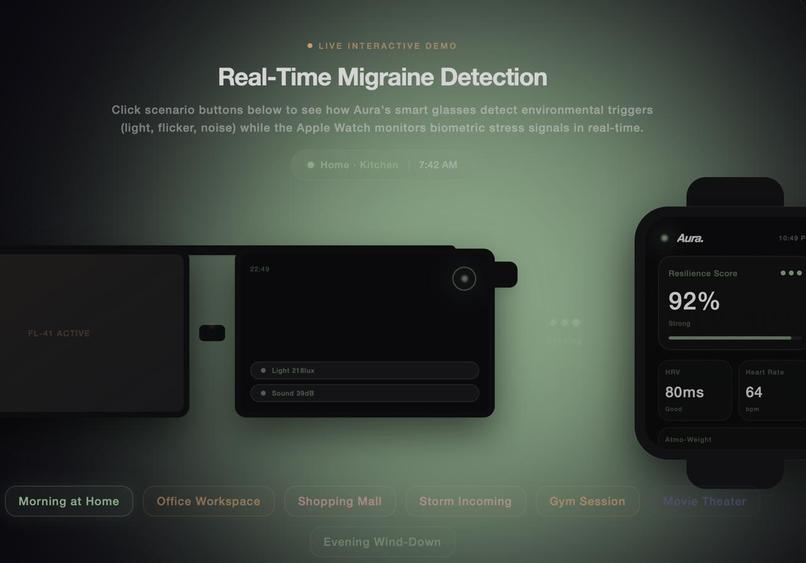
Real-time Migraine detection
-
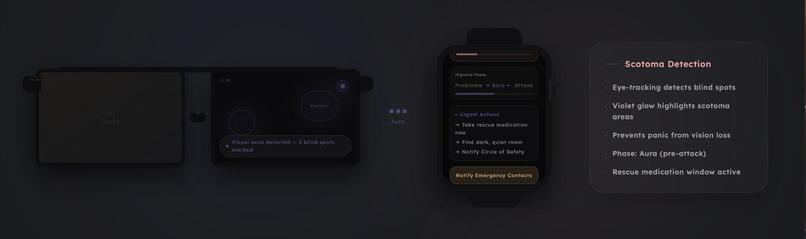
Scotoma detection
-
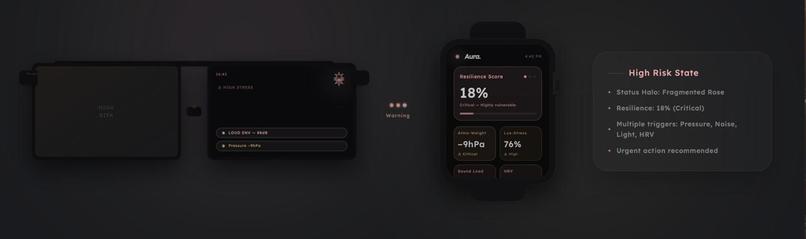
High Risk State
-
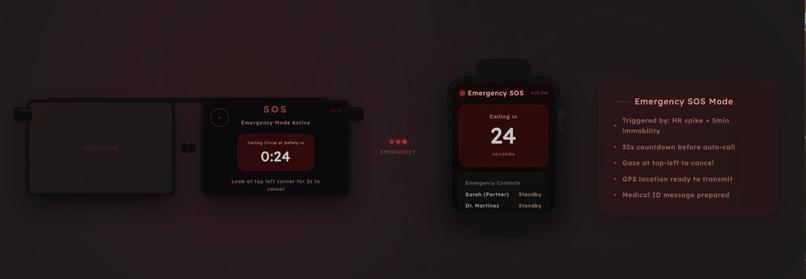
SOS Mode
-
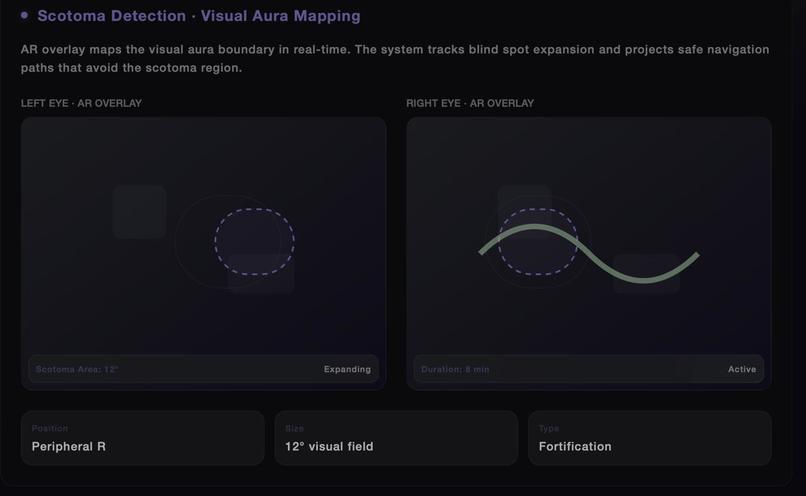
Visual Aura Mapping
If you have never had a migraine, it is hard to imagine... One moment you are fine, and the next the world becomes unbearable. More than one billion people worldwide suffer from migraines. And the hardest part is not the pain. It is that you never see it coming. Migraine triggers are invisible. They include light flicker, pressure changes, and stress signals from your body. The real problem is that you never know when it is coming. UNTIL NOW!!!
We built AURA, a wearable system that predicts migraines before they start. Imagine if your glasses could warn you about a migraine before you even feel it. Aura is the FIRST wearable migraine prediction system built directly into smart glasses. By combining signals from your environment and your body, Aura detects the neurological patterns that precede an attack. In other words, Aura turns invisible triggers into visible signals and gives migraine sufferers their time back.
AURA
Turning invisible migraine triggers into visible signals
“I will go take medication… until Aura exists.” — a sentence said by our teammate while we were building this prototype.
Inspiration
Migraines are not rare. They are not niche.
More than one billion people worldwide live with migraines.
For one member of our team, migraines have been a constant companion since childhood. Studying, working, concentrating, even socializing can suddenly become impossible.
The hardest part is not just the pain.
It is the uncertainty.
You never know when the attack will start.
People take medication. They try injections. They track sleep. They avoid triggers.
But most existing solutions are reactive. They treat the pain after it begins.
While building this project, something happened that made our mission even clearer.
While we were writing this very submission, our teammate suddenly said:
“My head is starting to hurt. I will go take medication… until Aura exists.”
That sentence became the reason this project matters.
We realized the real problem is not just migraines.
The real problem is that the triggers are invisible.
And invisible problems require new kinds of tools.
What it does
Aura is a wearable migraine prediction system.
It combines signals from smart glasses and a fitness wearable to detect patterns that precede a migraine attack.
Think of it as:
A fitness tracker, but for your neurological state.
Aura monitors signals from two sources:
Environmental signals
Captured through smart glasses
- light intensity and flicker
- environmental noise
- pressure changes
- visual disturbances
Biometric signals
Captured through wearables like Apple Watch
- heart rate variability
- stress response
- physiological changes associated with migraine onset
These signals are fused in real time to compute a Resilience Score.
When the score drops, Aura alerts the user:
- early warning about a potential migraine
- recommendation to take medication
- suggestion to move to a safer environment
- AR navigation toward a calmer space
Instead of reacting to pain, the user gains time to prevent it.
Aura turns invisible triggers into visible signals.
How we built it
This project was developed as a fully interactive prototype using modern technologies and rapid design tooling.
Design and prototyping
The entire experience was designed and prototyped inside Figma Make, allowing us to simulate a full wearable ecosystem.
The prototype includes:
- 20+ interactive screens
- 17 pitch deck slides
3 device contexts
- Apple Watch
- Smart Glasses
- AR passthrough interface
We modeled multiple real-world scenarios:
- migraine risk alerts on Apple Watch
- environmental detection through glasses
- AR safe path navigation
- trigger history visualization
- resilience scoring system
The goal was not only to design a product.
The goal was to simulate how Aura would behave in everyday life.
Challenges we ran into
The most significant challenge was not software.
It is hardware integration.
Building a migraine prediction system requires simultaneously collecting signals from multiple physiological and environmental sources.
Some of the open challenges include:
Sensor placement
Smart glasses must capture:
- light flicker patterns
- environmental context
- visual triggers
But migraine prediction may also require signals from the head or temples, where neurological indicators appear.
Designing sensors that remain comfortable and wearable is a major challenge.
Multi-device synchronization
Aura combines signals from:
- smart glasses
- wearable fitness devices
- environmental sensors
Synchronizing these data streams in real time while preserving battery life is non-trivial.
Signal interpretation
Migraine triggers are highly personal.
What triggers an attack for one person may not affect another.
This requires:
- personalized models
- adaptive learning
- continuous calibration
In other words, Aura is not just a device.
It is a personal neurological sensing system.
Accomplishments that we are proud of
The most important achievement is not technical.
It is human.
Aura is not another productivity tool. It is not another social app.
It is an attempt to solve a real medical problem affecting millions of people.
We are proud that:
- the idea emerged from a real lived experience
- the system focuses on prevention rather than reaction
- the prototype demonstrates a realistic wearable interaction model
- the concept resonated immediately with people who suffer from migraines
The moment people hear about Aura, they often respond with the same sentence:
“I wish this existed already.”
What we learned
Building Aura taught us something important about technology today.
With modern tools and artificial intelligence, it has become relatively easy to build software.
But building something that actually improves people's lives is much harder.
Real impact requires:
- understanding human problems deeply
- designing around real experiences
- integrating hardware, software, and data
Aura reminded us that the most meaningful innovations are not always about speed or scale.
They are about reducing suffering.
Even slightly.
What is next for AURA
Aura is currently a prototype.
But the vision is much larger.
The next steps include:
Clinical research
Partnering with neurology researchers to validate migraine prediction models.
Potential collaborators include:
- Mayo Clinic
- Cleveland Clinic
- university neuroscience labs
Hardware partnerships
To bring Aura into the real world, collaboration with wearable hardware companies will be essential.
Potential partners include:
- Apple (Apple Watch ecosystem)
- Meta / Ray-Ban Smart Glasses
- Google AR / Android XR
- Snap Spectacles
- Neural wearable startups
Machine learning models
Developing personalized migraine prediction models based on:
- physiological signals
- environmental data
- historical attack patterns
A global migraine dataset
Aura could eventually become the first large-scale dataset of real-world migraine triggers, enabling better treatments and prevention strategies.
Our vision
Migraines should not arrive without warning.
Aura is our attempt to give people something they have never had before.
Time.
Time to prepare. Time to prevent. Time to live normally.
And maybe one day, a sentence like this will disappear:
“I will go take medication… until Aura exists.”
Because Aura will exist.
Built With
- figma
- figmamake
- figmaslides
- sora
- veo


Log in or sign up for Devpost to join the conversation.