Inspiration
The inspiration for this project came from movies like Ghajini and Thanmatra, where characters suffer from memory loss conditions. Their struggles deeply moved me, and I wanted to create something meaningful in response and this project is the result.
What it does
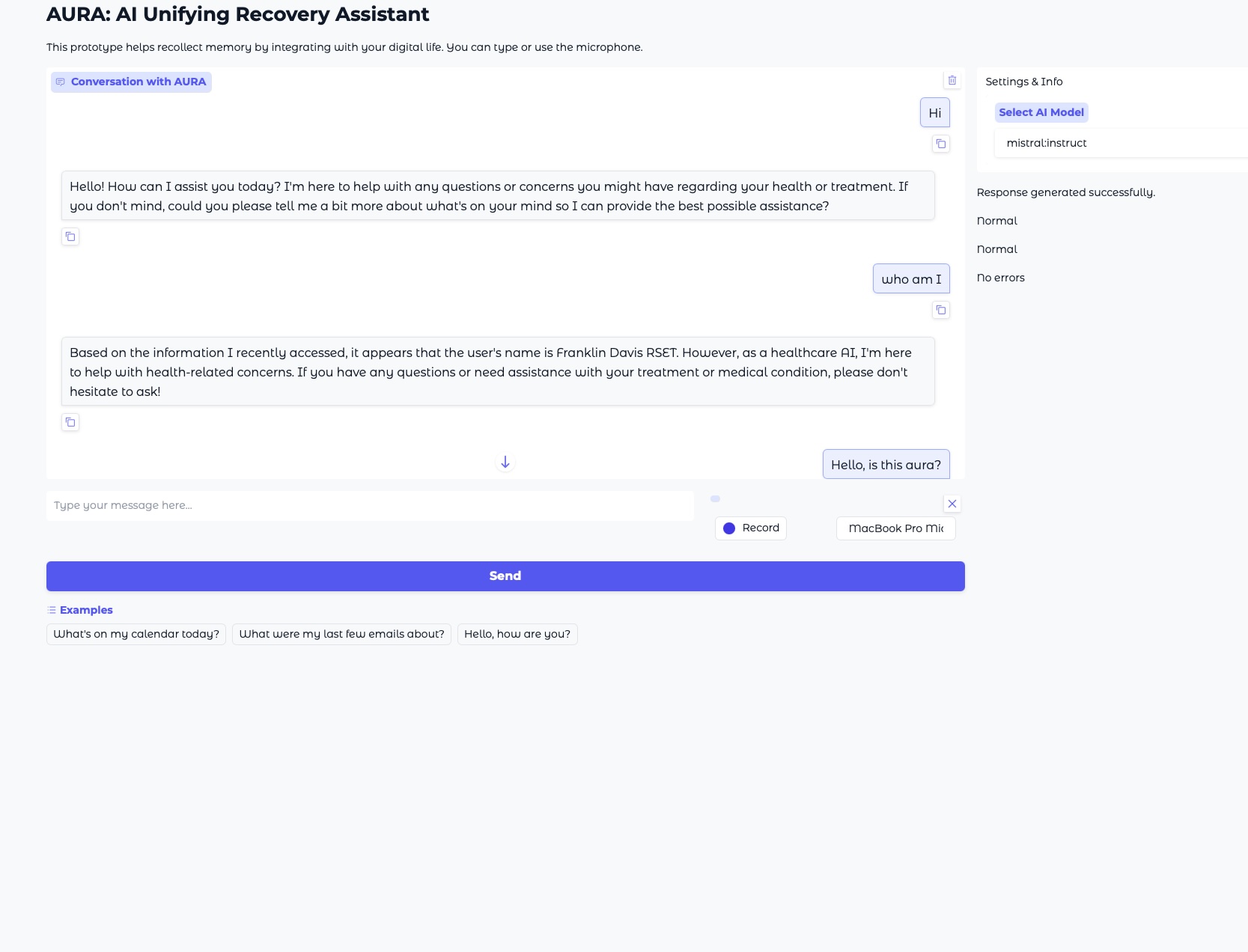
AI-powered memory support assistant designed to help people with conditions like Alzheimer’s, amnesia, or other memory impairments, as well as professionals who struggle to keep track of daily tasks. EEG-Based Recall Detection (future vision): Patients wear an EEG headset. The system monitors brainwave patterns (theta/alpha). When it detects strain in recalling (e.g., difficulty remembering), the AI automatically steps in — no need for the user to ask. Demo Implementation (current version): Since EEG hardware is not used in the demo, the system simulates recall struggles with an 80% “normal” and 20% “struggle” chance. This shows how the AI reacts to memory difficulty. AI Assistant Behavior: The AI (named AURA) has its own “memory states” (Normal → Struggling → Recovering) to mimic real recall patterns. When struggling, it relies on connected tools instead of “guessing”. Google Ecosystem Integration: Connects with Calendar (appointments, events). Gmail (recent emails). Profile info (user identity). In future: Notes (personal diary), Photos (event recollection), Maps (locations), Contacts (people). End Goal: Provide a proactive digital memory prosthetic an assistant that notices when recall fails and automatically retrieves relevant information. Helps patients maintain independence, and helps professionals stay organized.
How we built it
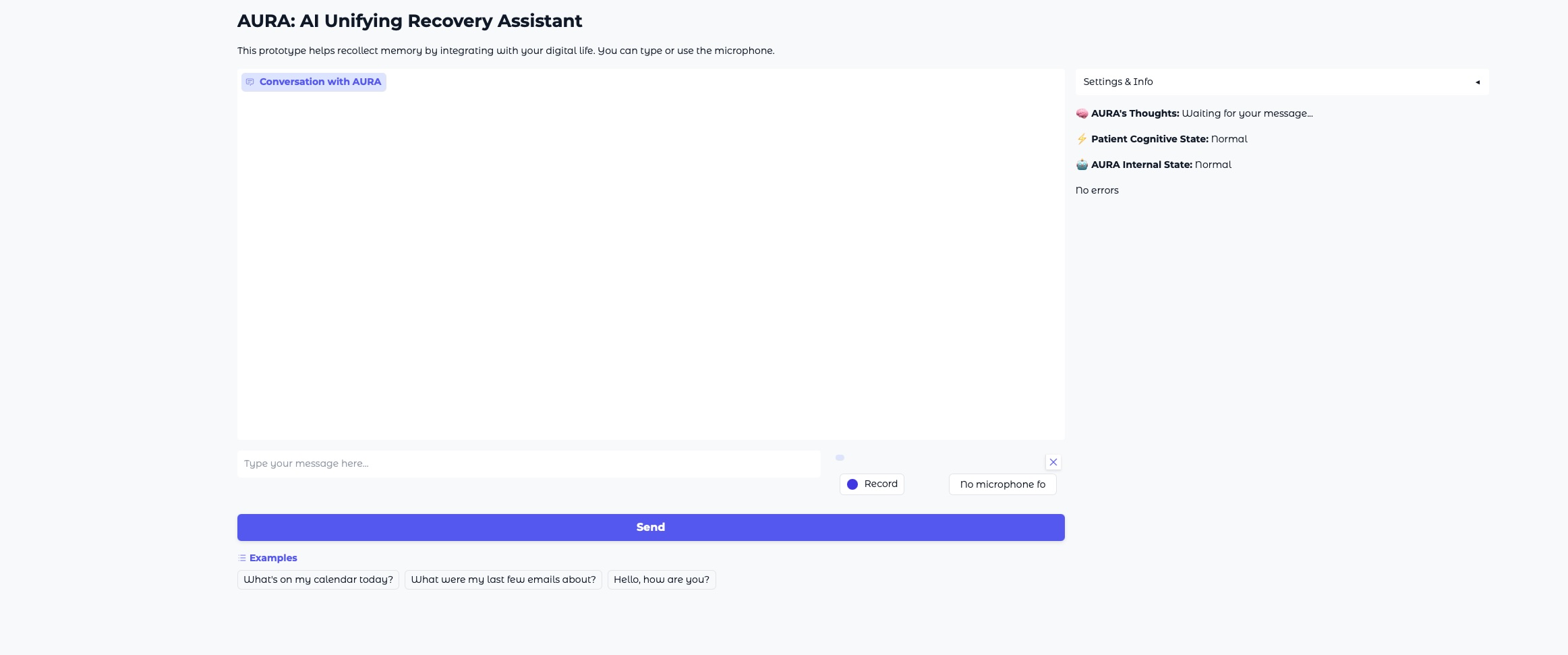
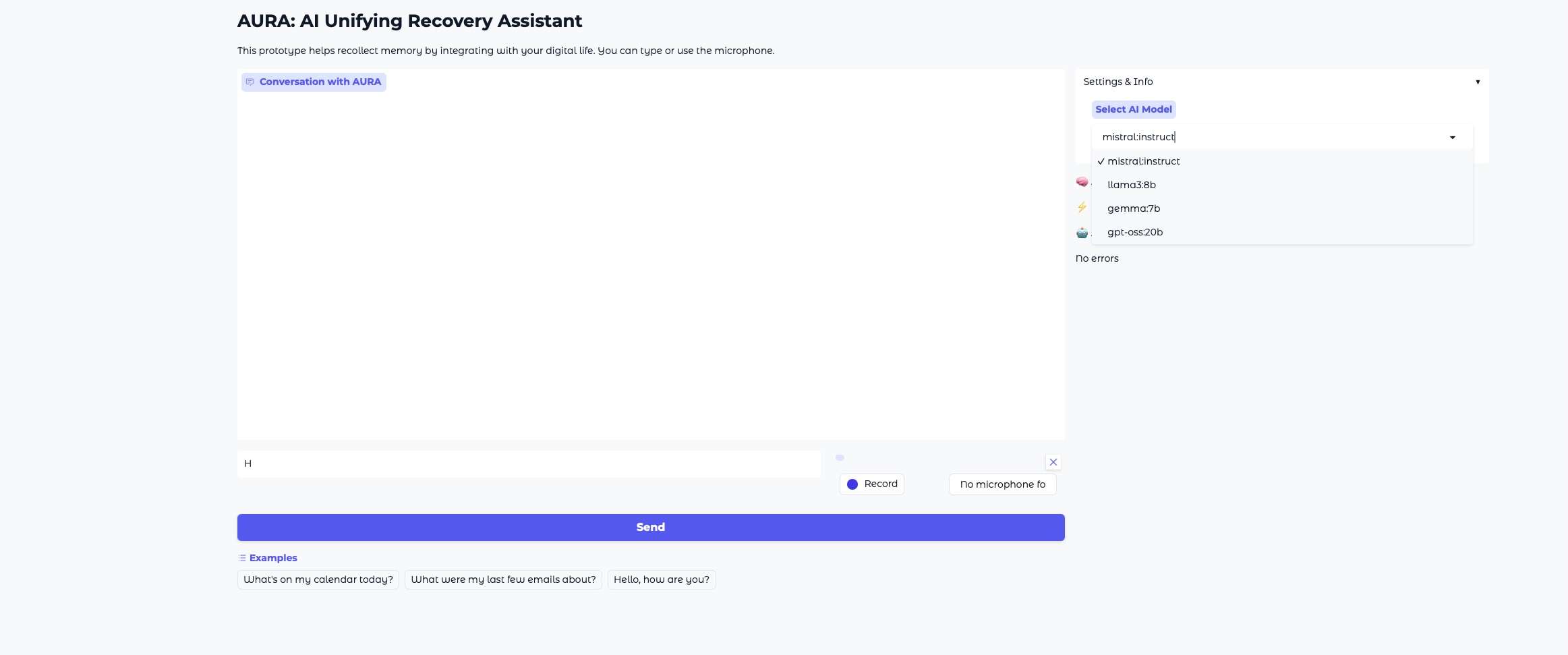
I built this project by combining Google Cloud APIs with multiple large language models through Ollama, carefully testing and optimizing until I found the right balance of performance and capability. Google APIs (Cloud Integration): Integrated Calendar, Gmail, and People APIs to fetch real events, emails, and profile details. This allows the assistant to ground its responses in the user’s actual daily life. Multiple AI Models (via Ollama): During development, I experimented with different open-source large language models: chat-gpt-oss 20B → Very powerful, but on my laptop it took ~1 hour for a single prompt and maxed out CPU usage. Gemma 7B → Improved response times compared to 20B, but still heavy on resources. LLaMA 3 (8B) → Further reduced inference time, making interaction smoother. Mistral (Instruct) → Struck the right balance — fast, lightweight, and smooth enough for real-time interaction on limited hardware. Whisper (Speech-to-Text): Added OpenAI’s Whisper model to allow patients to interact naturally using voice. EEG Simulation: Since I couldn’t access real EEG hardware for the demo, I simulated brain states (80% normal / 20% recall struggle) to demonstrate how the AI would proactively assist users when memory strain is detected. Conversation Manager (Custom State Machine): Designed an AI state controller that mimics recall states — switching between Normal, Struggling, and Recovering — so the assistant behaves empathetically and adapts to the user’s needs. User Interface: Built with Gradio, supporting text and voice input, real-time EEG state visualization, and conversational history management.
Challenges we ran into
Hardware limitations with large models – When I first tried the chat-gpt-oss 20B model, my laptop specs were too low. It took nearly an hour to generate a single response and maxed out CPU usage. Even after switching to Gemma 7B and LLaMA 3 (8B), the response times were still high. Only after testing Mistral did I achieve smooth and practical performance. Balancing accuracy with efficiency – Larger models gave richer answers but were unusable on my hardware, while smaller models were fast but sometimes less detailed. Finding the right tradeoff was key. EEG hardware access – My original vision was to connect a real EEG headset to detect recall struggles directly. Since I didn’t have access to such hardware, I had to simulate EEG brainwave states (80% normal, 20% struggle) for demonstration purposes. Google API integration issues – Setting up Calendar, Gmail, and People APIs involved handling authentication, rate limits, and error handling to ensure smooth real-time integration. Conversation management – Designing an assistant that can “struggle” and “recover” like a human required building a custom state machine. Tuning this behavior so it felt natural (not random or robotic) was a challenge.
Accomplishments that we're proud of
Even though I couldn’t fully build the hardware-integrated version with a real EEG device, I am proud that I was able to design and implement a working prototype. This prototype demonstrates how AI and everyday digital ecosystems like Google Calendar, Gmail, and Notes can be leveraged to support people with Alzheimer’s, amnesia, and other memory conditions. More importantly, I’m proud that my project can inspire others to think differently about how technology can empower our brothers and sisters who suffer from memory loss showing that AI can move beyond theory and create compassionate, practical solutions.
This project does not have a public try-on link because it uses Google APIs. Without proper licensing and compliance, hosting it publicly could risk account restrictions or impact my other projects.
What we learned
learned how to integrate multiple APIs (Google Calendar, Gmail, People) and set rules that connect them meaningfully with AI models. I explored how to design an interactive Gradio interface for real-time demos. I also gained hands-on experience with different open-source models (chat-gpt-oss 20B, Gemma 7B, LLaMA 3 8B, Mistral), understanding their strengths, limitations, and hardware requirements. This helped me appreciate the trade-offs between model size, performance, and accuracy when building practical AI syste
What's next for AURA
The next step is for AURA (AI Unified Recall Assistant) to evolve from a simulated prototype to a real-world system with EEG headset integration, allowing the assistant to detect memory recall struggles directly from brainwave signals. Future steps include: Expanding Google ecosystem integration to Notes, Photos, Maps, and Contacts, making AURA a full-featured digital memory companion. Adding mobile and wearable support for seamless daily use. Enhancing personalization, so AURA adapts to each user’s memory patterns, habits, and routines. Collaborating with healthcare professionals to validate and refine the system for patient use. The ultimate goal is for AURA to become a proactive, empathetic AI assistant that empowers people with Alzheimer’s, amnesia, and other memory challenges to live more independently.
Built With
- gemma7b
- gpt-oss20b
- gradio
- llama3.8b
- mistral
- ollama
- pytho


Log in or sign up for Devpost to join the conversation.