-
-
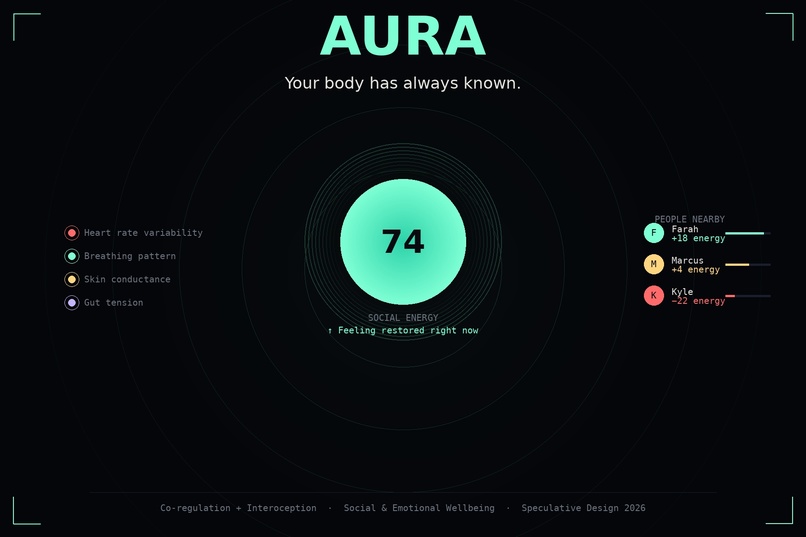
AURA
AURA — Making the Invisible Visible
What Inspired Us
The idea for AURA started with a feeling most people recognise but nobody can explain.
You leave a meeting, a party, or a conversation feeling completely hollow — but nothing bad happened. Nobody said anything wrong. You just feel empty and you don't know why.
We started asking: what if that feeling wasn't random? What if your body was generating real, measurable data about your social world — and you just never had access to it?
That question led us to an area of neuroscience that most people have never heard of: co-regulation.
Science has known for decades that humans unconsciously synchronise their physiological states with the people around them. Your heart rate, breathing rhythm, and cortisol levels shift in response to others — completely below conscious awareness. Combined with interoception — your body's internal signal system — this forms a rich social intelligence that most people spend their entire lives completely blind to.
We wanted to change that.
What We Built
AURA is a speculative wearable and mobile application that tracks your nervous system's hidden social signals and makes them visible — in real time and over time.
It works across three surfaces:
- A thin wrist wearable that continuously reads physiological signals
- A mobile app that visualises your social energy score and builds your tribe map over time
- A haptic language that communicates privately without requiring you to look at a screen
The core sensing model draws on five physiological channels:
Social : Delta HRV, Breath, Skin, Vocal, Gut
Where Social is your social energy score, computed as a weighted function of:
- Delta HRV — heart rate variability deviation from personal baseline
- Breath — breathing rate and depth
- Skin — skin conductance fluctuation
- Vocal — vocal microfeature tension index
- Gut — gut tension proxy via diaphragmatic movement
The app surfaces two types of insight:
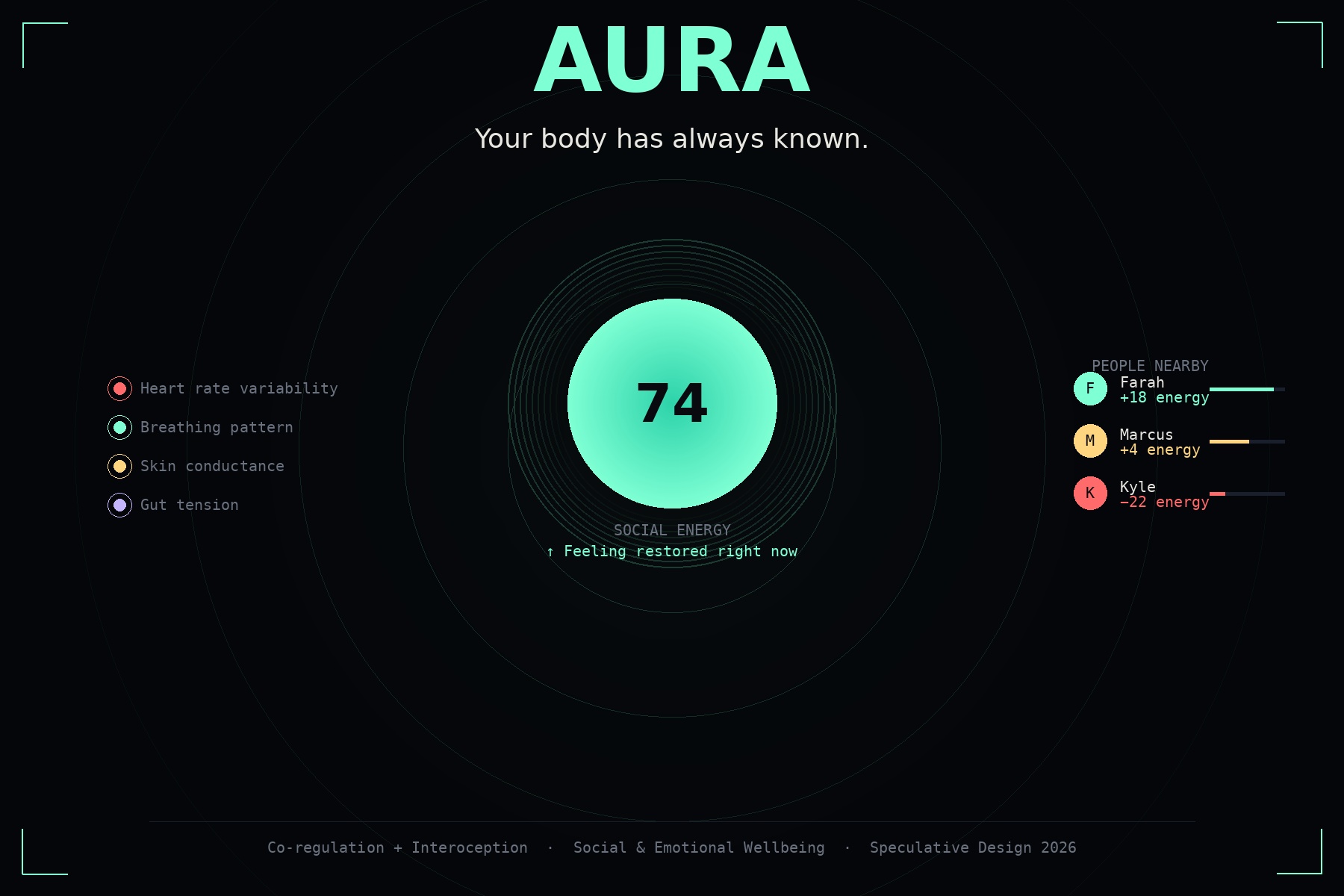
Right Now — a live social energy score shown as a glowing orb that shifts in real time as you move through environments and people.
Over Time — a growing tribe map that builds your social landscape from weeks of passive data, revealing which people genuinely restore you and which quietly drain you.
Who It Is For
AURA is designed for adults aged 22–40 — urban professionals, students, and caregivers living in high-stimulus social environments who experience chronic social exhaustion but lack the language or data to understand why.
It addresses two dimensions of wellness:
- Social wellbeing — understanding and consciously building relationships that restore rather than deplete
- Emotional wellbeing — developing a body-based emotional literacy that goes beyond self-reported mood tracking
How We Built It
We approached this as a full speculative design challenge — not just a visual exercise but a rigorous attempt to answer every hard question the concept raises.
The concept phase began with mapping all 33 identified human senses and identifying which were genuinely unmeasured and socially significant. Co-regulation and interoception emerged as the most compelling — invisible, universal, and deeply connected to a real wellness crisis.
The design phase involved building six mobile app screens covering the complete user journey:
- Onboarding — introducing the sense
- Home — the real-time energy orb
- Live Drop — the alert state
- Person Detail — individual energy signatures
- Tribe Map — the long-term social constellation
- Weekly Letter — the Sunday narrative summary
The presentation was built entirely in Figma Slides with an embedded interactive prototype, covering all six brief requirements: target audience, the new sense, the wellness goal, three use cases, the interface design, and safeguards.
What We Learned
Building AURA taught us that the most powerful design problems are the ones hiding in plain sight.
Social exhaustion is one of the defining experiences of modern life — and yet no tool exists to help people understand it at the physiological level. The gap between what our bodies know and what our minds can articulate is enormous.
We also learned that speculative design is most powerful when it is grounded in real science. The concept of co-regulation is not science fiction — it is established neuroscience. AURA's speculative leap is not the sensing itself, but making that sensing accessible, personal, and actionable.
Finally, we learned that extra perception requires extra responsibility. The most challenging part of designing AURA was not the interface — it was the ethics. Who gets to see this data? What happens when a score is low? How do you design a tool that empowers self-knowledge without enabling social judgment?
Every design decision in AURA — from the orb instead of a number, to the weekly letter instead of a dashboard, to the mutual consent Bluetooth model — was a direct answer to one of those questions.
Challenges We Faced
The consent problem was the hardest to solve. If AURA can tell you that someone drains your energy, what does that mean for that person? Our solution — measuring only your body's responses, never scanning others, and requiring mutual consent via Bluetooth pairing — took several iterations to get right.
Information overload was the second major challenge. Physiological data is continuous and complex. Showing users raw numbers would be overwhelming and meaningless. The orb, the haptic language, and the weekly letter were all designed to solve this — surfacing only what is actionable, only when it matters.
The cold start problem was also significant. AURA needs weeks of data to build a meaningful tribe map. Designing an experience that feels valuable from day one — before the patterns emerge — required careful thought about how to communicate potential without overpromising.
The Vision
$$ \text{Self-knowledge} = \frac{\text{Body data} \times \text{Time}} {\text{Conscious bias}} $$
Your body has been reading every room you've ever walked into. Every conversation. Every relationship. Every first impression.
AURA doesn't give you a new sense.
It gives you access to one you've always had.
Built With
- figma


Log in or sign up for Devpost to join the conversation.