Inspiration
Our inspiration came from a single, powerful quote from the T. Rowe Price challenge: "Give a man a fish, and you feed him for a day; teach a man to fish, and you feed him for a lifetime."
We were shocked by their data that only 36% of adults have basic financial literacy, with huge gaps across all genders. We realized the problem: traditional banking apps are just calculators. They show what you spent, but never why you spent it or how you can get better.
This led us to the Capital One Best Financial Hack challenge. Their mission to "improve financial literacy" was the perfect match. We decided to build a "bank of the future" that is also a teacher. Our inspiration was to use the Capital One Nessie API as the engine to power a solution for the T. Rowe Price educational mission.
What It Does
"Mind Over Money" is a smart, behavioral finance coach. It’s not another pie chart.
It connects to the Capital One Nessie API to pull your (mock) transaction history. Then, the "hack" begins: our backend analyzes this data to find your hidden behavioral biases the psychology behind your spending.
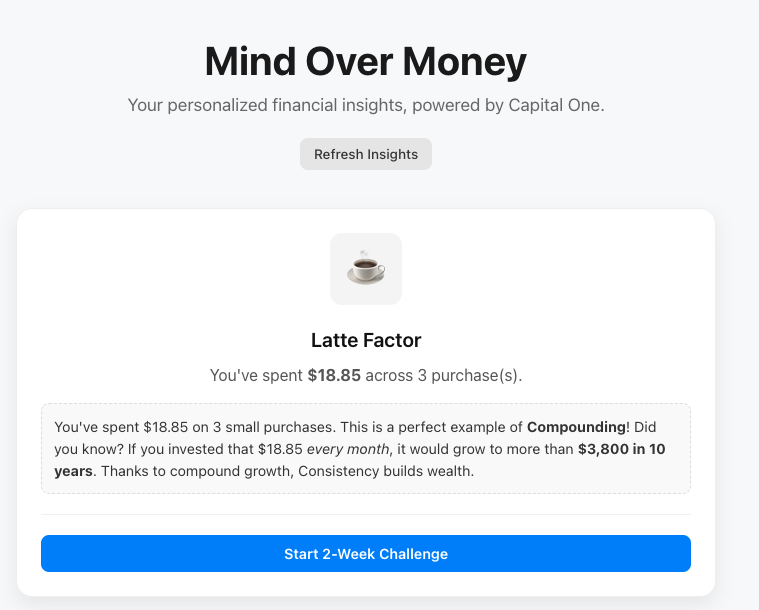
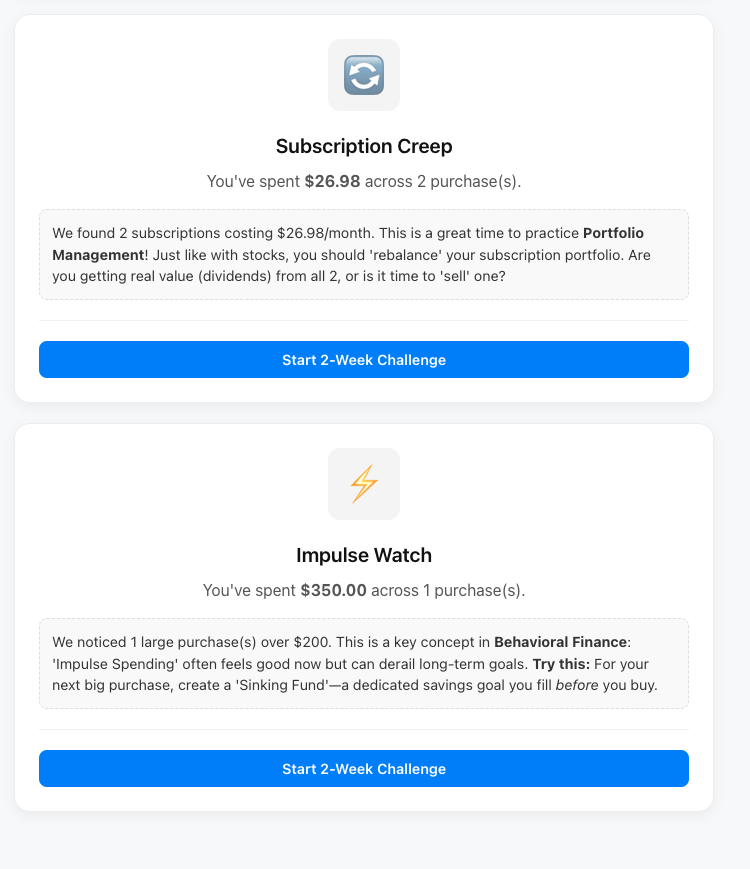
Instead of a spreadsheet, it shows you simple "Insight Cards" that use your own data to teach you core financial concepts.
- When it sees 3 small coffee purchases, it doesn't just show "$18.85 spent." It uses that data to teach Compounding (an Investing Fundamental), showing how that $18.85/month could become over $3,800 in 10 years.
- When it sees 2 streaming subscriptions, it teaches Portfolio Management, asking you to "rebalance" your subscriptions just like you would stocks.
- When it sees a large $350 impulse purchase, it teaches Behavioral Finance, explaining "Impulse Spending" and the "Sinking Fund" strategy.
This directly hits Capital One's goal of "helping consumers shop smarter" by truly improving financial literacy.
How We Built It
We built a complete, full-stack MERN inspired application (React, Node.js, Express) to meet the "complexity" and "completeness" criteria.
- Backend (The "Complexity"): A Node.js/Express server acts as the "brain." This is our "modern architecture" API. It securely calls the Capital One Nessie API to fetch data.
- The "Hack" (The "Creativity"): We wrote a custom 'Bias Finder' rules engine. This engine processes the raw JSON from Nessie, running our logic to find the patterns (Latte Factor, Subscription Creep, etc.). This is where the real value is created.
- Frontend (The "Completeness"): A React app (built with Vite) provides a clean, "accessible," and "engaging" UI. It fetches the analyzed insights from our backend, not just the raw data. We used React
useStateto make the "Start Challenge" buttons interactive, proving the app is a complete, dynamic loop, not just a static page.
Challenges We Ran Into
Our biggest challenge was the Capital One Nessie API. It was a fantastic, real-world API, but the complexity wasn't just in connecting to it.
The first challenge was data integration. The API gives you raw, real-world purchase data. We had to figure out how to build a system that could not just read this stream of JSON, but also make sense of how do you programmatically decide that "Starbucks" and "Morning Coffee" are the same "Latte Factor" bias?
The second, and bigger, challenge was creating the educational content. It's easy to make a pie chart. It's hard to look at "$18.85 on coffee" and figure out how to turn that into a powerful, accurate, and engaging lesson on Compounding. We spent a lot of time researching stock market returns just to make sure our "over $3,800" claim was realistic and trustworthy.
Bridging the gap from raw data to real, accessible education was the hardest and most rewarding part of this hack.
We also learned the hard way that the API required http (not https), and the endpoint we needed was /purchases, not /transactions. Taming this complex API was a huge accomplishment.
Accomplishments That We're Proud Of
We're incredibly proud of building a complete, full-stack application that is 100% functional. We didn't just build a mock-up, we built a working system that connects to a live, complex API, runs custom logic, and delivers real, educational value.
We're also proud that we took the time to fact-check our math. We verified that $18.85/month could become over $3,800 based on the S&P 500's historical 10% average return. For an education app, this accuracy is what builds trust.
What We Learned
We learned the massive difference between data and education.
- Data is: "You spent $18.85 on coffee."
- Education is: "We showed how that $18.85/month can become over $3,800 thanks to the magic of Compounding."
Technically, we mastered full-stack communication, from axios calls on the backend to managing useState on the frontend. But most importantly, we learned how to build an app that truly empowers users, fulfilling the "teach a man to fish" mission.
What's Next for Mind Over Money
This is just the start. The next step is to make the app "stickier" and more "complete" by:
- Building out the "Start Challenge" feature: Allowing the app to track your progress in real-time against your new goal.
- Adding more Biases: We want to add logic for "FOMO Spending" (Fear Of Missing Out) and other behavioral patterns.
- Real-World Integration: Integrate with Plaid to let users securely connect their real bank accounts.
Built With
- axios
- capital-one-nessie-api
- cors
- css
- express.js
- html
- javascript
- node.js


Log in or sign up for Devpost to join the conversation.