

Inspiration
Aura Manager began with a problem I experienced in my own creative work.
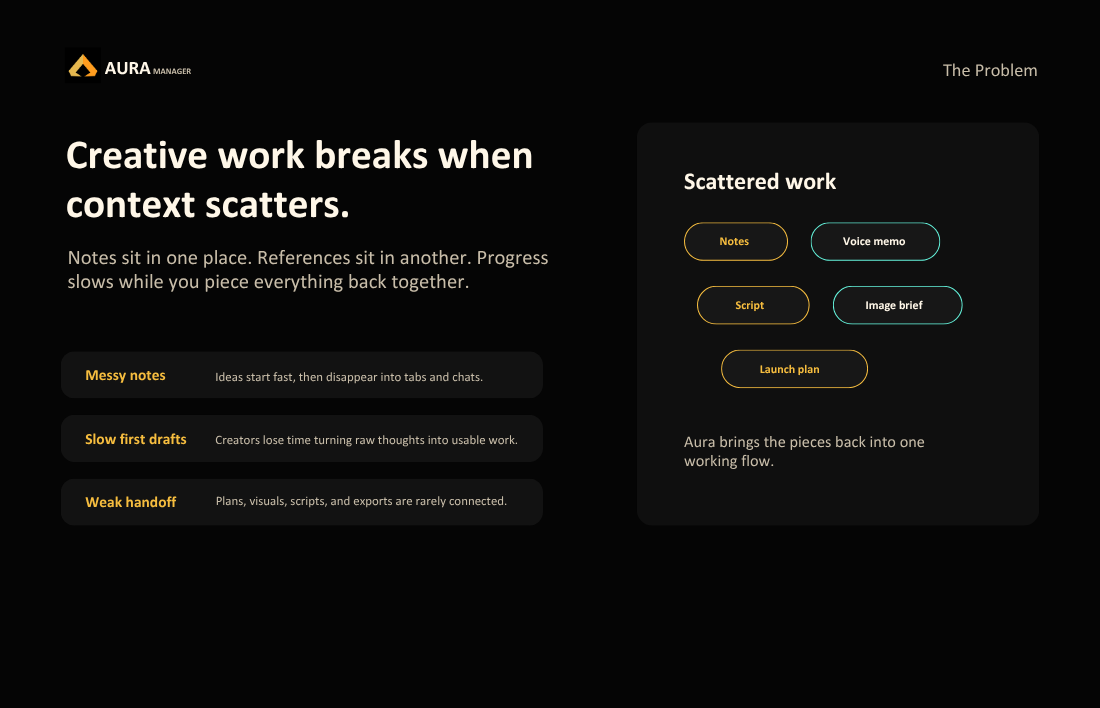
Ideas rarely started as polished documents. They began as voice recordings, unfinished notes, screenshots, references, or brief conversations. As projects evolved, those pieces became scattered across different apps, making it difficult to find context, revisit decisions, or continue where I had left off. Clients could also lose sight of the original vision as projects became more complex.
While existing AI tools were excellent at answering questions, they weren't designed to support an evolving creative project. Every conversation felt isolated, requiring me to repeat context, explain goals again, and rebuild momentum from scratch.
I wanted something different: a workspace that could understand what someone is trying to accomplish, remember meaningful context over time, and turn unfinished ideas into practical next steps.
That idea became Aura Manager.
What it does
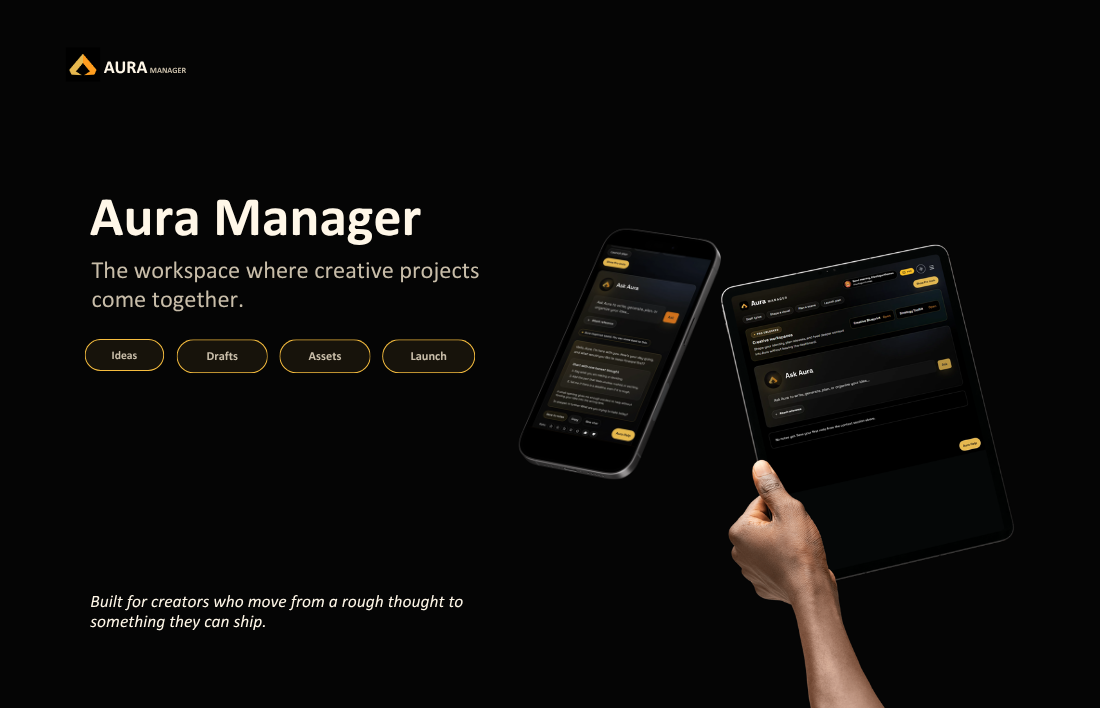
Aura Manager is a context-aware AI workspace that helps creators transform rough ideas into actionable projects.
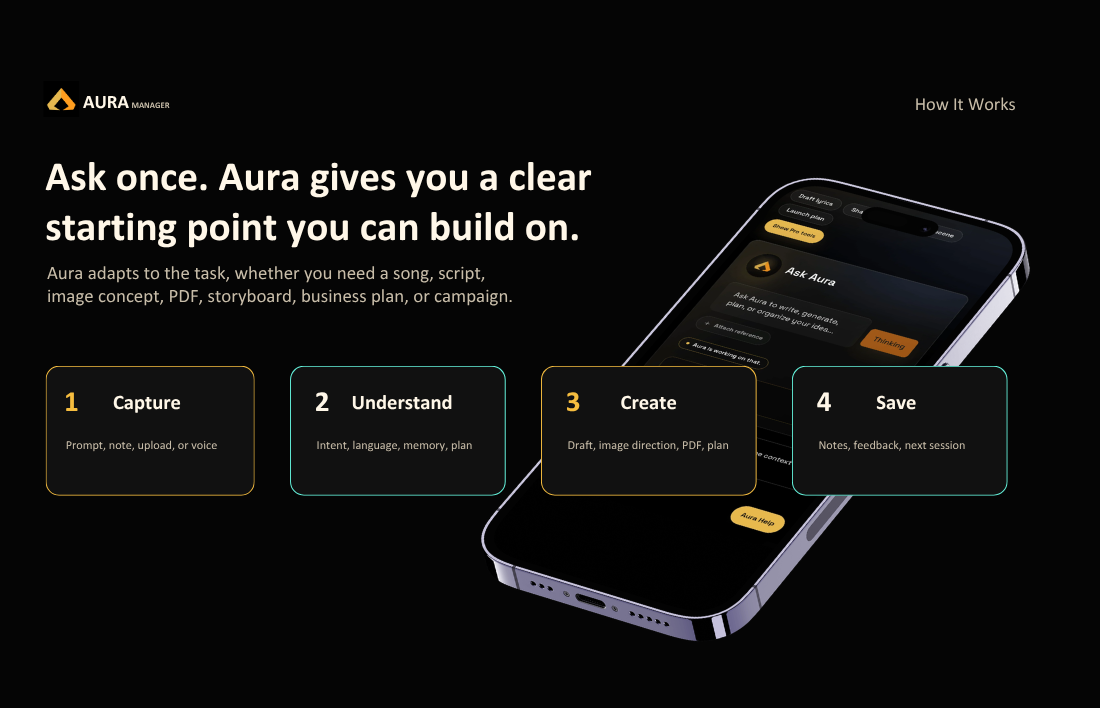
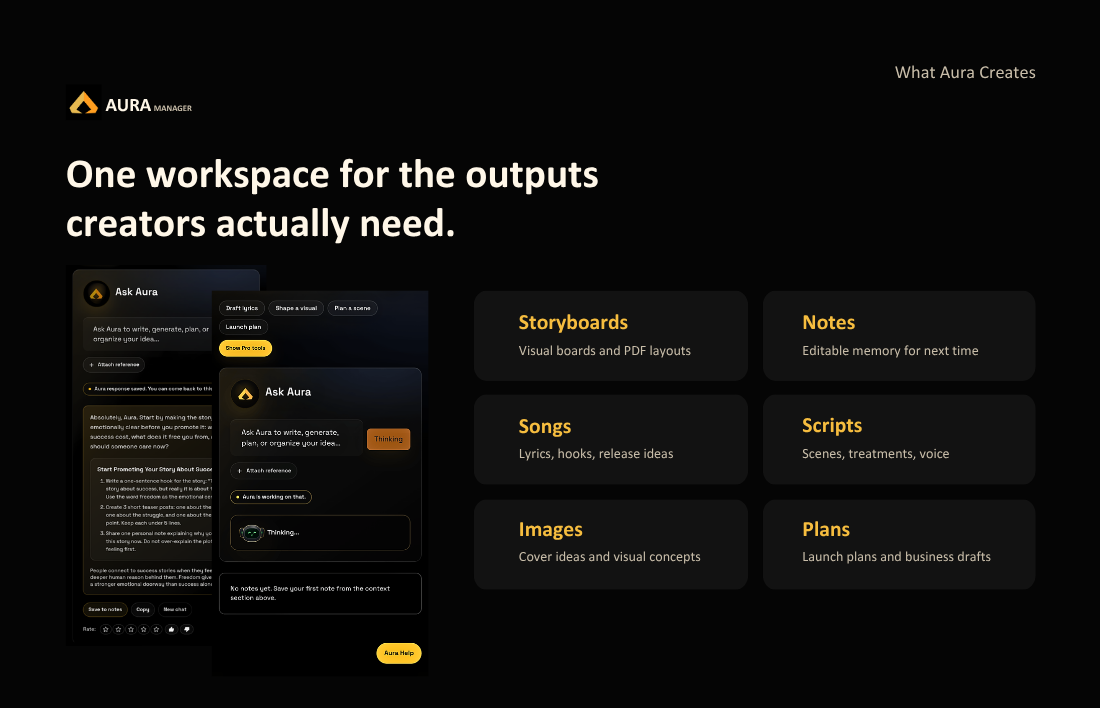
Users can type a request, record a voice note, upload references, or continue previous work without rebuilding context. Aura can generate business plans, scripts, songs, visual concepts, campaign strategies, storyboard treatments, PDFs, structured project plans, and creative guidance tailored to each user's goals.
Rather than assuming every user is a filmmaker, musician, writer, or founder, Aura first identifies the user's intent, available references, preferred language, saved project context, and desired outcome before generating responses.
Projects remain connected over time. Users can save notes, revise previous work, export supported files, and continue developing ideas exactly where they left off.
How I built it
Aura Manager was built using Next.js, React, TypeScript, and Tailwind CSS.
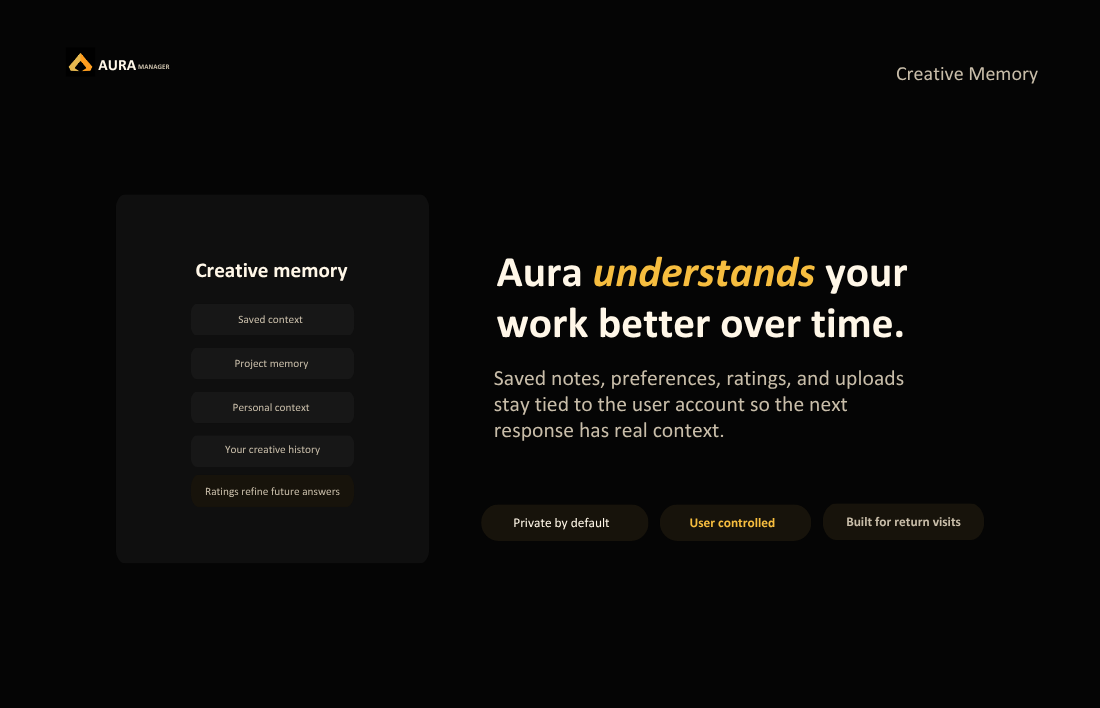
Supabase manages authentication, PostgreSQL storage, row-level security, and user-specific project data. Every user's notes, preferences, ratings, uploaded content, and creative memory remain securely isolated within their own workspace.
The OpenAI Responses API powers conversational reasoning, intent recognition, structured content generation, and context-aware assistance. OpenAI's image, audio, and document capabilities support additional creative workflows across the platform.
Stripe manages subscriptions and billing. Resend powers transactional emails. Slack handles customer support handoffs and feedback, while Vercel hosts and deploys the application.
Throughout development, I used OpenAI Codex as an engineering collaborator. It helped inspect the codebase, investigate bugs, implement features, review security concerns, write tests, and improve documentation. I remained responsible for the product direction, user experience, architecture, and final implementation.
Challenges I faced
One of the biggest challenges was preventing Aura from making assumptions about the user's work.
Early versions leaned heavily toward music workflows because the original concept focused primarily on artists. That quickly became limiting when users wanted help with startups, films, research, marketing campaigns, education, or business planning.
To solve this, I redesigned the intent recognition system so every request is evaluated independently while still benefiting from relevant project memory. Context should support the user, not force them into an outdated category.
Authentication across mobile browsers presented another challenge. Some browsers delayed or rejected secure session cookies, leaving users stuck between sign-in and onboarding. Solving this required improving callback handling, session recovery, loading states, and authentication feedback.
Balancing persistent memory with privacy was equally important. Aura needed enough context to remain helpful while ensuring that one user's information could never become accessible to another. Implementing row-level security, protected routes, authenticated data access, and secure handling of uploaded references became essential parts of the architecture.
Reliability mattered just as much as intelligence. Voice input, image generation, document exports, saved notes, ratings, and support workflows all needed to work consistently in real-world use, not just during demonstrations.
What I learned
Building Aura Manager taught me that a useful AI product requires far more than a capable language model.
A great response means very little if users cannot easily sign in, save their work, return later, or continue developing a project over time. Reliability, continuity, and thoughtful user experience are fundamental parts of building trustworthy AI products.
I also learned that creative users do not want to think about prompts, models, databases, or technical workflows. They simply want to bring an unfinished idea and receive something they can understand, improve, and build upon.
Perhaps the most important lesson was that the best AI response is not necessarily the longest one. It is the response that understands the user's intent, preserves context, and helps them make meaningful progress.
Accomplishments I'm proud of
Aura Manager has grown from a personal idea into a fully functioning AI workspace.
Today it supports conversational guidance, voice input, uploaded references, private project memory, multilingual preferences, image generation, audio workflows, PDFs, storyboard creation, subscriptions, user feedback, and integrated customer support.
What I'm most proud of is that users do not need a fully formed idea to begin. A single sentence, voice recording, screenshot, or reference can become the foundation of an organized project that continues to evolve over time.
What's next
The next phase focuses on learning from real users and making Aura Manager an even more capable project workspace.
Planned improvements include stronger long-term project memory, improved storyboard consistency, richer document exports, expanded audio workflows, better organization across multiple projects, and more intelligent context-aware assistance.
I also plan to introduce collaboration features for small creative teams while maintaining strong privacy, ownership, and account separation.
The long-term vision is simple.
Build an AI workspace that remembers your projects, understands your goals, and helps turn scattered ideas into finished work.
Built With
- next.js
- openai-api
- postgresql
- react
- resend
- rive
- stripe
- supabase
- tailwind-css
- typescript
- vercel


Log in or sign up for Devpost to join the conversation.