Inspiration
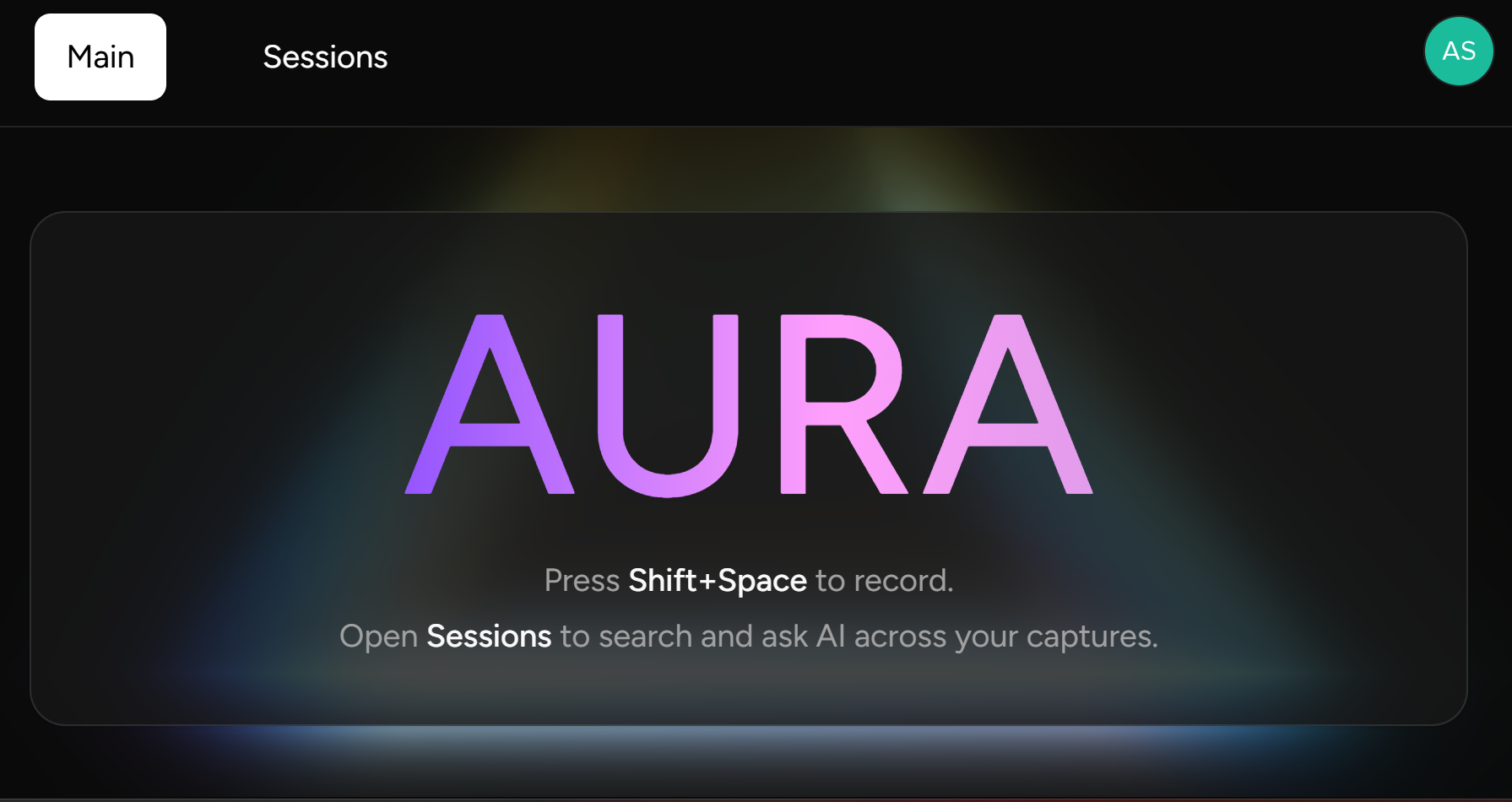
AURA was inspired by the gap between thought and action during focused work. We wanted an always-available assistant that can capture your voice, understand your context (clipboard + screenshot), and immediately execute the right tool flow without forcing you to switch apps or break concentration. What it does AURA is an overlay-based AI copilot that listens to voice or text commands, plans a tool graph, and executes it in real time. It can transcribe speech, read clipboard text/images, optionally capture screenshots, route requests through backend tools, stream results live, and return a final actionable output.
How we built it
We built AURA with an Electron + React + Vite frontend overlay and a FastAPI backend.
- Frontend handles the floating UI, audio recording, and local integrations (clipboard/screenshot).
- Backend handles ASR, planning (/router/plan), and graph execution (/execute/graph) with streamed events.
- Data/context layers use MongoDB for operational state and ChromaDB for retrieval/memory use cases.
- We connected everything through typed payloads and event-stream parsing to keep responses fast and interactive. ## Challenges we ran into
- Synchronizing multiple real-time flows (recording, upload, planning, execution, streaming) without race conditions.
- Handling unreliable edge cases gracefully (failed screenshot upload, partial stream chunks, empty audio).
- Designing a compact overlay UX that still surfaces rich execution detail (intent, tools, stream, final output).
- Keeping Electron boundaries secure while still exposing useful desktop capabilities. ## Accomplishments that we're proud of
- End-to-end voice-to-execution workflow working inside a lightweight overlay.
- Context-aware planning that combines voice, clipboard, and screen signals.
- Live streamed execution feedback with clear final outputs.
- Improved plan transparency by showing multiple planned tools as a readable list in the UI.
What we learned
- Users trust AI systems more when execution plans are visible before/during action.
- Multimodal context dramatically improves intent understanding, but demands strict payload and error discipline.
- Small UX details (panel states, keyboard shortcuts, status indicators) have outsized impact on perceived speed and quality.
- Building reliable AI products is as much about orchestration and resilience as model quality. What's next for AURA
- Add richer tool-step visualization (status, duration, success/failure per node).
- Introduce editable/confirmable plans before execution for high-impact actions.
- Improve memory and personalization so AURA adapts to user workflows over time.
- Expand integrations (calendar, docs, messaging, dev tools) and add stronger test coverage for streaming + ASR paths.

Log in or sign up for Devpost to join the conversation.