-
-
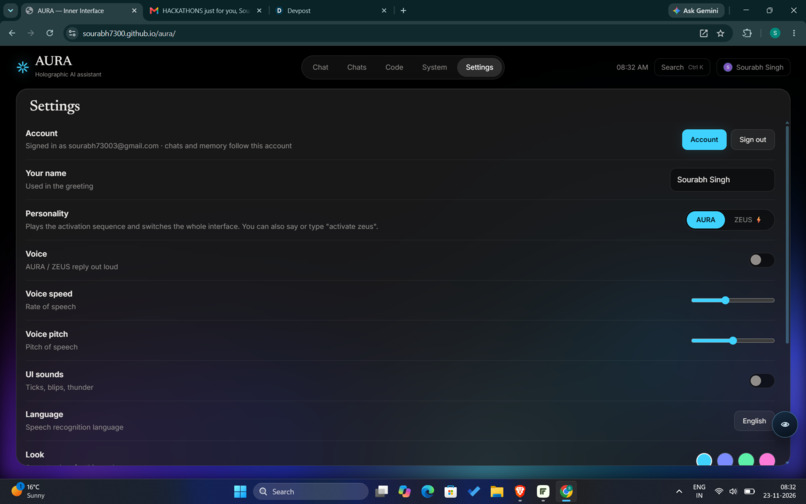
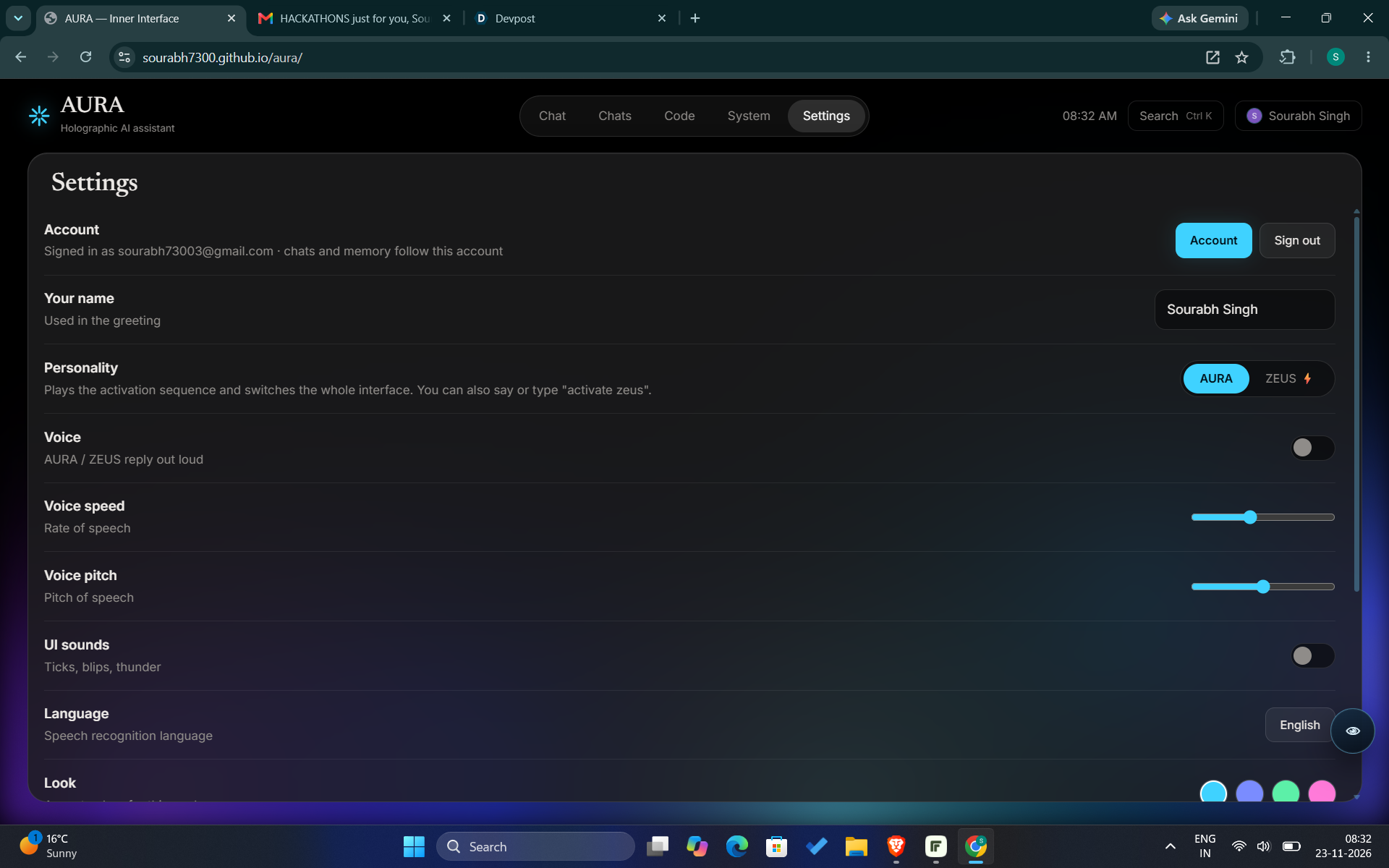
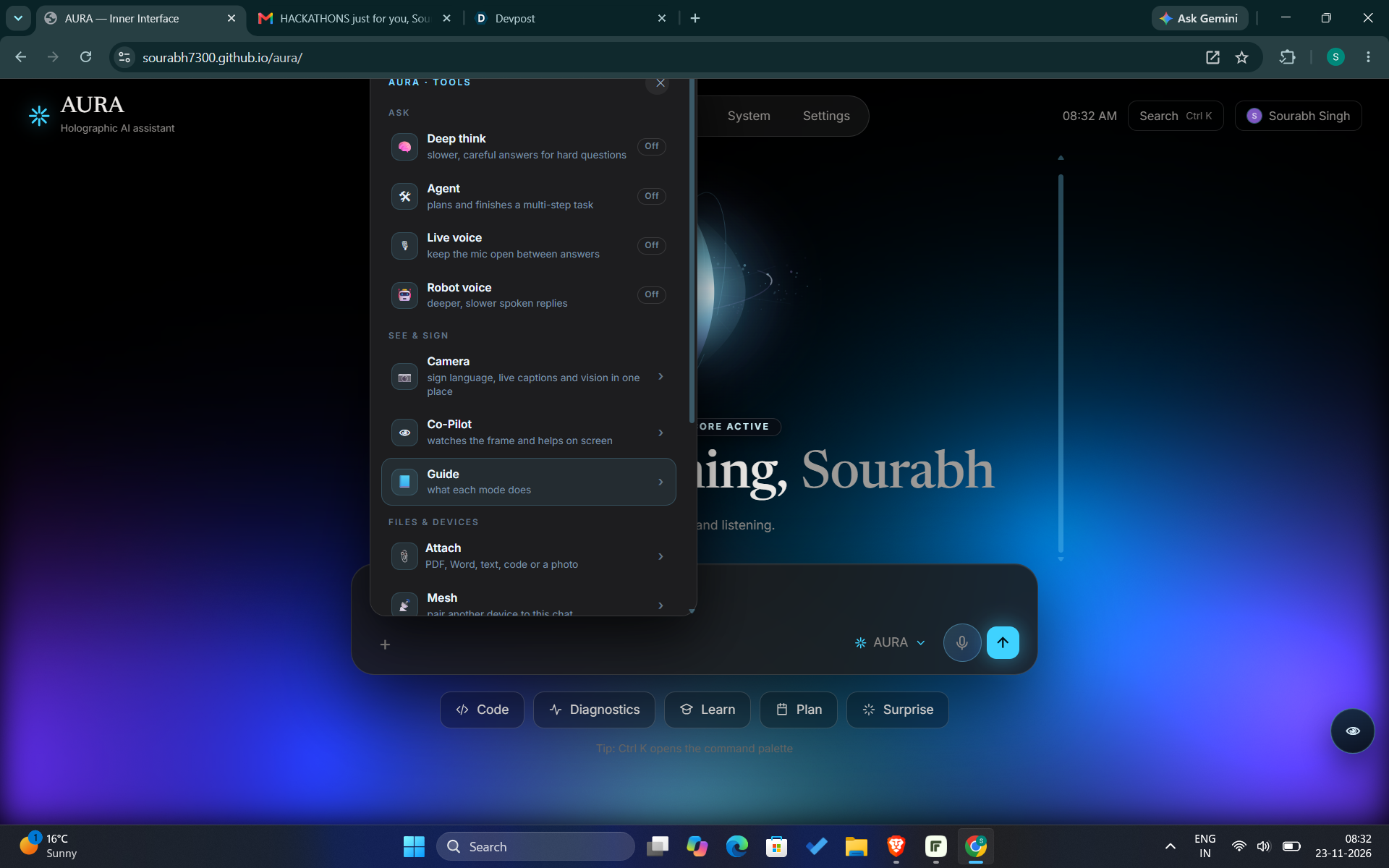
Full AURA workspace showing hybrid inference controls, system status panels, and multimodal command modules
-
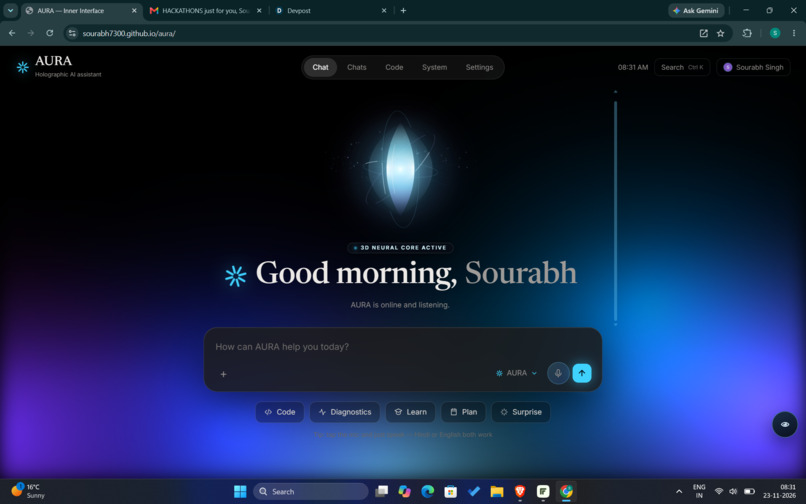
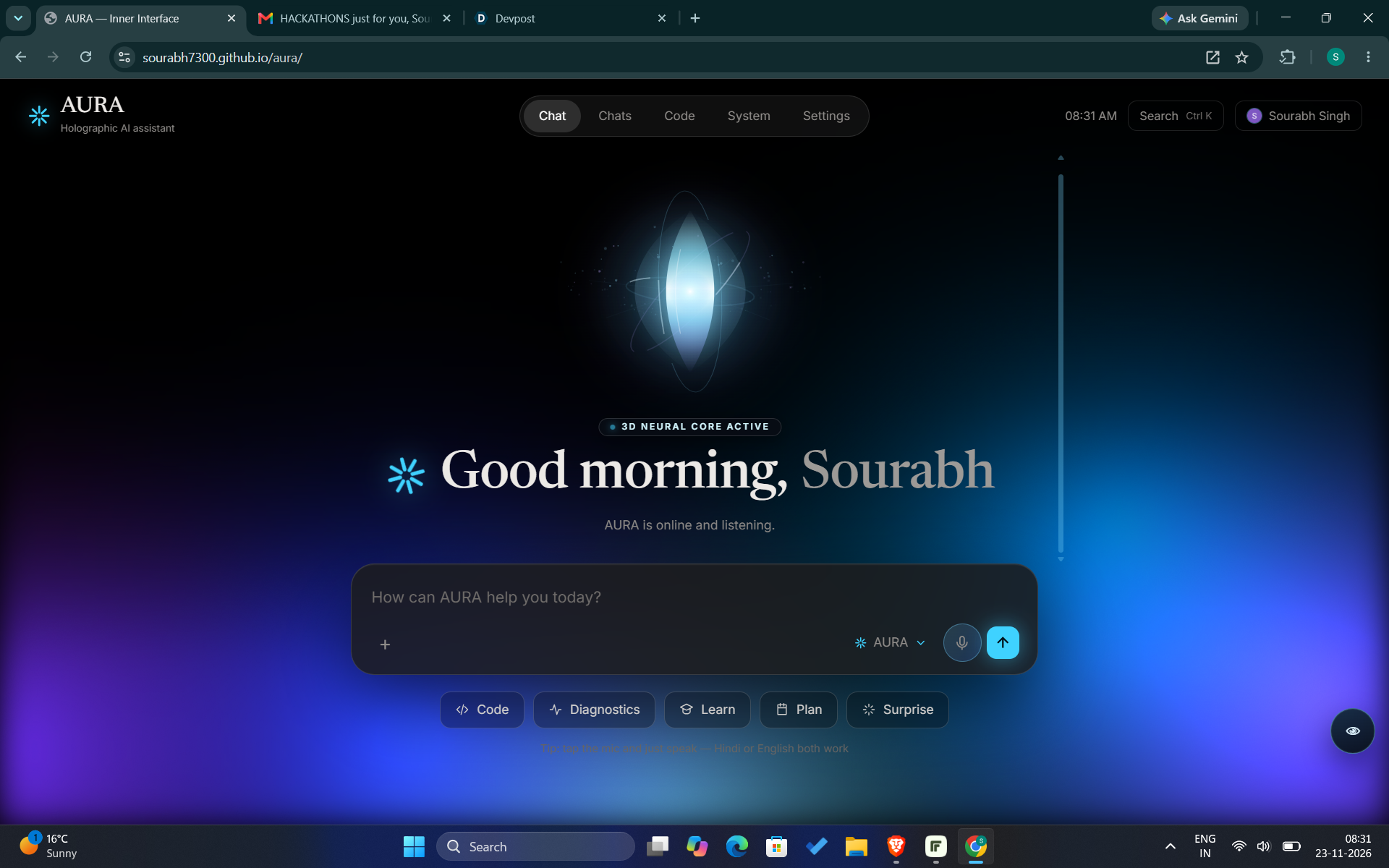
AURA 3D particle HUD home interface with personalized voice greeting and real-time audio-reactive core.
-
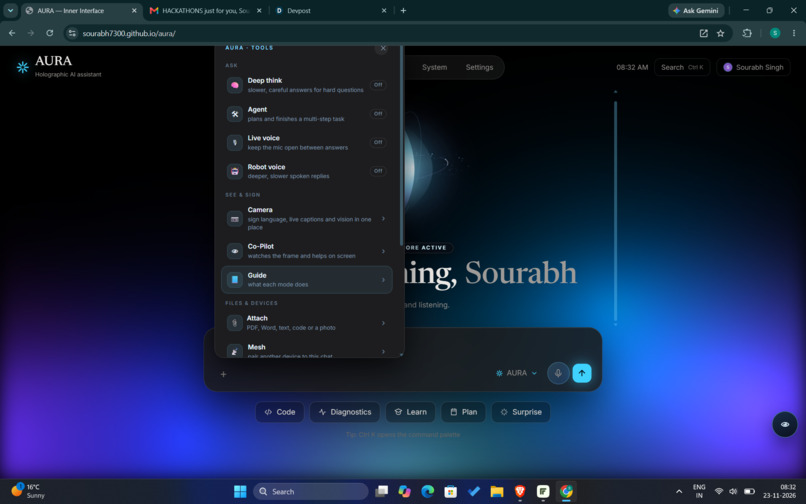
AURA settings overlay for configuring Firebase AI Logic hybrid routing, voice persona (Zeus), and local-to-cloud fallback.
Inspiration
While building my own voice and vision assistant AURA, I noticed a big problem with regular web-based AI bots: everything goes straight to the cloud. Even for a simple command like checking the time or switching a mode, waiting 2-3 seconds for a cloud round-trip kills the sci-fi feel—and if the internet drops, the assistant completely freezes. I wanted AURA to feel genuinely responsive and resilient, so I decided to split its brain between my local device and the cloud using Firebase AI Logic.
What it does
AURA (Artificial Universal Resilient Agent) is a web-based multimodal assistant featuring a reactive 3D particle HUD and a custom Zeus persona.
- Hybrid Brain (On-Device + Cloud): Basic voice commands, quick intent checks, and offline fallbacks run locally on-device with almost zero lag. When I ask Zeus to analyze what my webcam sees or solve a complex multi-step prompt, it automatically switches to cloud inference.
- Live 3D Particle Core: The HUD isn't just a static background—the particles react in real time when I speak, when AURA is thinking locally vs. hitting the cloud, and when Zeus responds.
- Hands-Free Voice & Vision: Uses the browser's Web Speech API for continuous voice interaction and captures live webcam frames whenever visual context is needed.
How we built it
- Hybrid AI Routing (Firebase AI Logic): I wired up Firebase AI Logic in the frontend to handle on-device inference (via Gemini Nano / Chrome's built-in AI) for fast local tasks, with a clean fallback pipeline to cloud Gemini models for heavy reasoning and multimodal vision.
- Frontend & 3D HUD: Built from scratch using HTML5, CSS3, and vanilla JavaScript so I could have full control over the 3D particle animations and audio-reactive states without heavy UI bloat.
- Backend: A lightweight Python FastAPI server deployed on Render handles API orchestration, session context, and cloud endpoints.
Challenges we ran into
- Smooth Local-to-Cloud Handoff: The trickiest part was deciding the exact threshold for when to stay on-device versus when to escalate to the cloud—without making the user wait twice if local inference couldn't handle a prompt.
- Browser Hardware Differences: Not every browser or laptop has local model weights ready immediately, so building a reliable fallback check that doesn't crash the HUD took quite a bit of testing.
- 60 FPS HUD + Multimodal I/O: Running speech recognition, webcam capture, and 3D particle rendering simultaneously in one tab required careful optimization to avoid frame drops.
Accomplishments that we're proud of
- Building a working hybrid AI loop where simple commands execute locally with near-zero latency while heavy multimodal vision queries seamlessly hand off to the cloud.
- Creating a responsive 3D particle HUD and custom Zeus voice persona that runs smoothly right inside the browser.
What I learned
- Splitting inference between on-device and cloud makes a massive difference in how "alive" an AI assistant feels—cutting out network latency for everyday commands changes the whole UX.
- Designing graceful fallbacks is just as important as the AI model itself when shipping hybrid web apps.
What's next for AURA - Hybrid Multimodal AI Assistant
- Adding deeper on-device tool calling so Zeus can control browser tabs and local workspace workflows completely offline.
- Syncing long-term user preferences securely across devices using Firebase.
