Inspiration
Household technology is powerful, but people should not need to remember device names, app menus, or complicated automation rules to use it. We were inspired by the idea of a household assistant that understands the intent behind a request and coordinates multiple actions in a way that feels natural, transparent, and trustworthy.
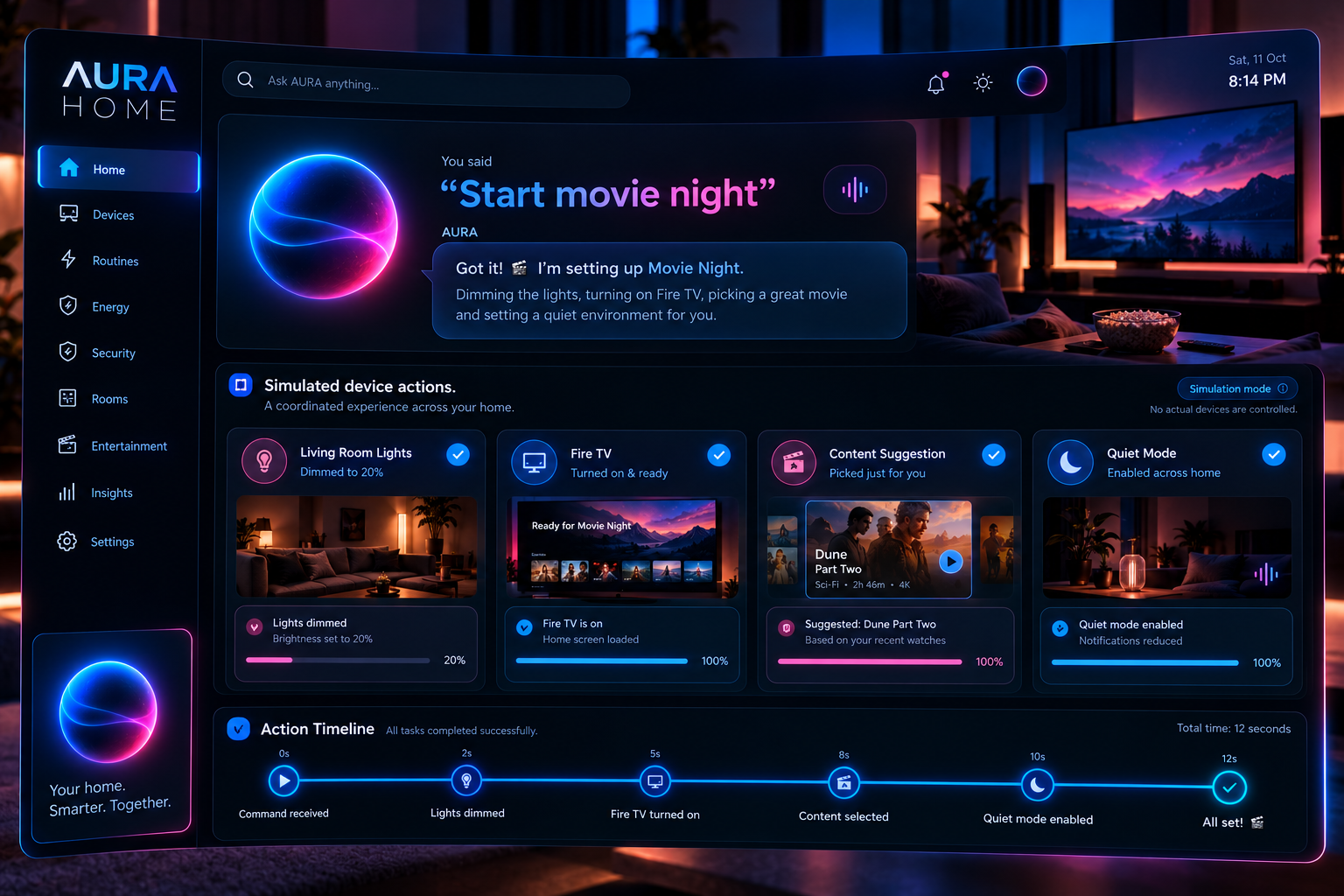
For example, “Start movie night” should not feel like four separate commands. It should become one understandable household moment: prepare the room, suggest something to watch, enable quiet mode, and show the user exactly what happened.
AURA HOME explores this idea through an Alexa+ simulated experience focused on everyday household coordination.
What it does
AURA HOME lets users interact with a household assistant using natural-language-style requests.
The prototype supports:
- Starting a simulated movie-night routine
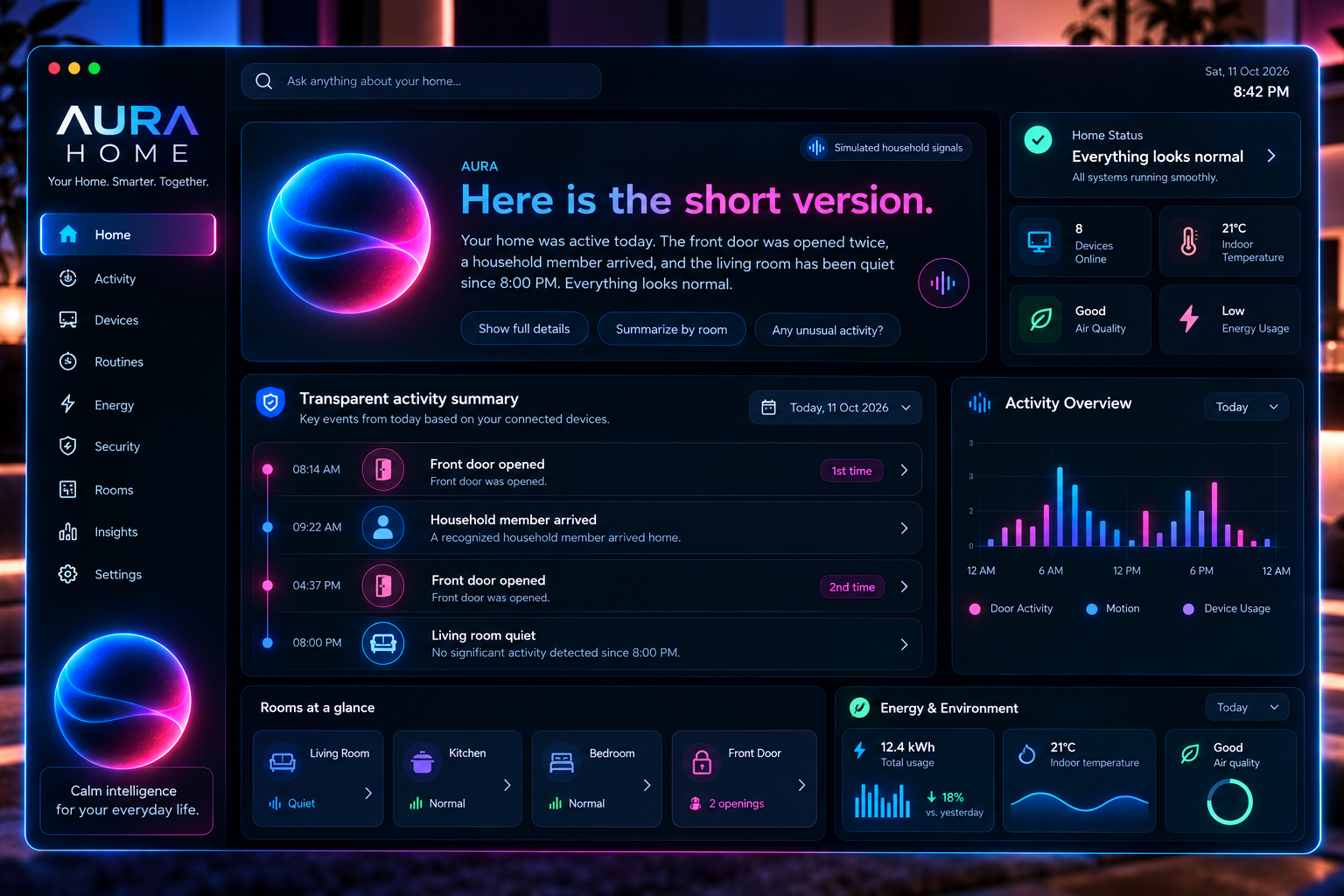
- Summarizing simulated home activity
- Creating a simulated quiet-time routine
- Announcing that dinner is ready
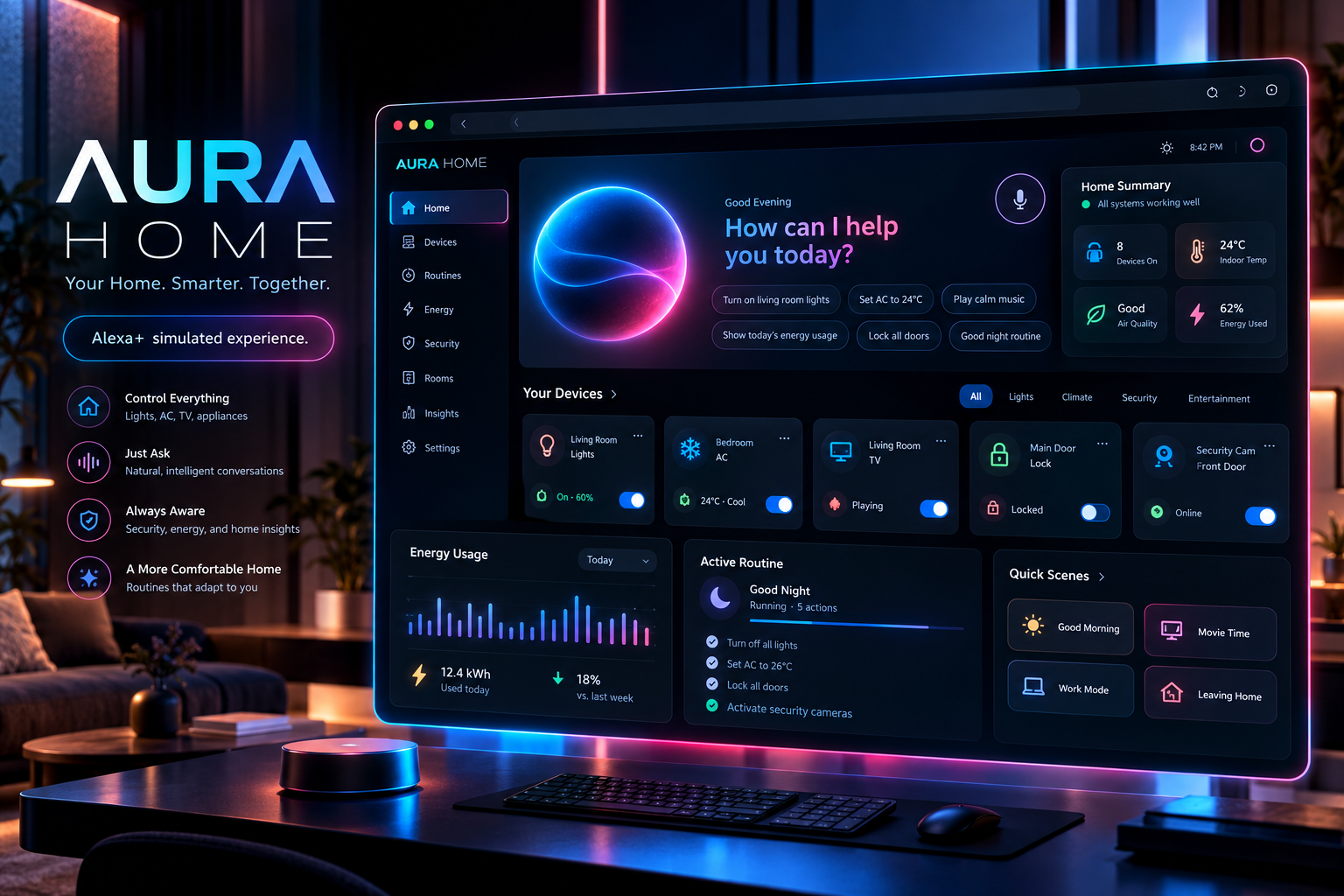
- Viewing connected spaces and device states
- Reviewing a transparent activity timeline
- Running and managing household routines
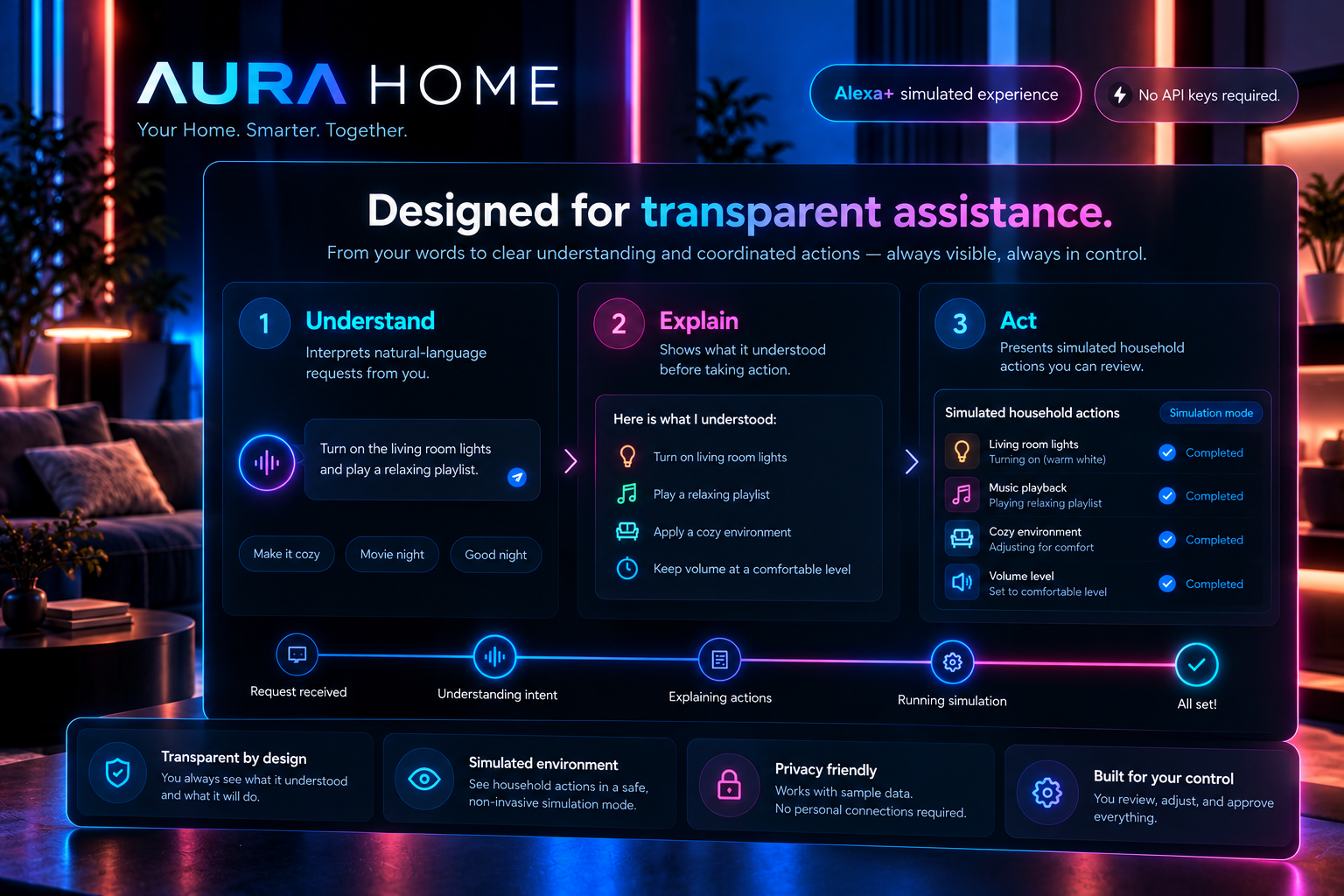
- Showing what the assistant understood before presenting the resulting actions
The experience is designed around three principles: understand, explain, and act. Every request produces a clear interpretation, visible action cards, and a completion state.
AURA HOME uses local deterministic mock data so the demo is reliable and can run without API keys, authentication, a database, or external device access.
How we built it
We built AURA HOME as a responsive React and TypeScript web application with a polished dashboard interface.
The application includes:
- A local command router for interpreting common household requests
- Structured mock responses for each supported intent
- Reusable assistant, device, routine, timeline, and status components
- Local simulated household state
- Responsive layouts for desktop, tablet, and mobile
- Accessible controls with keyboard-friendly interaction
- A focused visual system using Poppins, jet black, cerulean blue, and neon rose
The project follows the Alexa+ simulated-experience path. It does not claim to send commands to real Alexa+, Ring, Bee, or Fire TV devices. Instead, it demonstrates the interaction model and transparency that a production household assistant could provide.
Challenges we ran into
The main challenge was creating an experience that felt intelligent without depending on unreliable external services or API credentials. With limited time, we chose a deterministic local command engine so every important demo flow would work consistently.
Another challenge was making the interface feel conversational while still showing enough detail about the underlying actions. We wanted the assistant to feel simple for the user but not like a black box. We addressed this with interpretation labels, action cards, device statuses, and a chronological activity timeline.
We also had to balance a futuristic visual style with accessibility and readability. The neon rose and cerulean blue accents were used carefully against the jet-black interface so they communicate attention and system state without overwhelming the content.
Accomplishments that we're proud of
We are proud that AURA HOME turns multiple household actions into a simple conversational interaction while still showing the user what the system understood and what it simulated.
We are especially proud of:
- A reliable offline demo with no required API keys
- A polished and responsive dashboard
- Clear separation between user intent, interpretation, and simulated action
- Multiple connected-space views in one experience
- A reusable local command-routing architecture
- A complete demo flow that can be understood within a few seconds
- A design system that gives the prototype a distinct identity
The strongest moment in the experience is the movie-night flow, where one request produces a coordinated set of visible household actions.
What we learned
We learned that a convincing agent experience is not only about generating a response. It also needs to communicate intent, action, state, and limitations clearly.
We learned that deterministic mock data can be valuable during early product development because it allows the team to focus on interaction quality and user understanding before adding authentication, live events, device permissions, or production integrations.
We also learned that designing for trust requires showing the user what happened instead of hiding every operation behind a single assistant message. A useful assistant should be capable, but it should also be inspectable and predictable.
What's next for AURA HOME
The next step would be to connect the experience to a real Alexa+ Agent Skill or MCP server using the required Streamable HTTP transport.
Future versions could include:
- Real Alexa+ integration
- Voice input and spoken responses
- Device authorization and household permissions
- Live event streaming
- Real Ring, Fire TV, and smart-home integrations
- Personalized household profiles
- Privacy controls and data retention settings
- Confirmation flows for sensitive actions
- More advanced routines and event triggers
- A local testing environment for agent actions and device capabilities
The current prototype intentionally keeps all actions simulated so judges can run it immediately and understand the experience without credentials or physical hardware.
Built With
- accessibility
- ai-assisted
- antigravity
- css
- data
- design
- html
- javascript
- local
- mock
- react
- responsive
- tailwind
- typescript
- vite


Log in or sign up for Devpost to join the conversation.