-
-
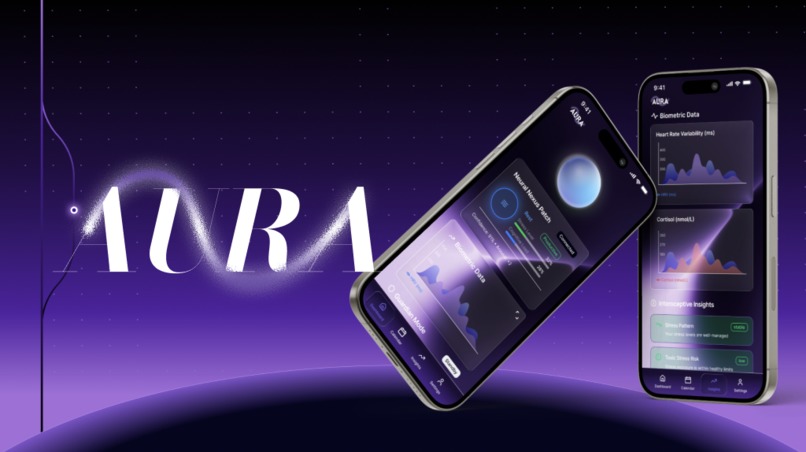
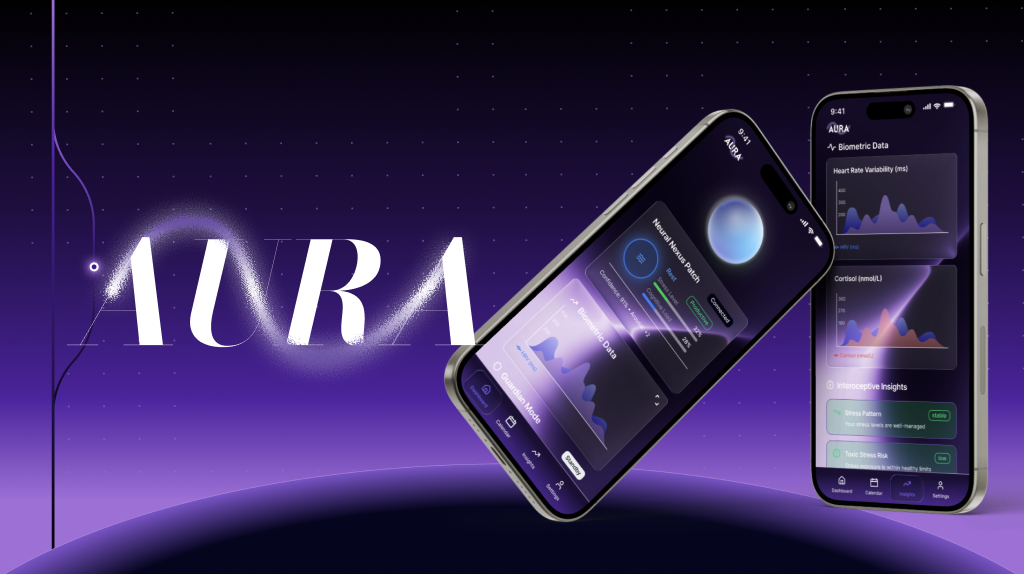
Mockup
Inspiration
Many students struggle with stress and social anxiety, especially during high-stakes moments like presentations, interviews, or exams. While tools like mindfulness apps exist, most only help after stress has already escalated.
Research shows that humans often have poor interoceptive awareness—the ability to sense internal bodily signals like rising heart rate, muscle tension, or cortisol levels. This means people don’t recognize their stress response until they are already overwhelmed.
We wanted to design a system that helps users detect and regulate stress in real time, before panic takes over.
That idea became Aura.
Aura bridges the gap between physiological stress and conscious awareness, helping people regain control over their emotional and cognitive performance.
What it does
Aura is a biometric-assisted wellness system designed to help users regulate stress before it escalates.
The system combines:
A wearable neck patch that monitors signals such as heart rate and heart rate variability (HRV)
A mobile app that visualizes the user’s internal state through an intuitive animated “Aura”
When stress levels rise, Aura activates subtle interventions to help regulate the nervous system, including:
Vagal pacing haptic feedback to slow heart rate
Cooling stimulation to interrupt stress loops
Grounding interactions through synchronized touch between the phone and wearable
Instead of showing overwhelming raw data, Aura translates complex biometrics into a simple visual state, helping users instantly understand how their body is responding.
The goal is to move users from reactive panic to proactive self-regulation.
How we built it
The project was designed through a combination of UX design, wellness research, and speculative hardware interaction design.
Our process included:
- Research
- Investigated interoception, vagus nerve stimulation, HRV, and stress physiology
- Studied youth mental health data and the rising prevalence of anxiety
- Concept Design
- Developed the concept of the Neural Nexus wearable patch
- Designed intervention systems such as Guardian Mode, which activates during high-stress situations
- UX and Interaction Design
- Created flows in FigJam and Figma
- Designed key user experiences including:
- Onboarding and biometric calibration
- The animated Aura visualization
- High-stress intervention screens
- Recovery reports after stressful events
- System Logic
- Defined how the wearable would detect stress spikes through biometric signals
- Designed real-time feedback loops between the wearable and the app ## Challenges we ran into One of the biggest challenges was balancing complex biometric data with simple user experience. Stress signals like HRV, cortisol, and vagal tone are difficult for users to interpret. We needed to design an interface that communicates emotional and physiological states instantly without overwhelming the user. Another challenge was ethical design.
Biometric data is deeply personal, so we incorporated safeguards such as:
- On-device processing of sensitive data
- Clear boundaries that Aura is a support tool, not a medical treatment
- Safety limits on interventions like cooling and haptic pacing We also had to carefully consider misuse scenarios, such as users relying on the device to push themselves beyond healthy limits. ## Accomplishments that we're proud of Delving into a completely different style and being able to express freely our idea without being concerned about feasibility. ## What we learned Through this project we learned how powerful biofeedback and human-computer interaction can be when applied to mental wellness.
We also learned that designing technology for mental health requires more than technical solutions — it requires ethical responsibility, thoughtful UX design, and empathy for users experiencing stress.
Aura showed us that by translating invisible physiological signals into something intuitive and actionable, we can help people regain agency over their mental state.
What's next for Aura
Implementing an earpiece feature that plays a specific noise to calm down the user.
Built With
- figma
- figma-make


Log in or sign up for Devpost to join the conversation.