
Inspiration
Standard Large Language Models (LLMs) like ChatGPT suffer from a fundamental flaw: Amnesia. They rely on a linear context window (token limit), meaning they inevitably forget older conversations and specific facts as the chat grows. We wanted to build an AI that doesn't just "read" chat logs, but actually "learns" and "remembers" forever. We were inspired to build a true "Second Brain"—an AI that structures knowledge the same way human neurons do, allowing for infinite, persistent memory.
What it does
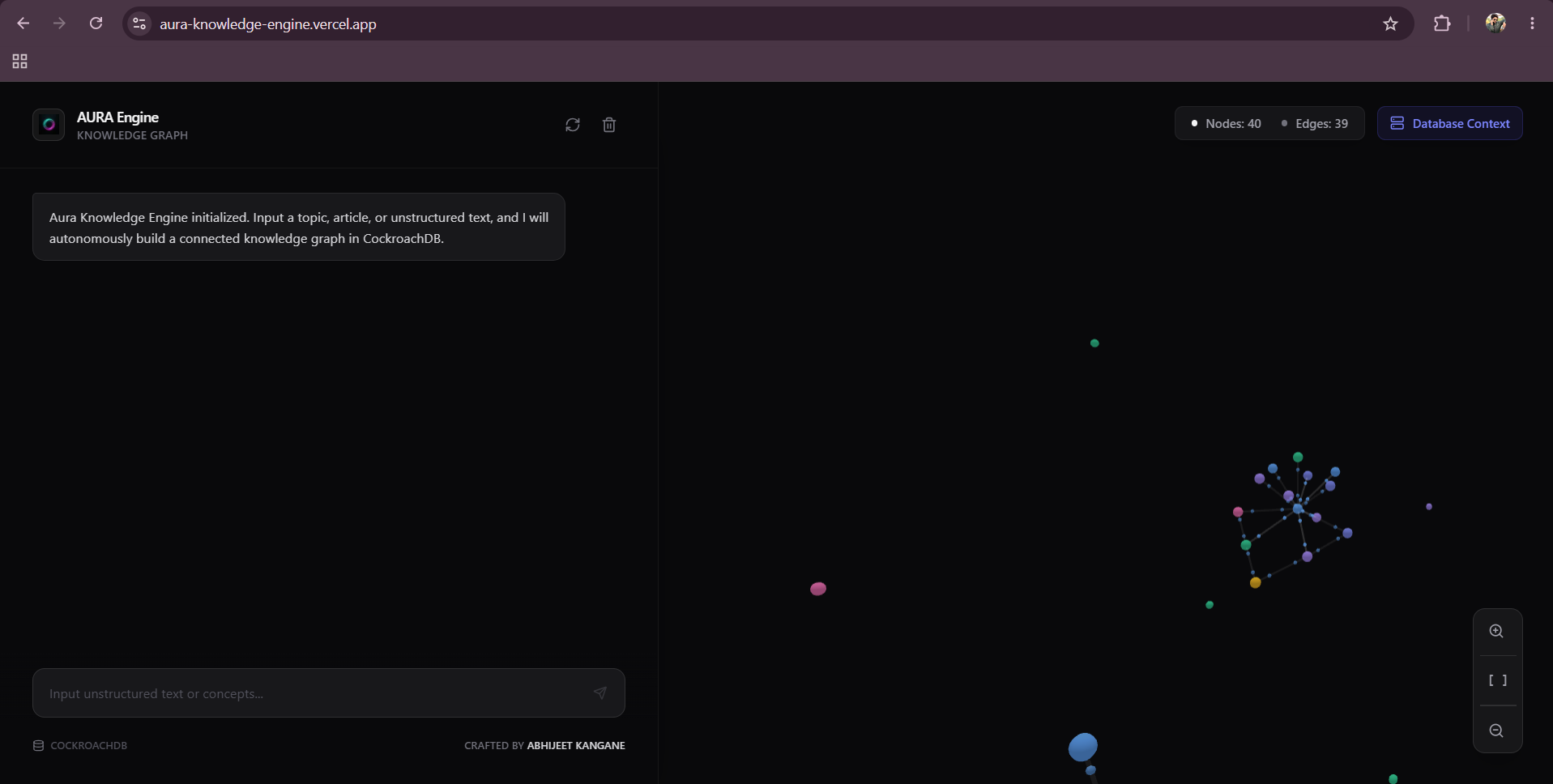
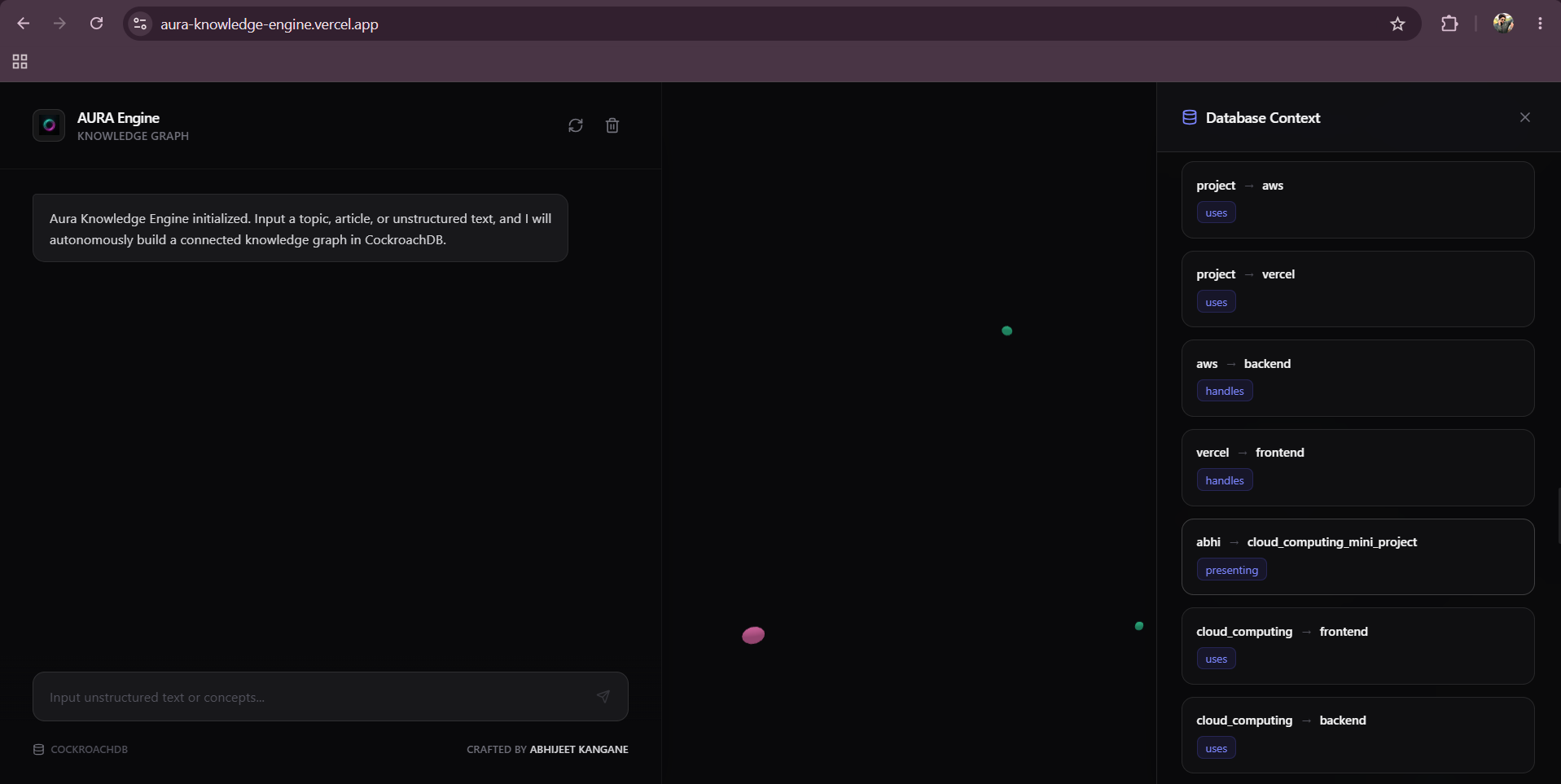
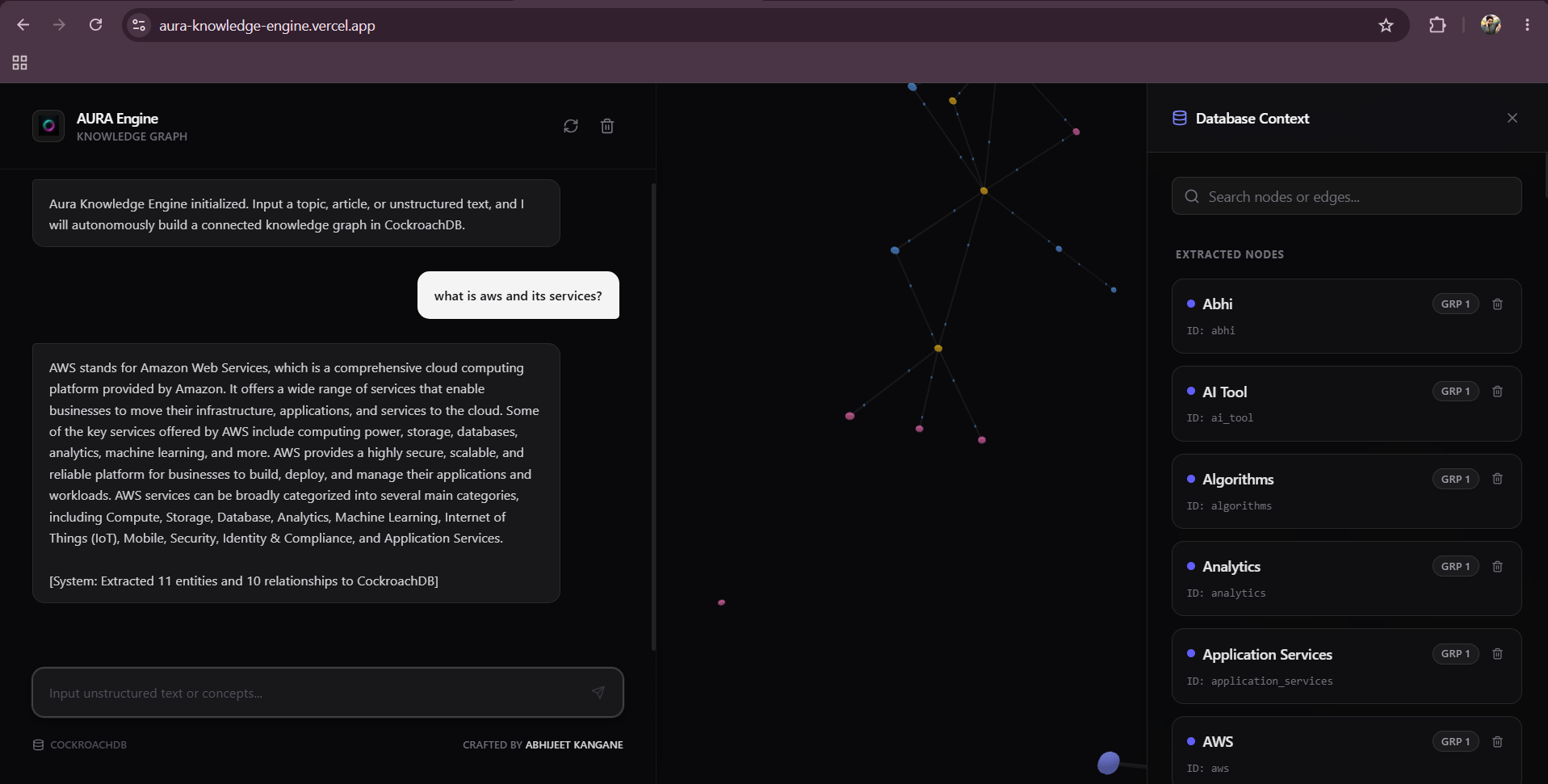
Aura Engine is a Stateful AI Knowledge Graph. When you converse with Aura, it autonomously extracts core entities (Nodes) and their relationships (Edges) from the unstructured text. It then saves this structured mathematical graph permanently into a distributed database (CockroachDB).
When you ask a question months later, Aura doesn't need to read a massive transcript. It queries the database, retrieves the exact sub-graph related to your question, and generates a highly accurate, hallucination-free response. To make it completely transparent, Aura streams this data to the frontend, giving users a beautiful, real-time, physics-based 3D visualization of their AI's "brain".
How we built it
We utilized a robust Cloud-Native Microservices Architecture:
- Frontend (Edge): Next.js & React deployed on Vercel. We used
react-force-graph-3dto render the complex physics-based node networks. - Backend (IaaS): Python & FastAPI hosted on an AWS EC2 Ubuntu instance running 24/7.
- Database (DBaaS): CockroachDB Cloud (Serverless). We chose CockroachDB for its unbeatable resilience and distributed SQL capabilities, perfectly suited for storing thousands of relational knowledge graph nodes.
- AI Brain: Llama-3 (8B) running via Groq API. We heavily engineered the system prompt to enforce strict Named Entity Recognition (NER) for accurate Graph Retrieval-Augmented Generation (GraphRAG).
Challenges we ran into
- GraphRAG Precision: Initially, the LLM kept generalizing terms (e.g., turning "Cloud Computing Mini Project" into just "Project"), which ruined the graph's accuracy. We overcame this by writing highly strict system prompts.
- Database Wipe Deadlocks: When trying to build a "SaaS-level Granular Delete" feature, CockroachDB's Python async driver (asyncpg) threw 500 errors when attempting multi-statement deletion commands. We had to split and sequentially await the SQL commands to achieve an instant graph reset without blocking the UI.
- Z-Index Wars in 3D Space: Layering SaaS UI components over a WebGL-based 3D Force Graph caused significant overlapping issues.
Accomplishments that we're proud of
- Successfully implementing a true GraphRAG architecture from scratch.
- Building a seamless, real-time sync between a highly interactive 3D WebGL frontend and a distributed Cloud SQL database.
- Completely solving the "LLM Amnesia" problem with infinite persistent database memory.
What we learned
- The massive difference between standard text-based RAG (Vector Databases) and GraphRAG (Relational/Graph Databases) for deterministic fact-recall.
- How to manage asynchronous state between Vercel Edge functions, AWS EC2 instances, and Serverless CockroachDB clusters.
What's next for Aura Engine
- Multi-User Authentication: Allowing thousands of users to have their own isolated "Second Brains" on the same CockroachDB cluster.
- Document Ingestion: Uploading massive PDF files and having Aura autonomously build a Knowledge Graph from an entire textbook in seconds.
Built With
- amazon-web-services
- cockroachdb
- fastapi
- llama-3
- next.js
- python
- react
- tailwind.css

Log in or sign up for Devpost to join the conversation.