Inspiration
Small brands are locked out of effective marketing. High-quality content requires hiring creators, managing revisions, tracking trends, and posting consistently, costing both time and money they don’t have. Meanwhile, the algorithms reward volume, consistency, and fast iteration.
We set out to remove that bottleneck entirely.
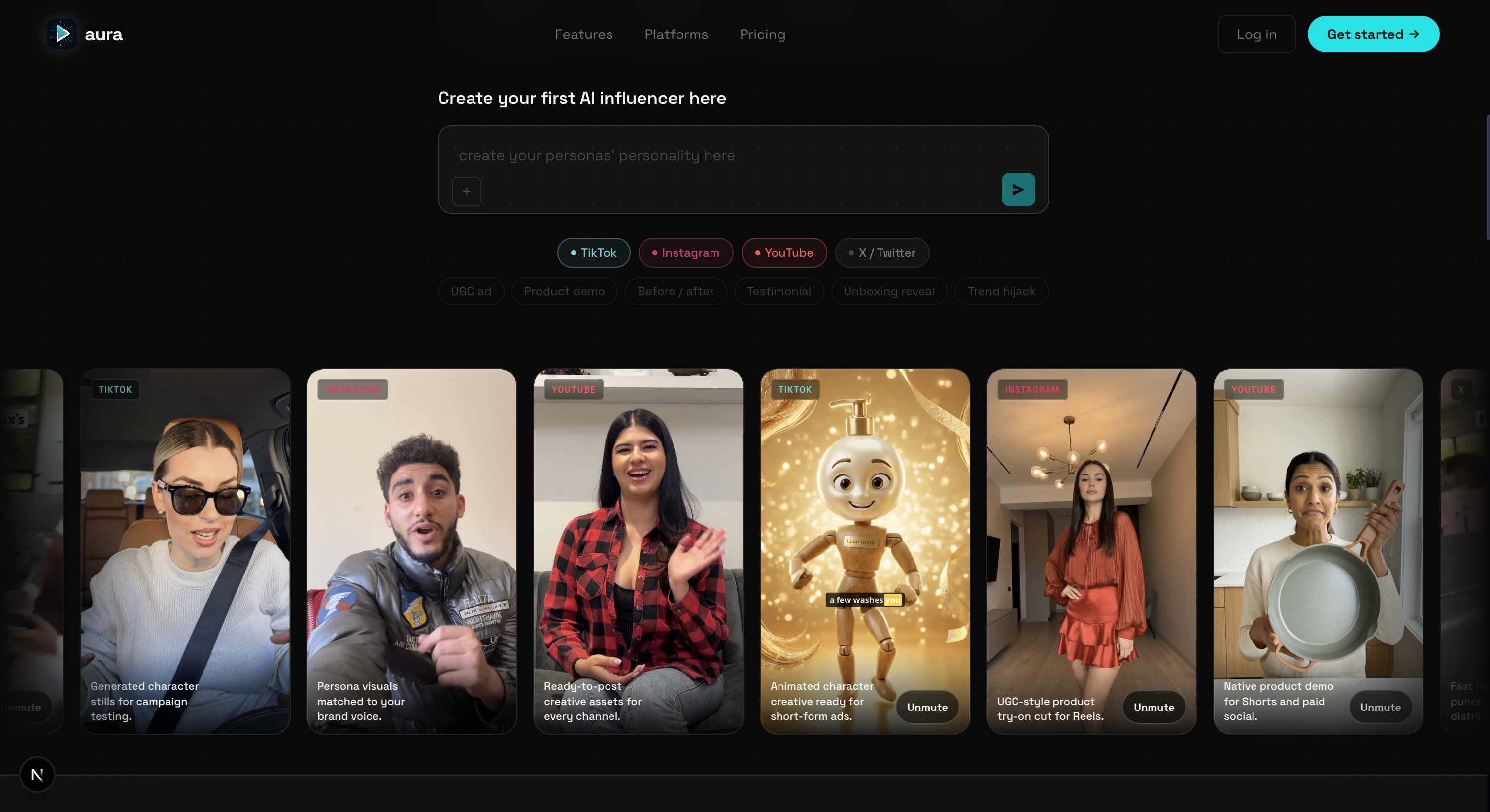
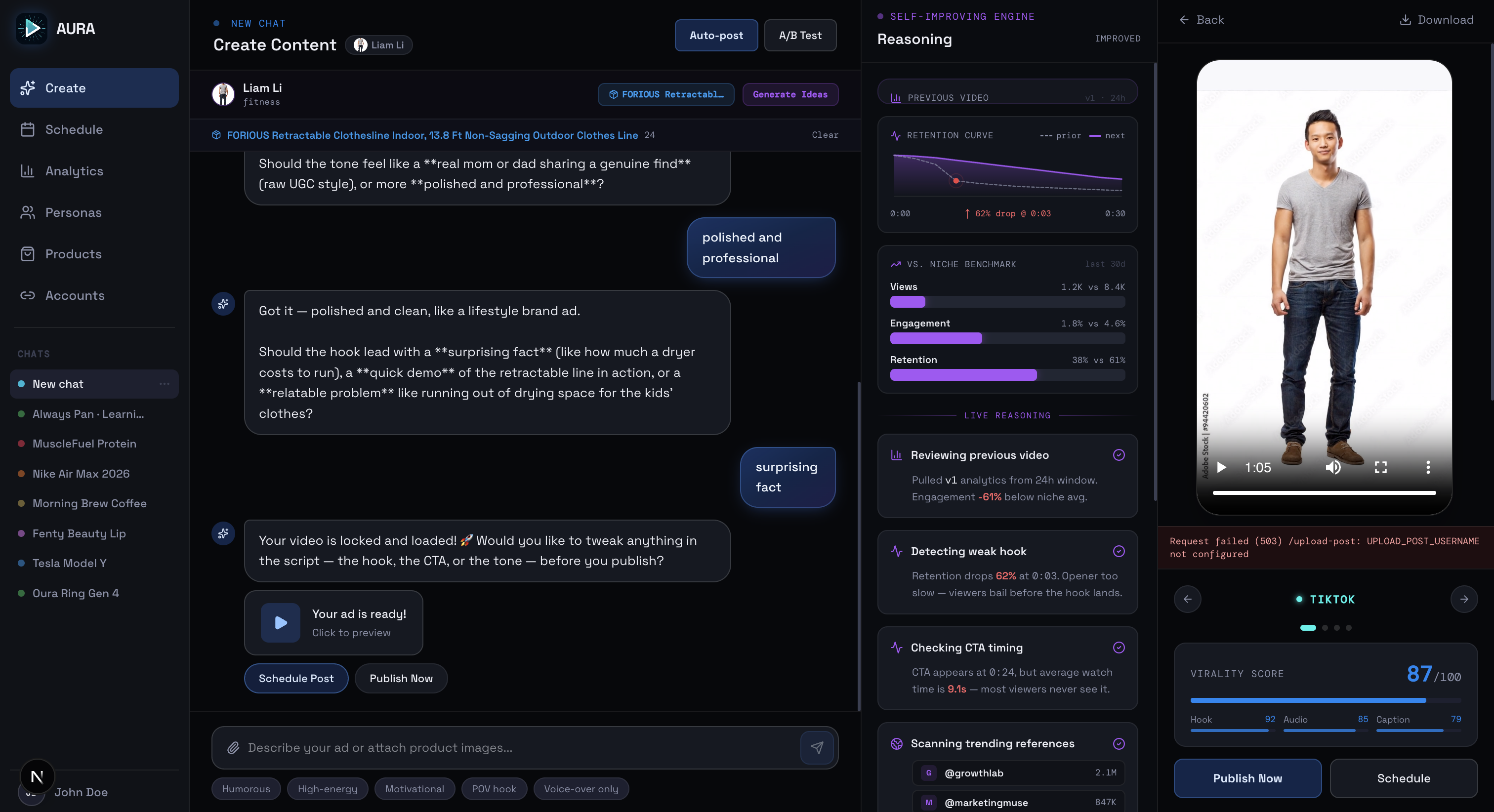
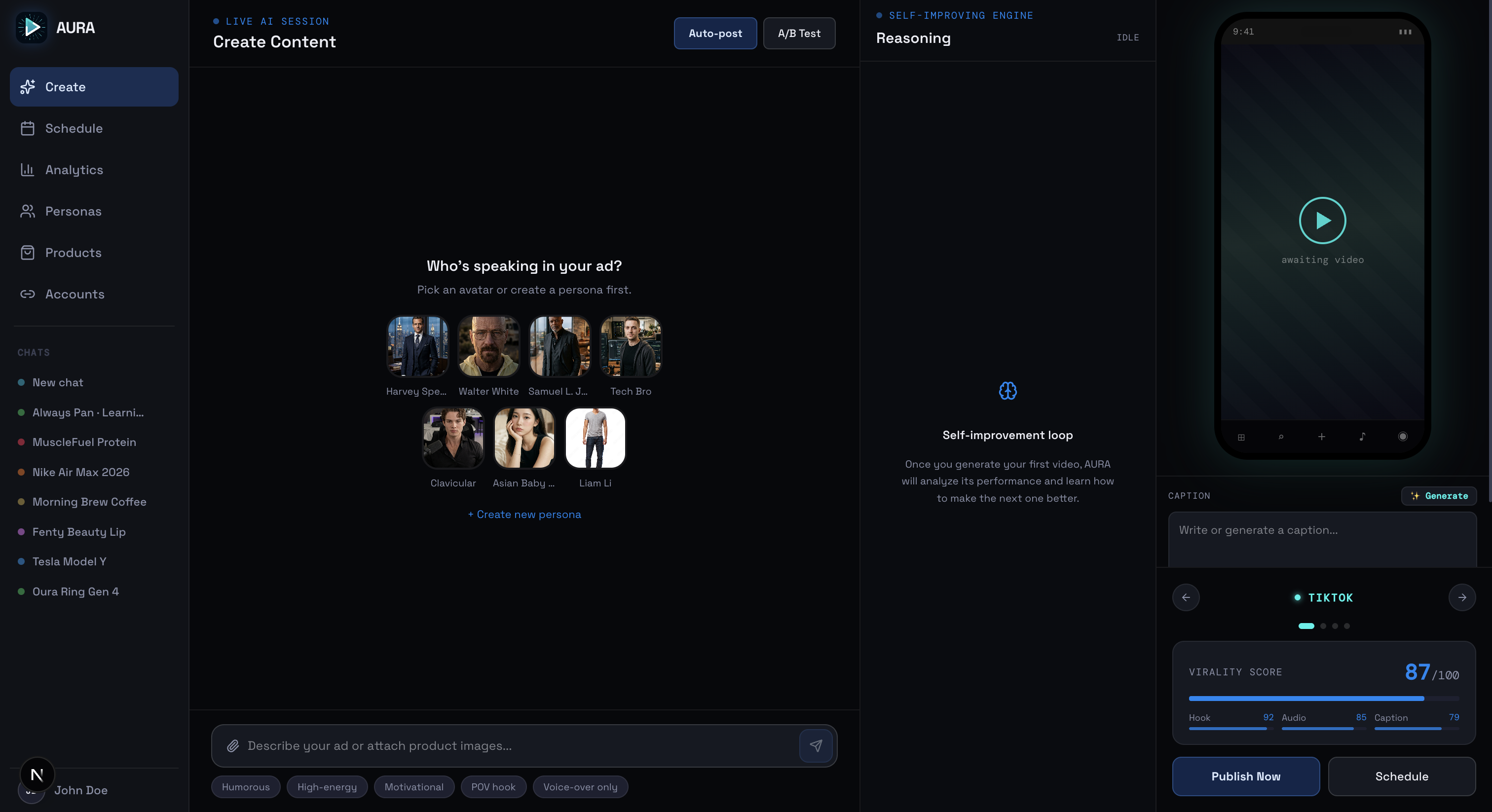
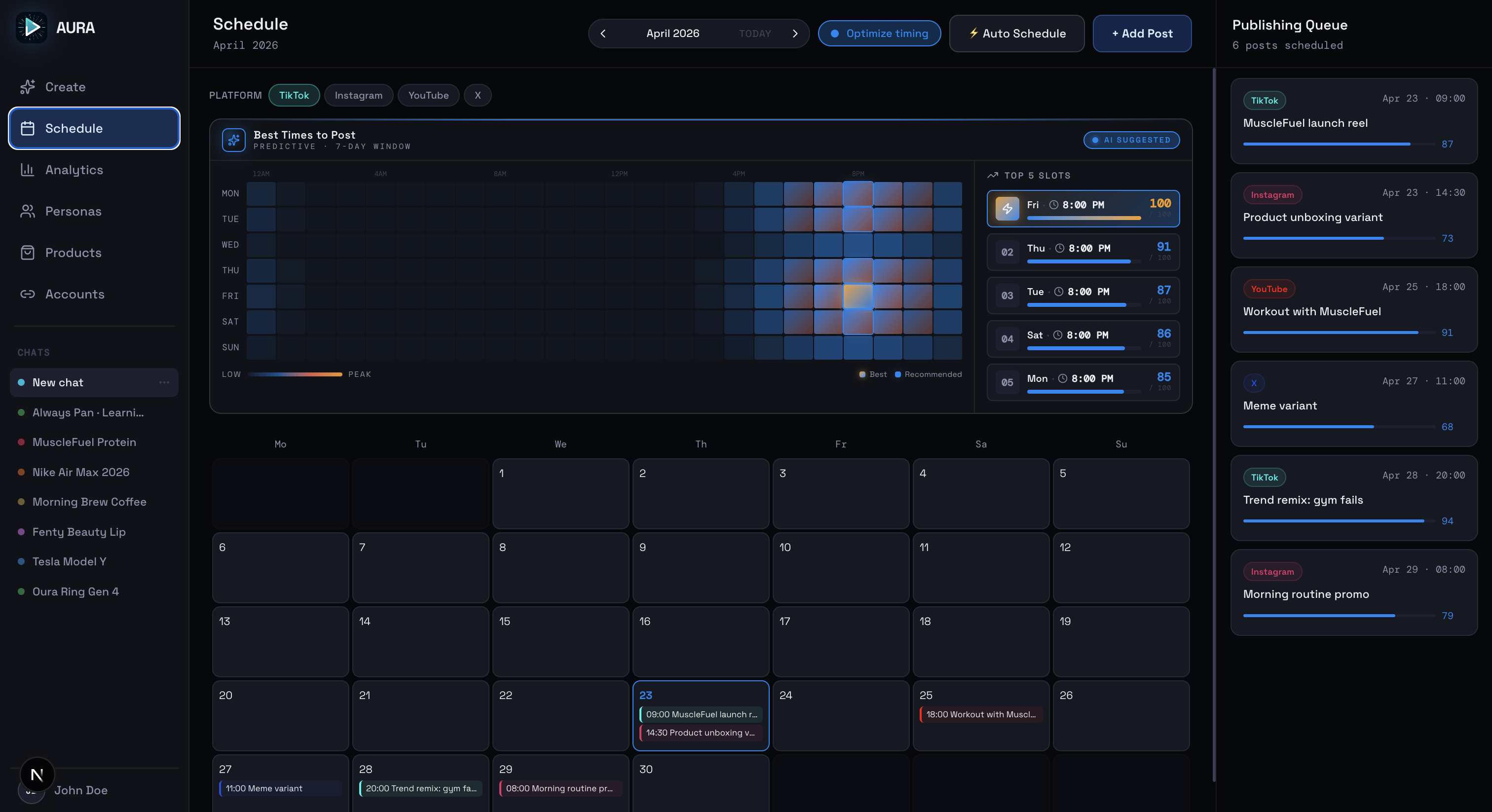
Our vision for Aura was to create a fully autonomous AI influencer: a persistent digital persona that can generate, post, and optimize content in a continuous self-improving loop. Instead of manually coordinating creators, users define a persona once, and an agent takes over—sourcing trending content, analyzing high-performing hooks, generating scripts, producing videos, writing captions, selecting optimal posting times, and publishing directly to connected social accounts. Over time, it learns from analytics and improves output without requiring further user input.
How we built it
Aura is built as an end-to-end asynchronous content generation pipeline that transforms a high-level user prompt into fully produced, publishable video content.
We started by solving character consistency. Using Flux (via Replicate), we generated multi-angle images of a user-defined avatar to ensure facial consistency across frames and scenes. An LLM then interviews the user to understand brand tone, audience, and messaging goals, and uses this context to generate structured multi-scene scripts.
Each script is decomposed into a sequence of short scenes. For every scene, Flux generates both a starting frame and an ending frame, anchoring visual continuity. These frames are passed to HeyGen, which interpolates and animates the sequence into short video clips while preserving identity and motion realism.
To handle asynchronous orchestration, we built a distributed pipeline using RabbitMQ and Redis. Each generation step (script → scene → image → animation → voice → stitching) is queued and processed independently, allowing long-running AI tasks to scale without blocking the system. Redis is used for caching intermediate outputs and tracking job state across the pipeline.
For audio, we use ElevenLabs to generate consistent voiceovers aligned with the persona, and apply lip-syncing to match the generated speech to the animated video.
Finally, all clips are stitched together into a single cohesive video, with captions generated by the LLM and timed to the audio. The system is designed to run continuously: once social accounts are connected, the agent can autonomously generate, schedule, and publish content in a loop, improving over time based on performance data.
Challenges we ran into
One of the biggest challenges was connecting multiple AI systems into one believable end-to-end workflow. It is easy to generate text, images, voice, or video separately, but much harder to preserve a consistent character and make the final output feel like authentic TikTok-native UGC instead of a generic AI avatar. Stitching together several short clips into one cohesive video also introduced challenges around pacing, continuity, and making the final result feel natural. Another challenge was handling async orchestration and long-running AI tasks while still making the app feel responsive and transparent to the user.
Accomplishments that we're proud of
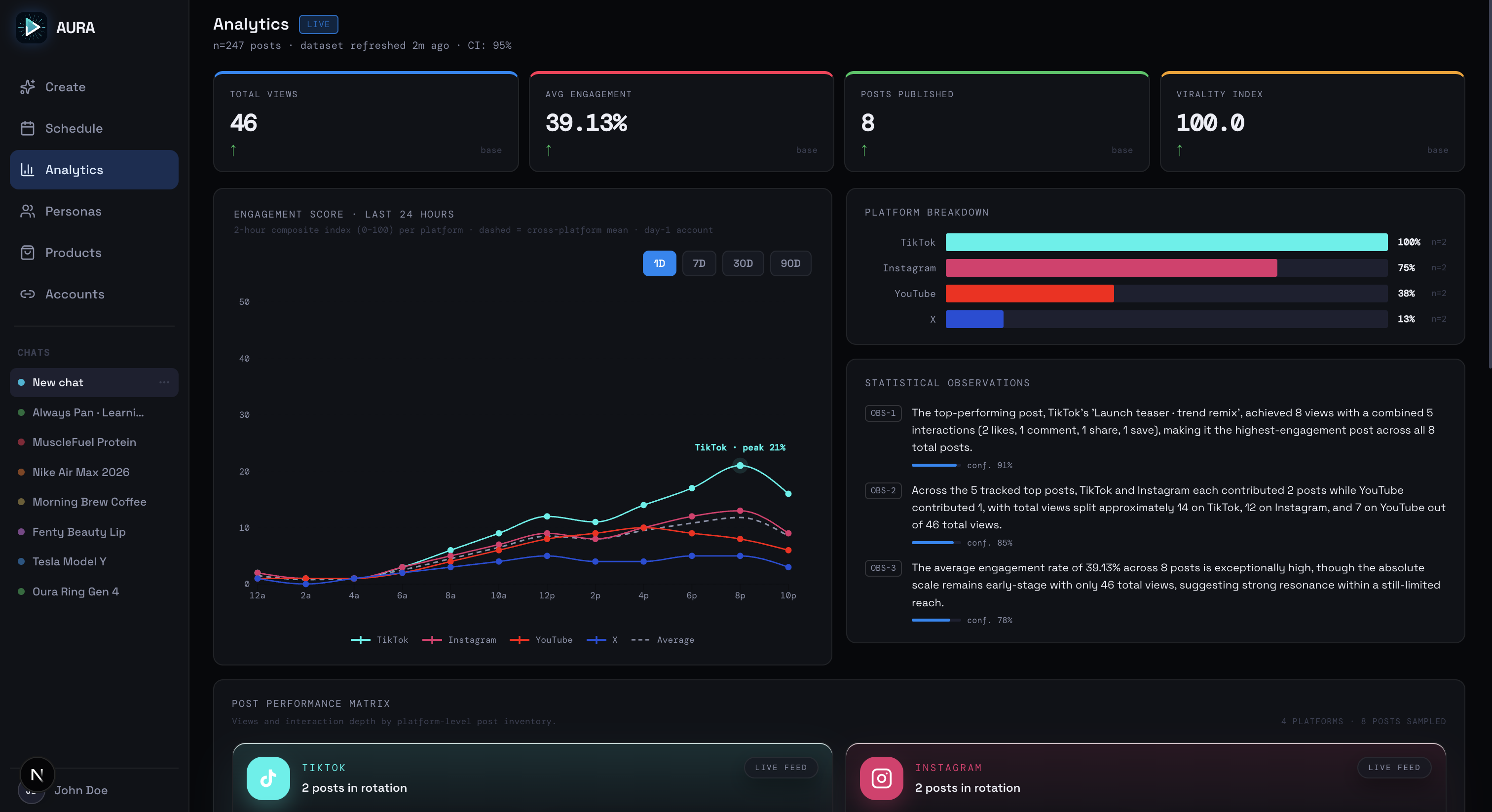
We’re proud that Aura is more than a set of disconnected demos. It already brings together personas, content generation, scheduling, analytics, and a live autonomous agent workflow into one cohesive product. We’re especially proud of the agent layer, because Aura does not stop at generating a single clip. It can research competitor content, extract the angle, adapt it to a persistent persona, generate multiple short scenes, stitch them into a finished ad, and move that output toward a publishable draft with a consistent AI-generated voice.
What we learned
We learned that consistency is the hardest part of AI content products. The real challenge is not just generation quality, but maintaining identity, tone, voice, and strategy across repeated outputs. We also learned that users need visibility into what an AI agent is doing, which made streaming progress and exposing tool actions just as important as the model outputs themselves.
What's next for Aura
Next, we want to close the loop from content to revenue. We plan to integrate Stripe so each AI persona can directly monetize—selling products, capturing leads, or driving paid campaigns tied to performance.
Beyond that, we’re building a fully autonomous growth loop: Aura won’t just create content for brands, it will market itself. The agent will generate and publish its own promotional content, analyze what converts, iterate on messaging, and reinvest into higher-performing strategies—continuously improving without manual input.
Long term, Aura becomes a self-sustaining AI growth engine where each persona can create, distribute, optimize, and monetize content end-to-end.


Log in or sign up for Devpost to join the conversation.