AURA: The Autonomous Universal Resource Agent
Tagline: "Where Professional Potential Blooms through AI-Driven Renewal."
🌿 Inspiration
Most career platforms are static filing cabinets where resumes sit dormant, often entering a "career winter"—a state of stagnation where growth is stalled and potential remains untapped. We were inspired by the concept of "Code Spring" to build something that treats professional growth as a living, breathing ecosystem. We wanted to move away from passive tracking and create an autonomous partner that actively "waters" a user's career through continuous AI-driven renewal and strategic action.
🌱 What it does
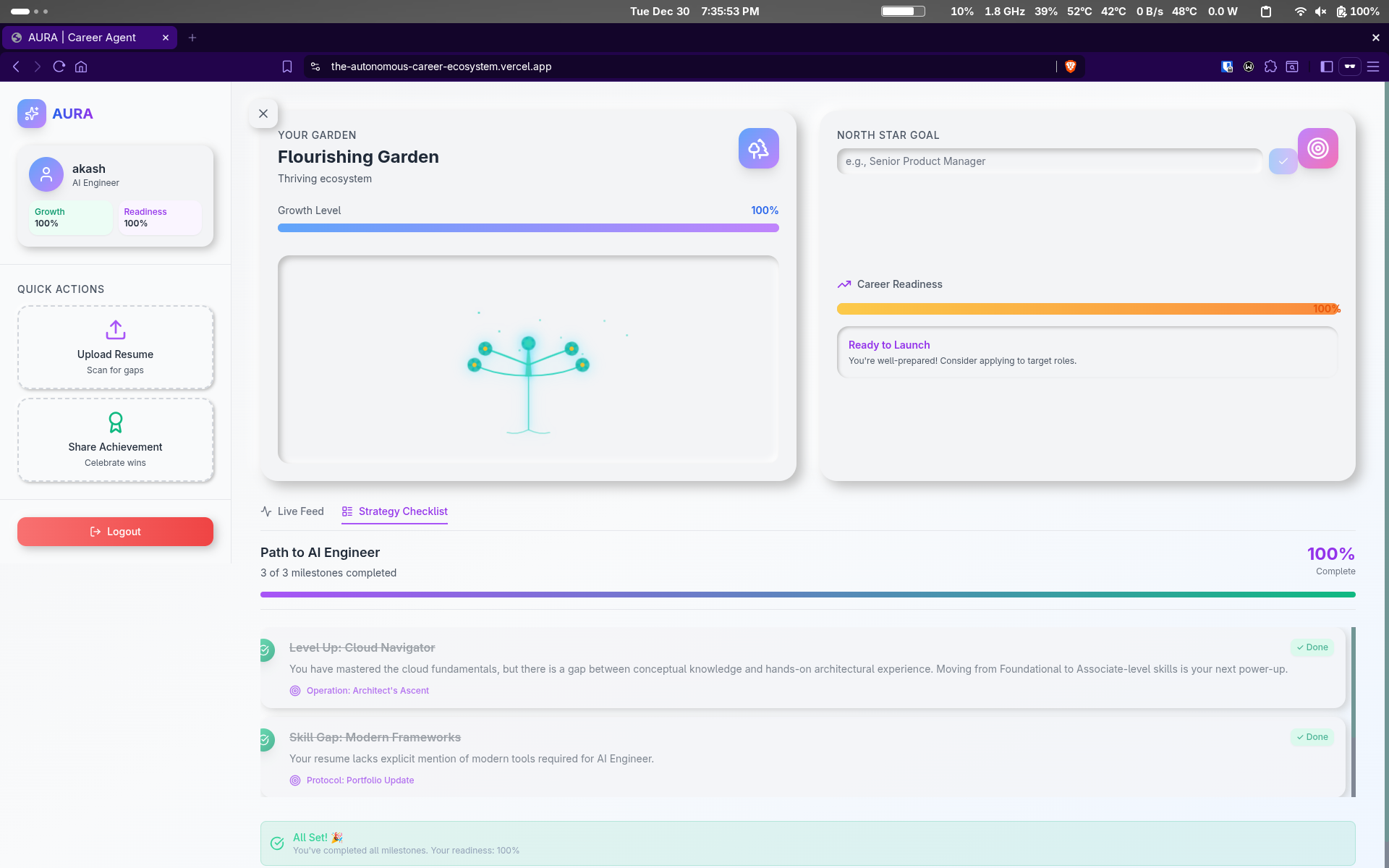
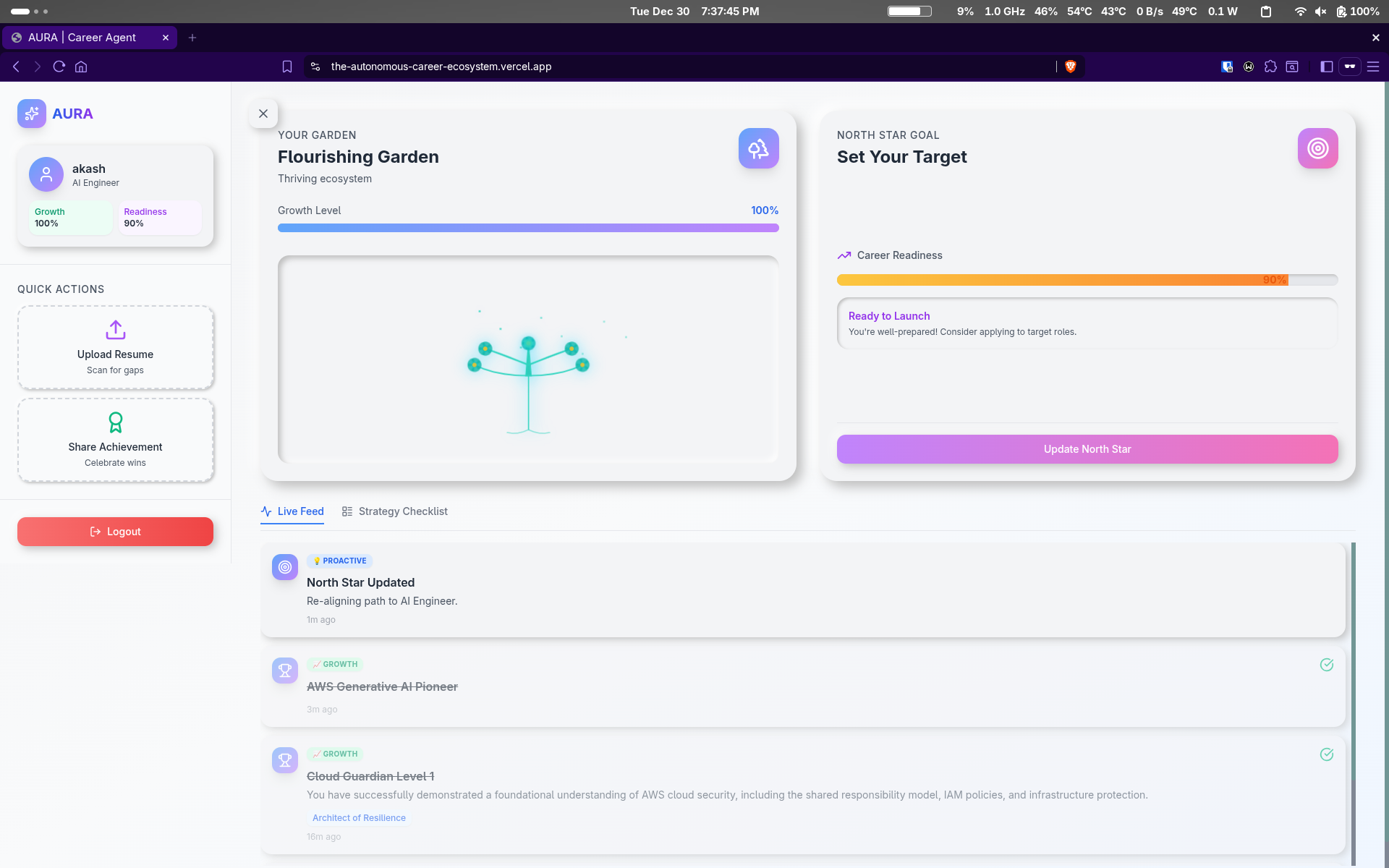
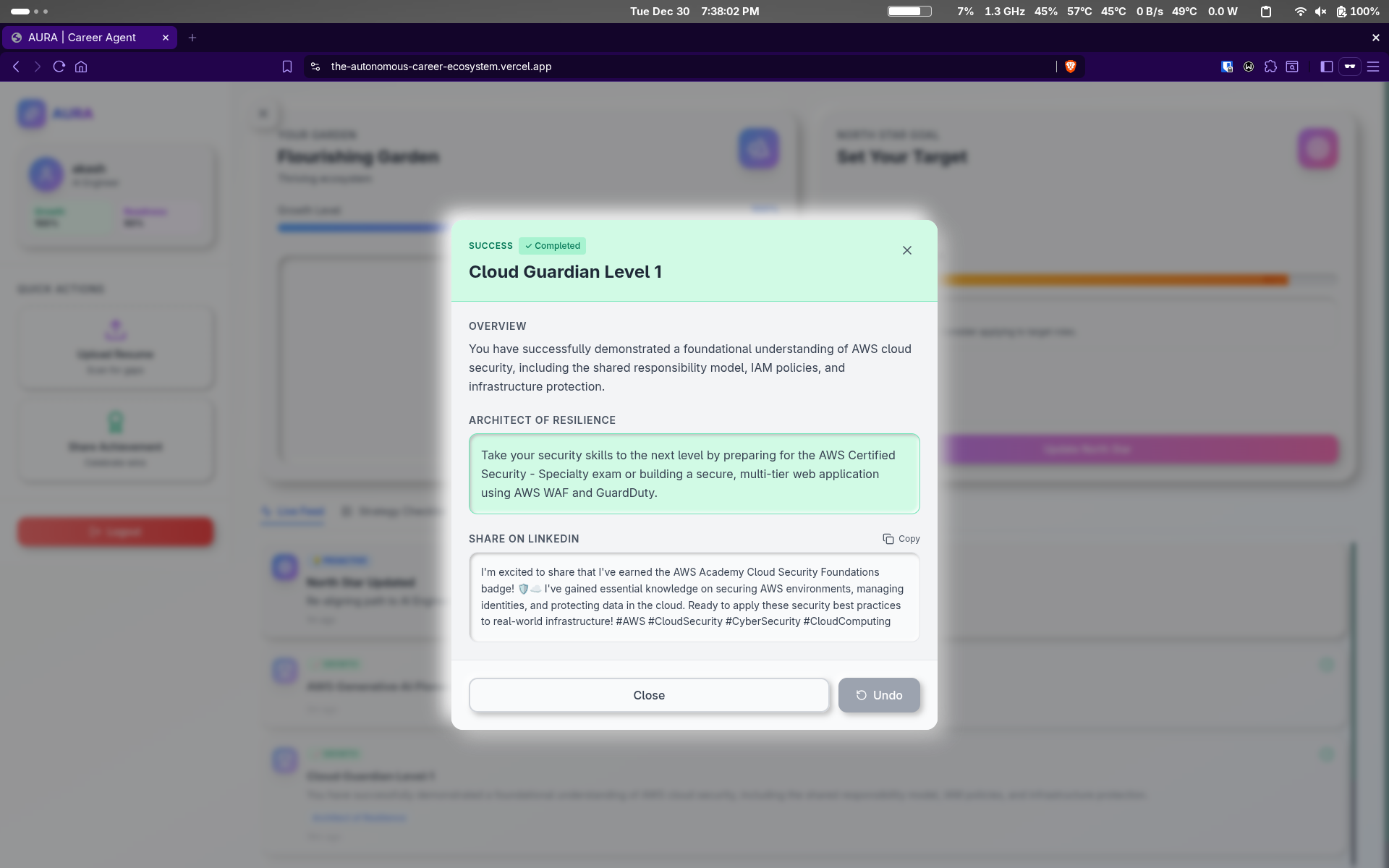
AURA is an autonomous career agent that transforms the job search into a Dynamic Digital Garden:
- The Soil: Users upload their base resume to establish a professional baseline and experience history.
- The Bloom: Every time a user adds a certificate, project, or achievement, the AI parses it and visually "grows" their digital garden in real-time.
- North Star Milestones: Users set a target role (e.g., AI Engineer), and AURA performs a Semantic Gap Analysis to show exactly how close they are to that goal.
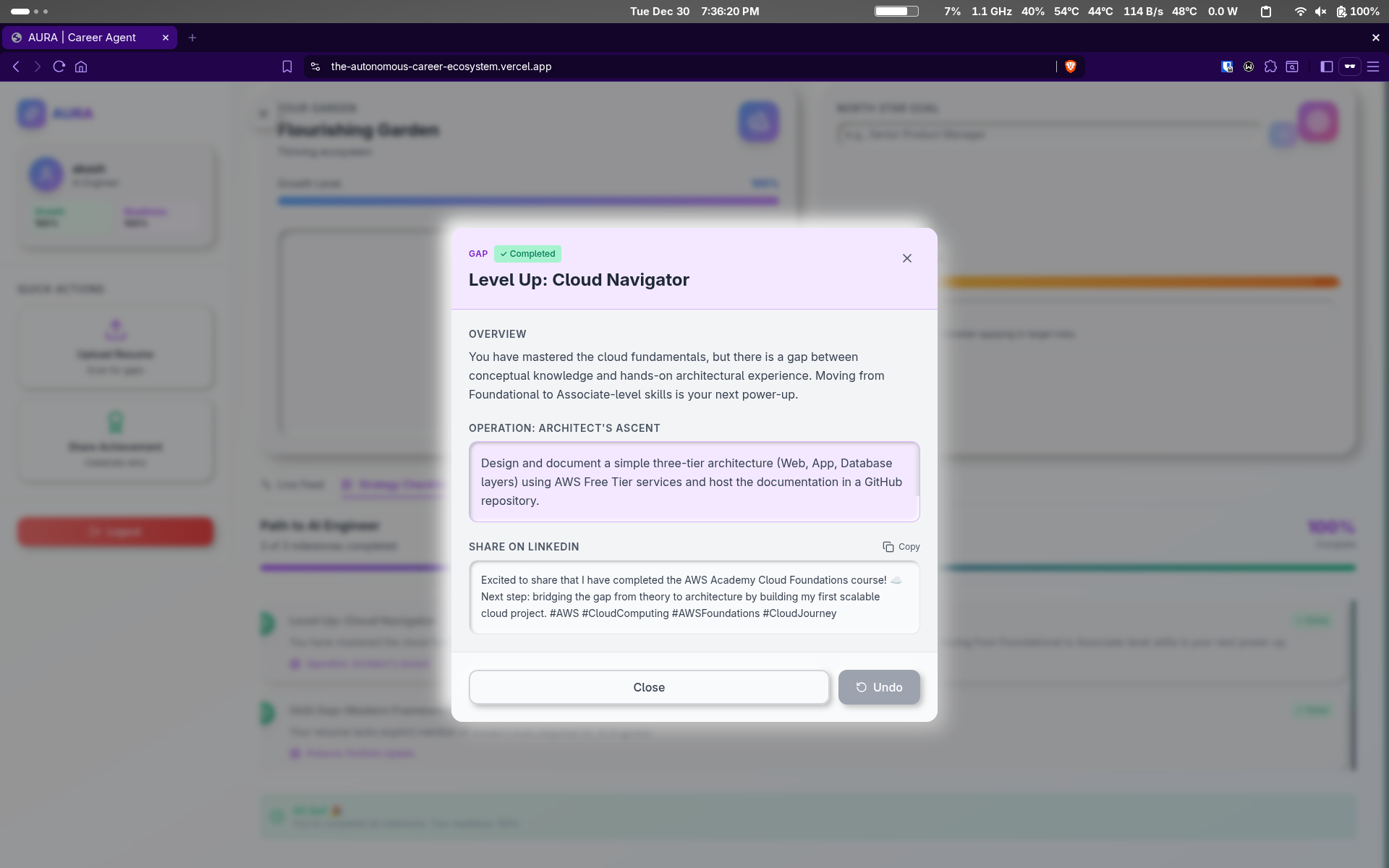
- Mission Protocols: Instead of just showing gaps, AURA generates "Agentic Missions"—actionable steps and social media drafts to help users bridge those gaps and automate their professional branding.
🛠️ How we built it
We utilized a cutting-edge Google Cloud and AI stack to ensure production-grade performance and high-speed intelligence:
- Frontend: Built with React and Tailwind CSS using a premium "Glassmorphism" light theme for a crisp, professional, and modern feel.
- Intelligence: Powered by Gemini 2.5 Flash for high-speed reasoning and Gemini Embeddings for skill vectorization.
- Database: Aiven for PostgreSQL with pgvector serves as the "Long-Term Memory," allowing for semantic similarity searches between user skills and job requirements.
- Parsing: Google Document AI was used to transform unstructured PDFs (resumes and certificates) into structured career data for the agent to analyze.
🚧 Challenges we ran into
Integrating pgvector with high-dimensional Gemini embeddings required careful schema design to ensure fast and accurate similarity scoring. We also faced significant design challenges in refining the UI/UX transition from a dark "hacker" aesthetic to a sophisticated, accessible light theme that accurately represents the "Growth/Spring" metaphor without losing the technical "vibe" that judges expect.
🏆 Accomplishments that we're proud of
We are incredibly proud of the "Phase-based Mission Protocol" system. Successfully creating a loop where the AI identifies a gap, provides a directive, and then "rewards" the user with a social media draft and visual garden growth feels like a true step toward Agentic AI rather than just another chatbot interface.
📖 What we learned
We learned the power of Vector Databases in creating "semantic memory" for AI applications. Beyond just simple keyword matching, using pgvector allowed us to understand the meaning and context behind a user's experience. We also learned that in AI products, Visual Feedback (like the blooming garden) is essential for making complex data feel relatable and encouraging.
🚀 What's next for AURA
The next step for AURA is integrating Real-Time Market Intelligence. We plan to connect AURA directly to job board APIs so it can notify users the second a "North Star" role becomes available that matches their current bloom level. We also want to implement Multi-Agent Orchestration, where one agent finds the job and another agent custom-tailors a cover letter based on the specific "Garden" of skills the user has grown.
Built With
- aiven
- gemini-3-flash
- google-gemini
- lucide-react
- node.js
- pg
- postgresql
- react
- tailwind-css
- typescript
- vercel
- vercel-edge-network
- vercel-serverless
- vite


Log in or sign up for Devpost to join the conversation.