🤖 AURA: From Idea to Autonomous Agent in 48 Hours
The Spark: Automating the Analyst
My journey with this project began with a simple question inspired by the daily grind of cybersecurity professionals: What if an AI could do their job for them?
In a world where time is the most critical asset, I saw Red Teamers spending days on manual reconnaissance and Blue Teamers buried under mountains of logs. This manual process is slow, inefficient, and doesn't scale. I was inspired to build a solution—not just an assistant, but an autonomous, cognitive collaborator. That's why I built AURA.
What it Does: A Multi-Agent AI Suite
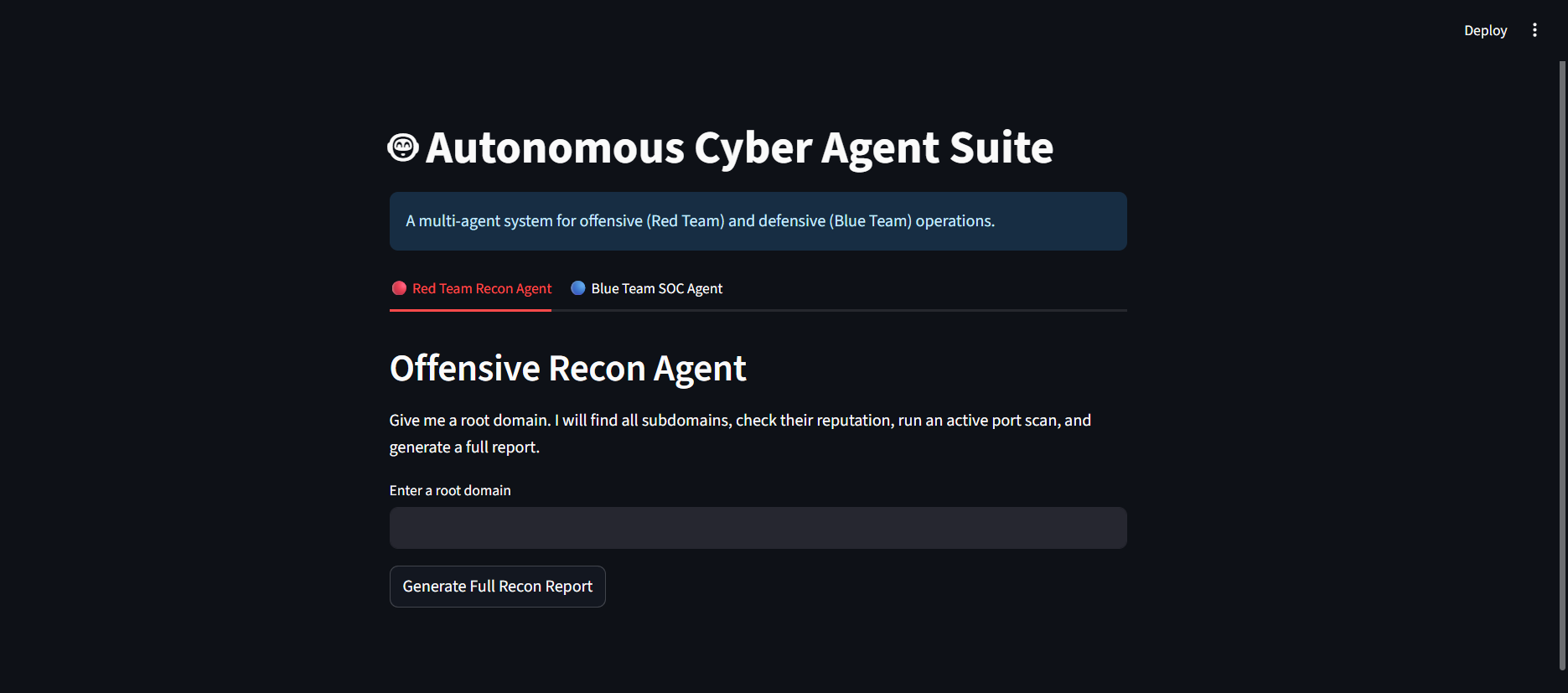
AURA (Autonomous Unified Reconnaissance & Analysis) is a multi-agent AI system designed to be a force multiplier for security teams. It features two specialized agents in a single suite:
🔴 The Red Team Recon Agent: Give it a single domain, and it autonomously executes a complex, 4-step mission: finding subdomains, vetting their IP reputations, conducting active port scans, and writing a comprehensive, formatted intelligence report.
🔵 The Blue Team SOC Agent: This agent acts as an AI Security Operations Center (SOC) Analyst. It ingests raw server logs, hunts for threats by forming its own hypotheses (like searching for brute-force attacks), enriches its findings by checking suspicious IPs, and escalates confirmed threats by writing a formal incident report.
How I Built It: Brain, Nerves, and Hands
I built AURA in under 48 hours using a modern, agentic AI architecture.
- 🧠 The Brain (LLM): I chose Google's Gemini 1.5 Flash as the core reasoning engine. It's responsible for analyzing the mission, formulating multi-step plans, and deciding which tool to use next.
- 🔗 The Nervous System (Framework): LangChain provides the essential agentic framework. It connects the "Brain" to its "Hands," managing the critical thought-action-observation loop that makes the agent truly autonomous.
- 🛠️ The Hands (Custom Toolbox): I wrote a suite of custom Python functions to give the agent real-world capabilities. These tools handle everything from calling external APIs (AbuseIPDB, WhoisXML) to performing active network scans with the
socketlibrary. - 🎈 The Interface: The entire application is served through a clean, intuitive web UI I built with Streamlit.
Challenges I Faced & What I Learned
My biggest challenge was the agent's "brain" itself. My initial multi-step agent was too "chatty," making too many sequential calls to the LLM. This was inefficient and quickly caused me to hit the free-tier API rate limits.
This forced me to re-architect my tools and learn a critical lesson in agent design: a "smart" tool is often better than a "smart" agent. I rebuilt my tools to handle complex loops and logic internally within the Python code. This freed up the AI to focus on high-level planning instead of getting bogged down in repetitive steps.
Through this process, I learned that prompt engineering isn't just about asking questions; it's about giving the AI a clear mission, powerful and reliable tools, and the confidence to execute its plan without "panicking" when it encounters a minor, non-critical error.
What's Next for AURA
This project is a powerful proof of concept, but it's just the beginning. The next steps would be to give the agents persistent memory to learn from past scans and to expand their toolbox—perhaps with the ability to query vulnerability databases (like CVEs) or even trigger automated defensive actions, like adding a malicious IP to a firewall blocklist.

Log in or sign up for Devpost to join the conversation.