-
-
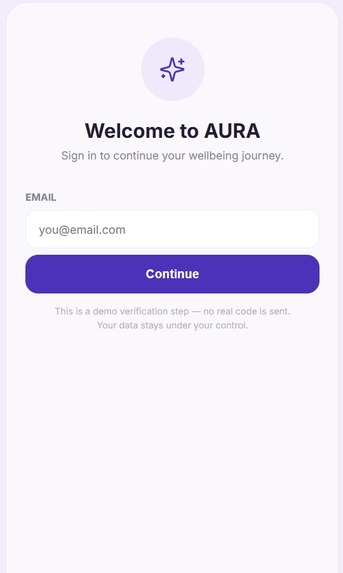
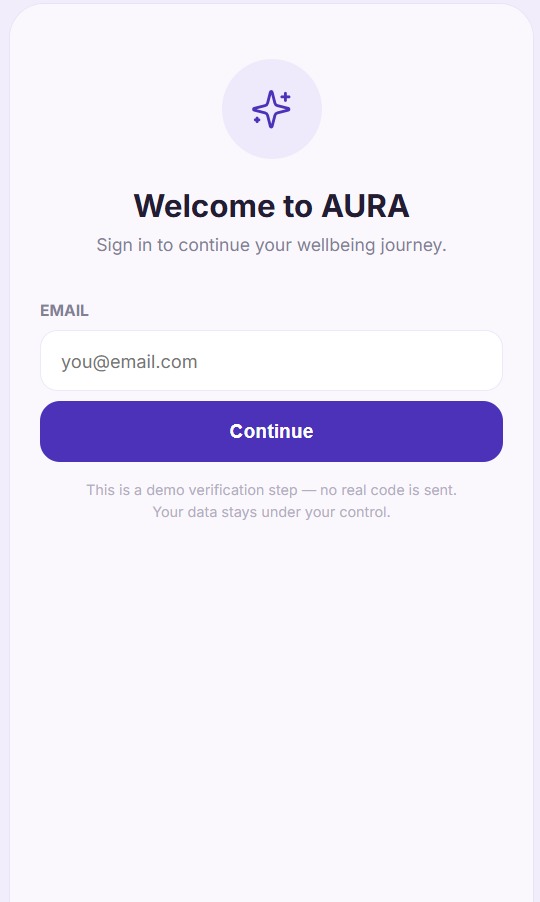
Welcome screen where users enter their email address to continue into the AURA wellbeing experience.
-
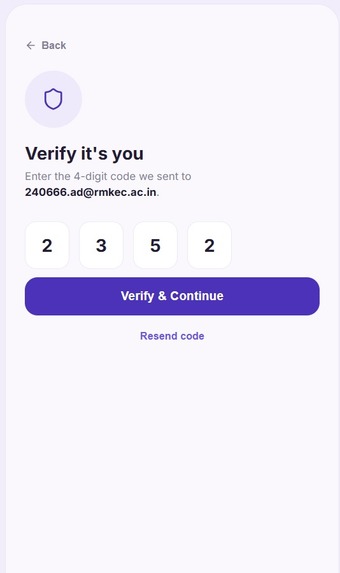
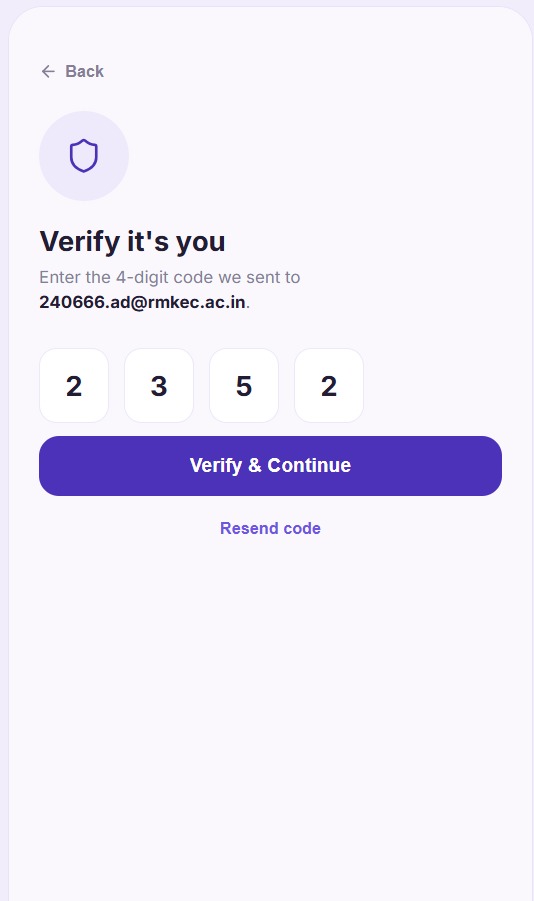
Four-digit verification-code screen used to confirm the user’s identity before continuing.
-
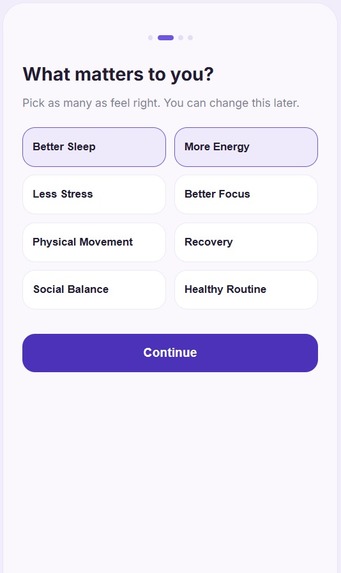
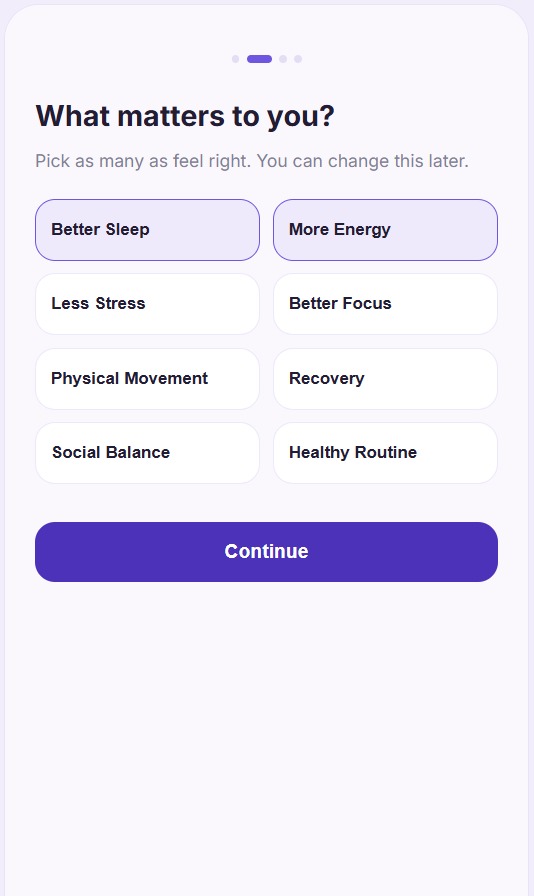
Onboarding screen where users choose goals
-
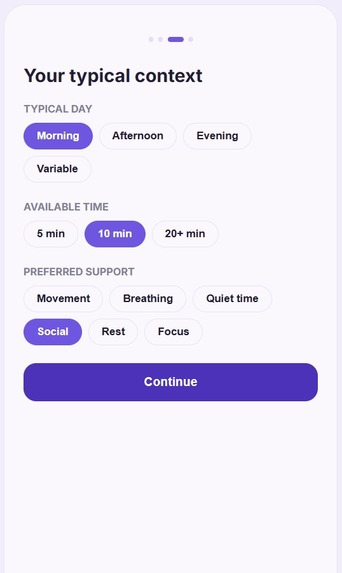
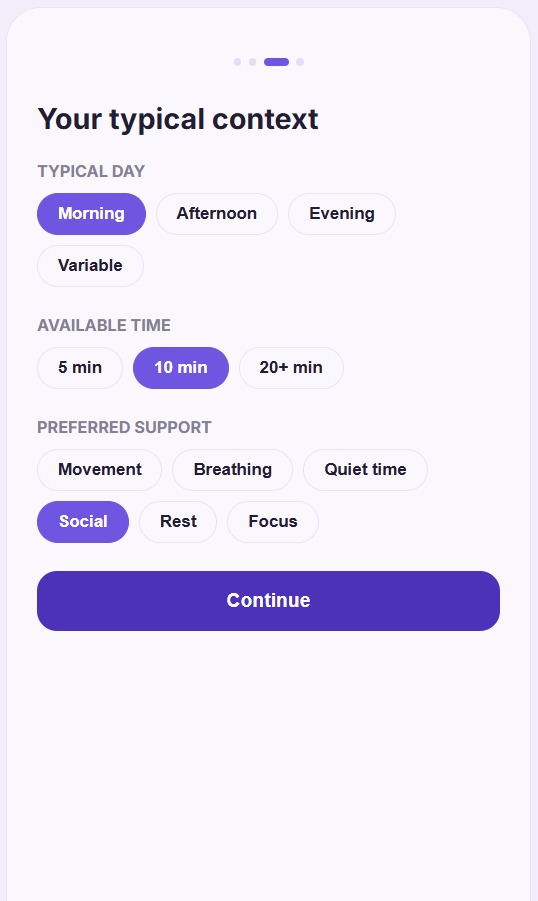
User selects their typical time of day, available time, and preferred type of wellbeing support.
-
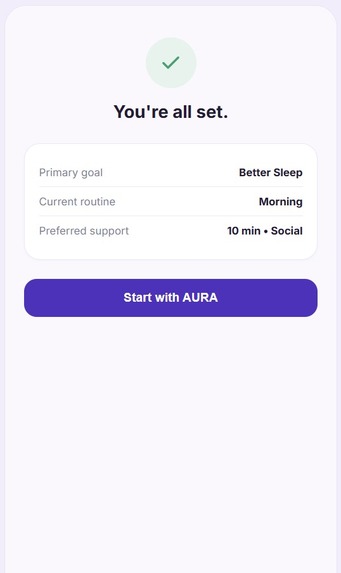
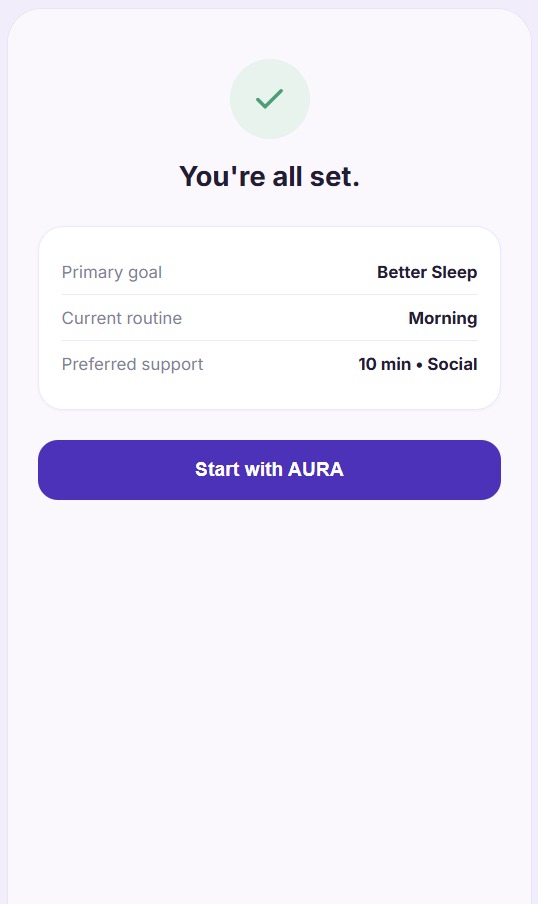
Confirmation screen summarizing the user’s primary goal, routine, preferred duration, and preferred support style.
-
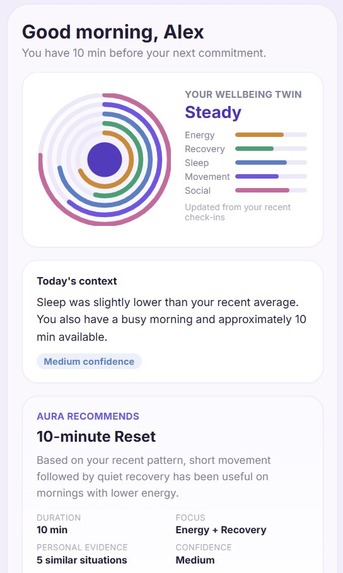
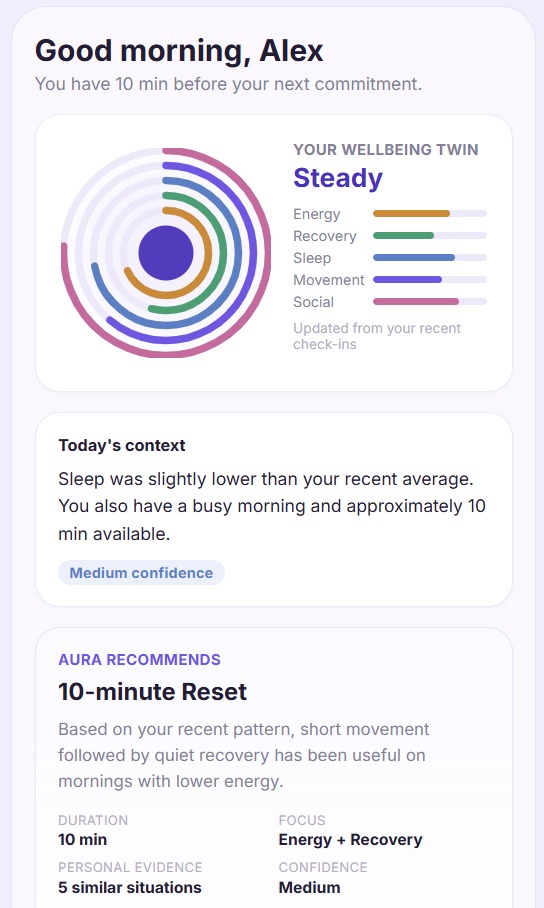
Personalized morning dashboard showing the user’s wellbeing state, current context, and recommended 10-minute reset.
-
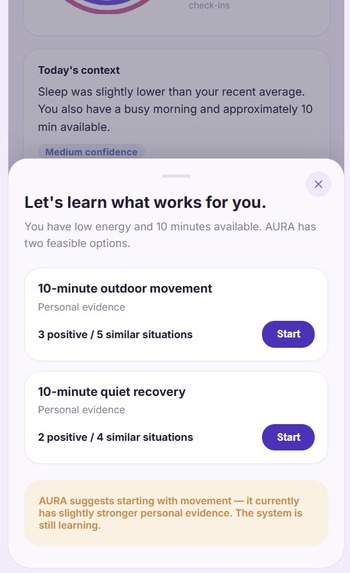
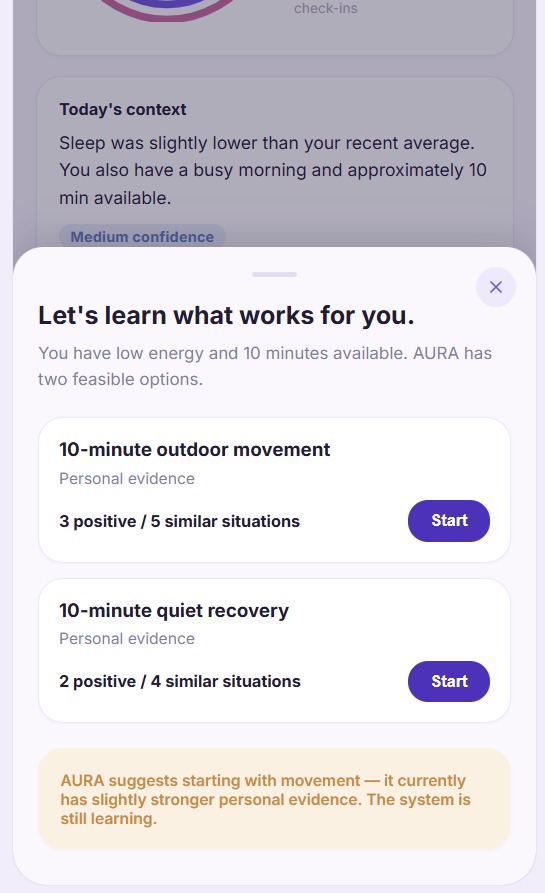
AURA compares two possible interventions using personal evidence and recommends the option with slightly stronger supporting evidence.
-
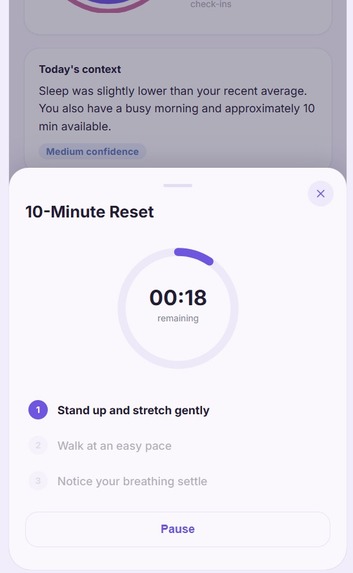
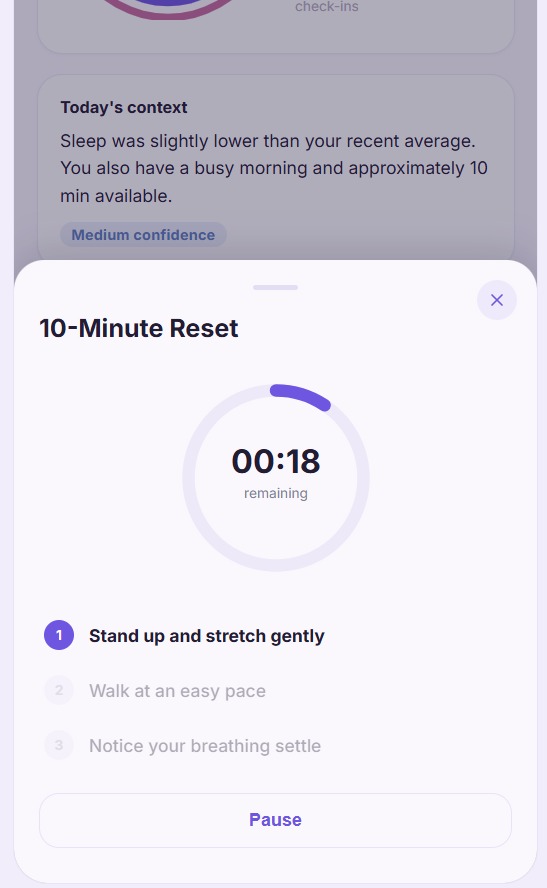
Guided reset session with a countdown and steps for gentle stretching, walking, and settling breathing.
-
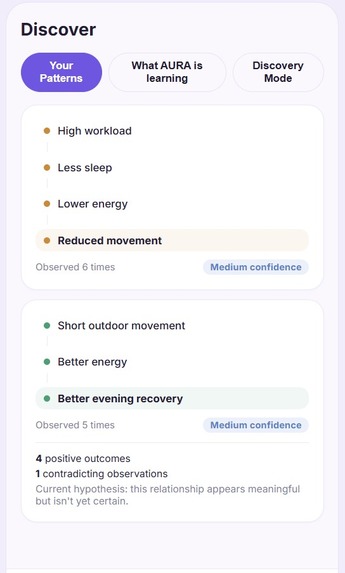
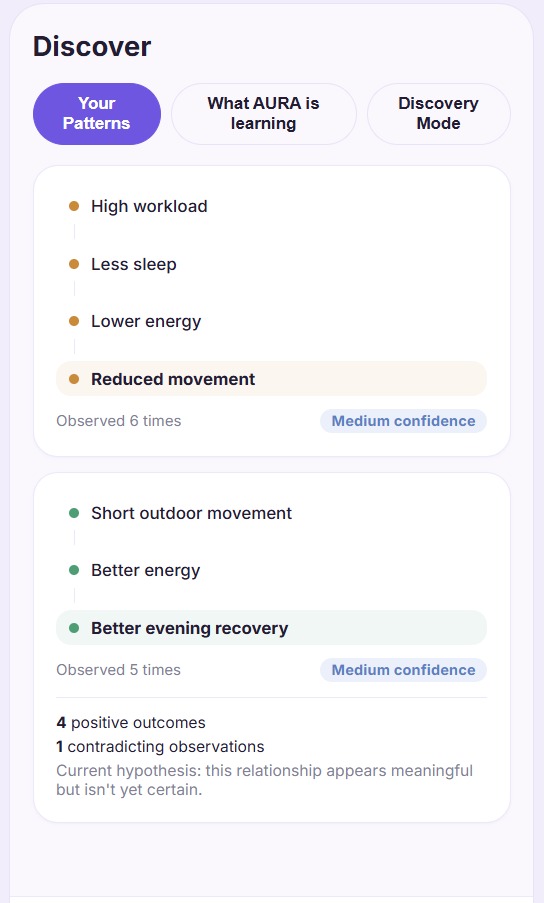
Presents observed personal patterns, including relationships between workload, sleep, energy, movement, and evening recovery.
-
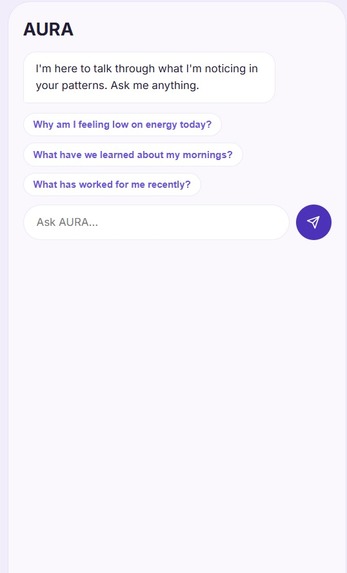
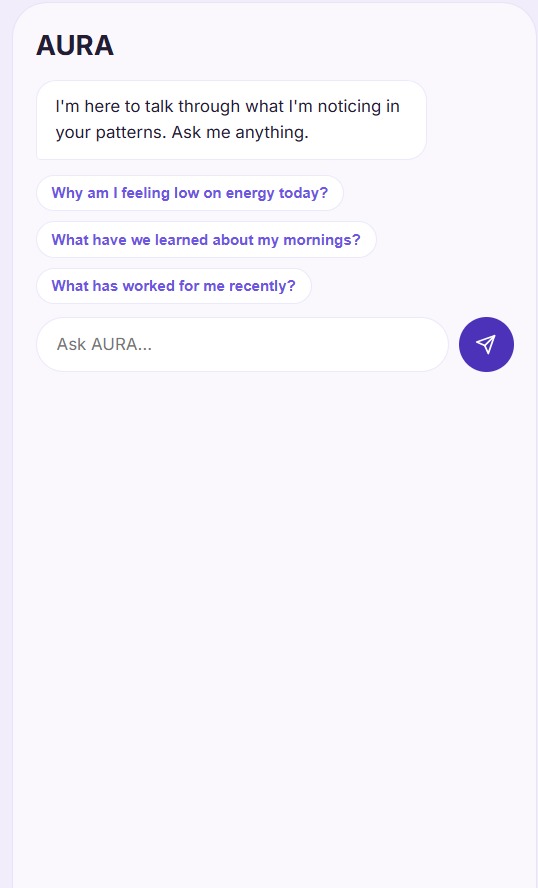
Chat interface where users can ask AURA questions about their wellbeing patterns, mornings, energy, and recent experiences.
-
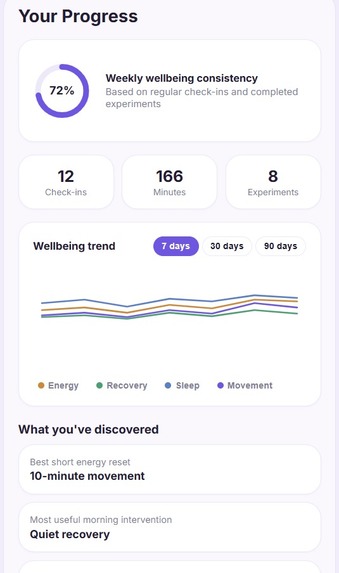
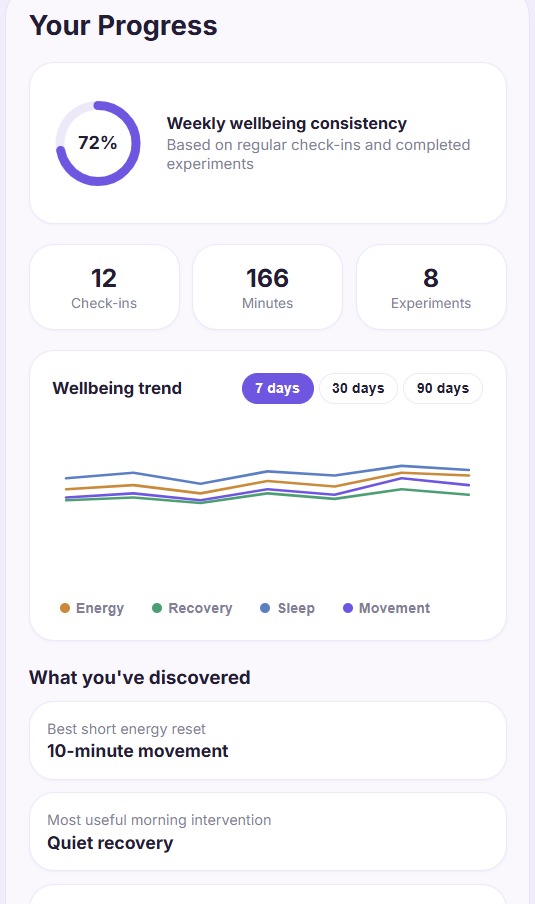
Shows weekly wellbeing consistency, check-ins, minutes, experiments, wellbeing trends, and key discoveries.
-
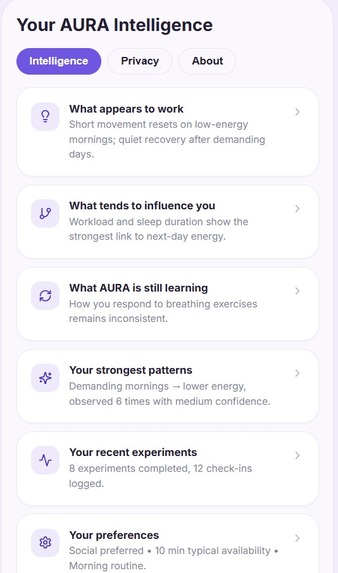
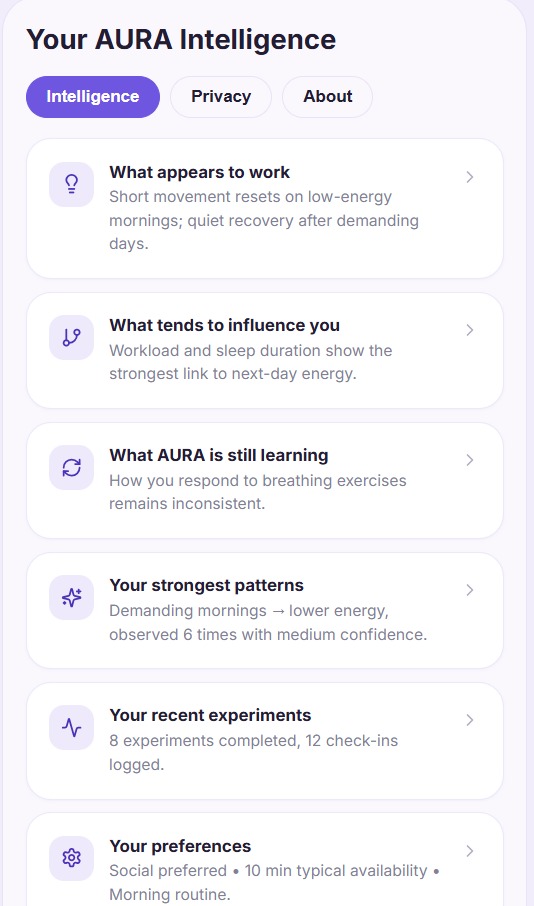
Displays learned patterns, influencing factors, areas still being learned, strongest patterns, recent experiments, and user preferences.
-
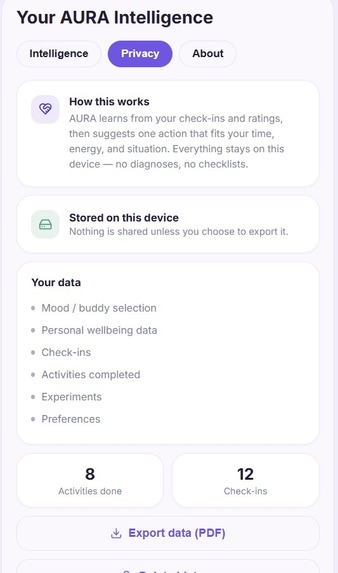
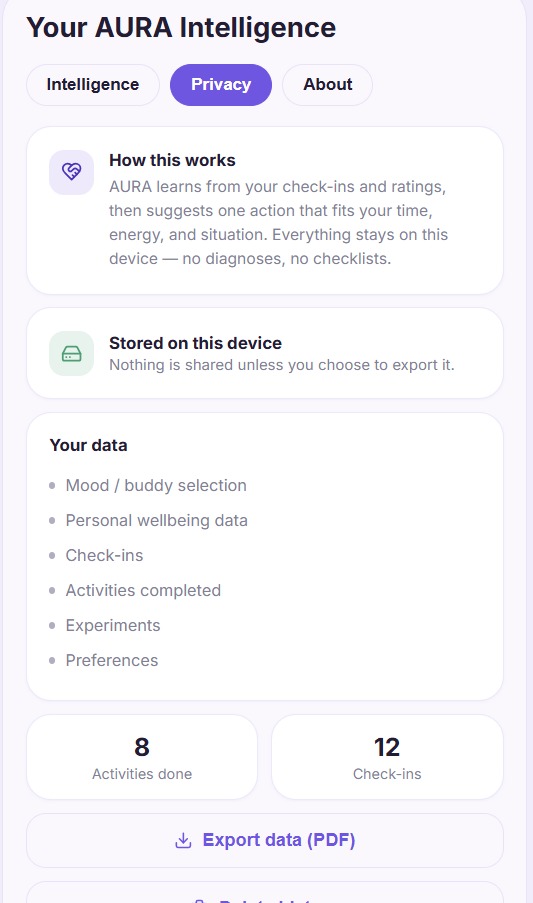
Explains how AURA works, what data is stored locally, what information is collected, and the user’s option to export data.
-
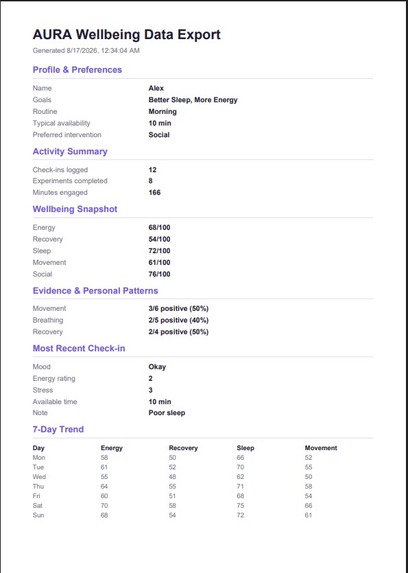
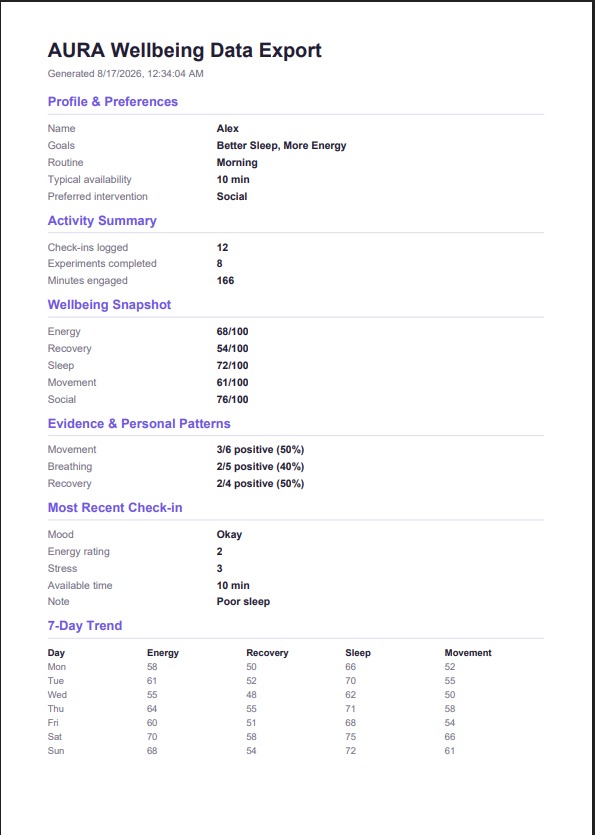
PDF export showing the user’s profile, activity summary, wellbeing scores, personal patterns, latest check-in, and 7-day trends.
-
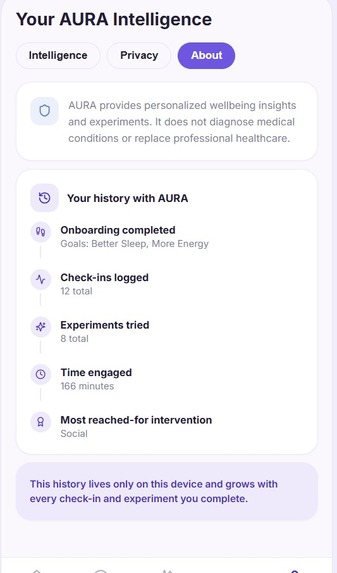
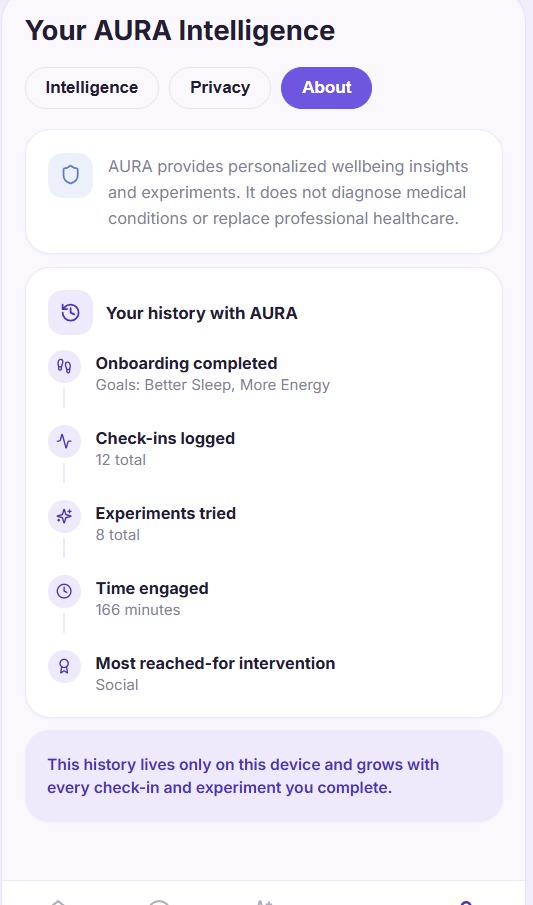
Overview of AURA’s purpose, user history, completed check-ins, experiments, engagement time, and most-used intervention.
Inspiration
Many wellbeing apps only track isolated metrics such as mood, habits, or activity. We wanted to create something more personal: a system that learns how different aspects of a person's daily life influence their wellbeing. This inspired AURA, a Personal Wellbeing Twin that continuously learns from check-ins, context, experiments, and feedback.
What it does
AURA creates a personalized digital representation of the user's wellbeing. It allows users to: Complete daily wellbeing check-ins. Track mood, energy, sleep, stress, and daily context. Discover personal patterns and relationships between behaviors and wellbeing. View a dynamic Wellbeing Twin. Receive personalized intervention recommendations. Understand "Why this?" behind each recommendation. Try small wellbeing experiments and provide feedback. Track progress, discoveries, and changes over time. Chat with AURA for personalized, context-aware guidance. The core learning loop is Observe → Understand → Identify Patterns → Recommend → Experiment → Receive Feedback → Learn → Update the Twin.
How we built it
AURA was built as a full-stack web application using React and Vite for the frontend and Node.js with Express for the backend. The frontend includes authentication, onboarding, check-ins, the Wellbeing Twin, Discover, AURA Chat, Progress, and Profile screens. The backend provides APIs for users, check-ins, recommendations, experiments, patterns, progress, and AI conversations. A structured wellbeing data model stores user context, interventions, experiments, patterns, personal responses, and hypotheses. We implemented a deterministic AI layer that grounds responses in the user's structured wellbeing data rather than inventing information. The prototype uses in-memory persistence and is designed to be extended with a real LLM and database such as PostgreSQL or Supabase.
Challenges we ran into
One of our biggest challenges was making personalization meaningful without making unsupported medical claims. We designed AURA to communicate uncertainty and use language such as "appears to" and "moderate confidence." Another challenge was creating a complete Human–AI learning loop rather than simply building a chatbot. We needed recommendations, experiments, feedback, evidence, pattern discovery, and Twin updates to work together as one continuous experience. We also had to balance a polished hackathon-ready interface with a functional full-stack architecture that could be extended beyond the prototype.
Accomplishments that we're proud of
We are proud that AURA goes beyond simple wellness tracking and demonstrates an actual personal learning loop. Key accomplishments include: A dynamic Wellbeing Twin experience. Personalized recommendations based on user context. Explainable "Why this?" recommendations. Micro-experiments with Better/Same/Worse feedback. Personal pattern and influence discovery. Progress and trend visualization. Context-aware AURA AI Chat. Full frontend and backend architecture. A safety-conscious design that avoids presenting wellness insights as medical diagnoses.
What we learned
We learned that effective personalization is not just about collecting more data. The system needs to understand context, communicate uncertainty, explain its reasoning, and learn from the user's actual experiences. We also learned the importance of designing AI around structured, trustworthy data rather than allowing a language model to freely generate recommendations. Building the complete feedback loop helped us understand how AI can become an adaptive companion instead of just a conversational interface.
What's next for AURA — AI-Powered Personal Wellbeing Twin
Our next step is to transform the prototype into a production-ready platform. We plan to: Integrate a real LLM for deeper personalized conversations. Replace in-memory storage with Supabase/PostgreSQL. Connect optional wearable and activity data. Improve the Personal Utility Score and pattern detection. Build stronger longitudinal wellbeing models. Add more personalized micro-experiments. Improve privacy, security, and consent controls. Add multilingual support, including regional languages. Develop stronger uncertainty and safety mechanisms. Explore an agentic architecture where AURA can proactively identify opportunities and guide users through personalized wellbeing experiments. Our long-term vision is for AURA to become a trusted personal wellbeing intelligence layer that learns with the user—not just tracks them.
Built With
- ai
- api
- behavioral
- chatbot
- css
- detection
- digital
- express.js
- generative
- health
- insights
- javascript
- node.js
- pattern
- personalization
- react
- rest
- supabase
- tailwind
- tracking
- twin
- typescript
- visualization
- vite
- wellness


Log in or sign up for Devpost to join the conversation.