About the Project
Inspiration
Code reviews are powerful, but they’re also slow and mentally taxing. Most of the time isn’t spent on the new code itself, but on reconstructing context:
- Where does this function live?
- What other files does it touch?
- How do I know this change won’t break something downstream?
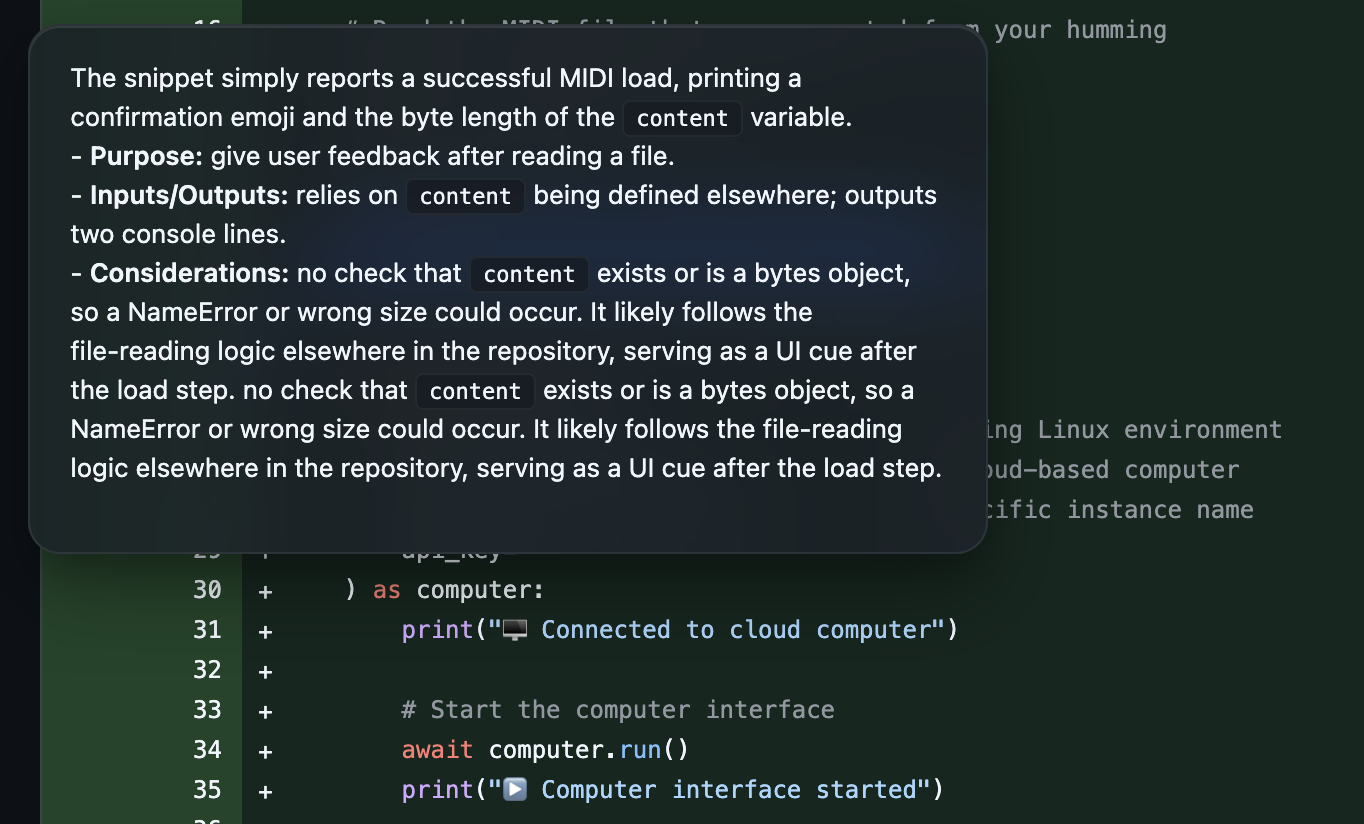
We wanted a tool that could reduce that cognitive overhead. Inspired by Arc’s link previews and modern AI copilots, we asked: what if GitHub reviews had inline AI explanations—just by selecting the code you care about?
What We Built
Oracle is a browser extension + backend that augments GitHub pull requests. With Oracle, you can:
- Select any block of code in a PR.
- Get an AI-generated summary of what it does, how it works, and why it matters.
- Pull in repo-wide context (definitions, callers, related files) to ground the explanation.
Architecture:
- Extension: Content script detects code selection in GitHub diffs and triggers a floating tooltip.
- Backend: FastAPI service with two main endpoints:
/ingest: loads the entire repo into memory, chunks it (functions/blocks), computes embeddings, and stores them in a vector DB./select: takes the selected code, finds related chunks via semantic search, and asks the LLM for a concise explanation.
- Storage: ChromaDB for vectors, lightweight caching, and OpenAI/Cerebras for summaries.
How We Built It
Repo ingestion
- Fetched repositories directly via the GitHub Trees + Raw API.
- Implemented naive chunking around functions, classes, and defs.
- Generated vector embeddings (
text-embedding-3-small) and upserted into Chroma.
- Fetched repositories directly via the GitHub Trees + Raw API.
Selection to summary
- Extension packages the selection (
file,sha,range,selected_text). - Backend performs k-NN search over embeddings to find semantically related chunks.
- Prompt constructed with both the selection and nearest neighbors.
- LLM outputs structured bullets and a concise explanation.
- Extension packages the selection (
Streaming UX
- Implemented
StreamingResponsein FastAPI so summaries stream progressively. - Tooltip updates in real time, creating an Arc-like feel.
- Implemented
What We Learned
- Streaming is tricky — browsers buffer unless you use
ReadableStream+TextDecodercarefully. - Vector embeddings matter — improving how we chunked files and generated embeddings had a direct impact on context quality. Better embeddings = higher precision in selecting relevant functions, tests, or callers.
- Context-sensitive analysis — explanations became far more accurate once we included related code blocks via semantic search. Pure “selected text” summaries often hallucinated; context-aware prompts grounded the LLM in reality.
- Developer experience counts — even small UI touches (tooltip delay, smooth streaming) make the tool feel like a natural part of GitHub reviews.
Challenges We Faced
- GitHub App vs. simplicity: private repo auth was too complex for the MVP, so we stuck with public repos.
- Large repos: had to filter by file type/size and truncate to keep embeddings tractable.
- Prompt balance: too much context = token explosion, too little = shallow explanations.
- Vector relevance: ensuring embeddings captured semantics (not just syntax) was non-trivial; we experimented with different models and chunk strategies.
- Error handling: the tooltip needed to fail gracefully without breaking GitHub’s DOM.
Next Steps
- Integrate Tree-sitter for smarter symbol parsing and chunk boundaries.
- Reduce the latency of the ingest functionality (Ollama embedding is a bit slow)
- Experiment with higher-quality embedding models and hybrid retrieval (vector + keyword).
- Add impact analysis: highlight downstream callers, related tests, and potentially affected modules.
- Support private repos through GitHub Apps.
- Polish the UX: inline definition modals, reviewer notes, and richer side panels.
Takeaway
Oracle taught us that the key to useful AI code review isn’t just summarization—it’s context-sensitive analysis powered by embeddings. By improving the quality of our vector index and grounding the LLM in relevant repo context, explanations became more reliable, concise, and reviewer-friendly.
Built With
- cerebras
- chroma
- docker
- fastapi
- javascript
- ollama
- python
- typescript


Log in or sign up for Devpost to join the conversation.