Inspiration
My inspiration began not with a specific application, but with a fundamental, universal problem in distributed systems: inefficiency caused by data redundancy. In any network generating parallel data streams—be it in finance, cloud computing, or logistics—redundancy wastes resources. I was fascinated by the idea of creating a truly adaptive, decentralized system that could self-optimize, much like a biological brain.
This led me to the neuroscientific principle of Hebbian Learning: "neurons that fire together, wire together." I decided to apply a twist to this paradigm. Instead of building a conventional neural network, what if the network nodes themselves—the data sources—could be treated as neurons? When their data streams "co-move" (fire together), the system could identify this as a redundancy (wire together) and intelligently act on it. This bio-inspired approach became the foundation for AURA.
What it does
AURA is a complete, autonomous system that optimizes resource usage in distributed data networks. At its core, it performs four key functions:
- It Measures Redundancy: Using a novel mathematical formula called the AURA Index, the system analyzes multiple data streams in real-time to precisely quantify informational redundancy.
- It Takes Intelligent Action: When redundancy is detected above a certain threshold, the system intelligently and temporarily deactivates the most redundant node, saving resources like power or bandwidth.
- It Learns and Self-Optimizes: AURA features a background "Learner" module that uses a Differential Evolution algorithm to continuously find the optimal parameters for its own logic, ensuring it adapts to changing data patterns to maximize efficiency while preserving data fidelity.
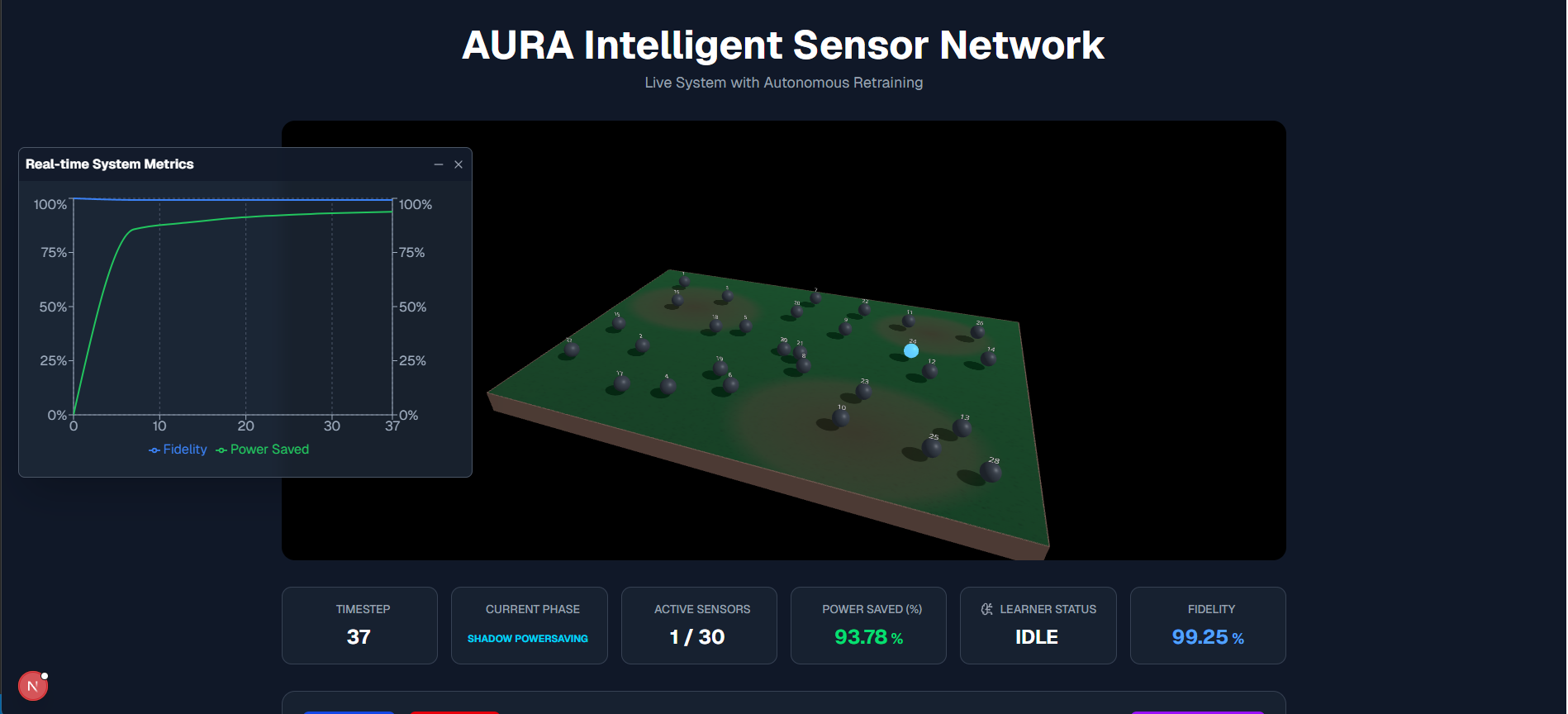
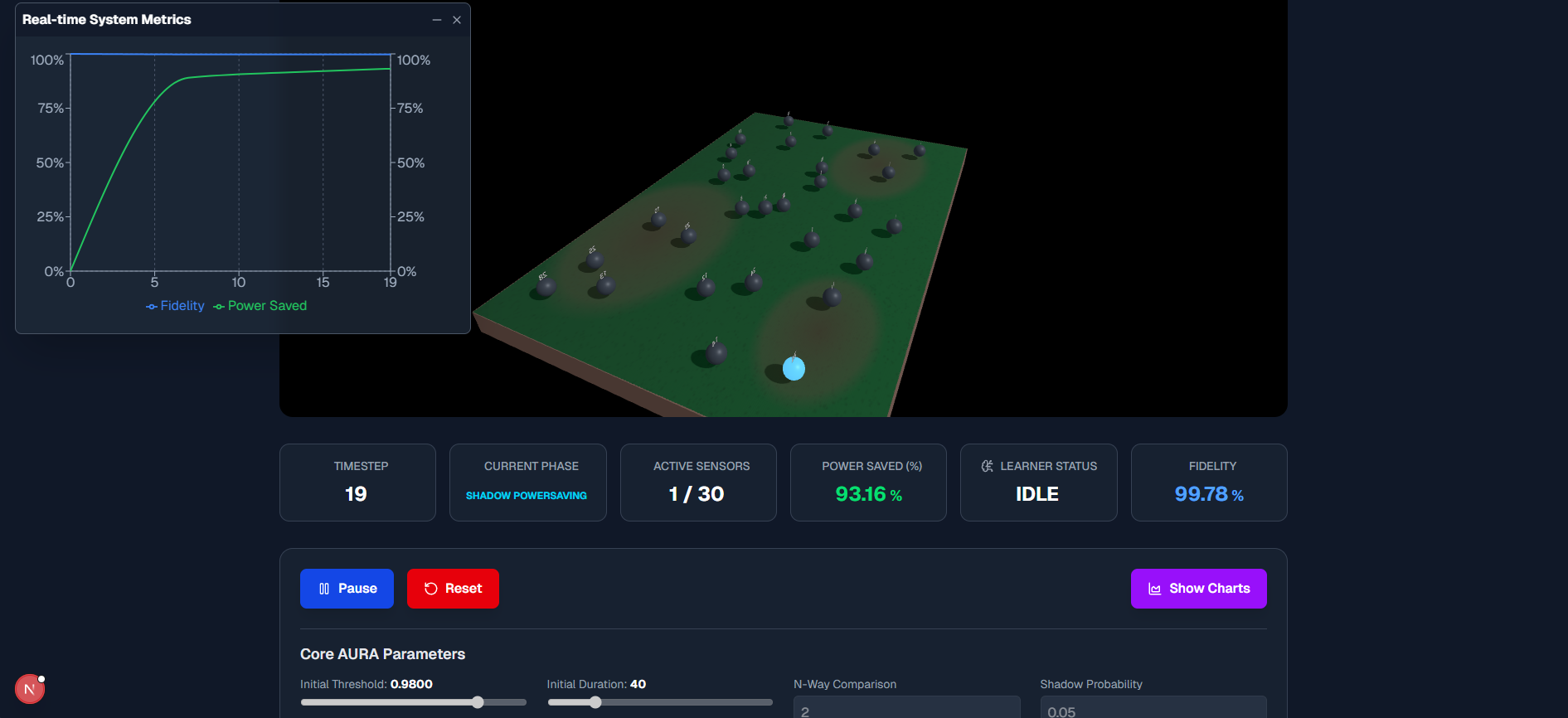
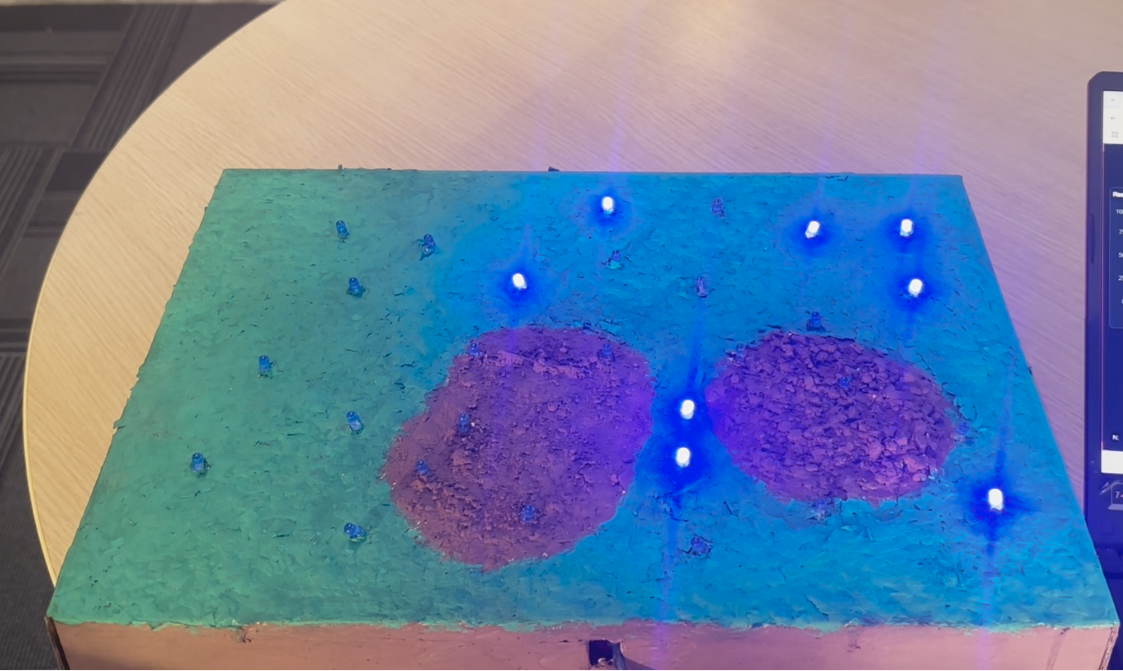
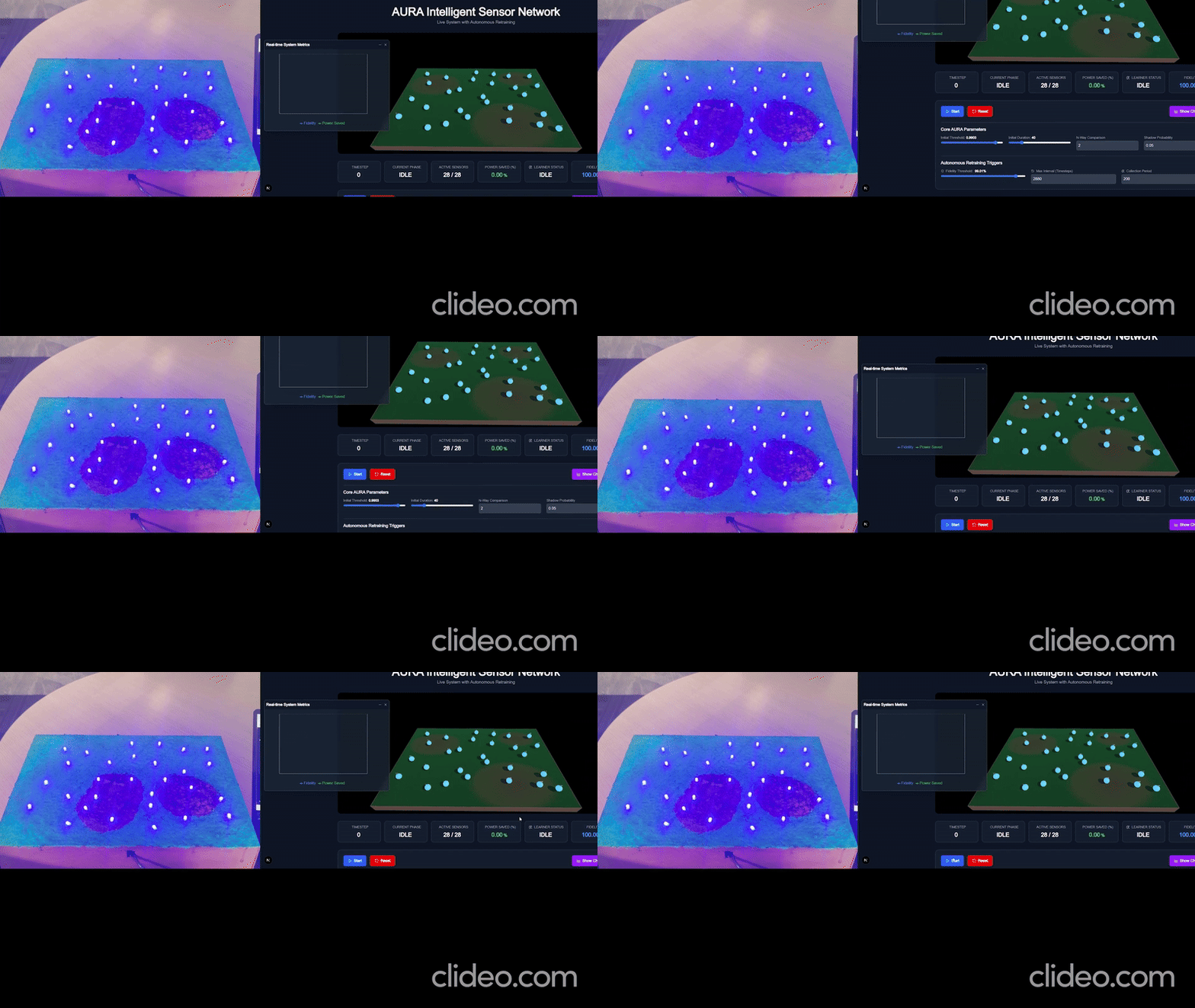
- It Visualizes Everything: The entire process is displayed through a real-time, interactive 3D web interface and mirrored on a physical hardware display, providing a transparent view into the algorithm's decisions and performance.
The end result is a high-performance network that uses significantly fewer resources with a negligible loss of data accuracy.
How I built it
The project evolved from a pure mathematical concept into a full-stack, hardware-in-the-loop prototype.
The first and most significant challenge was to design the mathematical "brain" of the system. After much experimentation, I developed a new, generalized formula that could measure multi-variable redundancy while being computationally lightweight. I call it the AURA Index (A):
$$ A = \frac{\sum_{i=1}^{n} \sin^2 \left( \frac{\pi \cdot s_i}{\sum_{j=1}^{n} s_j} \right)}{n \cdot \sin^2 \left( \frac{\pi}{n} \right)} $$
With this formula as the core, I built the rest of the system in four logical stages:
- The High-Performance Core: I built the simulation engine in Python, using Numba to compile the core AURA logic to machine code for the raw performance needed to benchmark the algorithm on large datasets.
- Adding Intelligence (The Learner): I integrated a Differential Evolution algorithm to run as a background "Learner" process. It autonomously discovers the optimal deactivation thresholds and durations for the Operator.
- Building the Interface (The GUI): I built a full-stack application with a FastAPI backend and a Next.js and Three.js frontend to create an immersive, real-time digital twin of the network.
- Making it Real (The Hardware): I integrated an Arduino Mega with a grid of LEDs that connects to the FastAPI server, mirroring the state of the digital simulation in the physical world in real-time.
Challenges faced
- The Hardware Hurdle: As someone who primarily focuses on algorithms and software, my initial attempts at hardware integration were met with cryptic errors and a few burnt components. This was frustrating, but it taught me invaluable lessons in hardware debugging.
- The Frontend Crash: Integrating a client-side library like Three.js into a server-side rendering framework like Next.js was a challenge. I was constantly met with white screens until I understood the nuances of how and when the 3D scene needed to be rendered.
- The "Honest" Metric: My first benchmark results were disappointingly low (~3% power saving). My confidence in the mathematical theory told me something was wrong with the implementation, not the idea. After scrutinizing the code, I found and fixed a logical flaw, which immediately validated the algorithm's power.
Accomplishments that I am proud of
- Developing a Novel Mathematical Formula: The single greatest accomplishment was the design of the AURA Index itself—a new, generalized formula for measuring multi-variable redundancy that is both computationally lightweight and highly effective.
- Achieving World-Class Performance: Across seven diverse datasets, our system achieved >75% power savings while maintaining an incredible 99.26% average data fidelity. This proves the algorithm is not just theoretically sound, but practically powerful.
- Building an End-to-End System: We successfully built a complete, complex system from the ground up, integrating a high-performance backend, a real-time 3D web frontend, and physical hardware into a single, cohesive prototype.
- Implementing True Autonomy: The "Learner" module makes the system truly autonomous. It can deploy into an unknown environment and teach itself the best way to operate, which is a major step beyond static, pre-configured systems.
What I learned
- Theory is your best Debugging Tool: When the initial benchmarks failed, it was the confidence in the mathematical foundation that pushed us to find the implementation flaw rather than give up on the idea.
- Integration is the Hardest Part: Designing a great algorithm is one thing; making it communicate flawlessly across a backend, a frontend, and physical hardware is where the real complexity lies. This project was a masterclass in full-stack, deep-tech integration.
- An "Honest" Metric is Everything: The process of debugging the performance metric taught us a critical lesson: the way you measure success is just as important as the algorithm itself.
Most importantly, we learned that a deep tech project's value is realized through the iterative, often challenging, process of building, testing, breaking, and fixing a complete system.
What's next for AURA
Having proven the algorithm's immense potential in a resource-constrained IoT network, the future of AURA lies in its universal applicability. Our next steps are:
- Apply AURA to New Domains: We plan to create case studies applying the AURA Index to other data-intensive fields, such as optimizing algorithmic trading signals, monitoring cloud server performance metrics, and streamlining logistics networks.
- Package as a Lightweight Library: We will distill the core algorithm into a lightweight, high-performance Python library that can be easily integrated into any data pipeline.
- Publish the Findings: We intend to write a formal whitepaper on the mathematical properties of the AURA Index and its performance benchmarks, contributing our findings to the broader technical community.

Log in or sign up for Devpost to join the conversation.