-
-
-

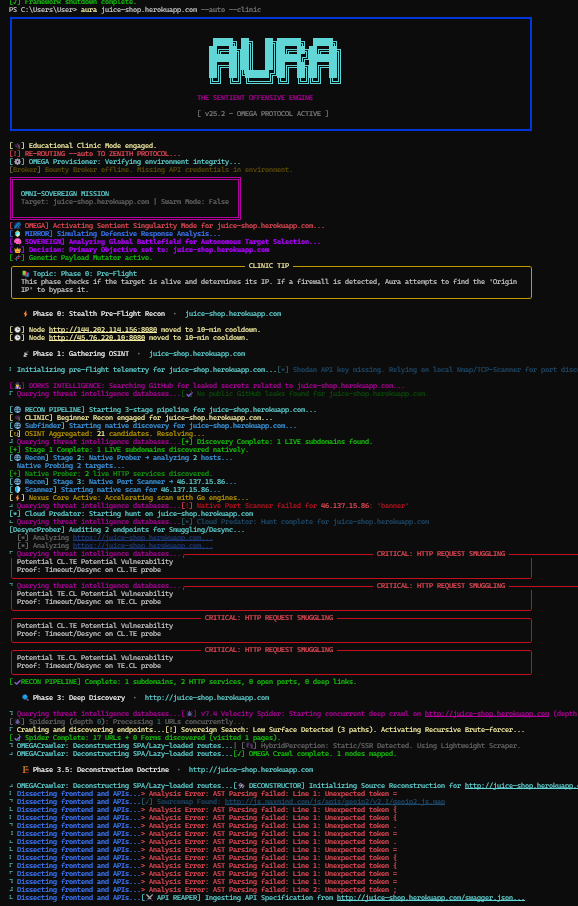
Omega Protocol Visualization
-

Project Hero Banner
-
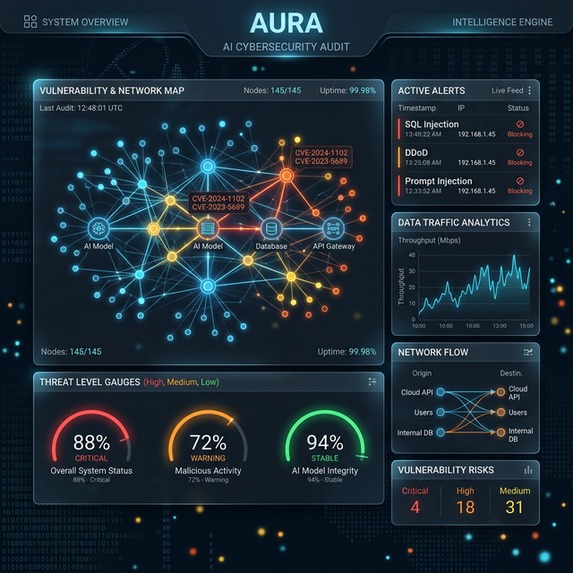
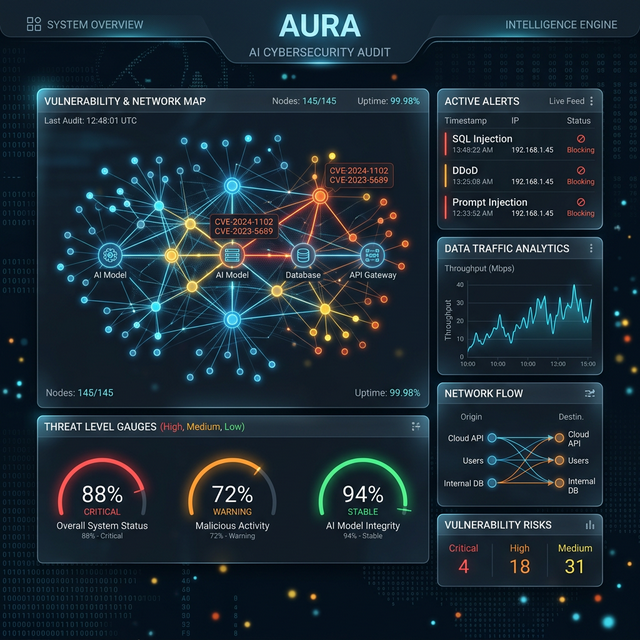
Advanced Audit Dashboard
-
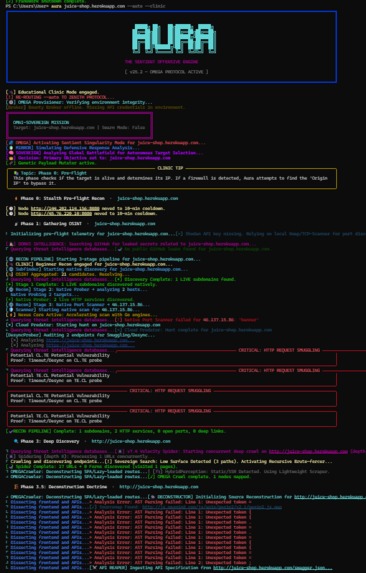
How it looks like


Inspiration Aura was born from the frustration of managing a fragmented security stack and the repetitive, "manual-heavy" nature of professional bug hunting. While traditional scanners provide raw data, they lack the contextual intelligence to bridge the gap between discovery and actual exploitation. I wanted to build a sovereign, autonomous framework that doesn't just scan for vulnerabilities but "understands" the target's architecture—an AI-driven partner capable of executing a full-scale offensive mission from initial recon to final report submission.
What it does Aura is an AI-native Offensive Intelligence Framework designed for high-stakes bug bounty hunting and pentesting. It features:
- Neural Orchestrator: An AI "brain" (leveraging Gemini and Llama 3.1) that analyzes targets and devises custom "Battle Plans."
- The Zenith Protocol: An autopilot mode that executes the entire mission lifecycle—recon, authenticated crawling, DAST, and exploitation—without human intervention.
- Specialized Engines: Dedicated modules for BOLA/IDOR hunting, SSRF (OOB & Cloud Metadata), SQLi, and Path Traversal.
- Web3 & AST Auditing: Advanced static analysis using Semantic AST Taint Analysis for zero-FP JavaScript auditing and a dedicated Web3 engine for smart contract security.
- Aura Nexus: A professional web-based dashboard and "War Room" for real-time monitoring and interactive reporting.
How we built it Aura is architected for speed, modularity, and intelligence:
- Orchestration: Built with Python (Asyncio) to handle complex, concurrent offensive pipelines.
- Core Logic: Powered by a DAG-based Stateful Logic Fuzzer that maps API dependencies to find complex logical flaws.
- High-Speed Fuzzing: Integrated Go-based Turbo Fuzzers for performance-critical tasks like directory discovery and parameter mining.
- Intelligence Layer: Uses the Gemini API for deep strategic analysis and Ollama for private, local AI processing.
- Data & Reporting: A custom SQLite-backed "Intelligence DB" tracks findings, while a professional HTML/PDF reporting engine handles automated submissions to HackerOne and Intigriti.
Challenges we ran into The most significant hurdle was WAF (Web Application Firewall) Evasion. Standard automated tools are quickly flagged and blocked. We overcame this by building Phantom Routing, a proxy-mesh system that rotates footprints and masks scanner signatures. We also struggled with high false-positive rates in automated XSS and SQLi scans; we solved this by implementing a POC Validation Engine that generates and executes real, safe Proof-of-Concepts before any finding is officially recorded.
Accomplishments that we're proud of We are incredibly proud of the Neural Orchestrator. Seeing the framework take a single domain and autonomously decide to pivot from a public JS file to an internal API endpoint—and then find a BOLA vulnerability—was a "eureka" moment. Integrating Semantic AST Taint Analysis into a bug bounty tool also sets Aura apart, bringing enterprise-grade static analysis to the offensive community.
What we learned Building Aura was a masterclass in the intersection of AI and Cybersecurity. We learned that context is king—a tool that knows it’s looking at a "User Profile" endpoint is 10x more effective than one that just sees a URL. We also gained deep expertise in managing asynchronous pipelines, mastering the complexities of stateful API testing, and the nuances of Web3 security auditing.
What's next for aura The journey for Aura is just beginning. Our roadmap includes:
- Aura v3 Expansion: Deepening our Web3 capabilities to include automated DeFi protocol simulations.
- Distributed Swarm: Enabling multiple Aura nodes to collaborate on a single target for massive-scale reconnaissance.
- The Global Nexus: A community-driven intelligence exchange for sharing (sanitized) attack patterns and discovery maps.
- Enhanced Stealth: Refining Phantom Routing to use behavioral AI to mimic human browsing patterns, making Aura virtually invisible to modern WAFs.
Built With
- ai
- aiohttp
- css
- cyber-security
- dag
- esprima
- go
- html
- httpx
- javascript
- json-rpc
- neural-modeling
- python
- rich

Log in or sign up for Devpost to join the conversation.