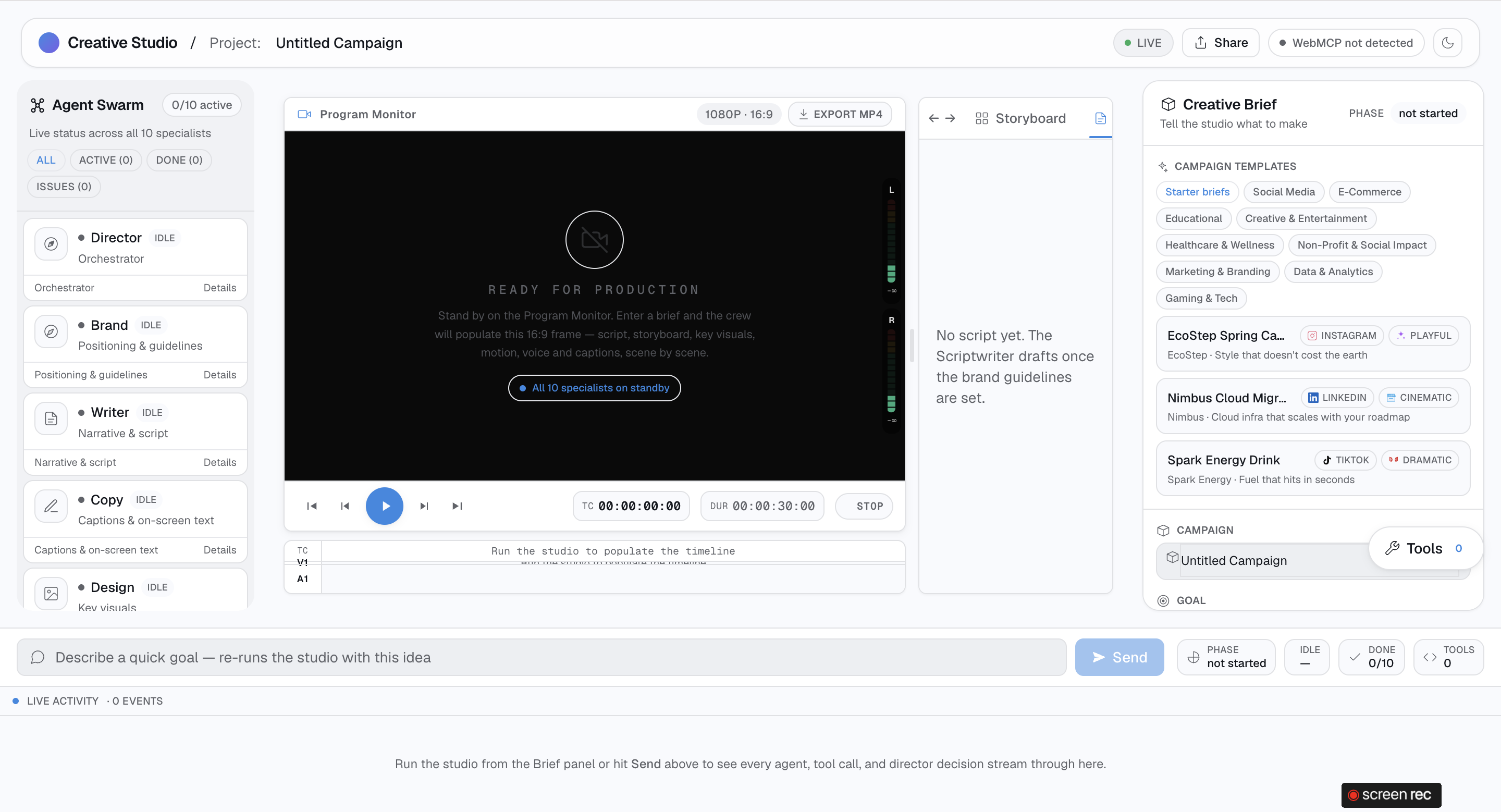
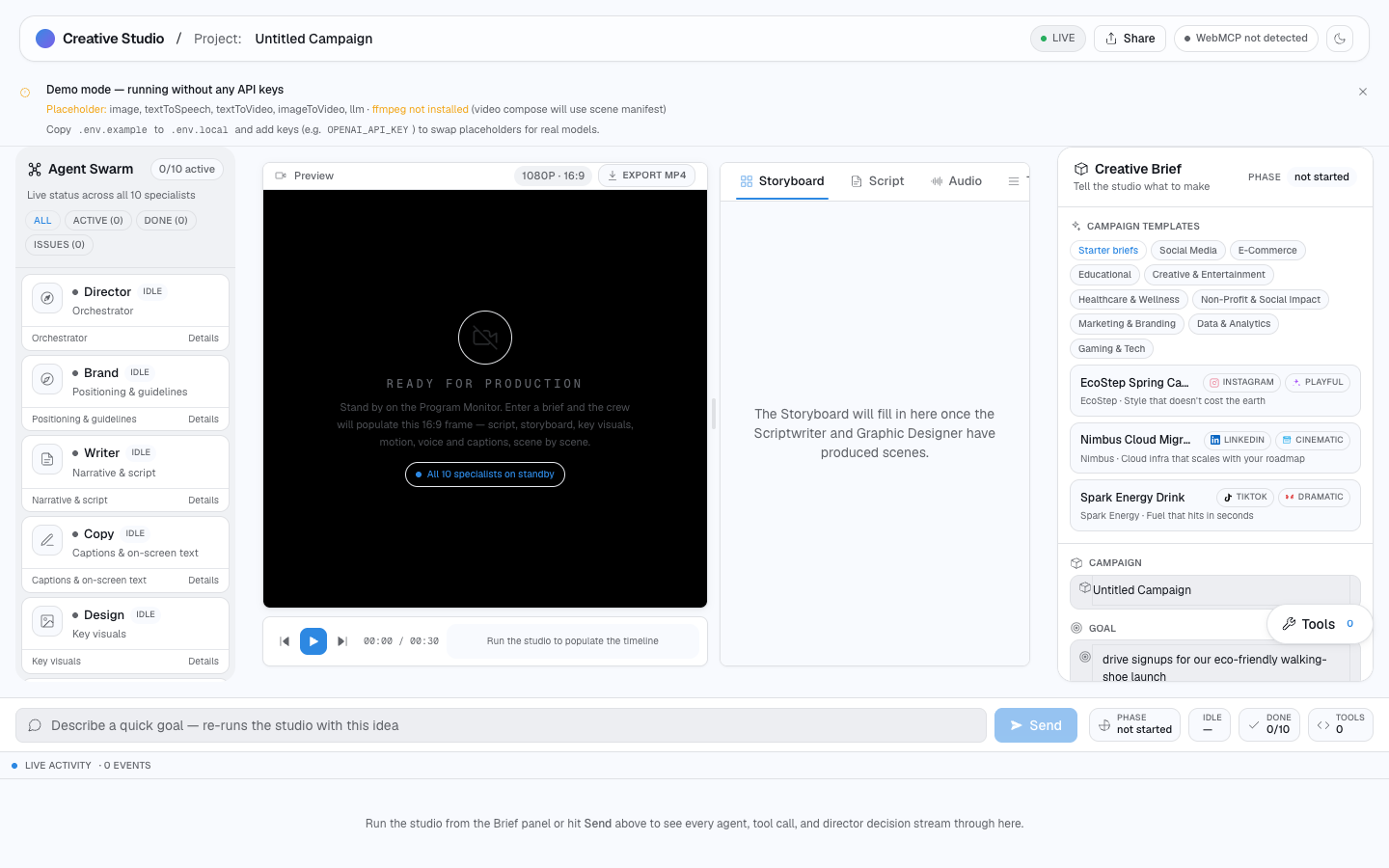
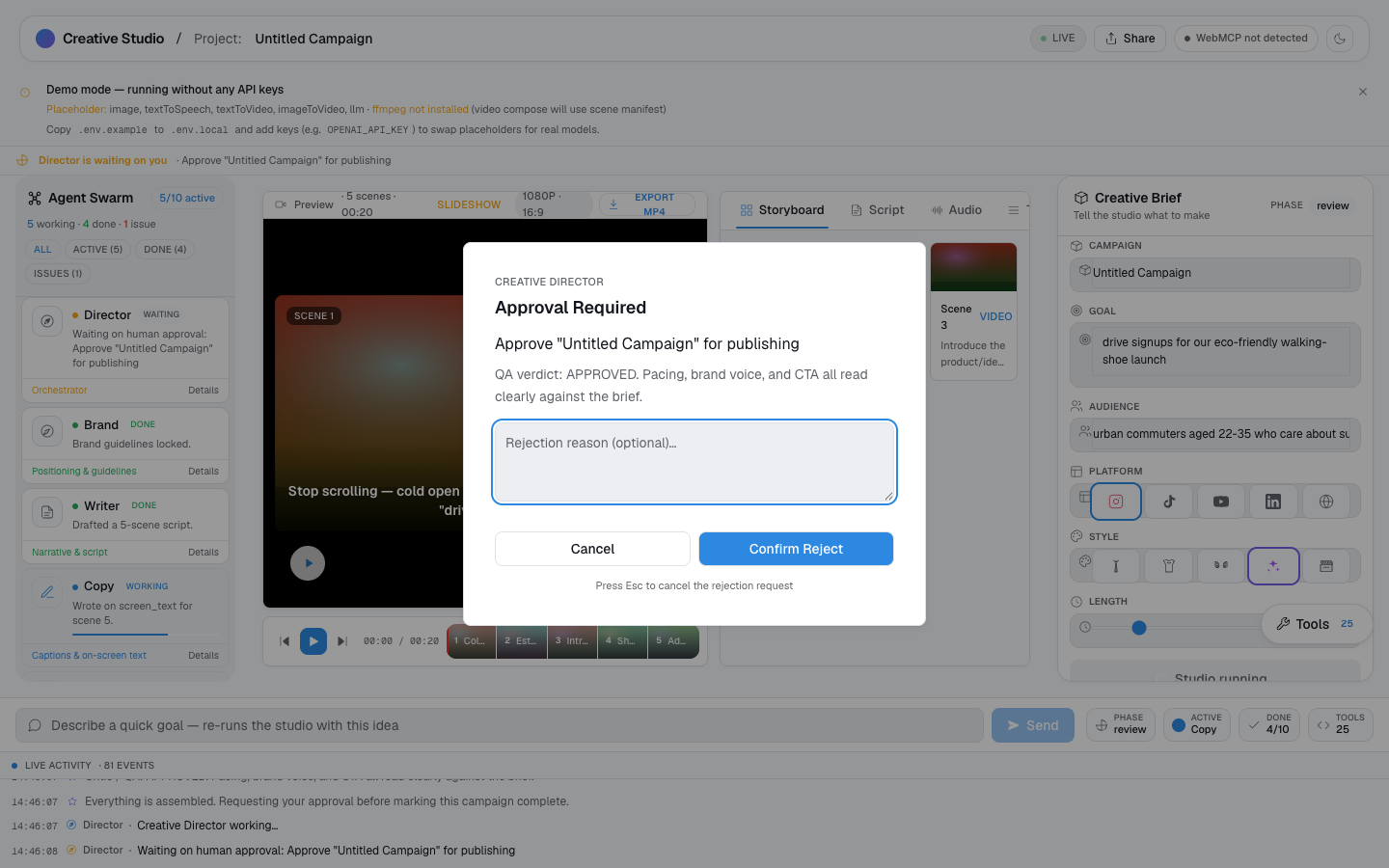
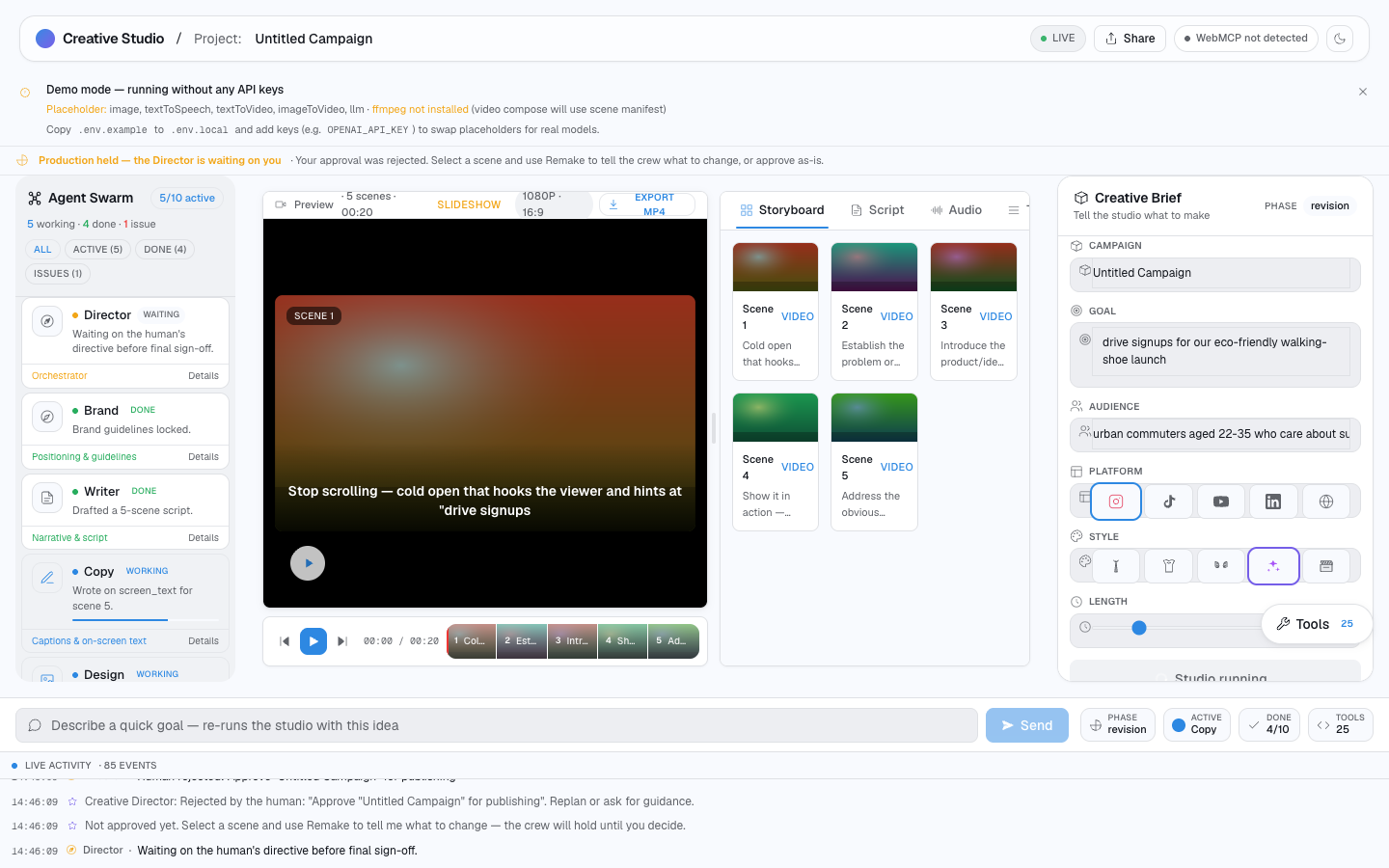
AURA Creative Atudioturns AI video generation from a black box into a collaborative production studio where agents work as a creative crew and humans remain the executive producer.
Demo proof chain: WebMCP → 16 tools → 10 agents → visible artifacts → human veto → adaptive re-make → final video. Every arrow is live on the deployed site.
Inspiration
A few weeks before the hackathon I watched a teammate try to get a 30-second product video out of a top-tier text-to-video model. The workflow was brutal: type a prompt, wait three minutes, watch a video that was almost right, and then type the prompt again with slightly nicer words. Each cycle cost minutes and money, and each cycle discarded everything from the last one. It wasn't a production tool. It was a slot machine.
That's when the shape of the problem clicked for me. The thing that makes a video actually good is not a single prompt — it's a chain of interdependent decisions:
$$ \text{video} = \big(\text{human gate} \circ \text{QA} \circ \text{compose} \circ \text{motion} \circ \text{visuals} \circ \text{voice} \circ \text{storyboard} \circ \text{script} \circ \text{brand}\big)(\text{brief}) $$
A script depends on brand tone. The storyboard depends on the script. The visuals depend on the storyboard. The motion depends on the visuals. The voice depends on the script. Each step is a role — a real job a human production house would assign to a different specialist. So the ambitious framing I wanted to test was: what if a video tool was structured like a studio, not like a chat box? What if every one of those roles was a named agent you could watch, every output was an artifact you could inspect, and one agent — the Creative Director — was answerable to you?
Then WebMCP made it feel inevitable. The whole value of a studio lives in its structure — coordinated, typed, sequential actions. That is exactly what WebMCP was designed to expose to agents. Instead of an agent scraping DOM and guessing at buttons, the studio could just declare its capabilities with JSON Schemas and let any WebMCP-capable agent drive them reliably. I wanted to prove, in one running app, that the same surface a human uses can be the surface any agent picks up — with the human still holding the final say.
The result is AURA: a 10-agent production crew, a control room a human can sit in, and a WebMCP tool surface that turns the studio into something *agents can work at — not just something agents can look at.
What it does
A human (or any WebMCP-capable agent) gives AURA a brief — "30-second Instagram Reel for a sustainable sneaker brand, premium feel"— and the studio runs a real production pipeline:
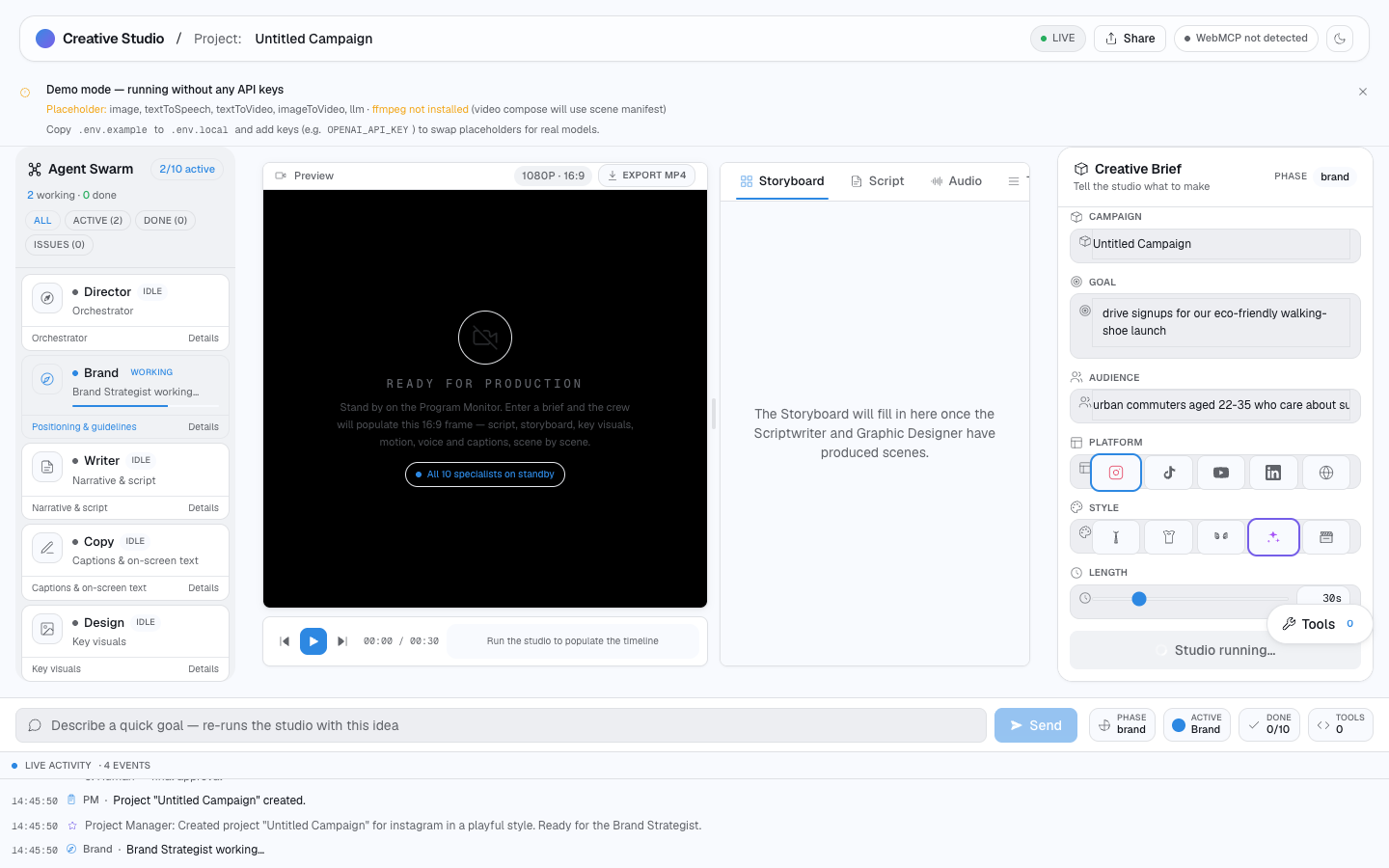
- The Creative Director announces a plan before anything generates: Brand Strategy → Script → Storyboard → Visuals → Motion → Voice → Edit → QA → Human Approval.
- The specialists execute in sequence**, each status flipping live in the left "Agent Swarm" sidebar. Every artifact lands in the center workspace as it's produced — script as text, storyboard as scene descriptions, visuals as stills, clips as video, narration as audio, captions as on-screen text.
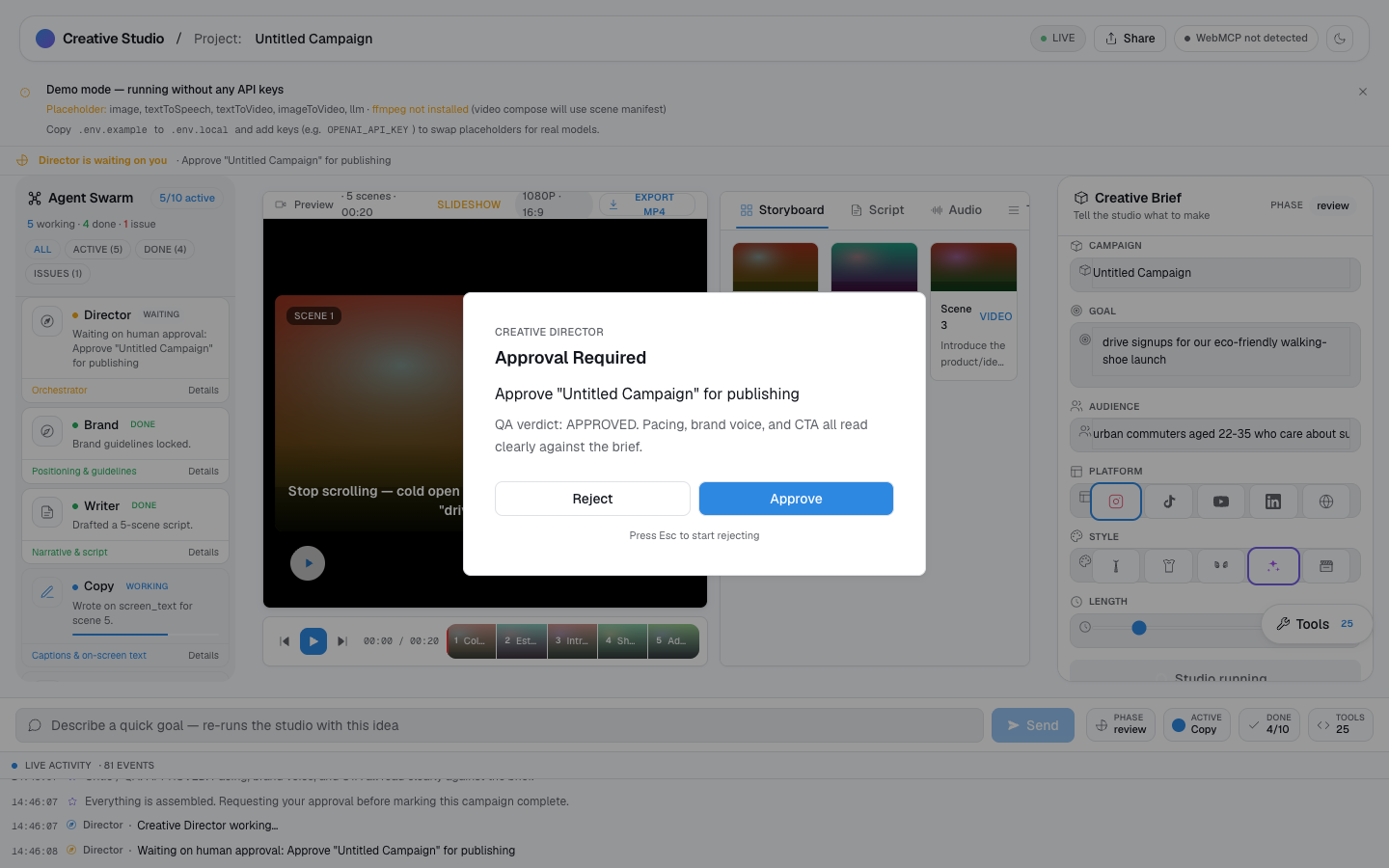
- The Critic/QA agent reviews the composed video and returns
APPROVEDorNEEDS_REVISIONwith actionable notes. - The Human Veto gate fires: the pipeline pauses, an approval modal opens
in-page, and the human decides.
- Approve → campaign complete, export enabled.
- Reject → pick the offending scene, type a note ("doesn't feel premium — elevate the product hero shot"), click Remake Scene 3. Only that scene regenerates; the script, the other scenes, the captions, and the voice are untouched.
It's a production system with multiple drivers, all acting on the same state and the same human gate:
- In-app Director — fill in the brief, click Run Studio. Zero API keys, fully deterministic demo mode.
- Browser agent over WebMCP — all 16 tools registered on
document.modelContext; any agent can inspect and invoke them. - Server-side agent over HTTP —
GET /api/webmcp/toolsfor the catalog,POST /api/webmcp/executeto invoke, with state persisted across requests.
All three paths log to one Debug Panel, so there is one unified trace no matter who is actually calling the tools.
How we built it
The spine: one store, three front doors
The non-negotiable architecture decision was state coherence. If the in-app
Director and an external agent could diverge, the whole "one studio, many
drivers" story collapses. So every tool is a small factory that reads and writes
the same Zustand store the UI renders (src/lib/webmcp/tools/, one file per
tool). The browser registers those tools on modelContext; the HTTP routes
invoke the same factories; the UI polls the server snapshot and hydrates. There
is one state, three front doors.
Reading the spec, not the summary
WebMCP is young and the implementation details churn. Three gotchas we learned
by reading webmachinelearning/webmcp/index.bs directly rather than trusting
secondhand docs:
document.modelContext, notnavigator.modelContext.The spec defines it onDocument. Chrome's origin trial shipped it onnavigatorin 149 and moved it todocumentin 150.useWebMCP.tsprefersdocumentand falls back tonavigator, so the studio survives the transition.registerTool()is synchronous and throws.** Its IDL return type isundefined; it throwsInvalidStateError(duplicate/empty name) orNotAllowedError(permissions policy) synchronously. So registration is wrapped in try/catch, not.catch().- Tool results use the MCP content-block shape.**
{ content: [{ type: "text", text: "..." }] }— a sharedtextResult()helper keeps every tool consistent with the Model Context Protocol format WebMCP deliberately mirrors.
The human veto as a first-class tool
request_human_approval is the one tool every path must call before
completion. It implements WebMCP's confirmation pattern
(client.requestUserInteraction) so execution genuinely pauses until the human
decides — whether the driver is the in-app Director or an external agent. On
reject, refine_scene re-generates only the affected asset. The server-side
state machine refuses to transition to phase=complete without an explicit
human approved: true. No agent can ship around the human.
Demo-first, keys-later
We built the studio to run end-to-end with zero API keys. Every
/api/generate/* route checks for a provider key; when absent it returns a
deterministic placeholder asset. Real providers (OpenAI gpt-image-1,
Speechify, Google Veo 3, fal.ai, Runway, Luma, Replicate) are wired and
configurable, but the default experience — the one judges hit — works with no
signup, no billing, no black box.
Verification as a product
We shipped a hardware-style verification harness (scripts/verify/build-mode.sh):
6 gates, 39 acceptance tests, 3 strategic pauses, driving real Chrome to
exercise the WebMCP registration, the veto loop, and external-agent→UI
hydration. Every claim in the README is something a script actually does, not
something we assert.
Challenges we ran into
The moving WebMCP target
The API surface changed during the hackathon: Chrome 149 exposed
navigator.modelContext, Chrome 150 moved it to document.modelContext to
match the spec. Code written against blog posts would have broken on exactly the
wrong day. The fix was to stop trusting summaries, read index.bs, and support
both namespaces with a fallback chain. It taught me that for a brand-new
platform API, the spec source is the true documentation.
Trackpad swipes that "did dead nothing"
Swipe-to-change-tab on the workspace felt dead on trackpads. The root cause
was subtle: the browser assumes every horizontal pan could be a scroll and fires
pointercancel to steal the gesture — dropping the swipe before it ever crossed
our 60px threshold. The fix had two parts: touch-action: pan-y on the panel
(telling the browser only vertical pans belong to it) and committing the tab
change live the instant the threshold is crossed, so a late pointercancel
can't eat a completed swipe.
A stray Esc could fire a human veto
The rejection modal's Esc handler accidentally shortcut the rejection — one
stray keypress would drop the user straight into the remake loop, which is a
disaster for a flow whose entire point is that rejection is deliberate. We
made Esc toggle a two-step Reject confirm (with a reason field); a second
Esc cancels. Reject never resolves a decision on its own.
"It worked yesterday" — the leftover-state problem
Server state persisted in .studio-state.json, and the UI persisted split
settings in localStorage. Fine during development, terrible for a judge demo:
a fresh visitor could load straight into someone else's finished project. We made
startup a blank session — remove localStorage persistence so prior demo state is
gone until a judge initiates — and the reset endpoint (DELETE
/api/webmcp/execute) idempotent.
Serverless is not a laptop
File-based state and public/assets/ writing are fine in next dev and break
on cold-start serverless. For the Vercel deploy we added a durable
Supabase-backed state path and Cloudflare R2 for generated media, with graceful
fallbacks when config is absent. Same lesson as the swipes: the demo path must
be the deploy path.
Shipping a "finished" video without burning money
Real generation costs real money, and a judge demo shouldn't rack up a provider
bill. We added a global content cache + stills-default strategy and a
cache-first guard for image-to-video so repeated scenes reuse assets, keeping
demo cost bounded while still showing real generation paths. And when ffmpeg
isn't available on the host, compose falls back to a scene-manifest slideshow the
preview plays in-browser — the pipeline never dead-ends on a missing binary.
Accomplishments that we're proud of
- A genuine human veto, not a fake one. The state machine physically cannot
complete without
approved: true, and rejection triggers a targeted remake. This is the difference between a generator and a studio. - One studio, three drivers, one trace. The same 16 tools power the in-app
Director, a browser agent via
document.modelContext, and an external agent over HTTP — all visible in one Debug Panel and one Zustand store. - It runs with zero keys.** A judge can
npm install, run the studio, run the whole pipeline, and download an MP4 without creating a single account. - Spec-verified WebMCP.Every registration choice is checked against the W3C
source, including the
document/navigatortransition and the synchronous throw semantics ofregisterTool(). - 64/64 acceptance checks green across the build-mode harness (6 gates, 39 tests, 3 pauses) — WebMCP regression, veto loop, and external-agent hydration all end-to-end against real Chrome.
What we learned
WebMCP's real power is that a site declares its actions. The coordination problem agents used to solve by scraping and clicking is replaced by a typed, described, owner-labeled tool surface. Once I saw the studio as "a set of structured actions," the UI became just one more client of that surface — and every other agent became a first-class user too.
The human gate is the feature. Early on I treated the veto as a compliance checkbox. It turned out to be the emotional core of the demo: "I interrupted mid-production, the crew adapted, and the final cut is mine." Trust in AI creative tools comes from the ability to say no and be heard on one specific decision — not from burning the whole roll.
Crew size is a design decision.One agent is a black box; fifty agents is theatre. Ten — a Director plus nine specialists with narrow, non-overlapping "you do NOT do X" boundaries — is legible in a sidebar, true to how a real production house staffs a 30-second spot, and small enough to verify.
Demo-first forces product discipline. Every provider needed a fallback, so the whole app had to be cohesive to run with zero keys. That constraint made the architecture better, not worse.
What's next
- Durable multi-tenant state.Swap the single-file store for a Postgres/Redis-backed server store keyed by project, so the studio becomes a real SaaS surface with per-tenant auth.
- Parallel scene production.Where steps are independent (scene visuals, voice, captions), dispatch them concurrently with cost/quality telemetry.
- Refinement memory. Carry brand guidelines and rejection notes across campaigns so the crew gets better at a brand over time, instead of starting from zero each brief.
- Provider cost guardrails. A per-campaign budget model with live spend telemetry, so the Director self-limits based on the brief's risk class.
- A WebMCP-native "agent time" UI — a view where the human reviews and comments on the crew's decisions while they run, not only at the gate.
Built With
- cloudflare
- css
- fal.ai
- ffmpeg
- middleware
- next.js
- openai
- playwright
- r2
- react
- speechify
- supabase
- tailwind
- typescript
- veo
- vercel
- webmcp
- webmcp-(`document.modelcontext`-/-`navigator.modelcontext`)-next.js-14-(app-router)-react-18-typescript-(strict)-tailwind-css-v3.4-geist-(type)-zustand-4-openai-(`gpt-image-1`
- zustand

Log in or sign up for Devpost to join the conversation.