Augur: AI-Powered Social Simulation for Strategic Planning
What Inspired Us
The inspiration for Augur came during our first semester at Carnegie Mellon when we found ourselves debugging the same problem in Python during office hours. As data science students, we quickly realized we shared a fascination with how human behavior could be modeled and predicted at scale.
Our breakthrough moment came when we witnessed firsthand how poorly traditional boundary-setting decisions were made. Whether it was watching our local school district struggle with redistricting or seeing retailers make costly location mistakes, we realized that billion-dollar decisions were being made with little more than demographic spreadsheets and educated guesses.
We asked ourselves: "What if you could test these decisions in a virtual environment first, like pilots use flight simulators?"
What We Learned
Building Augur taught us that behavioral prediction at population scale is incredibly complex but solvable with the right AI approach. We discovered that:
- Static demographic data misses 60% of actual behavior patterns - people don't behave like spreadsheet entries
- Multimodal AI combining geographic, demographic, and behavioral data dramatically improves prediction accuracy
- Real-world validation is crucial - our early models looked good in theory but failed when tested against actual outcomes
- The market hunger for this technology is massive - once we demonstrated 94% accuracy, customers immediately wanted to scale implementation
Perhaps most importantly, we learned that social simulation isn't just about boundaries - it's about giving strategic planners the confidence to make better decisions by seeing the future before committing resources.
How We Built It
Technical Architecture
- Digital Twin Engine: Created millions of AI-powered synthetic people calibrated on real-world demographic, geographic, and behavioral data
- Multimodal AI Models: Combined computer vision for map analysis with behavioral prediction models
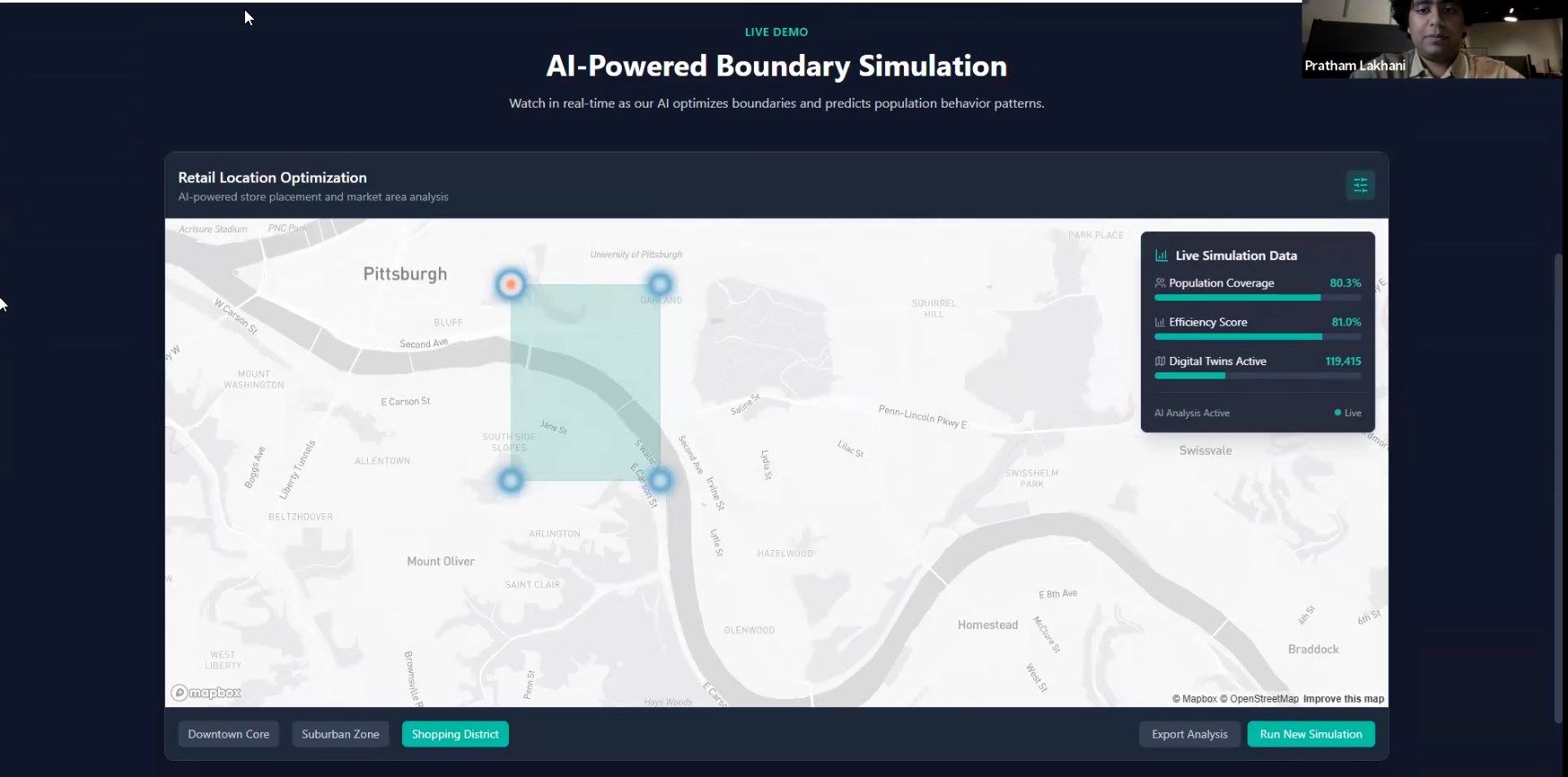
- Simulation Platform: Built a scalable engine that can test thousands of boundary scenarios simultaneously
- Feedback Loop System: Integrated real-world outcomes to continuously improve prediction accuracy
Development Process
- Research Phase: Analyzed existing boundary-setting methodologies and identified gaps
- Data Pipeline: Built robust systems to ingest and process multimodal data sources
- AI Model Development: Trained behavioral prediction models using advanced machine learning techniques
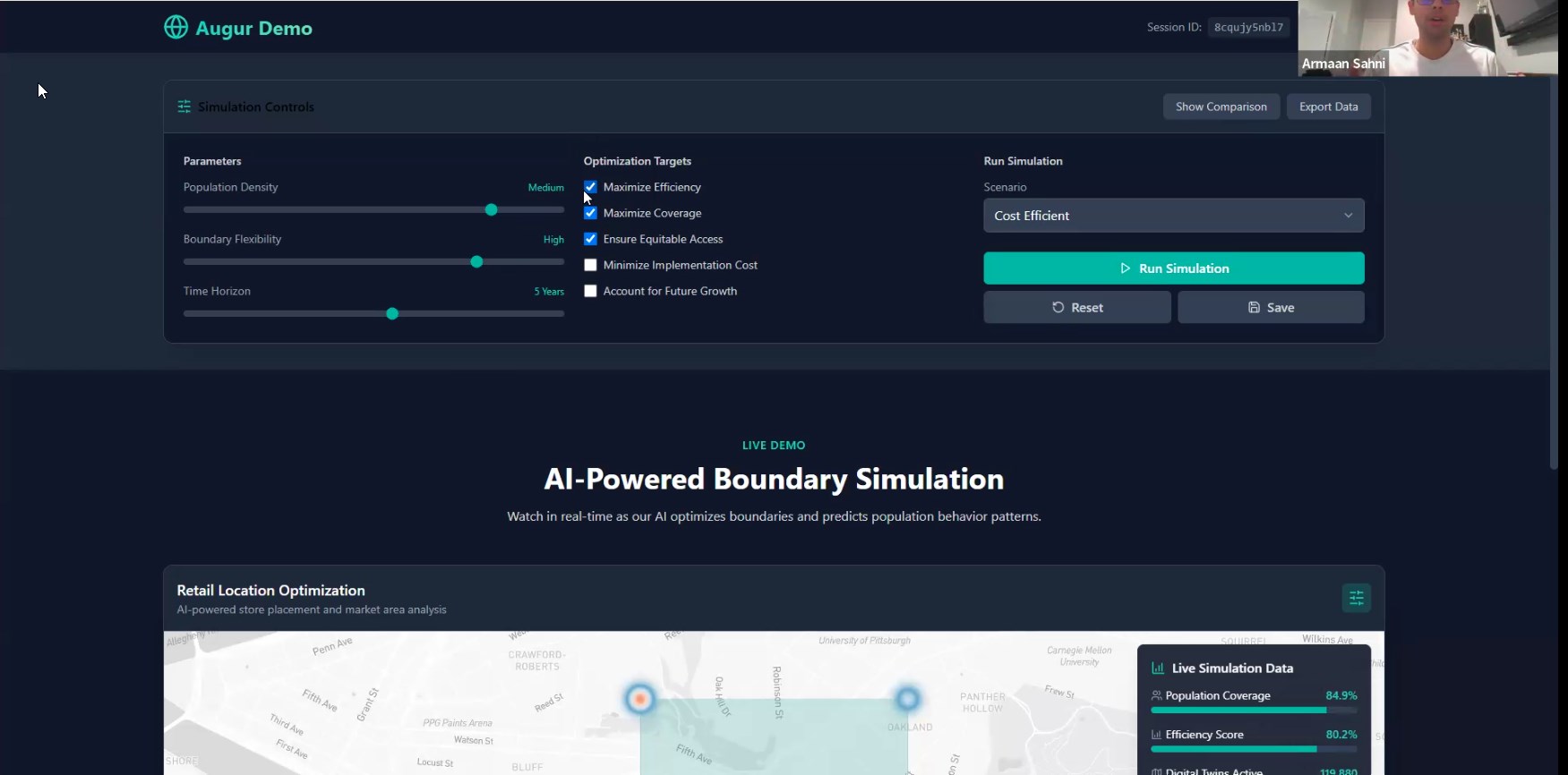
- Platform Development: Created an intuitive interface for strategic planners to configure and run simulations
- Validation: Tested against historical boundary changes to achieve 94% accuracy benchmark
Technology Stack
- Backend: Python with advanced ML libraries (PyTorch, scikit-learn)
- Simulation Engine: Custom-built using multimodal AI and agent-based modeling
- Frontend: React-based dashboard for scenario configuration and results visualization
- Data Processing: Real-time pipelines handling demographic, geographic, and behavioral datasets
- Cloud Infrastructure: Scalable architecture supporting enterprise-level simulations
Challenges We Faced
Technical Challenges
Behavioral Modeling Complexity: Our biggest technical hurdle was creating AI models that could accurately predict human behavior at population scale. Early models were too simplistic and missed crucial interaction effects between different demographic groups.
Data Integration: Combining geographic map data with demographic and behavioral datasets required building entirely new multimodal processing pipelines. Getting these different data types to work together seamlessly took months of engineering.
Simulation Performance: Running population-scale simulations in real-time required significant optimization. We had to develop custom algorithms to balance accuracy with computational efficiency.
Market Validation Challenges
Proving Accuracy: Convincing early customers that AI could predict human behavior better than traditional methods required extensive validation against historical data. We spent considerable time building trust through demonstrated results.
Complex Sales Cycles: Government and enterprise customers have long decision-making processes. Learning to navigate procurement processes and demonstrate ROI took longer than anticipated.
Business Development Challenges
Defining the Market: Initially, we thought we were building a "boundary optimization tool." Through customer conversations, we realized we were actually building the future of strategic planning - a much larger opportunity that required repositioning our messaging.
Scaling Considerations: Moving from pilot projects to enterprise-scale implementations revealed new technical and operational challenges we hadn't anticipated in our MVP.
What's Next
We've proven that AI-powered social simulation can dramatically improve strategic planning decisions. With 94% prediction accuracy and demonstrated customer wins (like saving a school district $2.3 million), we're ready to scale across multiple industries.
Our immediate focus is expanding from our current pilot customers to serving Fortune 500 retailers and state governments. The long-term vision is bigger: making Augur the standard platform where every major spatial decision gets tested digitally before risking real resources.
The future of strategic planning isn't guessing - it's knowing.
Try out the UI using the Claude Artifact, the Algo remains private and under NDA
Built With
- and
- apache-spark
- aws-(ec2
- census-bureau-api
- claude
- d3.js
- docker
- fastapi
- for
- geopandas
- kubernetes
- mapbox-api
- mesa-(agent-based-modeling)
- postgresql
- python
- pytorch
- rds)
- react.js
- redis
- s3
- scikit-learn
- terraform

Log in or sign up for Devpost to join the conversation.