-
-
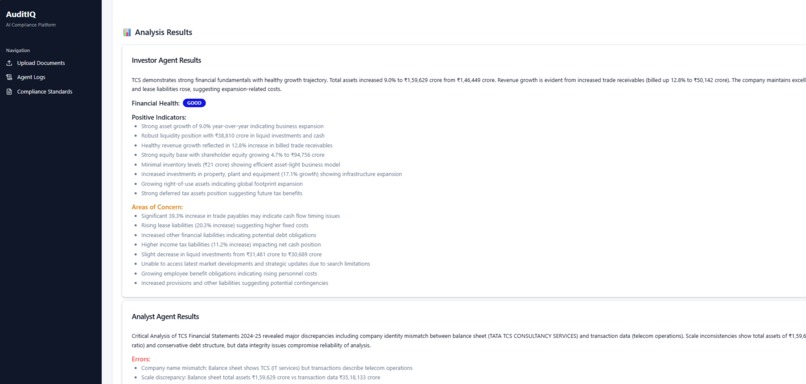
UI
-
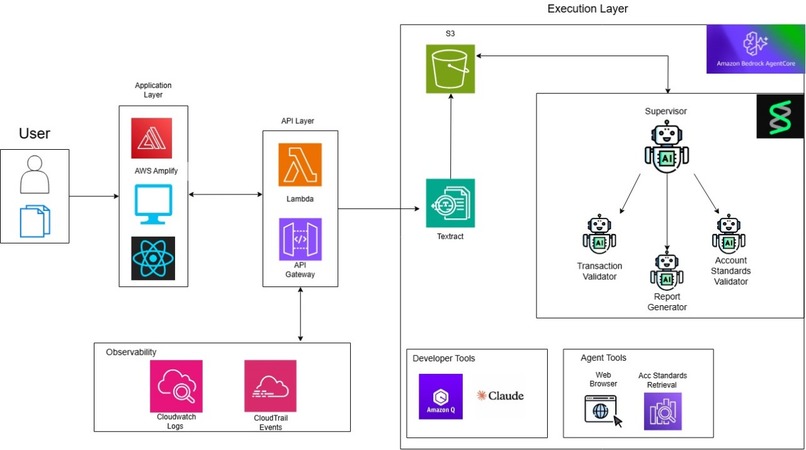
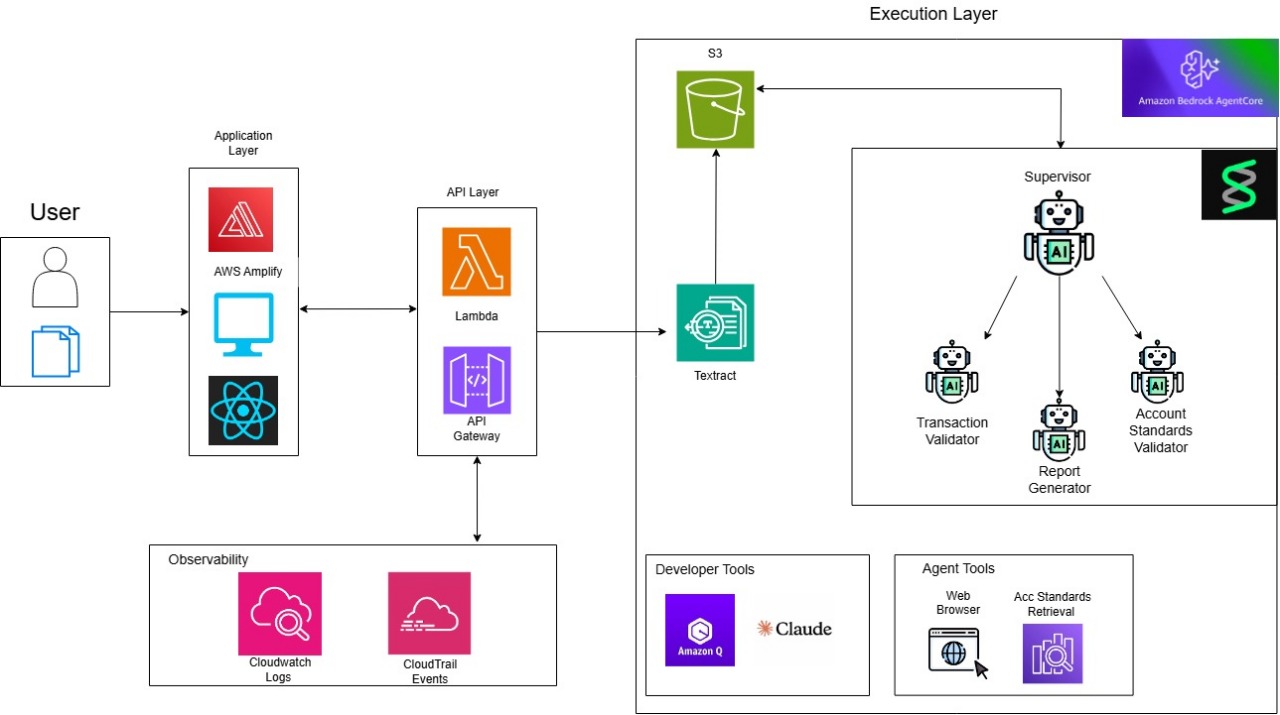
Architectural Diagram
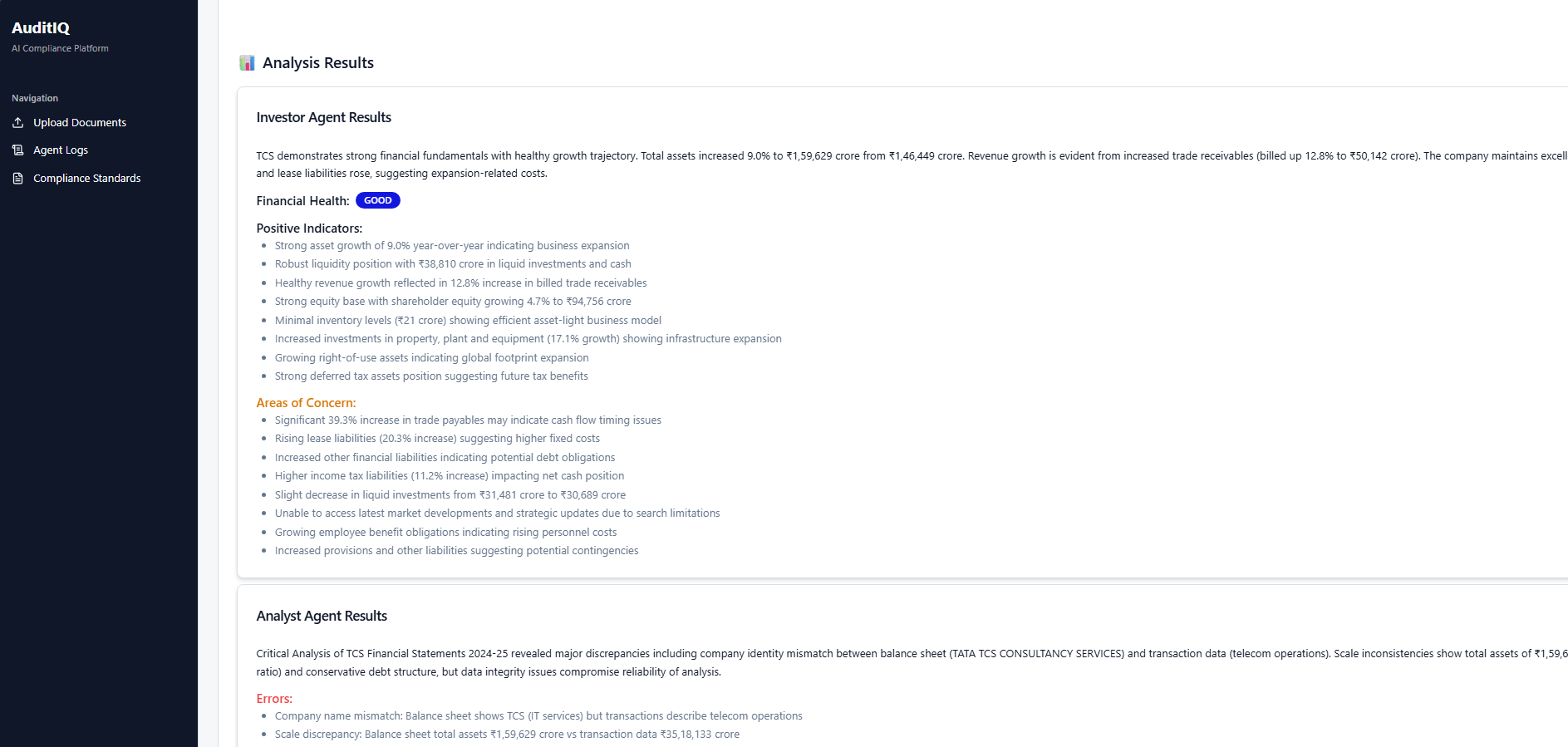
AuditIQ — Agentic Financial Audit + Investor Health Snapshot
AuditIQ is a modular crew of AI agents that turns financial statements into verifiable, explainable audit outputs and investor-facing company health checks. By combining a standards-aware auditor agent (Ind AS1 & AS 7), an analyst agent that cross-checks statements against synthetically generated transaction data, and an investor assistant agent with live web access, AuditIQ delivers provable numeric verification, standardized explanations, and real-time signal integration — all at scale.
What’s creative about AuditIQ
- Dual-use, single pipeline: the same agent orchestration provides both rigorous compliance checks and succinct investor health snapshots — avoiding duplicated engineering and increasing impact per dataset.
- Synthetic-transaction cross-checking: we generate realistic transaction streams to stress-test and validate reported figures, revealing inconsistencies that pure-statement analysis can miss.
- Agentic orchestration: specialist agents (ingest → reconcile → verify → explain → summarize) collaborate deterministically, combining symbolic checks with LLM-powered narratives for robust outputs.
Why it’s scalable
- Service-oriented design: AuditIQ exposes reusable services — reconciliation, provenance store, standards retrieval (RAG), numeric-verifier, natural-language reporter — that can be composed into many downstream products (bank credit briefs, SME cashflow coach, retail investor snapshots).
- Pipeline parallelism: deterministic checks run at scale (batch numeric validation), while agentic writers produce human-readable summaries asynchronously per report, enabling high throughput without sacrificing traceability.
Responsible & explainable by design
- Standards-first verification: the auditor agent checks compliance specifically against authoritative standards (Ind AS 1, AS 7) and cites the exact clause or line-item provenance for every claim.
- Provenance & confidence: every metric, flag, and recommendation includes (a) the source line/transaction IDs, (b) a confidence score, and (c) an uncertainty interval. This makes outputs auditable and actionable.
- Deterministic safety gates & human-in-the-loop: any high-stakes recommendation (loan sizing, covenant waiver language) requires a human sign-off; automated alerts include suggested remediation but never execute decisions autonomously.
- Mitigation of LLM failures: numeric claims are always backed by deterministic arithmetic checks; retrieval-augmented generation (RAG) is used for standards citations to reduce hallucination.
Explainability
- Line-item traceability: every sentence in the investor snapshot links to the exact balance-sheet/income-statement row (and synthetic tx support when applicable).
- Audit trail: an immutable provenance store records agent decisions, prompts, and verification steps for regulatory review.
- Failure-mode reporting: the system emits structured failure reports (numeric inconsistencies, unsupported journal entries, missing disclosures) prioritized for human review.
Evidence & inspiration
- ACL FinNLP: Financial analysis benchmarks and methods.
- Kim, Financial Statement Analysis with Large Language Models.
- Multimodal long-form summarization (finance) — numeric-hallucination taxonomy.
- Recent arXiv work on agent orchestration for financial tasks.
References:
- https://aclanthology.org/2025.finnlp-1.19.pdf
- https://www.bayes.citystgeorges.ac.uk/data/assets/pdf_file/0009/799794/Alex-Kim_Financial_Statement_Analysis_with_Large_Language_Models2024_-6.pdf
- https://arxiv.org/abs/2411.04788
- https://arxiv.org/abs/2506.17282v1
AuditIQ converts opaque financial filings into verifiable audit evidence and clear investor intelligence — reducing manual audit effort, speeding credit decisions, and democratizing financial insight while preserving audibility, safety, and human oversight.

Log in or sign up for Devpost to join the conversation.