Inspiration
German accounting reports can appear correct when reviewed individually while still contradicting one another as a complete set. In tax and audit matters, an automated system that guesses missing values can produce a polished result that cannot be supported by evidence or defended before the authorities.
AuditGuard DE was created around one principle: evidence before inference.
What it does
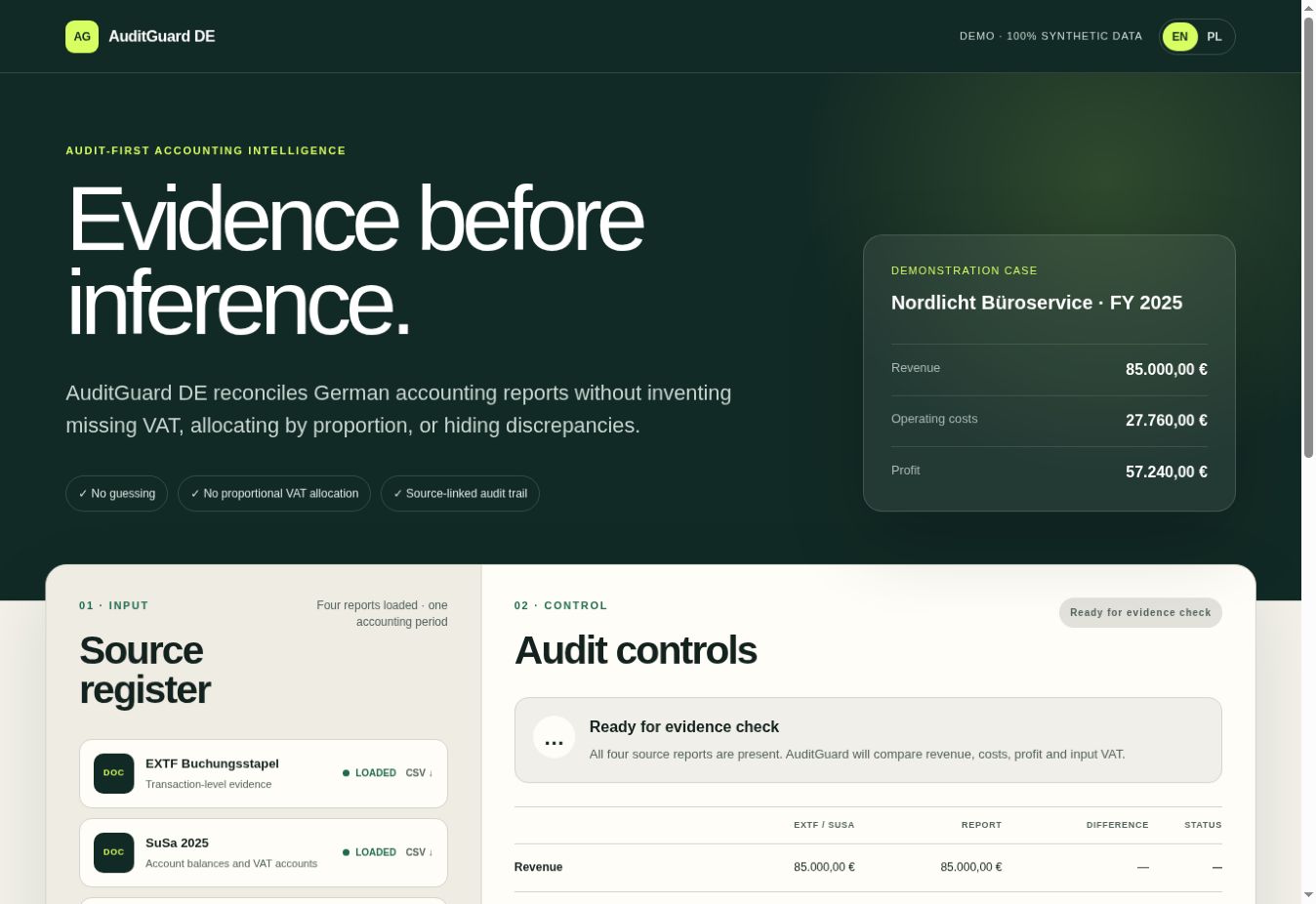
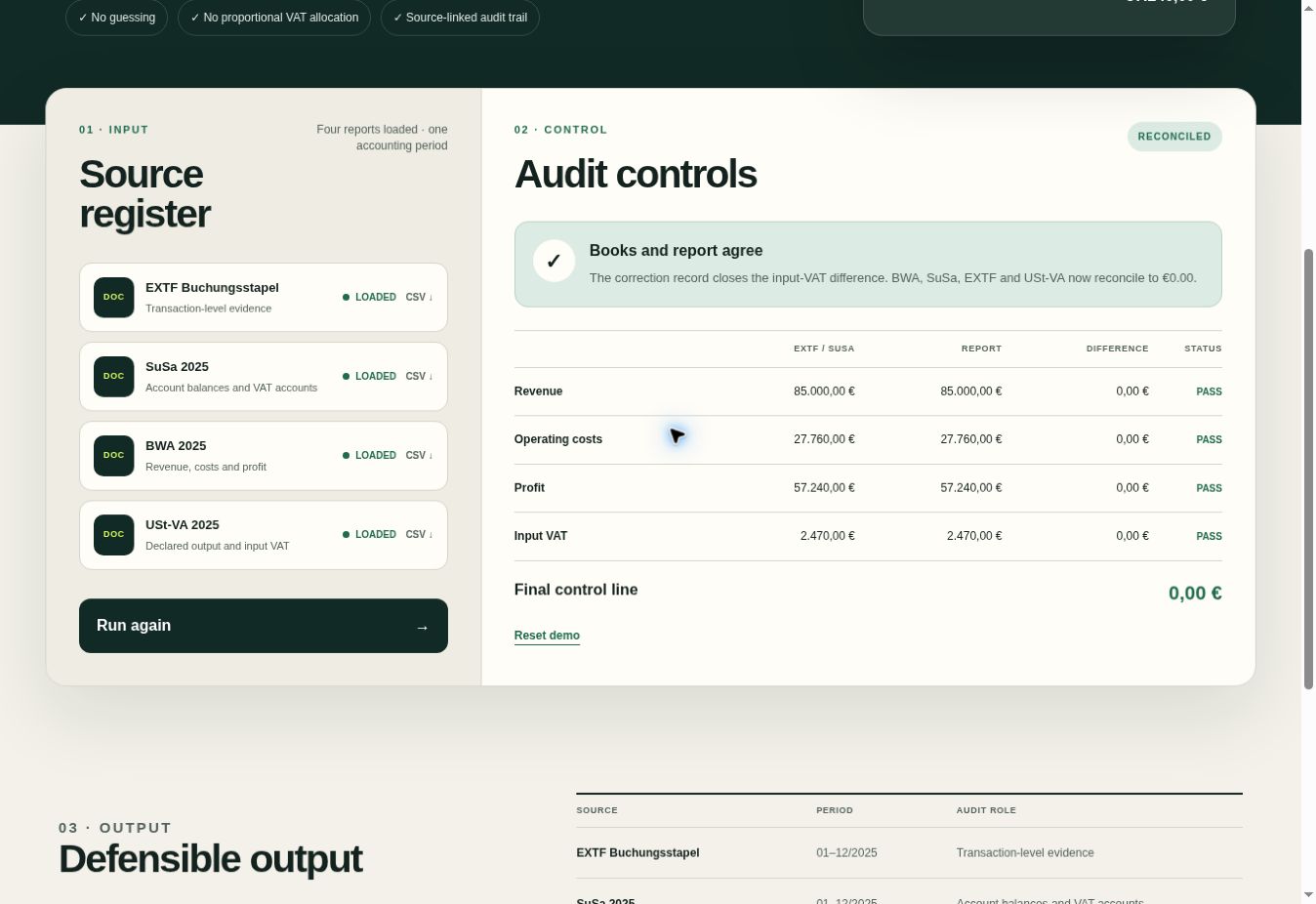
AuditGuard DE is an interactive, audit-first prototype for German EÜR and SKR03 workflows. It registers four synthetic source reports—EXTF, SuSa, BWA and USt-VA—and reconciles revenue, operating costs, profit and input VAT.
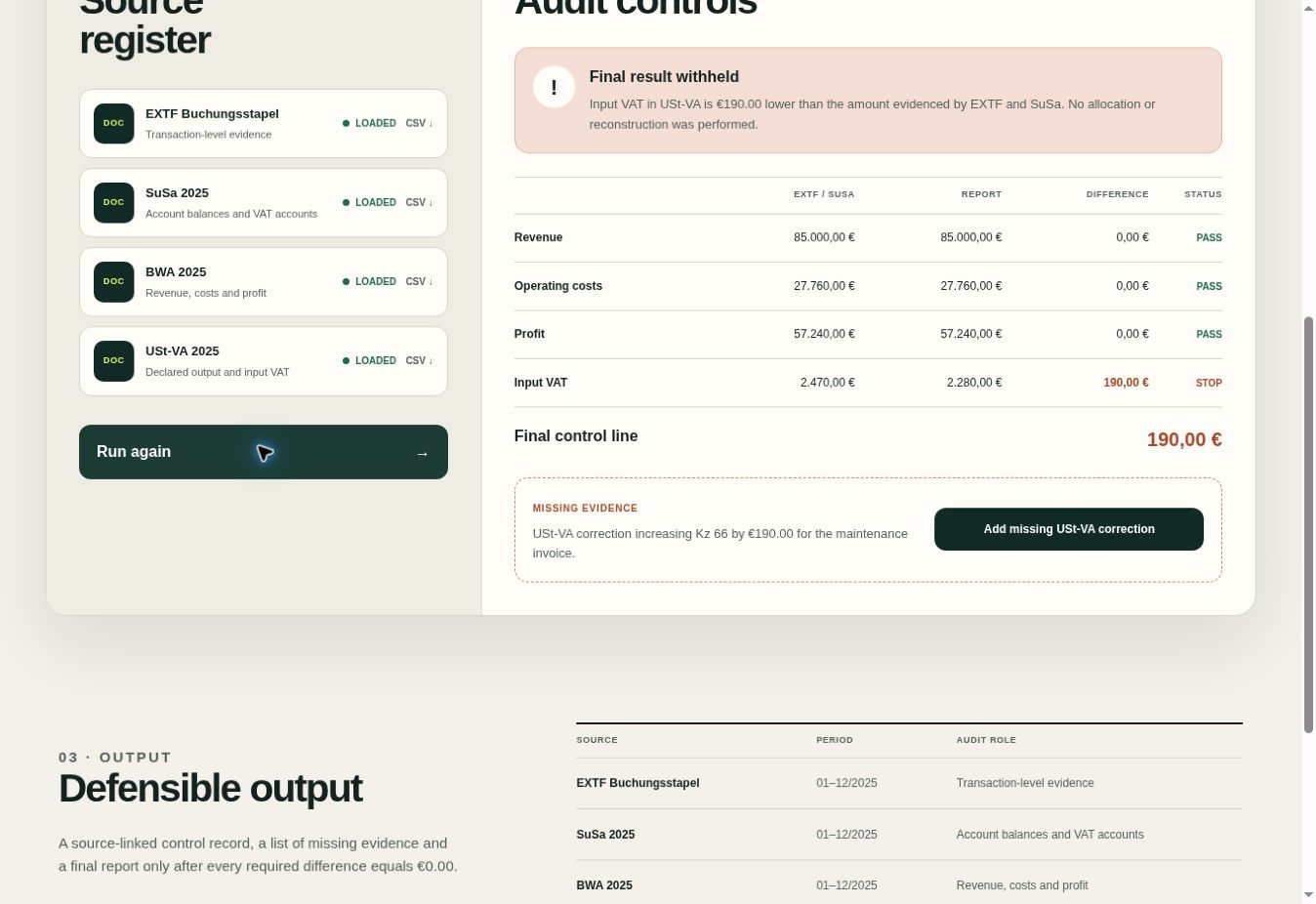
In the demonstration, EXTF and SuSa support EUR 2,470.00 of input VAT, while USt-VA contains only EUR 2,280.00. AuditGuard detects the EUR 190.00 discrepancy and activates a HARD STOP.
The system does not estimate, allocate or reconstruct the missing VAT. It quantifies the difference, identifies the missing evidence and withholds the final result. After the correction record is added, the audit runs again and releases the result only when every required control difference reaches EUR 0.00.
Try the demo
Open the live AuditGuard DE demo
- Run the audit to reveal the EUR 190.00 input-VAT discrepancy.
- Observe the HARD STOP and the identified missing evidence.
- Add the missing USt-VA correction.
- Run the audit again and confirm that every control difference reaches EUR 0.00.
The interface is available in English and Polish. All source reports can be downloaded as synthetic CSV files.
How it was built
Codex and GPT-5.6 were used throughout the development, review and validation process. The project was built with React, TypeScript, Next.js and Vite, then published as a public demonstration using OpenAI Sites.
The current demo uses a deterministic reconciliation workflow. This makes every decision visible, repeatable and easy to verify. It also demonstrates how expert rules developed with AI assistance can be converted into explicit system behavior.
How prompts guided the process
AuditGuard DE was developed through a sequence of focused prompts rather than one broad instruction. Separate prompts defined the evidence hierarchy, stopping conditions, synthetic data, interface states and validation checks.
The central instruction was:
Treat every value as a claim that requires support from a source. Never guess missing VAT or allocate it proportionally. If any material difference is not EUR 0.00, withhold the final result, quantify the difference and identify the missing evidence.
The prompt-driven workflow included:
- Defining the source hierarchy and the “evidence before inference” principle.
- Creating interconnected synthetic EXTF, SuSa, BWA and USt-VA data.
- Translating the audit rules into three states: ready, blocked and reconciled.
- Testing the behavior when EUR 190.00 of input VAT is missing.
- Reviewing and repairing the interface and verifying every displayed value.
- Publishing a working bilingual demonstration.
The prompts were not used only to generate code. They became a method for encoding expert knowledge as explicit and testable rules.
Why the rules matter
These rules keep the analysis within clearly defined evidentiary boundaries. Assumptions, automatic gap-filling and seemingly logical reconstructions cannot be presented as established facts.
A result is released only when every material value is linked to a source, the defined scope of the analysis is complete and all required control differences equal EUR 0.00.
This makes the result evidentially complete within the limits of the supplied data and the defined purpose of the analysis. The rules substantially reduce the risk of errors caused by guessing, unsupported assumptions or unauthorized reconstruction. When the available evidence is insufficient, the system clearly explains why a reliable final result cannot yet be produced.
Challenges and accomplishments
The central challenge was designing a system whose most important feature is its ability to refuse an unsupported result. Another challenge was creating internally consistent synthetic accounting data while keeping every figure traceable.
The finished prototype provides:
- A visible and repeatable evidence chain.
- A HARD STOP for unresolved material differences.
- No proportional VAT allocation or invented values.
- Explicit identification of missing evidence.
- Downloadable synthetic source data.
- A bilingual English/Polish interface.
- A complete correction and reconciliation workflow.
What I learned
Reliable AI-assisted workflows require more than answers. They need explicit stopping conditions, traceable evidence and a clear path for human correction.
Refusing to guess can be more valuable than producing a convincing but unsupported result. A well-designed system should know both how to generate an answer and when the available evidence is not sufficient to produce one safely.
What’s next
A future version could add validated document ingestion, schema mapping, OCR, source-level citations, configurable materiality thresholds, automatic detection of missing documents and human approval before releasing a final report.
Privacy
The demonstration uses only fully synthetic accounting data. It contains no client names, addresses, tax numbers, bank accounts, document metadata or copied accounting figures. It is a technical prototype and not tax or legal advice.
What it does
How we built it
Challenges we ran into
Accomplishments that we're proud of
What we learned
What's next for AuditGuard DE
Built With
- codex
- css3
- gpt-5.6
- html5
- next.js
- openai
- react
- sites
- typescript
- vite


Log in or sign up for Devpost to join the conversation.