-
-
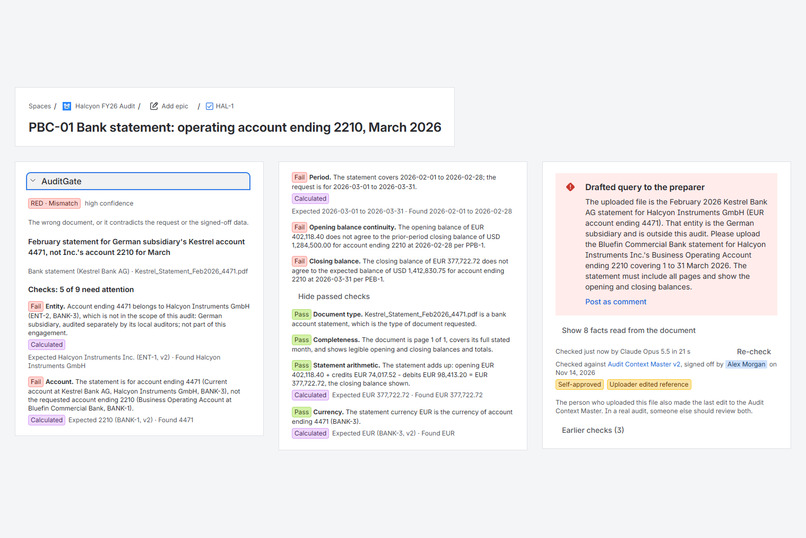
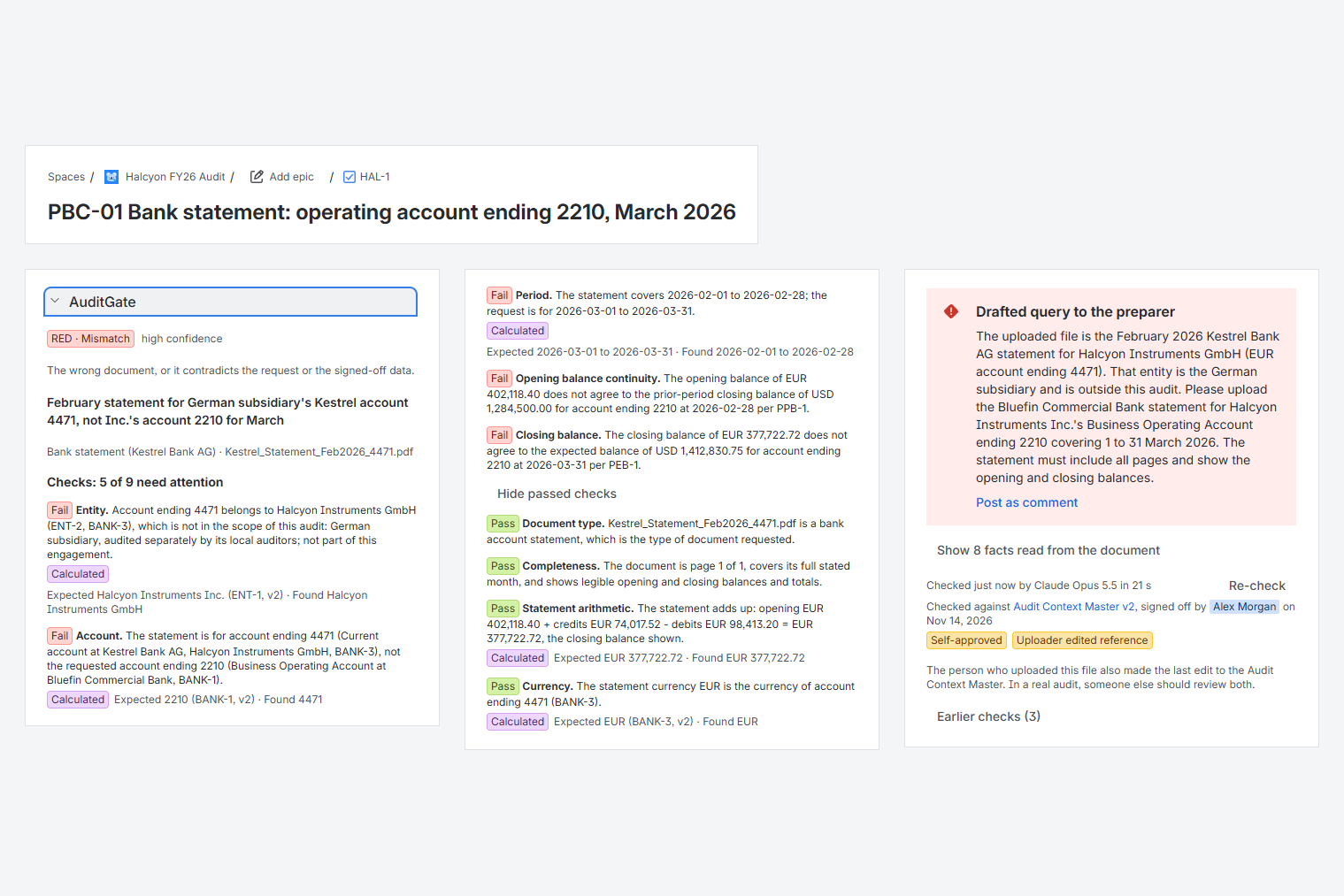
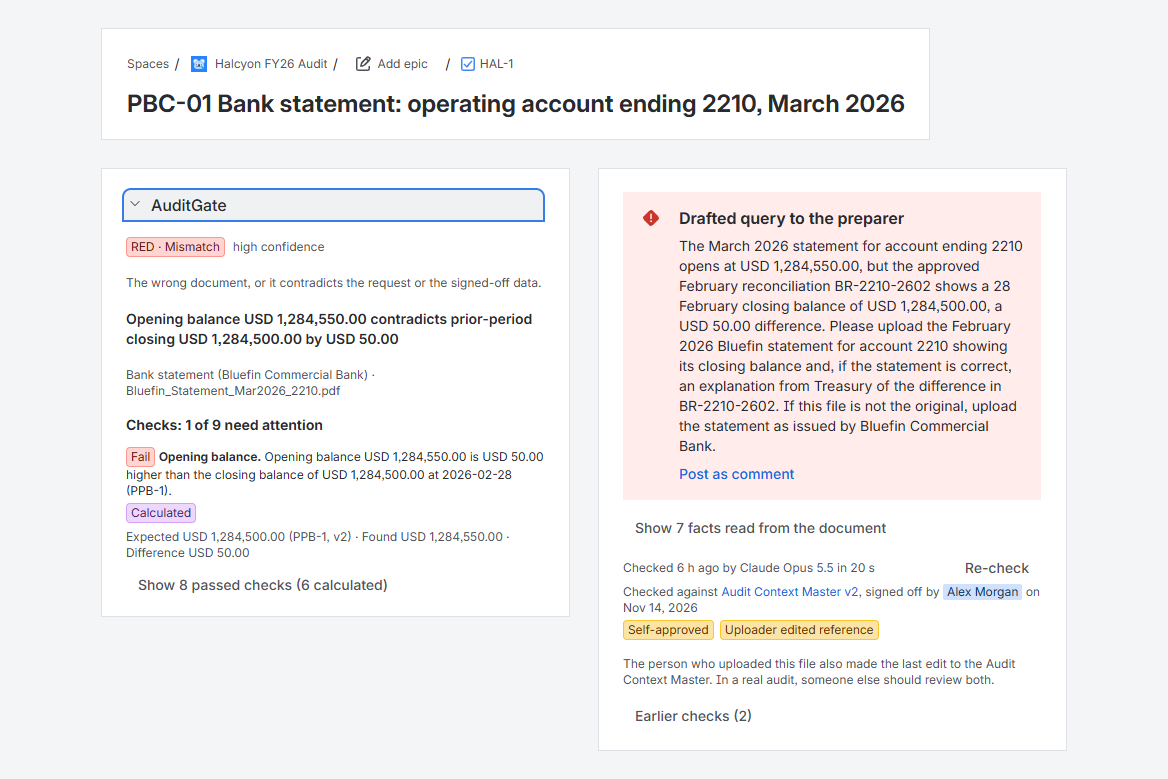
One AuditGate panel in Jira, shown in three parts: a statement for the wrong company, account and month, caught against the signed-off rows.
-
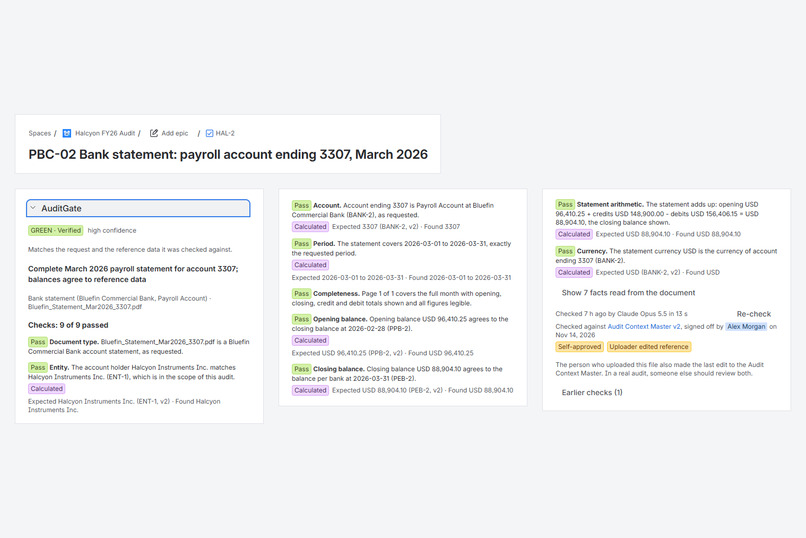
Every figure that can be calculated is, with its source row and version.
-
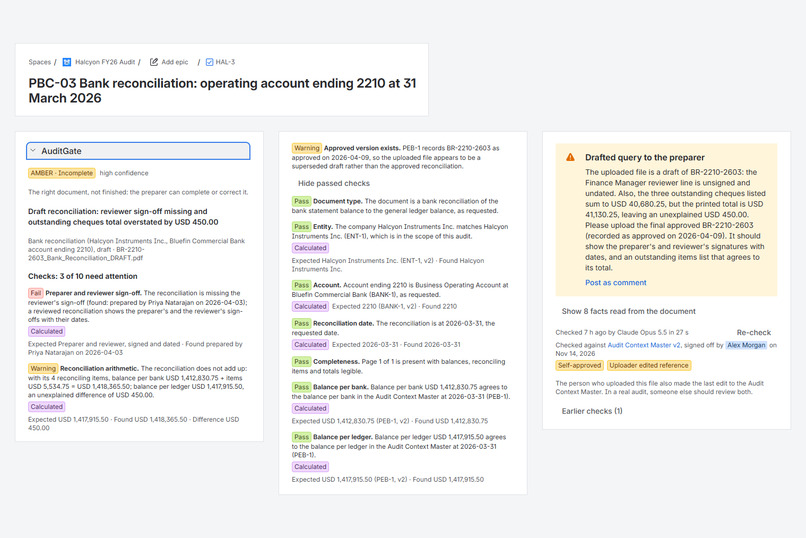
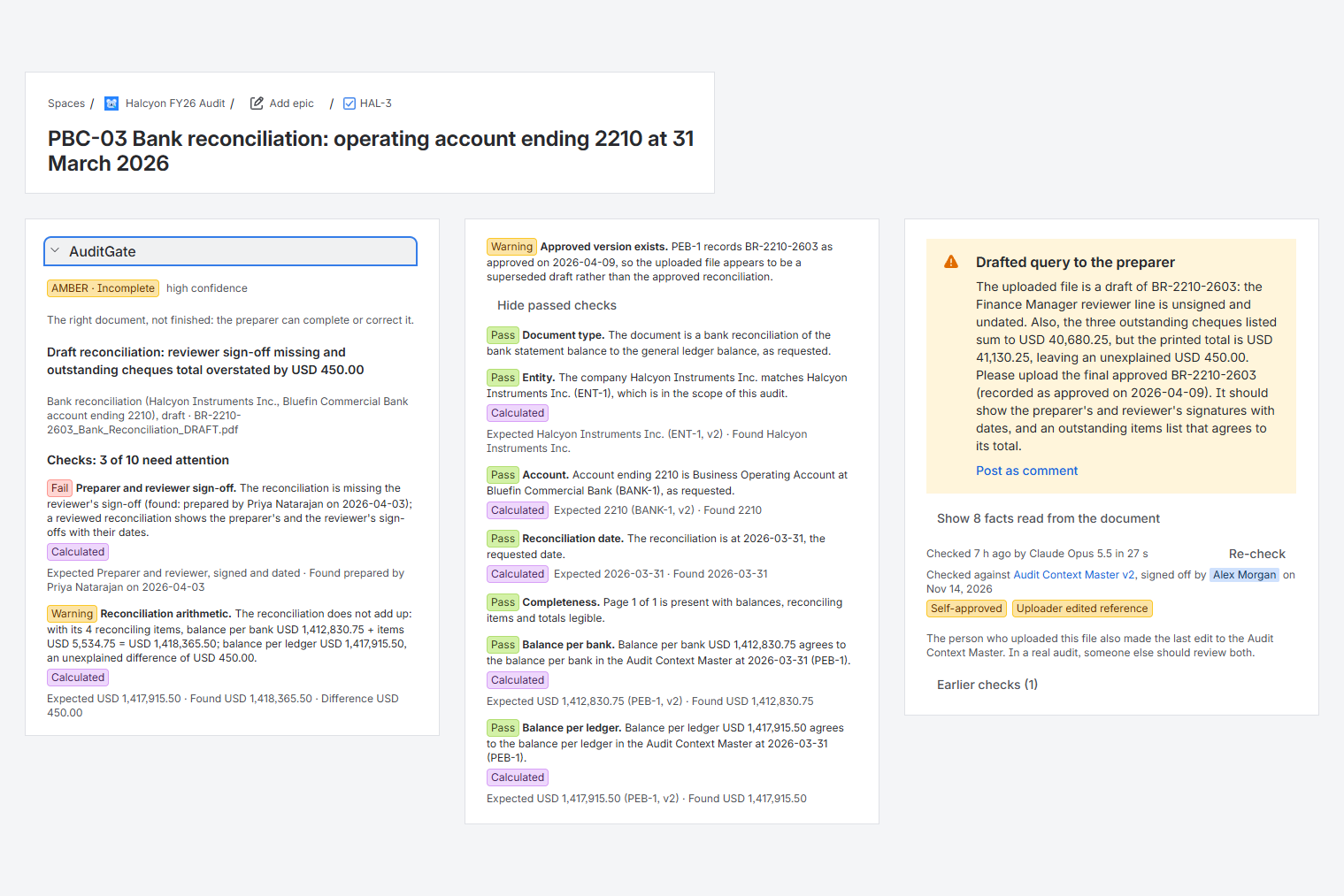
Printed totals that balance, and the USD 450.00 they hide. A missing reviewer sign-off makes the request Incomplete.
-
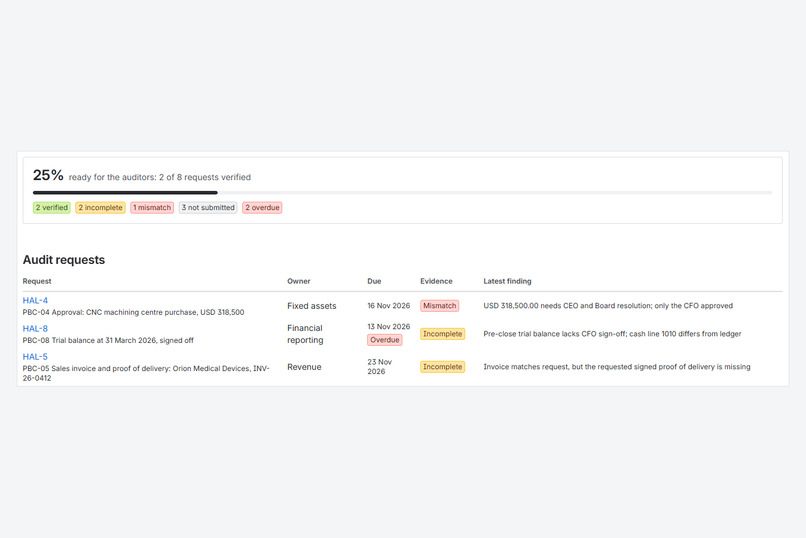
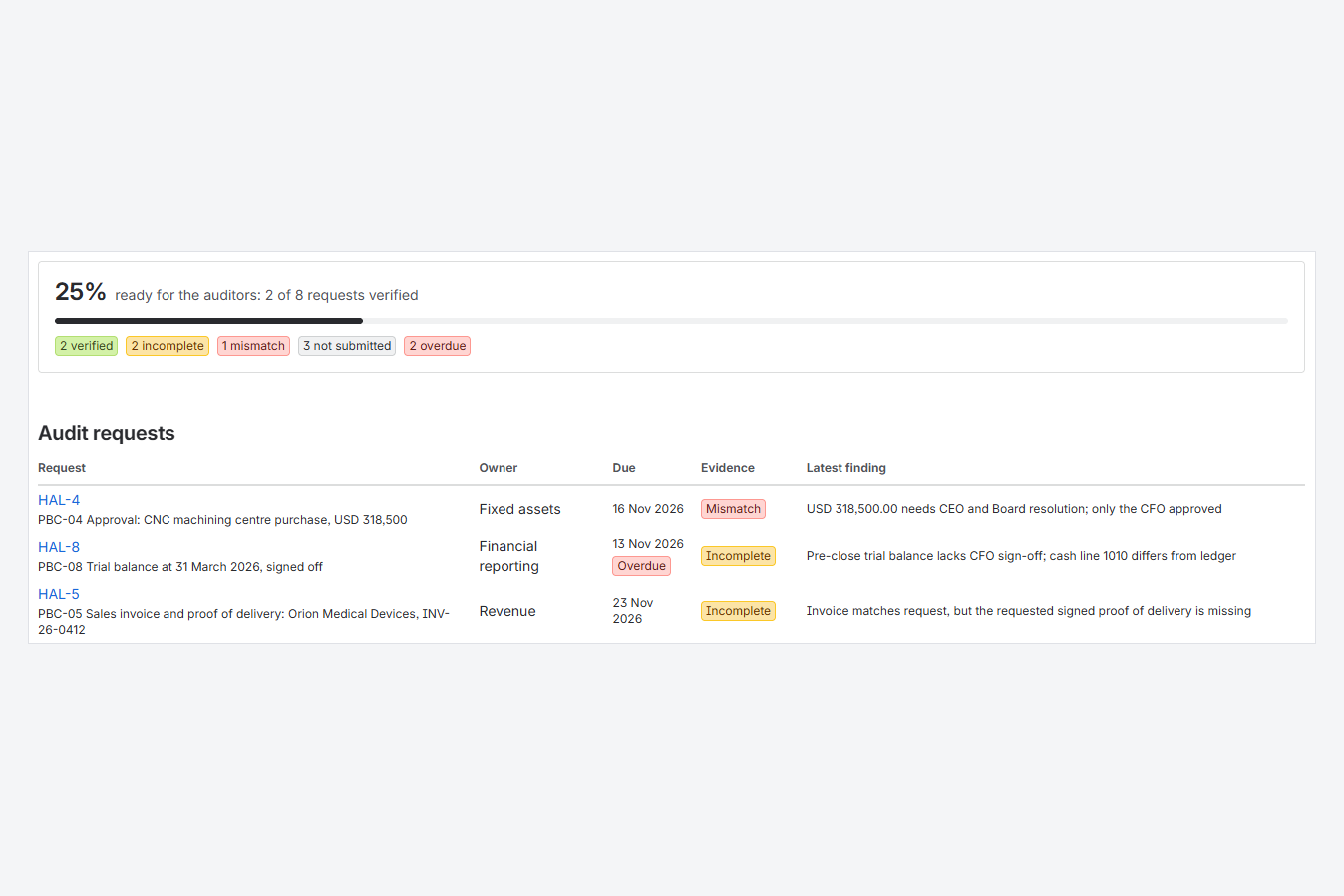
Readiness for the whole audit: every request with its owner, due date, status and latest finding.
-
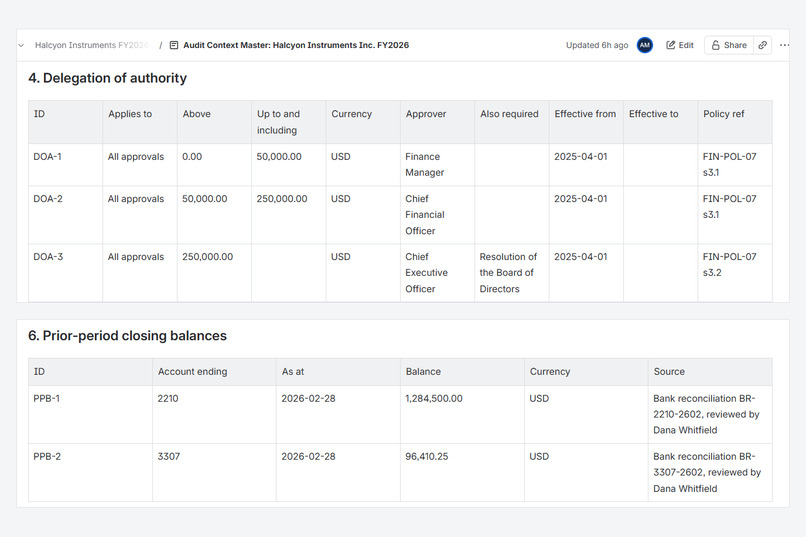
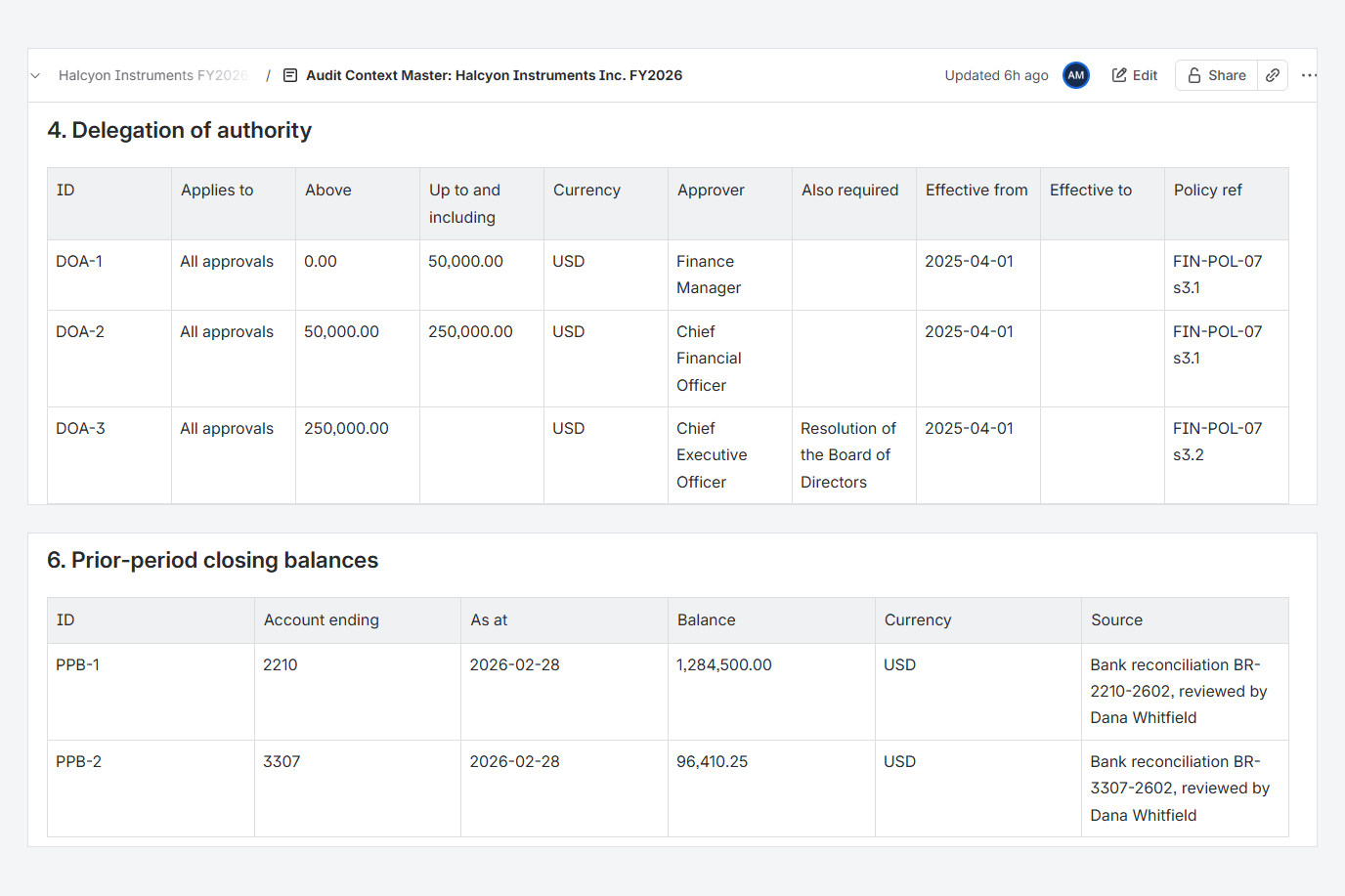
The company's facts, in an ordinary Confluence page that someone signs off.
-
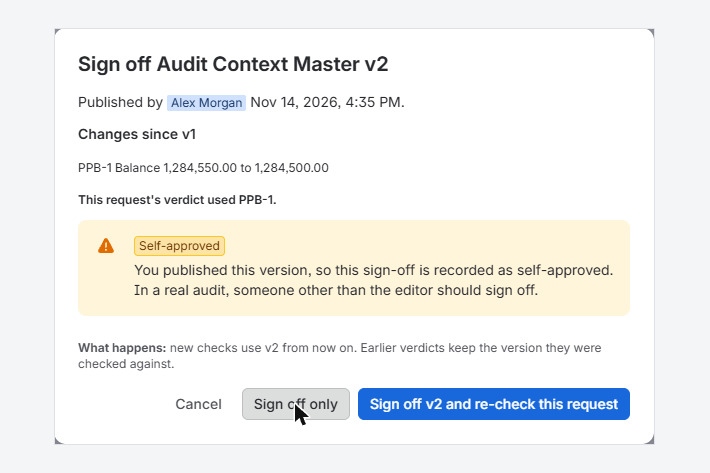
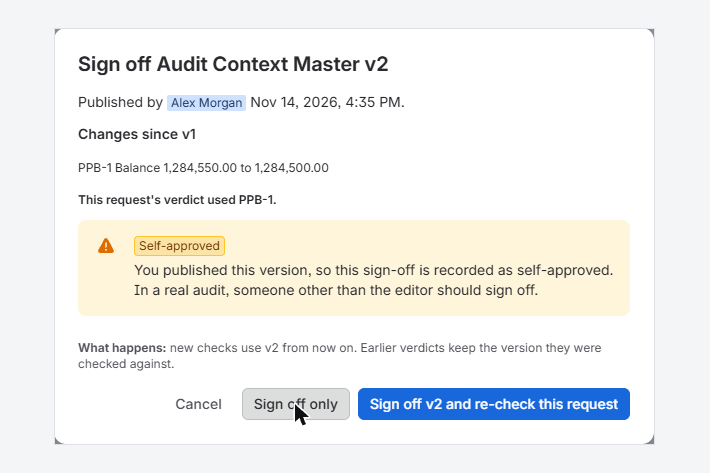
A change to the reference data is signed off, with the verdicts that used it, and recorded as self-approved.
-
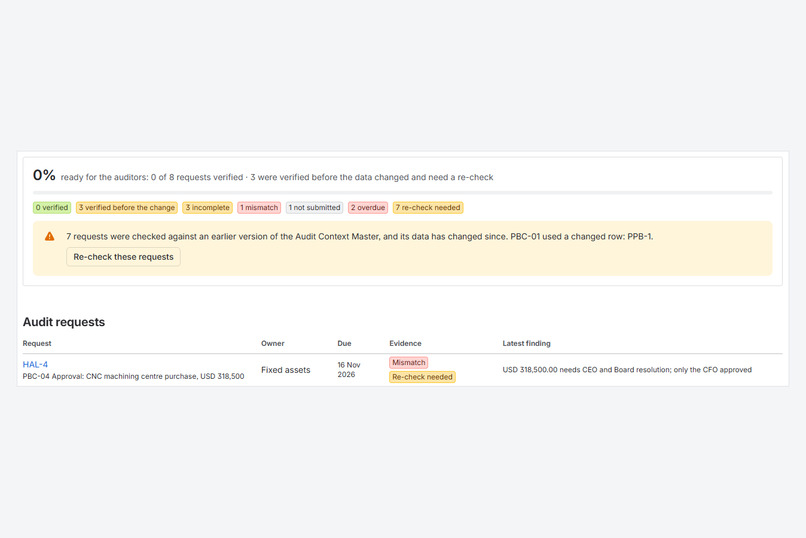
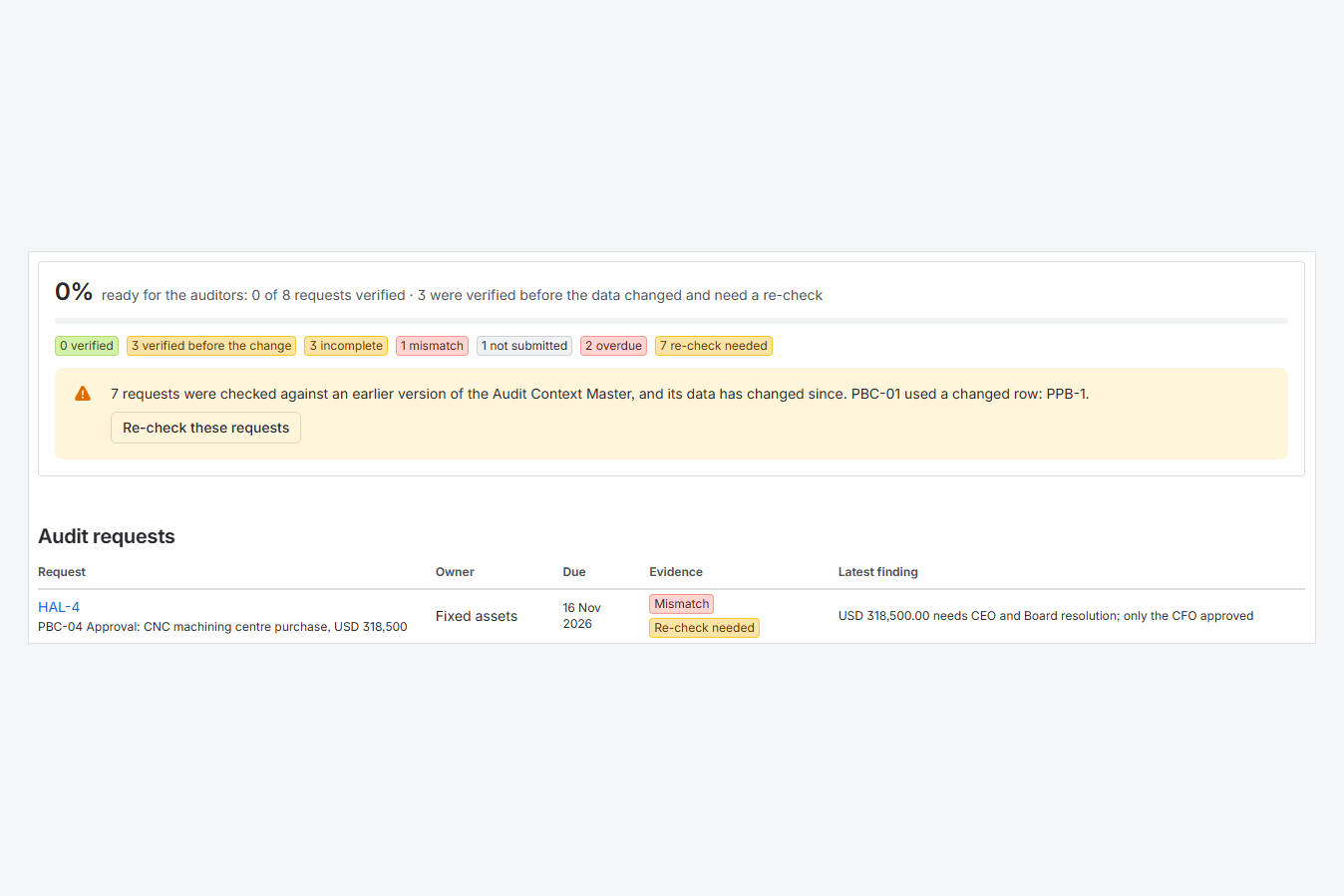
A signed-off change re-opens every earlier verdict until it is re-checked, and names the ones that used the changed row.
-
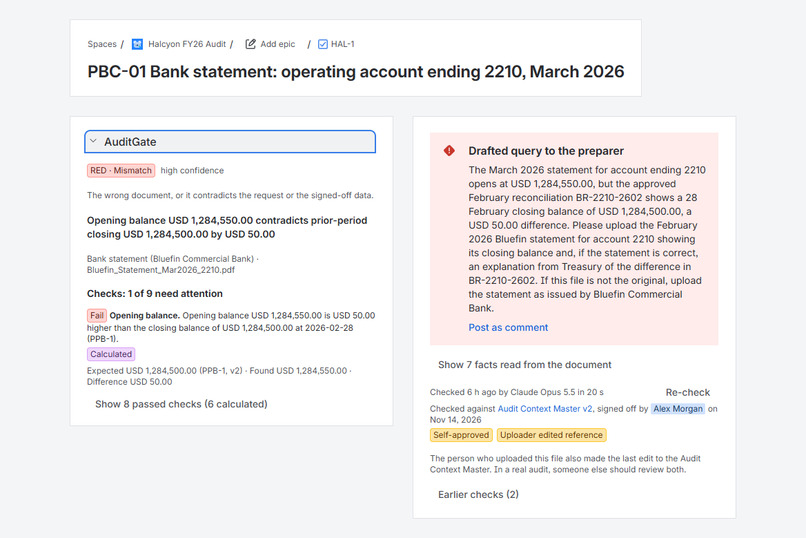
Re-checked against v2: the same March statement is now RED, off by exactly USD 50.00, with the row it came from.
-
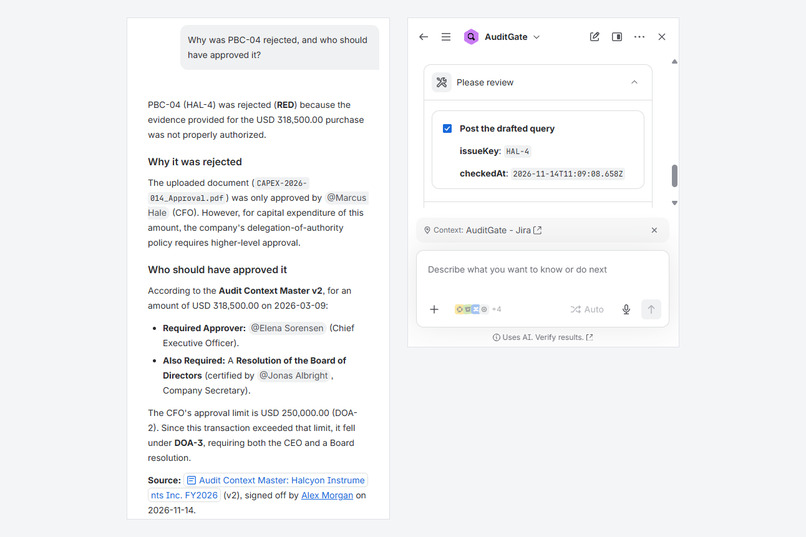
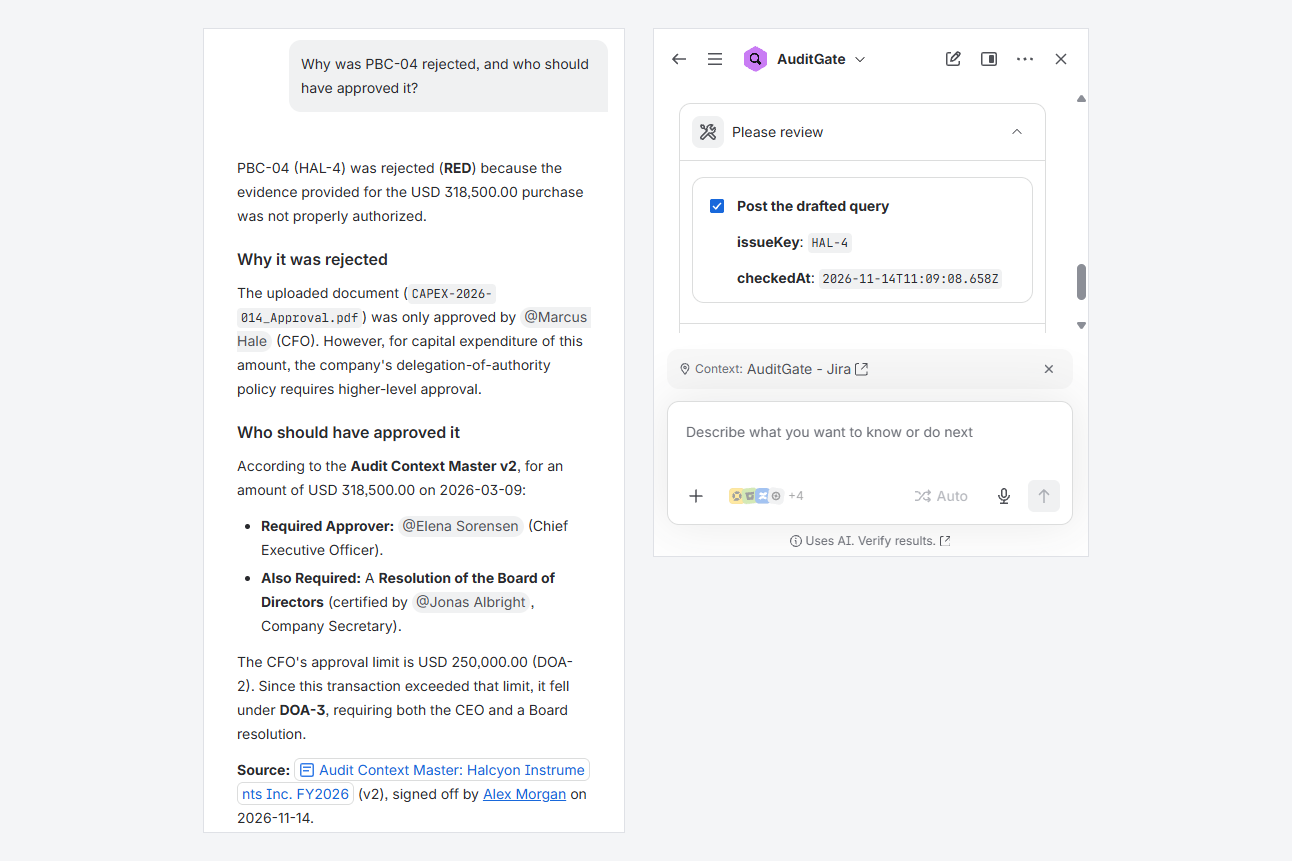
The agent answers from the calculated checks and asks before it acts.
Inspiration
Every financial statement audit runs on a "prepared by client" (PBC) list: often 200 to 500 requests from the external auditors for bank statements, reconciliations, invoices, approvals and contracts. The finance team chases owners by email and spreadsheet, and the auditors send files back when they are wrong: the wrong month, the wrong entity, an account the company does not hold, an opening balance that does not agree to last month, an approval signed by someone without the authority. Each round trip costs days in the busiest weeks of the finance year.
The knowledge needed to catch those mistakes already exists inside the company: which entities are in scope, which bank accounts exist, who may approve what amount, and what last period's balances were. It is just not in front of the person uploading the file. Codegeist's theme is "build with context"; AuditGate puts that context next to every piece of evidence.
What it does
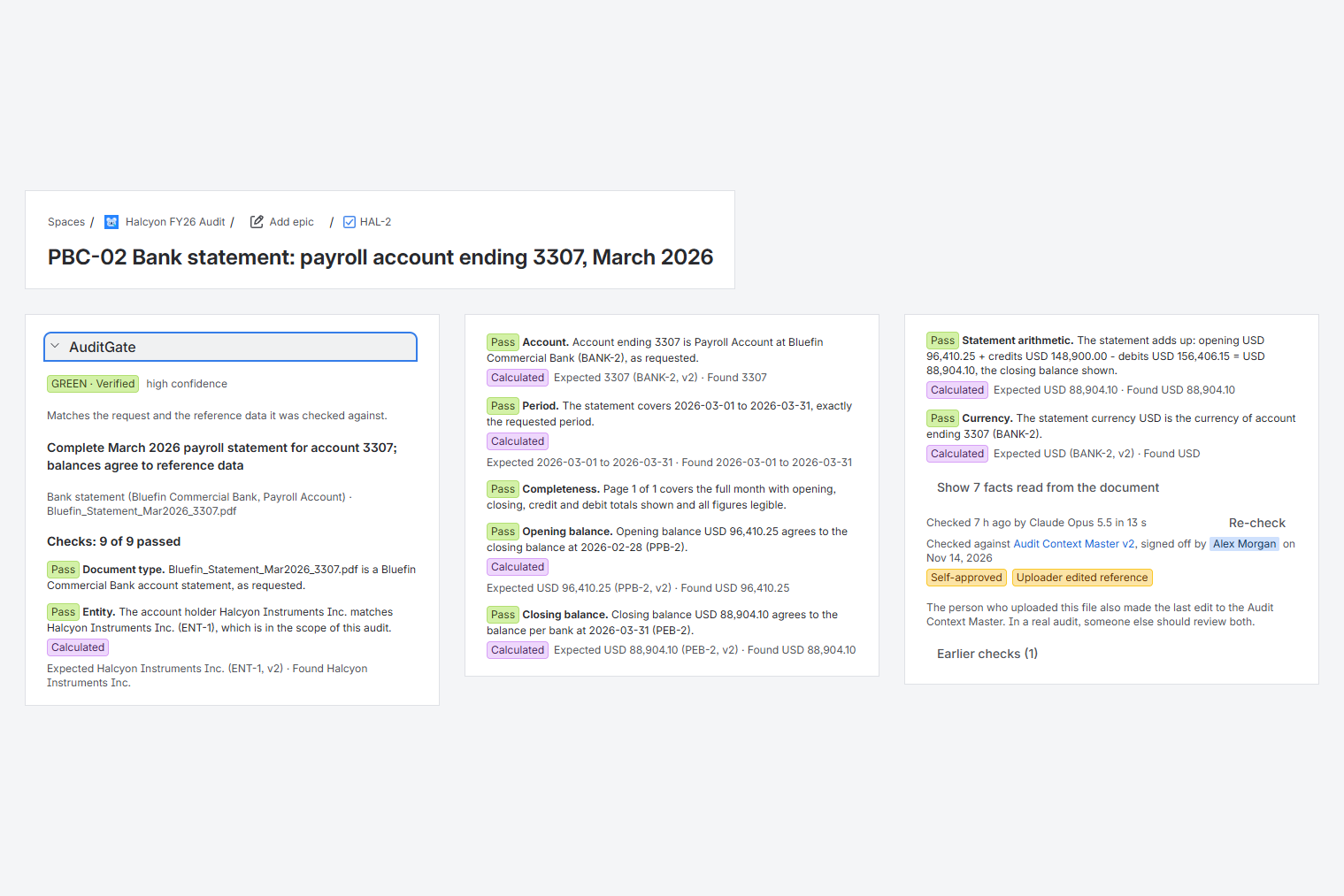
AuditGate checks each piece of audit evidence the moment it is attached in Jira, against the company's own signed-off facts in Confluence, and says Verified (GREEN), Incomplete (AMBER) or Mismatch (RED), with the reason, the figures and a drafted query back to the preparer.
How it differs. Document AI usually extracts fields or summarizes a file. AuditGate checks the file against facts the company has signed off, recalculates in code every figure that can be calculated, and ties each verdict to the version of those facts and the rows it used. A signed-off change re-opens every verdict made against the earlier data until it is re-checked, and names the ones that used a changed row.
- A verdict on every request. Each PBC request is a Jira work item labelled
pbc. The verdict sits in the work item's right column, with each check, what was read from the document, and a query the preparer can be sent as a comment. "Earlier checks" keeps every past verdict with the file's SHA-256 fingerprint and the reference version used. The latest verdict is also copied to a work item property indexed for JQL (auditgateVerdict = RED), for filters and boards; the panel stays the authoritative record. - Reference data signed off in Confluence. The "Audit Context Master" is an ordinary Confluence page with typed tables: entities in audit scope, bank accounts, delegation of authority, authorised signatories, and last period's and this period's balances. AuditGate validates each version with row-level fixes, keeps a write-once fingerprinted copy, and uses a version only after someone signs it off. The sign-off dialog lists exactly what changed ("PPB-1 Balance 1,284,550.00 to 1,284,500.00"), names the verdicts that used a changed row ("PBC-01 (PPB-1)"), and records a sign-off of your own edit as self-approved. After a new sign-off, verdicts made against older data show "Re-check needed" (with "Used PPB-1, which changed" where a verdict used a changed row) and can be re-checked in one click.
- Calculated checks, not just a model's opinion. For bank statements, approvals, bank reconciliations, trial balances and invoices, AuditGate recalculates in code what can be calculated (balances, totals, who may approve what amount on the date, sign-offs, amounts and dates) from the signed-off rows and the figures Claude read. Each carries a "Calculated" tag: "Expected USD 1,284,500.00 (PPB-1, v2) · Found USD 1,284,550.00 · Difference USD 50.00". Code can always make a verdict stricter, but clears Claude's doubt only on figures it recalculates in full, because a wrong GREEN is the costliest mistake an evidence check can make.
- Audit readiness. The project page shows the share of requests verified, counts by status, overdue items, and every request with its owner, due date and latest finding.
- A Rovo agent that acts. "Why was PBC-04 rejected, and who should have approved it?" gets the request's calculated checks and the approver calculated from the rows in force, cited with the page version and its sign-off. "Post the drafted query for PBC-04", "Re-check PBC-01" and "Publish the audit status to Confluence" change something, so Rovo asks you to confirm first; the status page is written by AuditGate from its own data.
- A demo that starts mid-audit. "Load demo audit" creates eight fictitious requests, the Confluence space and page, signs off v1, and checks sample files on five requests, so the readiness page fills in within a minute (two Verified, two Incomplete, one Mismatch). Every request has sample files (15 in all) that agree with one another like a real audit file.
Scale and data. An audit has 200 to 500 requests; AuditGate checks each when its file arrives, in the background. During judging it runs on AuditGate's own Claude key, so it allows 40 checks per site and 10 per request per day. A Jira admin can switch it to the organization's own Claude key on AuditGate's settings page (Jira settings > Apps), where AuditGate checks the key with Claude, keeps it in Forge's encrypted storage, never shows it again, and lets the admin set the daily limits; usage is then billed to the organization's Claude account. The page lists who changed the key or the limits and when, and says plainly when the organization's Claude account is out of credit, instead of blaming the file. Each check sends Anthropic only the uploaded files and their names, the request's key, title, description and due date, and the signed-off reference data. AuditGate is the finance team's pre-check: verified files still go to the auditors through their own portal.
How we built it
- Forge app for Jira with Confluence as an optional second app (
app.compatibility: Jira required, Confluence optional). Without Confluence, a project where the demo was loaded uses built-in demo reference data and says so on every verdict; any other project is checked without reference data and its verdicts say "No reference data linked". - UI Kit modules:
jira:issueContext(the verdict panel, with a Verified, Incomplete or Mismatch lozenge even while collapsed),jira:projectPage(readiness, the Audit Context Master card and the demo loader) andjira:adminPage(the organization's own Claude key and daily limits; Jira admins only, checked on every call). - Product events: a
triggeronavi:jira:created:attachmentqueues new evidence; deleting any file a verdict relied on removes that verdict. - Entity properties: a
jira:entityPropertymodule indexes the latest verdict on each work item, so JQL can find it (auditgateVerdict = RED,auditgateStatus = Incomplete,auditgateCheckedAt >= -7d). - Async events: the review runs in a
consumerwith a 300-second budget, because a Claude review of a PDF can outlast a resolver's 25 seconds. A job token, checked again just before the review starts, makes redelivered events run the paid review only once; temporary failures go back on the queue with a delay. Daily limits are enforced with write-once storage keys, so checks that start at the same moment cannot exceed them. - Forge storage (KVS) for verdicts, check history, write-once page snapshots and sign-off records, and Forge's encrypted secret storage for an organization's own Claude key.
- Confluence REST v2 to read page versions, create the demo space and page, and check whether the person may edit the page before a sign-off. Page reads for the panel and the agent run as the user, so Confluence permissions apply.
- Rovo:
rovo:agent"AuditGate" with the actions "Get audit evidence status" and "Get Audit Context Master" (GET), "Re-check an audit request" (TRIGGER), "Post the drafted query" (CREATE, a Jira comment) and "Publish the audit status to Confluence" (CREATE, a Confluence page under the Audit Context Master). - Claude API (Anthropic), declared as the app's only external egress,
api.anthropic.com. The model reads PDFs and images and returns a structured verdict through an enforced JSON schema; a token count runs before every paid call, and text from the page or the request is wrapped and treated as data, never as instructions. - Scheduled trigger for Atlassian's personal data reporting: the app keeps account ids and the display names of people @mentioned on the reference page, and reports them weekly so closed accounts are erased.
Challenges we ran into
- Trusting reference data that anyone can edit. A Confluence page is easy to change, so the check never reads the live page: it uses a signed-off, write-once copy whose fingerprint is verified before every check. If the copy fails the check, or nothing is signed off yet, the check stops before calling Claude, so nothing is billed.
- A model verdict is not audit-grade on its own. We split the work: Claude reads the document and judges what only a reader can (document type, completeness, signatures), and code calculates the facts that can be calculated.
- Turning a page into data. Finance teams format tables in many ways, so the reader accepts header aliases, thousands separators and @mentions, and every problem it finds is reported by section, row and column with a fix.
- Real-world timing. Jira attachment events can arrive late or out of order; several files attached together are reviewed as one set (up to five); daily limits (10 checks per request, 40 per site) protect the API key.
- Keeping the structured output small. Adding reconciliations, trial balances and invoices as nested lists made Claude's enforced JSON schema compile to a grammar the API rejected as too large. Nullable fields multiply the grammar, so dates became plain strings that the code validates, and the facts of the new kinds come as short "name: value" lines that the rules engine parses; a fact in any other form leaves its check undecided, never wrong.
Accomplishments that we're proud of
- The moment the whole idea rests on works live: change one balance on the Confluence page, sign it off, and the same bank statement turns from GREEN to RED with the exact USD 50.00 difference and the row it came from.
- A reconciliation whose printed totals balance can still be wrong: AuditGate adds up the items listed and finds the USD 450.00 that two swapped digits hide, then names the reviewer sign-off that is missing.
- The app installs from the sharing link exactly as a judge would install it (tested on a separate site), and the core demo takes about 15 minutes.
- Failure states are handled in plain language: no page linked, a page with errors, an unsigned page, a page the app account cannot see, Confluence not connected, and a page moved to the trash.
What we learned
- Context beats a bigger prompt: the most useful thing we gave the model was a small, signed-off table of facts plus a clear statement of which version it is.
- We measured the two readers against each other. In 44 live checks of the sample evidence (13 and 14 Nov 2026, production), Claude and the calculated checks agreed on 174 of the 180 checks both made; in the other six Claude said FAIL where the code found the evidence incomplete (WARN), which the merge weighs as AMBER. On these samples the calculation's main value was not overruling Claude but showing the expected value, its source row and the difference, which is what makes a verdict something an auditor can check.
- We also tampered with five signed samples, changing one digit in each the way real errors hide: two swapped digits in a reviewed reconciliation's cheque list (USD 450.00), a trial balance that no longer foots by 1,800.00, a cash line 720.00 off the ledger balance, and two statements whose opening balances were 30.00 and 270.00 off. Claude Opus 5.5 caught all five on its own, and the calculation caught the same five with the exact difference and the row it comes from. A phone-photo-style image of the March statement (tilted, shadowed, compressed) was read and verified like the PDF.
- Forge's building blocks (events, queues, storage and Rovo actions) were enough to build an audit trail without any server of our own.
What's next for AuditGate
- Import the auditors' PBC list from a spreadsheet, creating the requests with owners and due dates.
- The status page published on a schedule for the auditors (today it is published on request, through Rovo).
- Calculated checks for contracts and payroll, and for document sets (an invoice with its proof of delivery).
Built With
- anthropic
- claude-api
- confluence
- forge
- forge-async-events
- forge-storage
- javascript
- jira
- node.js
- react
- rovo
- ui-kit
