-
-
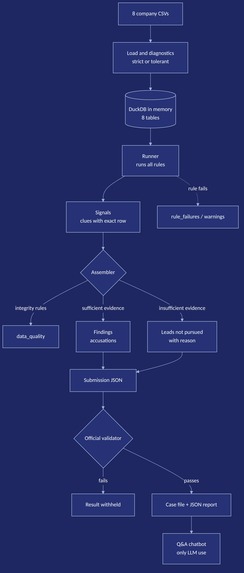
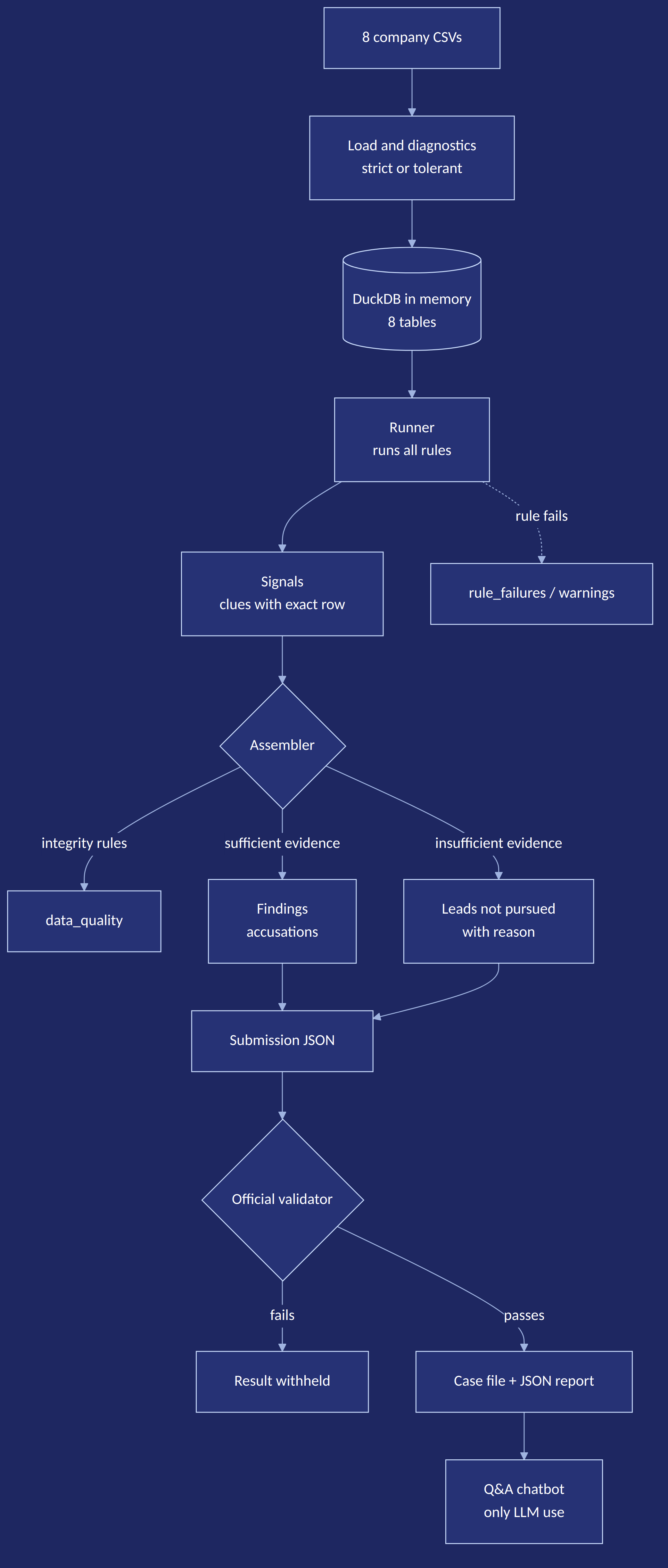
Audicore full flow
Inspiration
[Tell us what motivated you: did you see a real case of fake-invoice fraud (EFOS)? Are you interested in fighting corporate fraud in Mexico? Was it the specific HackMTY challenge?] Corporate fraud in Mexico moves enormous amounts of money through shell companies (EFOS) and simulated invoicing schemes — and the tools to detect it are often opaque: "the AI says it's fraud" isn't proof that can hold up an accusation. We wanted to build a system that investigates the way a forensic auditor would: with citable, traceable, reproducible evidence.
What it does
AudiCore takes a company's 8 accounting CSV files and delivers a readable case file: which vendors or employees are involved in fraud, with what evidence, how much money, and why the leads that were not accused got dismissed.
How we built it
- SQL rules engine on DuckDB: each rule is a pure function that runs a read-only query and returns signals (clues tied to an exact row), grouped into 5 fraud types (phantom vendor, kickback, round-tripping, threshold splitting, and revenue inflation).
- A deterministic assembler that groups signals by scheme (union-find), decides whether there's enough evidence (≥2 independent evidence families, ≥3 citable records, an amount that reconciles), and if not, closes the lead with the exact reason.
- Zero LLM in detection: the whole findings pipeline is SQL rules and fixed thresholds — same CSV + same seed always produces the same result, which is essential for a judge or auditor to reproduce the case.
- Layered validation: every finding self-verifies (exhibits exist, amounts reconcile, narrative stays within the word limit) and then passes through an official validator before publishing.
- [Add your real stack here: backend language, API framework, frontend if any, how you generate the HTML case file, etc.]
What we learned
- That "prove before accusing" is harder than detecting: designing the materiality conditions to avoid accusing an honest vendor (a decoy) took more iteration than the detection rules themselves.
- [Add concrete technical learnings: DuckDB vs. PostgreSQL, designing a deterministic engine, balancing recall vs. false accusations, etc.]
Challenges we ran into
- Balancing recall (finding real fraud) against the false-accusation rate (not accusing an honest decoy) — both errors are weighted equally in scoring.
- [Add team/time challenges: data limitations, hackathon time constraints, team coordination, debugging complex SQL rules, etc.]
Built With
- duckdb
- next
- postgresql
- python
- qwen2.5:7b
- tailwind
- typescript

Log in or sign up for Devpost to join the conversation.