INSPIRATION
Small clinics, schools, and light factories live under the same regulatory weight as large organizations, but without a compliance department. Fire NOCs, biomedical waste authorizations, pollution consents, boiler certificates, and staff clearances end up scattered across binders, desktop folders, WhatsApp photos, and emails. Then a surprise inspection is announced for tomorrow morning, and the scramble begins. Expired certificates get discovered too late, and the result can be fines or even a shutdown order.
Cloud compliance tools don’t solve this. Patient rosters, minors’ records, and factory schematics can’t safely be uploaded to third-party LLMs, and enterprise GRC software costs far more than a small facility can justify. We wanted a tool that could audit a facility’s documents without a single file leaving the building, and the UGREEN AI NAS was the natural place for it.
WHAT IT DOES
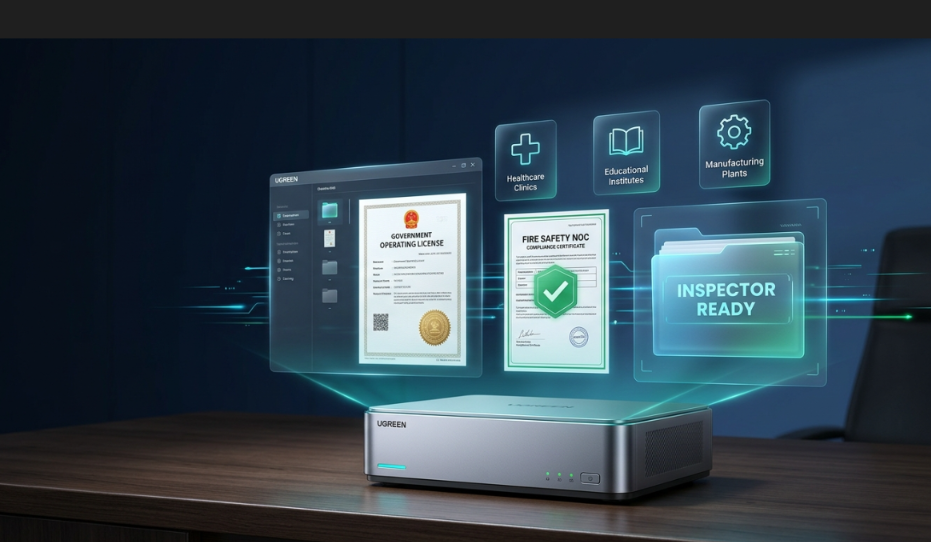
Audit Ready is an autonomous statutory compliance auditor that runs entirely on the UGREEN AI NAS. You ask in plain language, for example “Audit our clinic documents for tomorrow’s health inspection,” and the Skill:
- Discovers every relevant PDF, scan, and camera photo in the chosen NAS folders
- Extracts license numbers, issuing authorities, and expiry dates from digital documents
- Reads physical evidence such as framed wall licenses, fire extinguisher tags, and handwritten registers using local vision OCR
- Cross-checks everything against sector-specific statutory checklists for clinics, schools, and factories
- Tags each file as
audit:valid,audit:expiring-soon,audit:expired,audit:missing, oraudit:review-needed - Produces an Inspector-Ready Audit Pack, an organized folder you can hand to an auditor, plus an Audit Gap Report with a readiness score and a remediation action plan
Original files are never modified or deleted. Everything is copied, never moved.
HOW WE BUILT IT
We built Audit Ready as a Skill following the Uliya Skill Development Standard. A parent Skill orchestrates six delegated steps across the NAS’s registered subagents:
- file-agent (
ug-filesystem) finds and lists compliance files - document-agent (
ug-document) extracts structured metadata and expiry dates - photo-agent (
ug-photo, vision-ocr and vision-vlm) reads certificates and registers from photos - document-agent synthesizes the gap report against the checklist rules
- file-agent (
ug-filesystemandug-filemgr) stages the Inspector_Ready_Audit_Pack and applies status tags - knowledge-agent (
ug-knowledge) saves the Audit Gap Report and action checklist to the NAS
The domain knowledge lives in modular reference files: sector compliance matrices, facility profiles with the staging structure and tagging taxonomy, and disclosures and licenses. The Skill package is just SKILL.md plus linked markdown references, as the challenge requires, and passes the official Uliya static checker with 0 errors and 0 warnings against catalog version 2.2.0.
CHALLENGES WE RAN INTO
- Making statutory rules concrete. Compliance requirements differ by facility type, so we had to encode checklists for three sectors (clinic, school, factory) as clear, checkable rules in markdown instead of vague guidance.
- Messy real-world evidence. Compliance proof often exists as a crooked phone photo of a framed certificate, not a clean PDF. We designed a human-in-the-loop path, using
waiting_userfor blurred or low-light images, so the Skill asks for help instead of guessing. - Staying safe on real records. An auditor tool touches sensitive files, so we kept every operation non-destructive, required
waiting_approvalbefore batch filesystem changes, and avoided any credentials, direct shell execution, or privilege bypass. - Working within the format limits. A Skill-only package and a 500-word proposal forced us to be precise about what the Skill does and what it leaves to the user.
ACCOMPLISHMENTS THAT WE’RE PROUD OF
- A complete, working end-to-end pipeline that uses five NAS capability families (filesystem, file management and tags, document intelligence, visual multimodal AI, knowledge archival) in a natural sequence
- 100% local and privacy-first: zero remote telemetry and zero external API calls
- A static-checker pass with 0 errors and 0 warnings
- Coverage of three high-pressure sectors with realistic statutory checklists
- A tangible output people actually need: a folder you can hand to an inspector, plus a clear list of what is expired or missing
- A 404-word proposal and an 8.8 KB Skill package, well within the limits
WHAT WE LEARNED
- Choosing a narrow, high-stakes workflow works better than a general assistant. “Be inspection-ready by tomorrow” is a problem anyone understands immediately.
- The NAS is well suited to sensitive, regulated records because storage, AI, and files sit in one trusted place.
- Delegating to specialized subagents keeps each step simple and auditable.
- Good compliance tooling must be honest about uncertainty. Flagging a blurry scan for human review is better than silently marking it valid.
- Metadata tags turn a one-time audit into something users can keep querying and filtering.
WHAT’S NEXT FOR AUDIT READY
- More sectors and regions: restaurants and food businesses, hostels, pharmacies, and state-specific rule variants
- Continuous monitoring: scheduled scans that raise expiry alerts 60, 30, and 7 days ahead
- Regional-language support: reading Marathi and Hindi certificates and generating bilingual reports
- Renewal assistance: drafting renewal applications and reminder messages from the extracted data
- Mock inspection mode: an interactive walkthrough where the Skill asks the questions an inspector would
- Audit history: comparing reports over time to show a facility’s readiness trend
