-
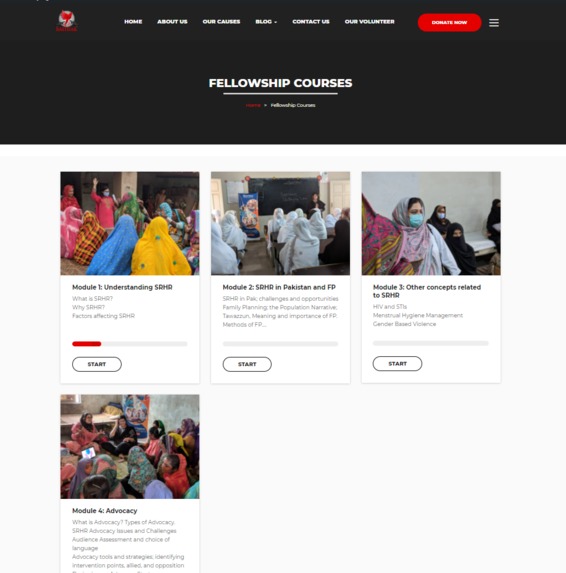
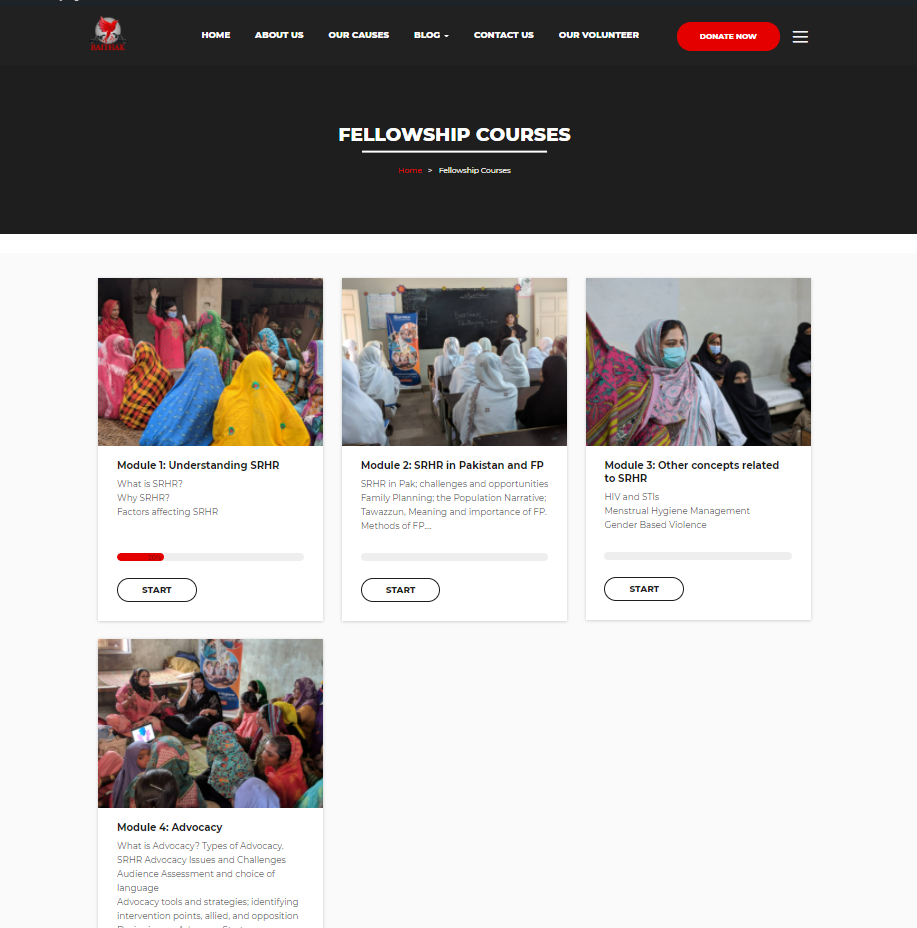
Screenshot of frontend of our fellowship's LMS.
-
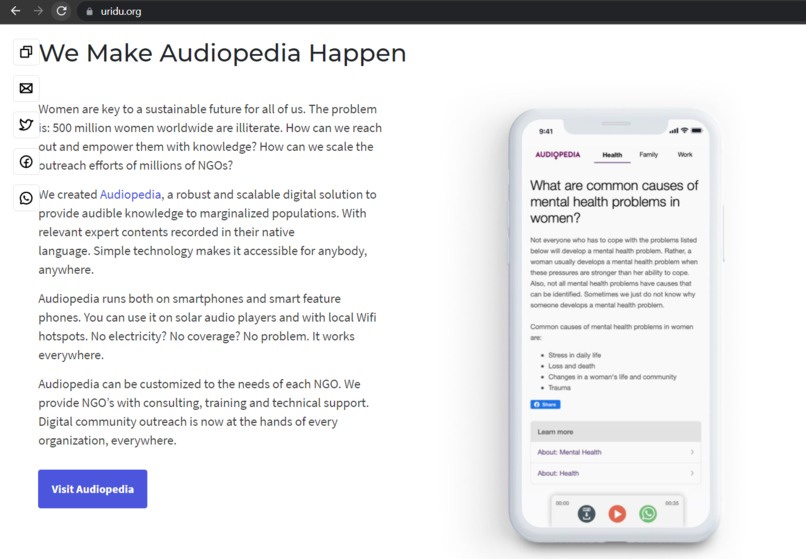
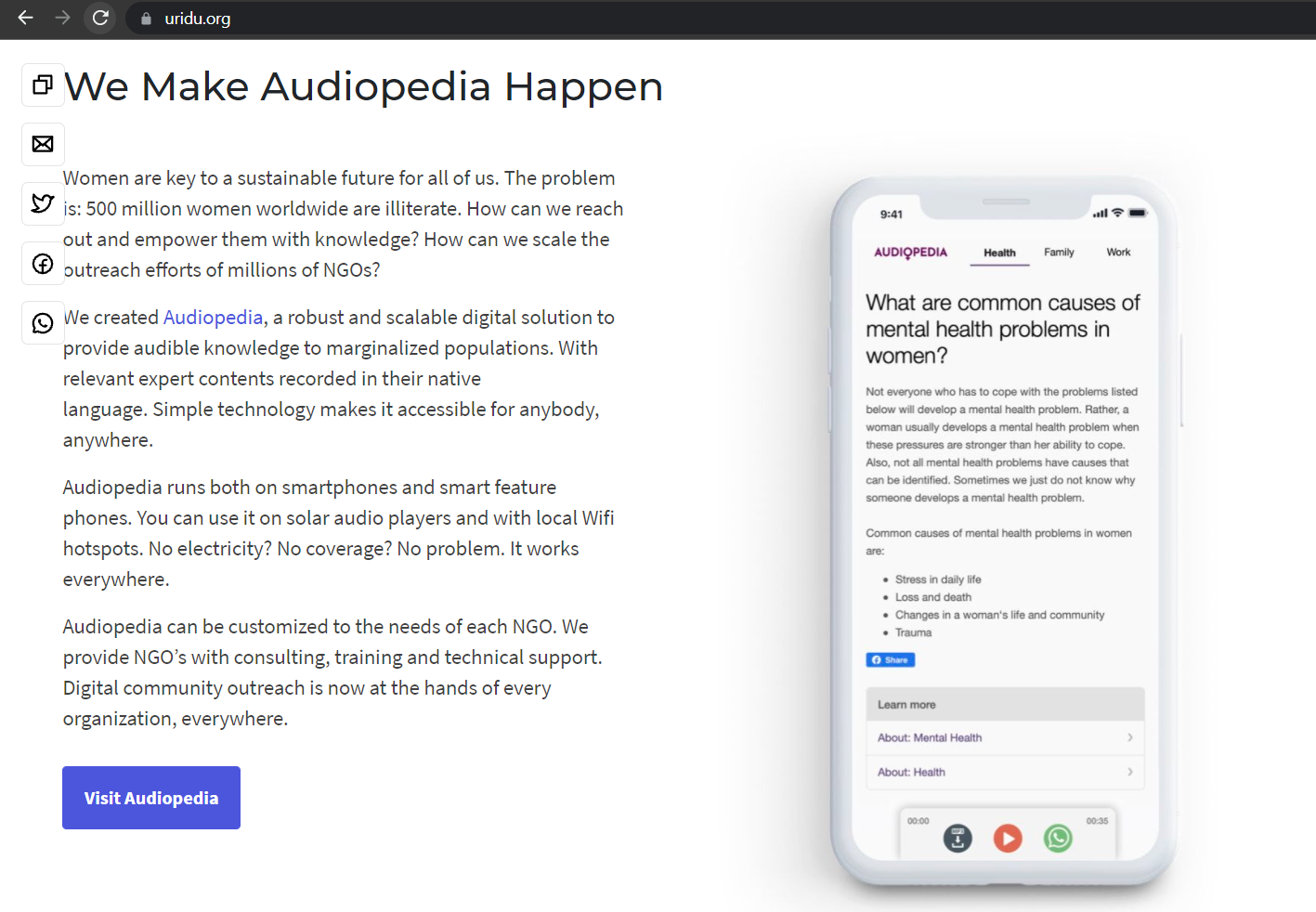
Uridu - Collaboration for audible content.
-
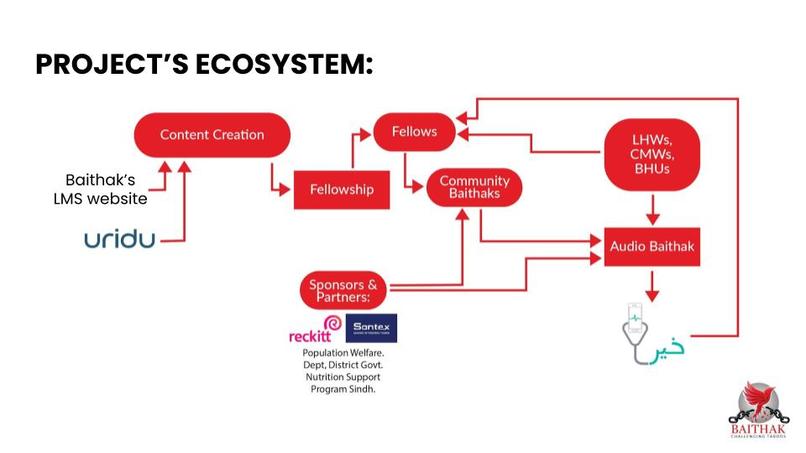
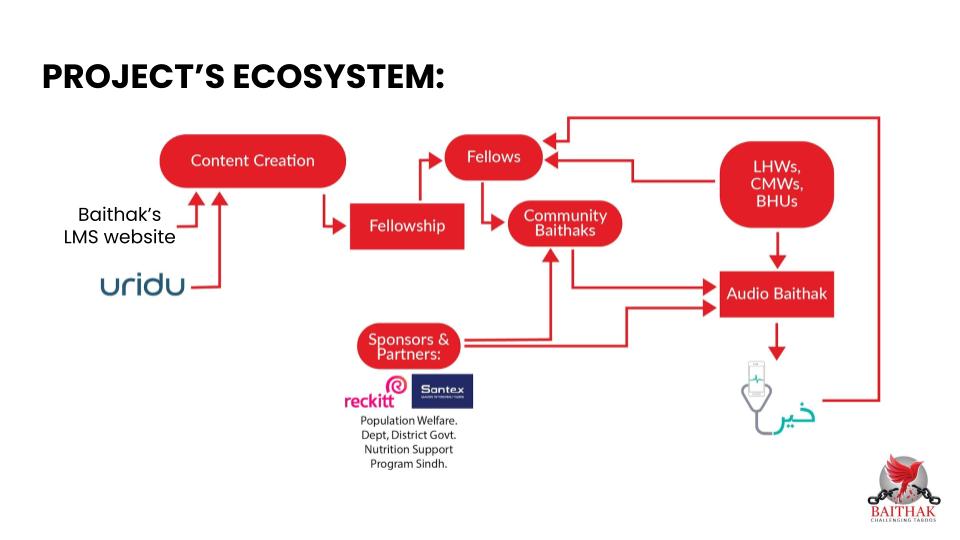
Project's complete ecosystem.
Inspiration
The organization that we are representing is Baithak - Challenging Taboos. Baithak has been working in rural Sindh for 3 years and what we have learned from all our work is that for SRHR advocacy to work, there is a need to provide safe spaces to women (and even men) where they can learn about SRHR. Passive, one-way awareness sessions are no longer effective, especially because of the cultural and religious beliefs tied to the mindset that is reluctant to access SRHR services. So the only way is to make people reflect by facilitating their thought process through education and information in a safe environment. Our initial inspiration to work in this space was sparked by our conversations with people in the community. During the research phase in these three days, we gained some very useful insights which inspired us to combine three technologies that our target beneficiaries are already comfortable with.
What it does
Our solution aims at creating a holistic, health ecosystem to create safe spaces for both; men and women to learn, reflect, and discuss about SRHR. It combines three powerful technologies; Ed-tech, Audible knowledge, and Whatsapp and has two major components. The second component is conducting ‘Audio Baithaks’ to educate people using audible knowledge via Whatsapp. The first component is a fellowship that will train young community leaders who will execute the first component.
Problem Statement: The knowledge, awareness, and motivation to use SRHR services is low in rural Pakistan; the literacy rate of the communities is quite low, they can speak and understand only their local language and they are not tech-savvy. There is clearly a need for a viable and effective solution that can educate them about SRHR in their local language in a safe environment using technology that they are comfortable using and with people who they can relate to.
Details of our proposed solutions are given below:
Phase I: Content creation:
- Step 1: Creating content for the online course consisting of 4 Modules using the our website and designing a 1-month fellowship programme. The course content will include articles, videos, reflection questions, and short quizzes. The content will include (insert some themes from fellowship)
Rationale: The fellows for this fellowship will be young community leaders who are studying in educational institutions, have access to the internet, have access to their communities, and are active in community affairs. A blended learning fellowship will allow them to develop an in-depth understanding about SRHR which is very necessary to work in this area.
- Step 2: Development of audible content in local languages both in male voice and female voice on SRHR information in partnership with URIDU, a Germany based non-profit organization that empowers marginalized women with robust and scalable digital solutions to provide them audible knowledge.
Rationale:The literacy rate in the communities that we are targeting is very low especially among women. A lot of them cannot write or navigate around any other digital solutions. However, we have observed that they know how to send audio messages on Whatsapp and listen to voice notes. In fact, many women prefer communicating via voice notes instead of text messages. We want to leverage that in order to educate and empower them on SRHR.
Phase II: Execution
1st Component: SRHR Advocacy Baithak: Executing an intense, virtual, blended-learning SRHR Advocacy Fellowship to train 30 young community leaders from across Sindh in SRHR Advocacy. etc. Every week, they will learn from experts from the field and design their own advocacy campaign. The fellowship will be followed by 3-month active mentoring and life-time support from our organization.
2nd Component:
- Step I: Roll out of SRHR Advocacy programs designed by fellows who will conduct in person 'Baithaks' and educate at least 400 people within three months post-fellowship in their own communities. The goal of these baithaks would be to sensitize the community and bring them on board for Audio Baithaks on Whatsapp. Fellows will also train them on how they can benefit from audible content that they will keep sharing with them from time to time.
- Step II: Delivery of audible, informative content via fellows to the beneficiaries.
- Step III: Connecting the beneficiaries with tele-health companies for SRHR services. ## How we built it Our solution/product is the result of team work, three days of problem solving, extensive research, and a lot of hard work. The process behind building is explained below:
Step 1: Problem identification and idea generation:
First, it was important for us to identify the problem in the category that we wanted to work in. So we conducted research to identify a problem which included 4 sources:
Desk Research: We reviewed several articles, policy briefs, and reports to understand the health infrastructure in Pakistan. We identified the gaps in access to SRHR and how stigma attached to it causes a lot of barriers especially for women and young people to access their SRHR. Prior experience: The organization that we are representing has been working in the field of SRHR since 2018. We have conducted focus group discussions with women in communities in rural Pakistan to understand their needs and the problems they face in accessing their SRHR. We used the data that we have and other insights that our team has collected through our work on ground. Insights from the field: We also reached out to some of our beneficiaries to gain fresh insights related to the problem. Use of voice notes via WhatsApp was one of the key findings. Expert opinion: We then contacted some experts in health and EdTech and asked them to share their opinions ok the subject. After our research, we were able to make our problem statement and started working on our solution.
Step 2: Framework of our solution
We knew what to do after Step 1 but we were not sure how to do it. So all the team members engaged in brainwriting and brainstorming sessions on Zoom and we decided to create a holistic health ecosystem to educate people on SRHR using three powerful technologies. The process is explained below: Step 3: Based on our research, we created 4 modules of SRHR Advocacy Fellowship on our website. Step 4: We finalized the structure of the fellowship and the strategy to execute it. Step 5: We finalized the languages that we will be hosting Audio Baithaks in the first 5 years of operation. Step 6: We researched on the organizations we can collaborate with and reached out to some of them including URIDU, Khair, FortheMenstruator, etc. Step 7: We made a list of all the resources that we have to execute the plan. Step 8(a): We created the mechanism of the ecosystem our solution will be working on. Step 8(b): We are creating the LMS for fellowship and its content based on interactive learning.
Challenges we ran into
1) Time constraints: this was the biggest challenge since we only had 3 days and a lot to do. We wanted to make sure that out solution/product addresses real needs of the communities we want to serve and that it's backed by research which was very time consuming. However, good coordination among team members helped overcome this challenge.
2) Availability of experts: we tried to gain insights from as many experts ad possible; however, due to their limited availability, we had to reschedule our meetings multiple times which delayed the whole process.
3) Coordinating everything in a virtual space: All our team members are based in different cities and we're working virtually. Power shutdowns and unstable internet created a lot of challenges; however, we tried to keep as much backup as possible.
4) Balancing the work on our solution and other events happening during GovTech: All the workshops were very interesting,; however, it was very difficult to balance the time that we need to work on the solution and the time that we needed to learn from all the workshops.
Accomplishments that we're proud of
1) Our biggest achievement is sorting the whole solution in 3 days. Before the start of the event, we had a vague idea on what we wanted to work on but didn't know anything else. During 3 days, we were able to transform a vague idea into a workable and viable product/solution
2) Our second biggest achievement is launching the fellowship structure on our website.
3) Our third achievement is creating the mechanism of the whole ecosystem that we are trying to build through our solution.
4) Our fourth achievement is reaching out to all potential partners. We have even started receiving responses from some of them.
5) Our fifth achievement is getting some experts on board who are willing to help us in executing the solution.
What we learned
We learned a lot of useful lessons during these three days. Some of them are mentioned below:
1) It's a very popular saying that team work makes the dream work. We wouldn't have been able to put up a viable solution in just three days if we didn't have solid team work. We learned how to work in a team and how effective communication in a team is essential.
2) While we were working on our solution, we learned how innovation can also happen by discovering new and effective ways of doing things. We are combining, in fact, leveraging the already existing technologies to bring an innovative solution to enable people gain access to SRHR information and services.
3) It is very important to try and fail. We came up with different solutions and multiple iterations of our solution until we finally reached our current product.
4) We also learned that if you put in the right amount of hard work and patience, you cab actually make a viable solution in just 3 days.
What's next for Audio Baithak
Next, we are very excited to execute our solution. We know it's going to be an overwhelming and a very difficult process but we can't wait to execute it. We don't just want it to be a one time thing, instead, we want our solution to be sustainable and we plan to scale it to every part of Pakistan and perhaps even in other countries.
We plan to look for resources to make our solution sustainable and to establish partnerships with all the stakeholders to maximize it's impact.


Log in or sign up for Devpost to join the conversation.