Inspiration
The hardest part of creating content is not always creating it.
For many creators, the real bottleneck starts before production: figuring out what is actually worth creating next.
YouTube comments contain direct signals about what viewers need — questions, repeated requests, missing resources, beginner difficulties, access barriers, and frustrations. But those signals are scattered across hundreds of comments, and manually turning them into a confident content decision is slow.
I built AudiencePulse around one question:
What is my audience asking me to create next — and is it actually a content gap?
Instead of treating comments as something to read after publishing, AudiencePulse treats them as input for the next content decision.
What it does
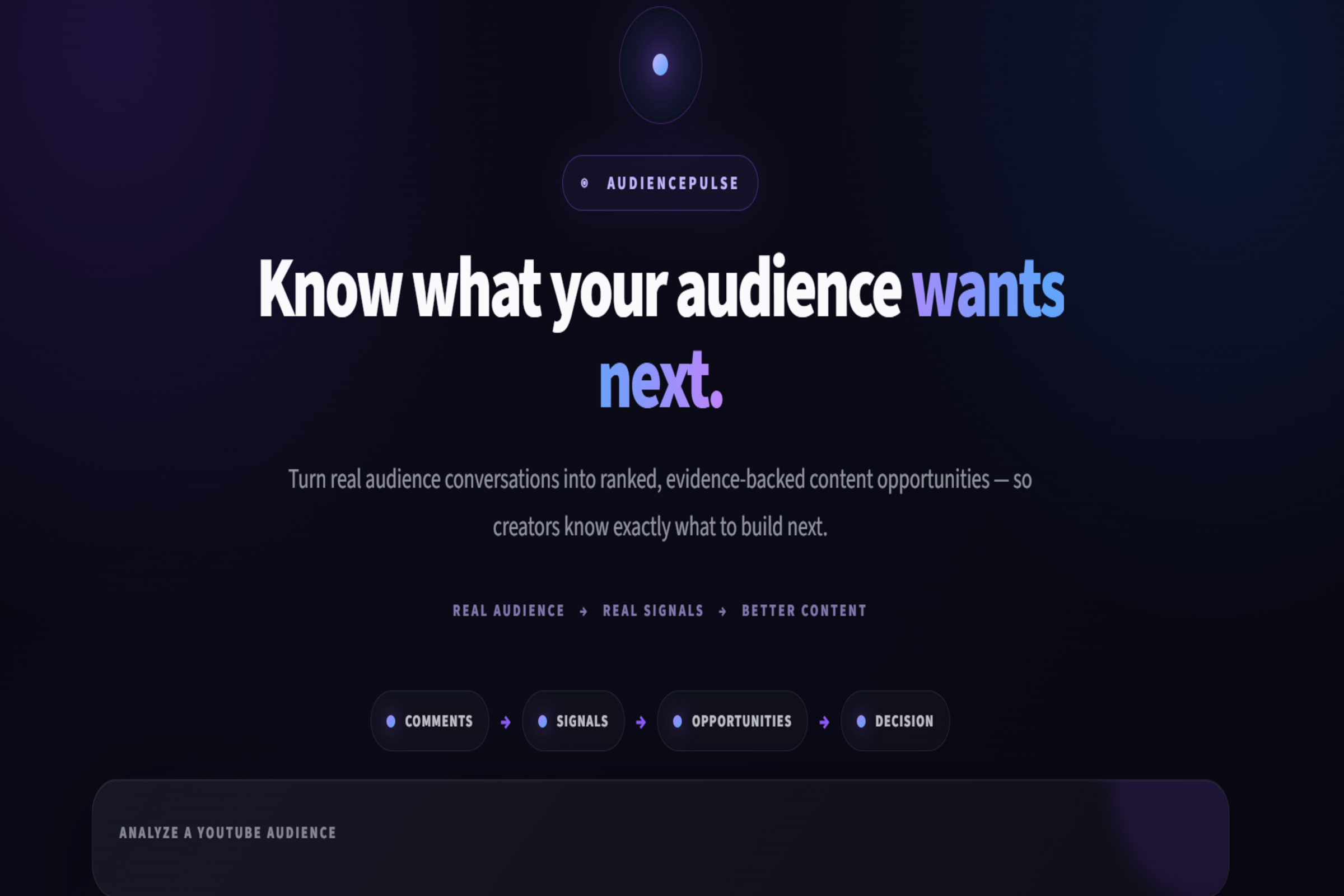
AudiencePulse turns real YouTube audience feedback into ranked, evidence-backed content opportunities.
The workflow is:
Real YouTube Comments
        ↓
Audience Signals
        ↓
Opportunity Score
        ↓
Evidence Strength
        ↓
Channel Coverage Proxy
        ↓
Evidence-Adjusted Content Gap
        ↓
Content Brief
        ↓
Ready-to-Publish Content Package
AudiencePulse identifies recurring audience needs such as:
- access and subscription barriers
- beginner difficulties
- missing resources or links
- usability problems
- feature and content requests
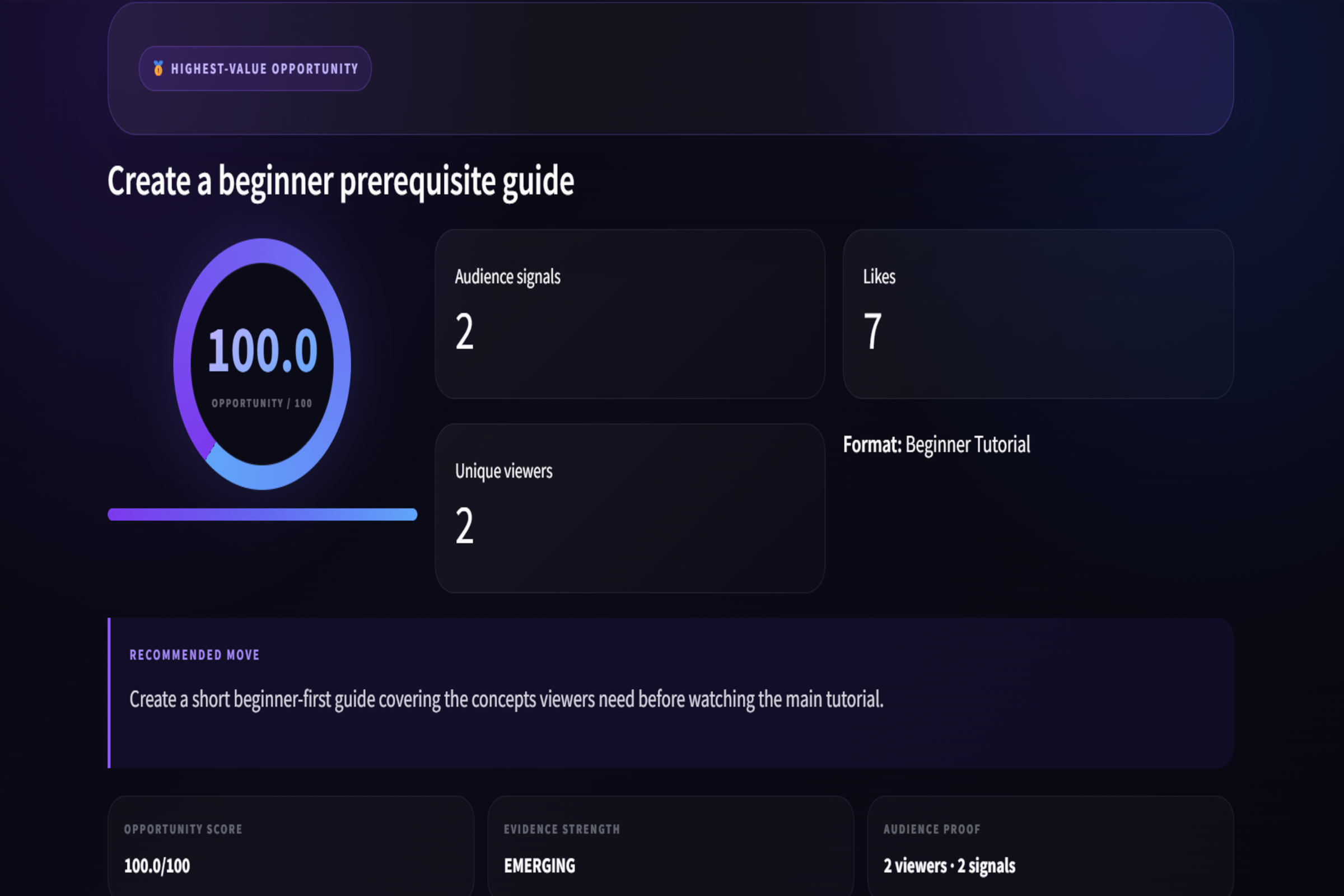
Each opportunity receives an explainable score based on observed audience demand.
The system then separates opportunity strength from evidence strength. This matters because a high score from a very small sample should not automatically be presented as strong statistical confidence.
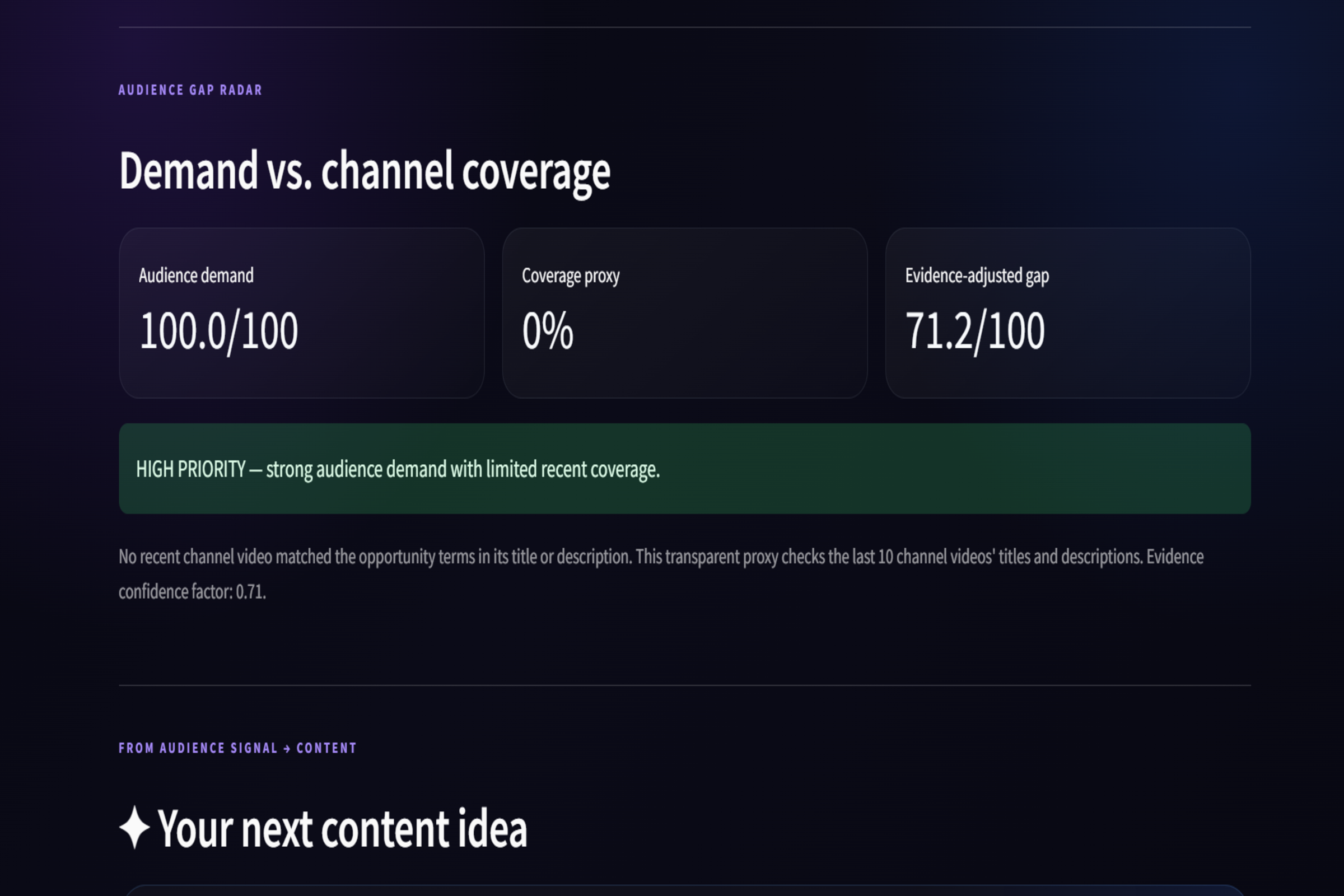
The Audience Gap Radar adds another decision layer by comparing audience demand with a transparent proxy of recent channel coverage using the titles and descriptions of recent videos.
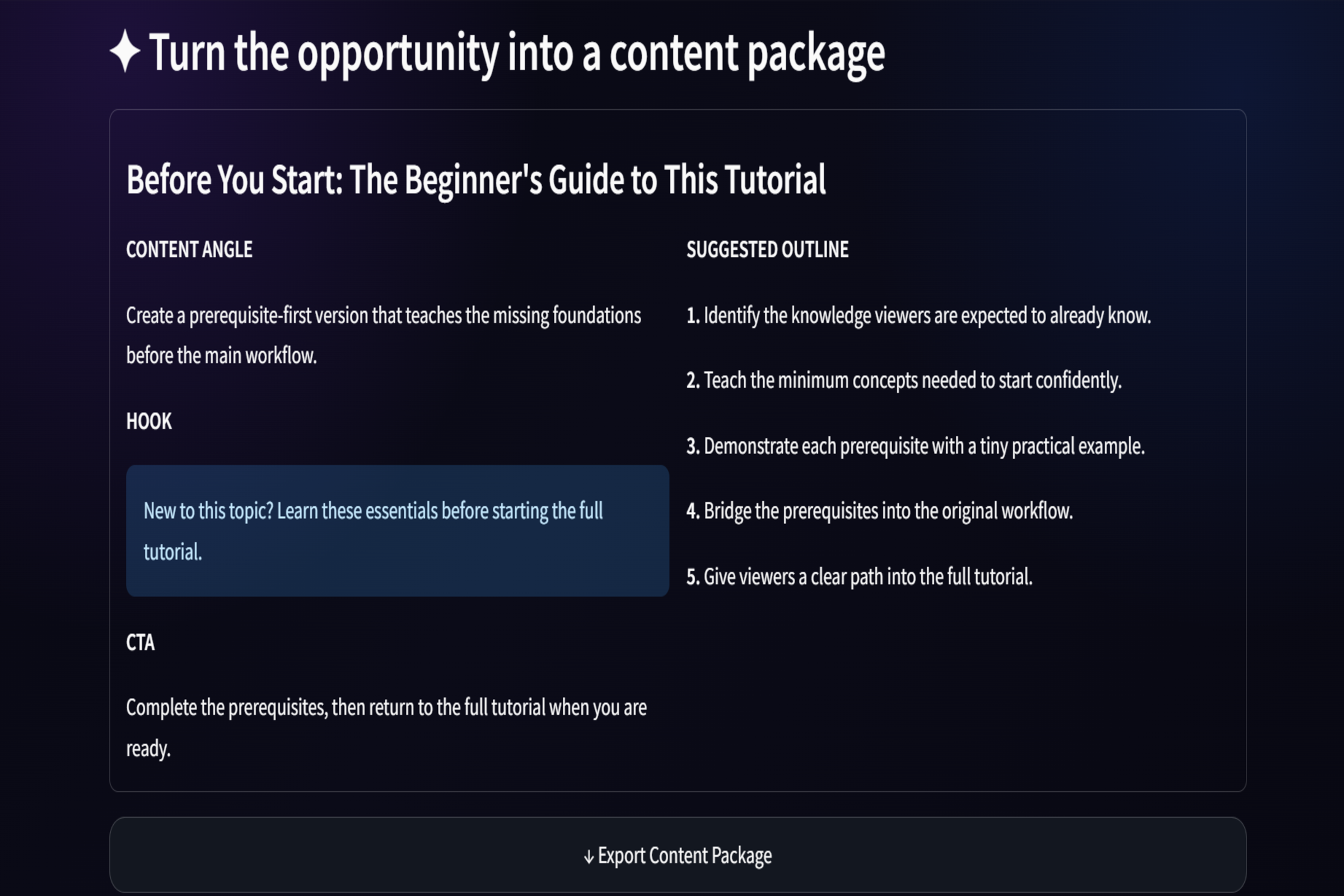
Finally, AudiencePulse turns the strongest opportunity into something a creator can actually use:
Content Brief → Title → Hook → Content Angle → Outline → CTA
The complete analysis can also be exported as a creator report.
How I built it
I built AudiencePulse as a modular Python application with Streamlit.
The pipeline is separated into components for:
- YouTube data ingestion
- comment preprocessing
- audience signal detection
- opportunity scoring
- channel coverage analysis
- evidence retrieval
- content opportunity generation
- content briefing
- content package generation
I use the YouTube Data API to work with real public comments and channel video metadata.
I use Pandas for data processing and scikit-learn in the analysis pipeline.
For the interface, I built a custom Streamlit design system rather than relying on a default dashboard layout. The goal was to make the product feel like a real creator tool, not just a technical prototype.
I also added automated tests and export functionality so the output can be inspected and used outside the application.
Challenges I ran into
The biggest challenge was turning noisy, informal YouTube comments into useful audience signals without pretending that every comment represents a meaningful demand.
I therefore designed the pipeline around evidence and explainability rather than a black-box score.
Another challenge was calibration.
A score of 100 can look extremely convincing even when it comes from only a few viewers. To avoid presenting that as statistical certainty, AudiencePulse calculates a separate Evidence Strength and uses it when calculating the final evidence-adjusted content-gap priority.
I also needed a transparent way to estimate whether the channel was already covering an opportunity. Instead of claiming full semantic understanding of every video, I deliberately use a clearly labeled Coverage Proxy based on recent titles and descriptions.
Finally, I tested the system with different real YouTube videos. Some videos contain strong actionable signals; others do not. That forced me to distinguish between a genuine low-signal audience and an application failure.
Accomplishments that I'm proud of
I am most proud of building a complete workflow from real audience feedback to an actual content decision.
A few things stand out:
- The application works with real YouTube data rather than mock comments.
- Recommendations can be traced back to audience evidence.
- Opportunity scoring is explainable instead of being an unexplained number.
- Evidence Strength prevents small samples from being presented as strong statistical certainty.
- Audience Gap Radar adds a channel-level decision layer.
- The final opportunity becomes a ready-to-publish content package rather than stopping at analytics.
- The project includes automated tests, reporting, and export functionality.
- The final product has a polished creator-focused interface.
In live testing, AudiencePulse has taken real audience comments through the full pipeline and produced ranked opportunities, evidence, a content-gap assessment, and an actionable content package.
What I learned
I learned that creator intelligence is not about collecting the most data.
It is about turning messy feedback into a decision that saves the creator time.
I also learned that explainability matters. A recommendation becomes much more valuable when the creator can inspect the evidence behind it and understand why it was prioritized.
Most importantly, I learned to distinguish between:
A strong signal and strong evidence for that signal.
That distinction influenced the final scoring design and became one of the core principles of AudiencePulse.
What's next for AudiencePulse
The next stage would be expanding AudiencePulse from single-video analysis toward deeper channel-wide intelligence.
Planned directions include:
- deeper semantic analysis of channel coverage
- recurring audience-signal tracking across multiple videos
- historical content-gap tracking
- multilingual audience intelligence
- multi-platform audience analysis
- creator analytics integration
- automated content calendars
The long-term goal is simple:
Help creators understand what their audience wants before they spend time creating it.
Real audience → Real signals → Evidence → Better content

Log in or sign up for Devpost to join the conversation.