-
-
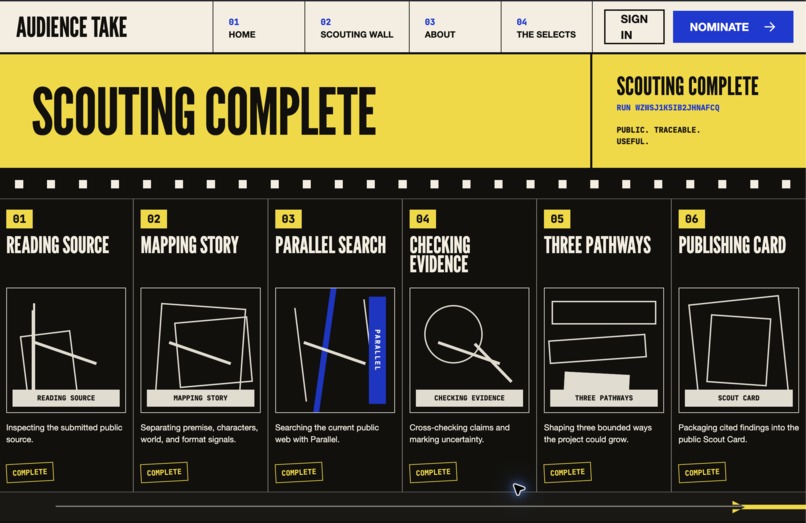
Agent Run Screen
-
-
-
-
-
-
-
Audience Take
Help overlooked screen stories get a closer look.
Inspiration
Audience Take was inspired by creators who build an audience for their stories online before finding opportunities in television or theaters—and by the fans who recognize their work early.
Issa Rae's path helped shape that idea. She built an audience on YouTube with The Misadventures of Awkward Black Girl, launched in 2011, before creating HBO's Insecure. Her experience also makes creator control central to the story: she declined a proposed television adaptation of Awkward Black Girl that would have recast its performers, including her. TheWrap's interview with Issa Rae.
A new generation is taking online filmmaking into theaters. Gen Z filmmaker Kane Parsons developed The Backrooms through his Kane Pixels YouTube work and was just 20 ahead of the A24 feature's release. Backrooms opened to $81.4 million at the domestic box office in May 2026. That is a concrete example of a filmmaker's online work developing into a major theatrical release. Vanity Fair's profile of Parsons, The Numbers' theatrical results.
Audience research gives this inspiration broader context. In Deloitte's 2025 Digital Media Trends survey, 56% of Gen Z respondents found social media content more relevant than traditional TV shows and movies, 52% felt closer to social creators than to television personalities or actors, and 49% said they would be more willing to watch shows or movies starring their favorite online creators. These are audience preferences, rather than measurements of filmmakers' commercial success. Deloitte's findings and survey methodology.
These examples made us interested in what happens before a breakthrough. A fan discovers a short, animated pilot, or web series and thinks: more people should see this. But the trailer, creator updates, crowdfunding history, audience discussion, and professional research can remain scattered across different places. Sharing the link does not bring all that context with it.
Audience Take aims to break down those silos. A shared Scout Card brings public research together with fan Takes, expressions of interest, and a route for creator contributions. Fans can explain why the work connects, creators can add authorized context, and professionals can inspect the evidence and choose a useful next conversation.
Exceptional success stories show what is possible; they do not make views or votes a reliable forecast of ticket sales. Our ambition is to give more projects a useful starting point—whether the creator wants a local screening, another independent episode, a wider audience, or a professional partnership.
A thoughtful discovery deserves a clearer path to its next conversation.
What it does
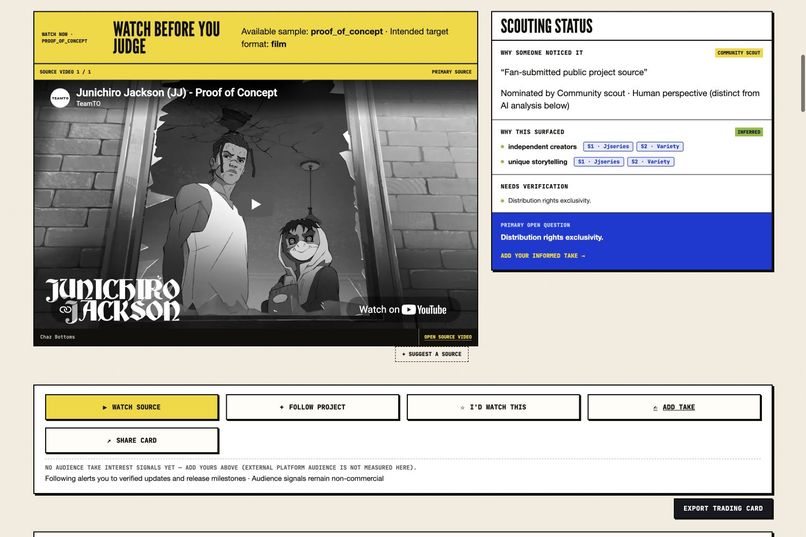
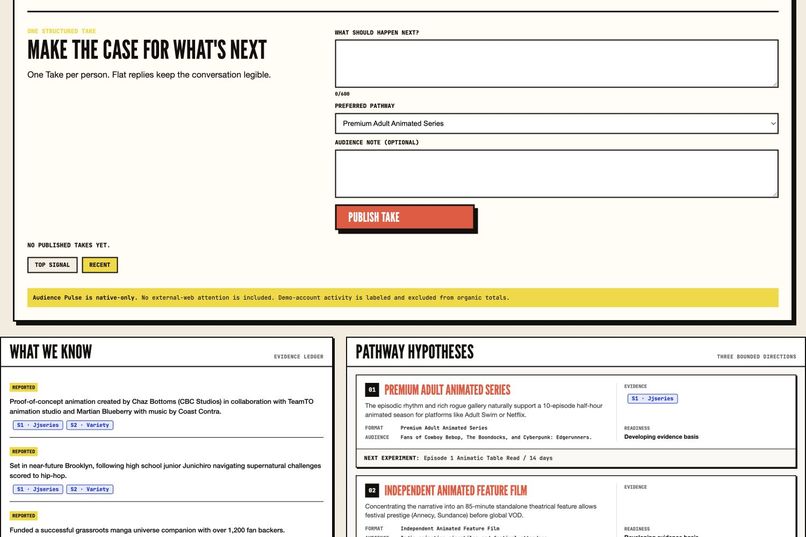
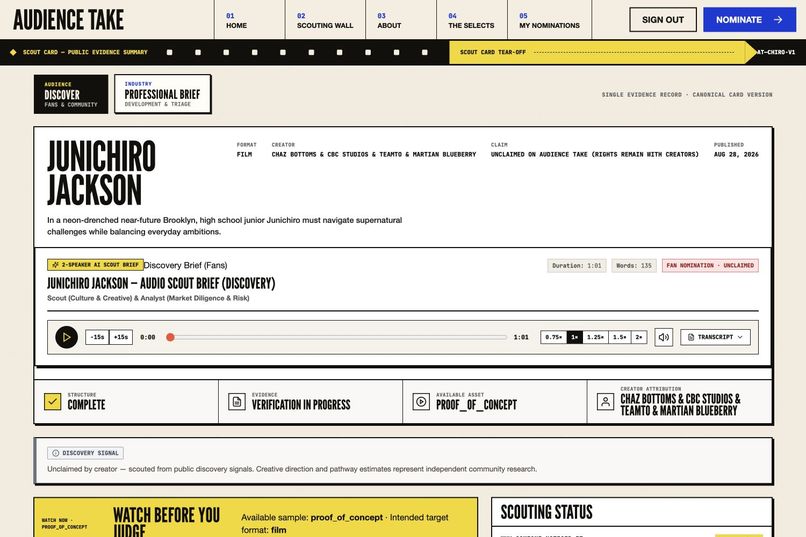
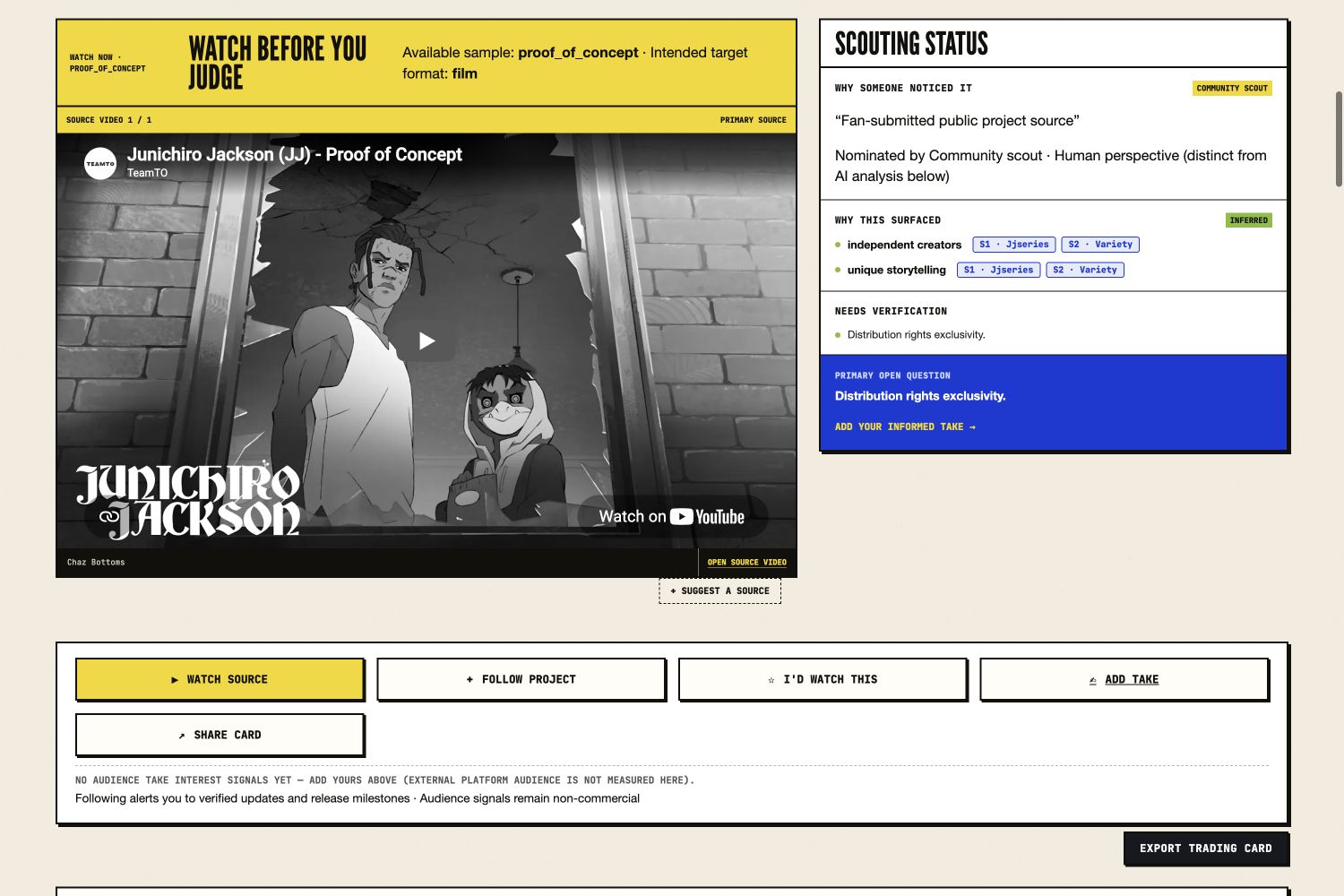
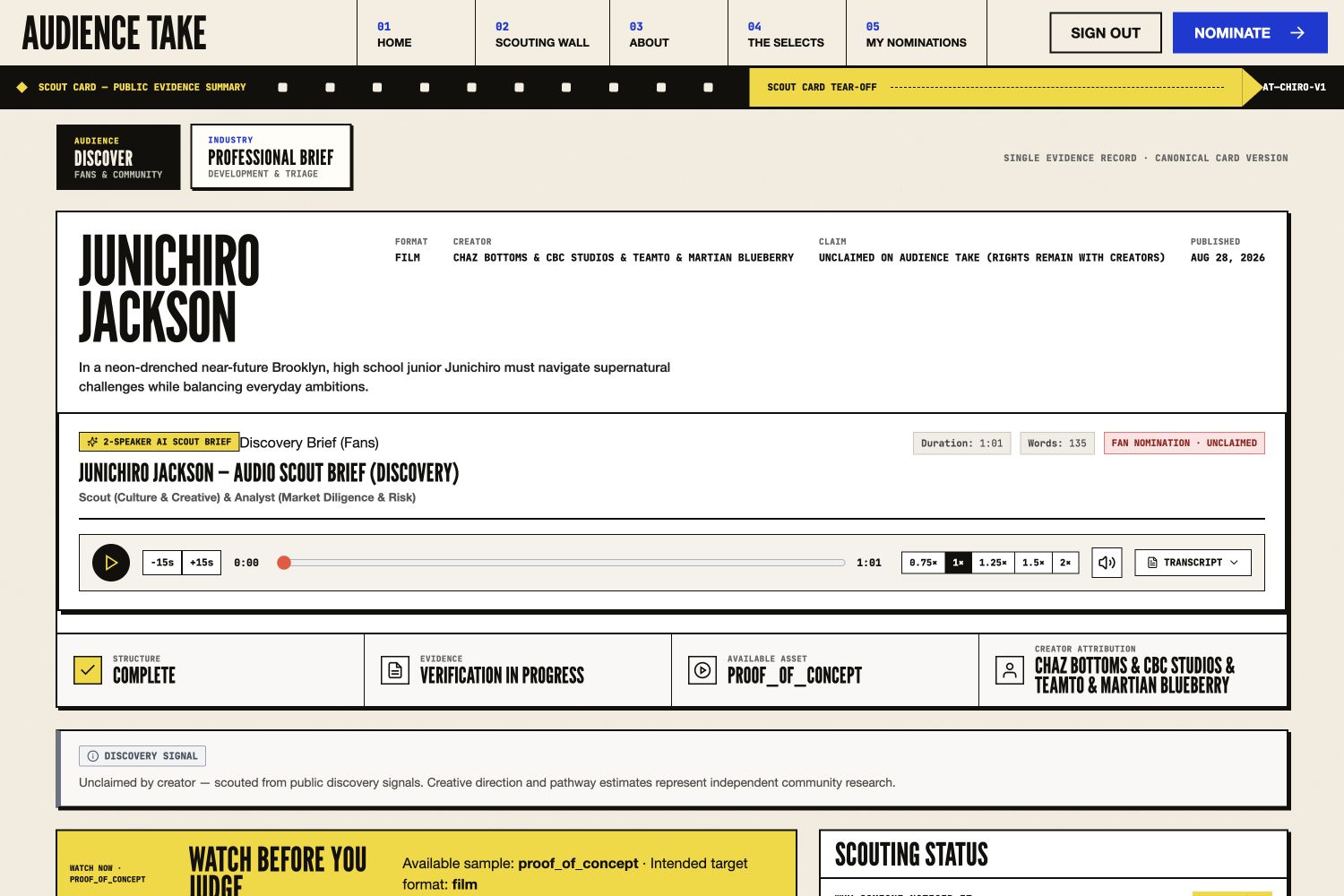
Audience Take combines AI-assisted research with a social layer organized around film projects. A public project link and a fan's reason for nominating it become a Scout Card: a shared home for the research, discussion, and expressions of audience interest around that work.
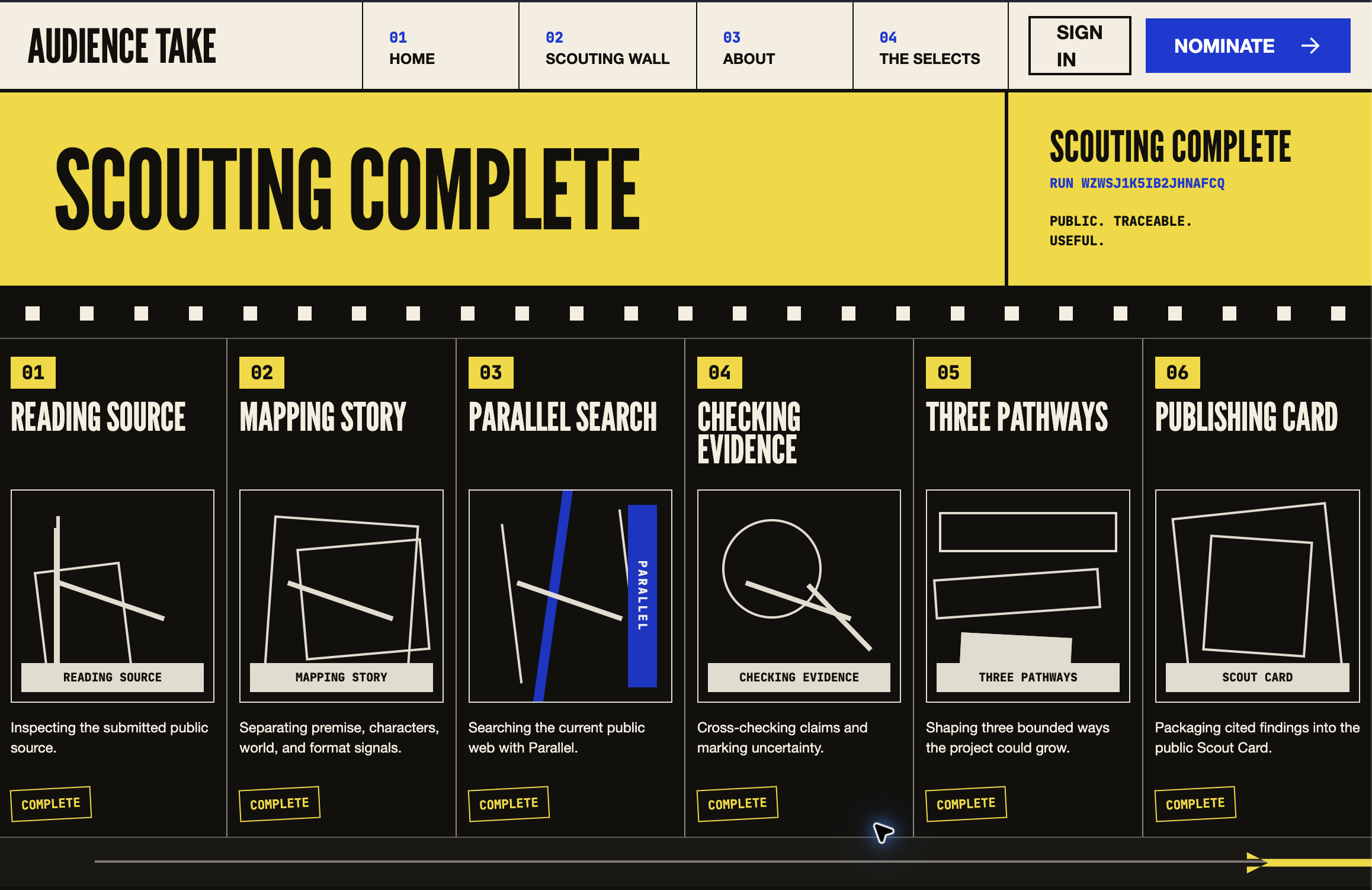
The research workflow investigates the project's identity, searches for public sources, retrieves relevant material, and uses Gemini to organize the findings. When an important question remains open, it can run a targeted follow-up search before producing the card.
The same project has two views:
- Discover: a fan-facing introduction to the project, its premise, source media, and ways to follow it or contribute a Take.
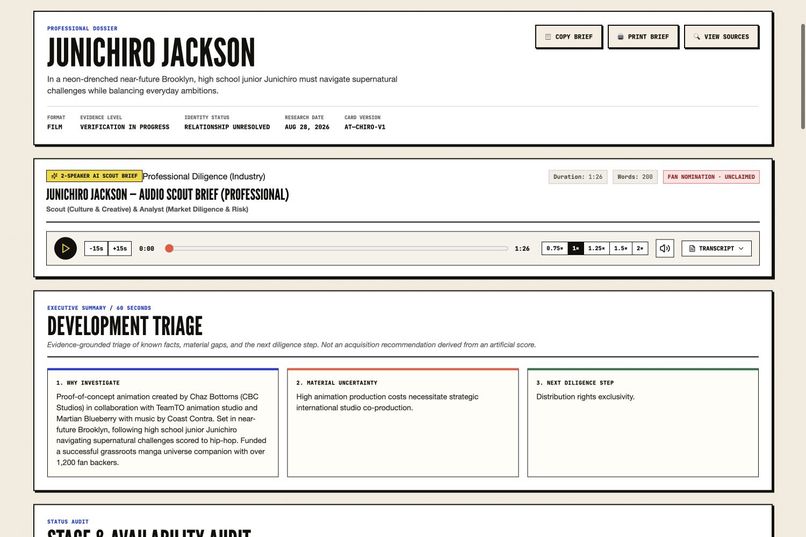
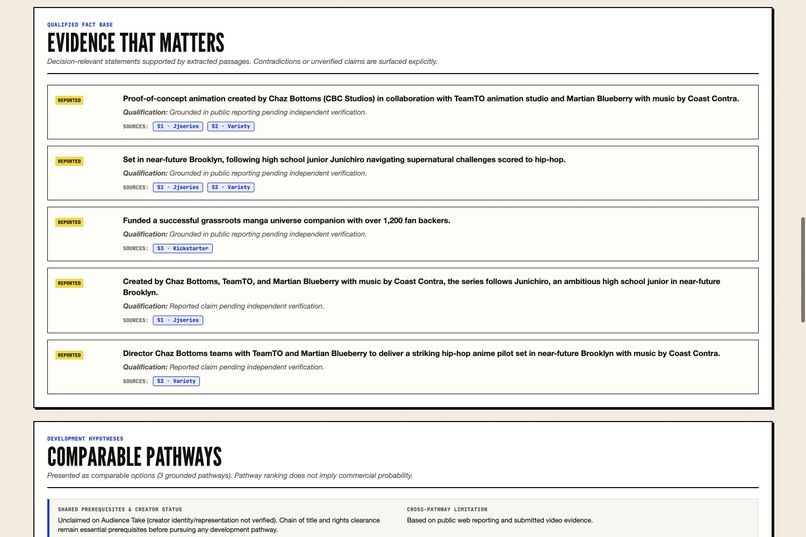
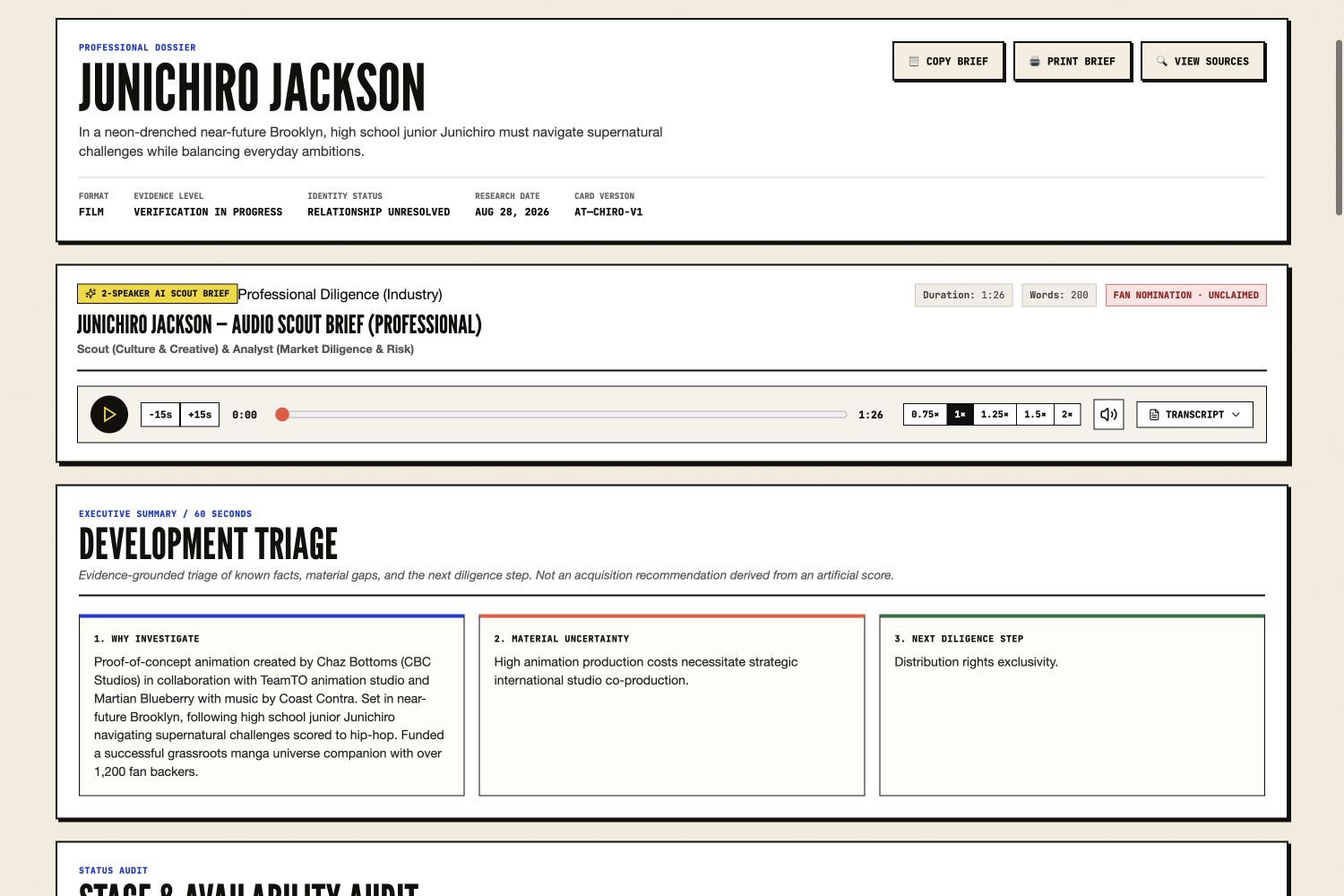
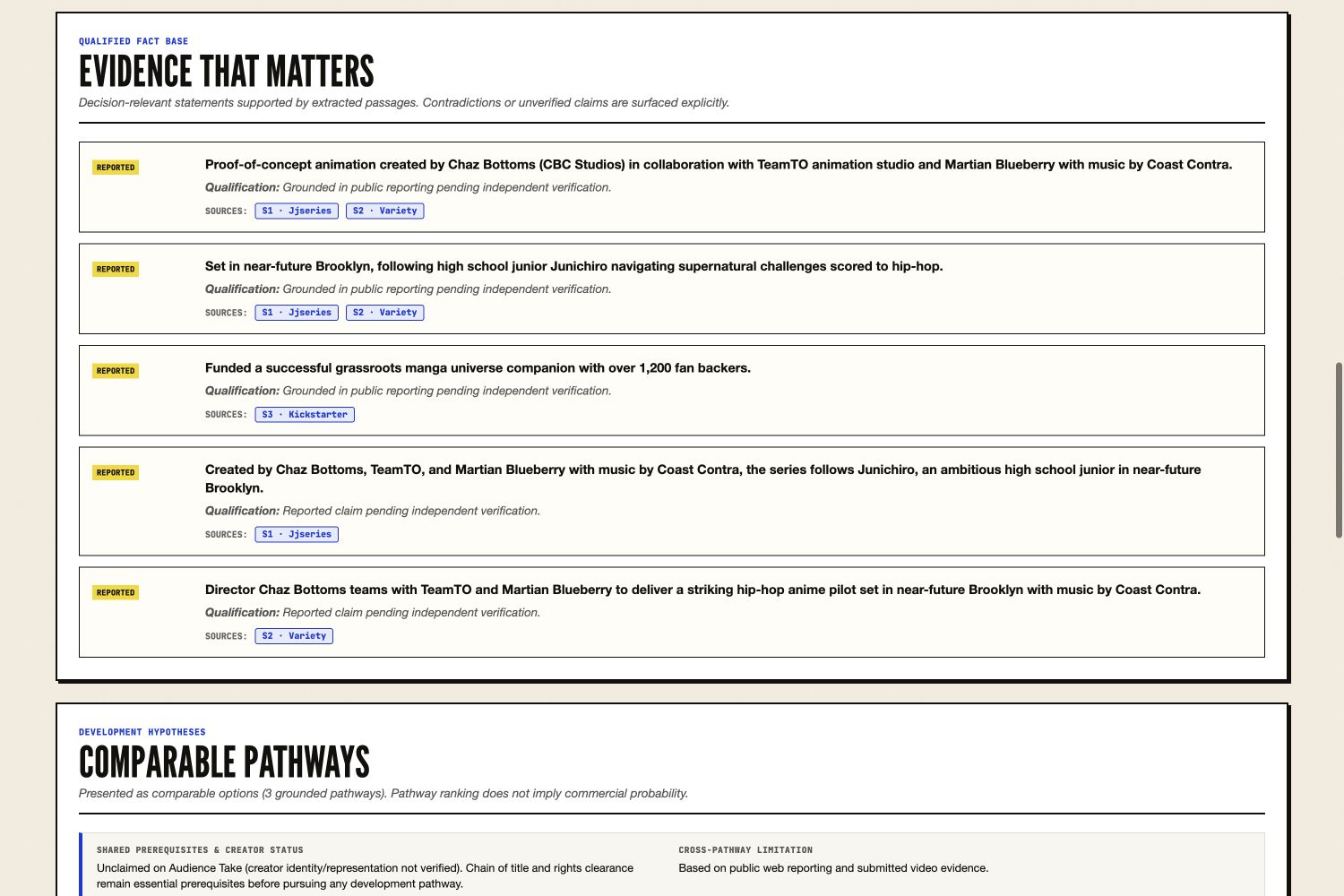
- Professional: a research-focused view with project and development context, supporting sources, and questions that warrant further investigation.
The social layer gives people specific ways to contribute:
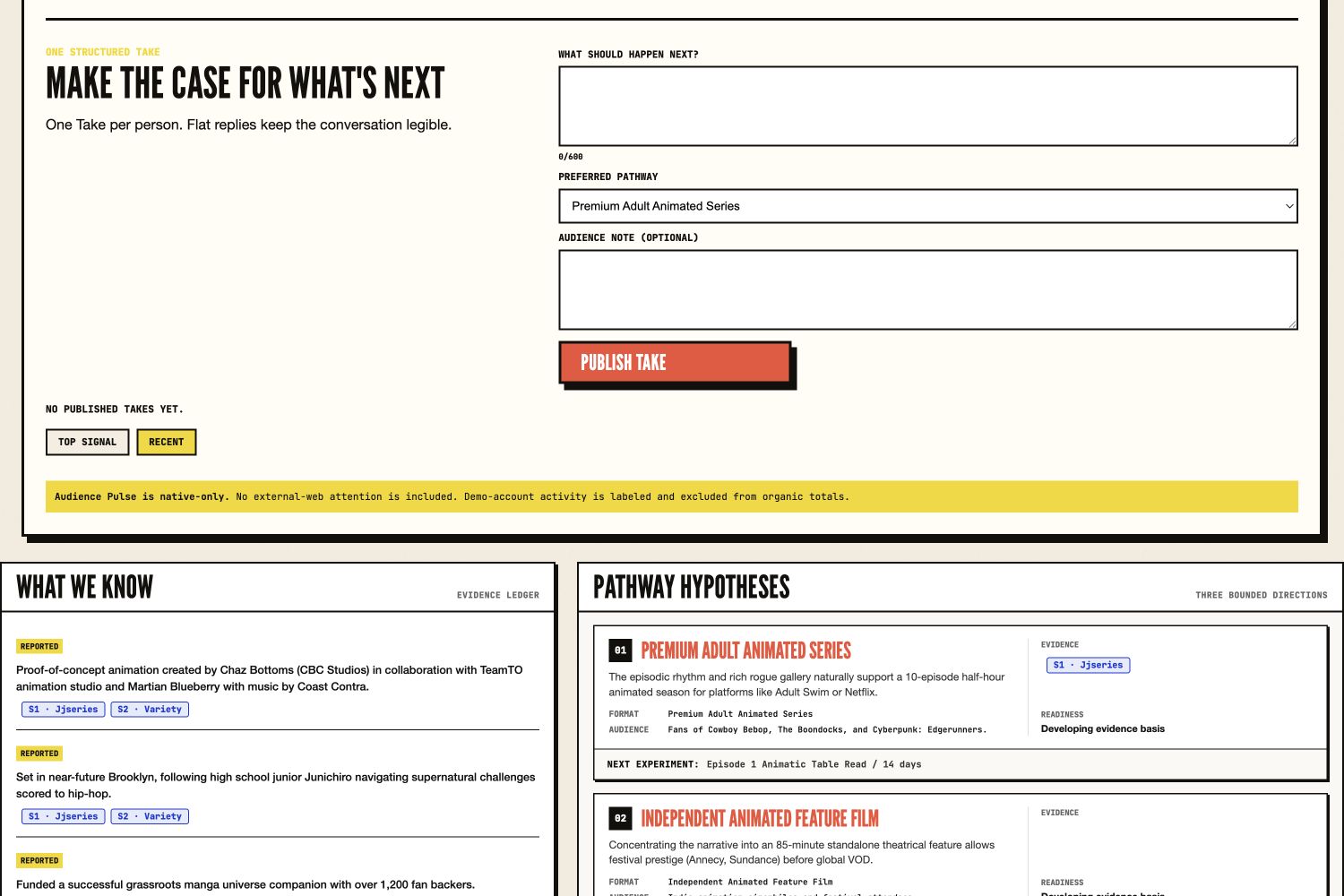
- Explain the interest: post a structured Take, reply to other perspectives, and upvote useful contributions.
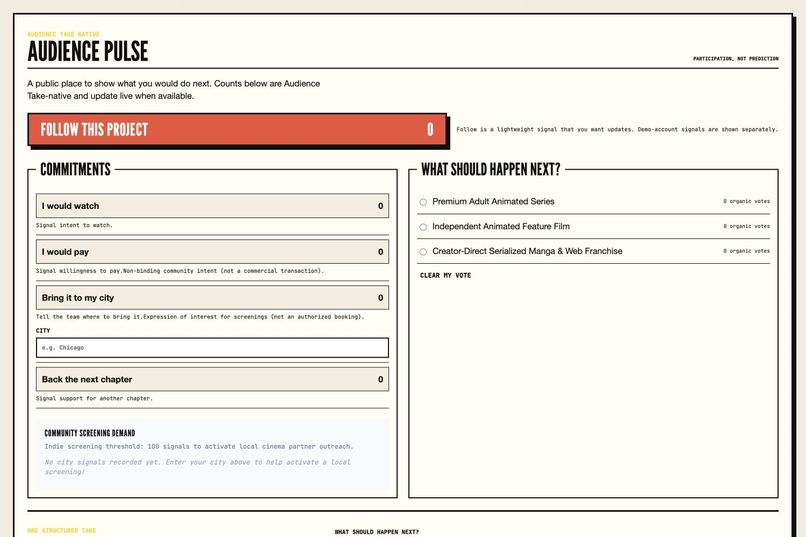
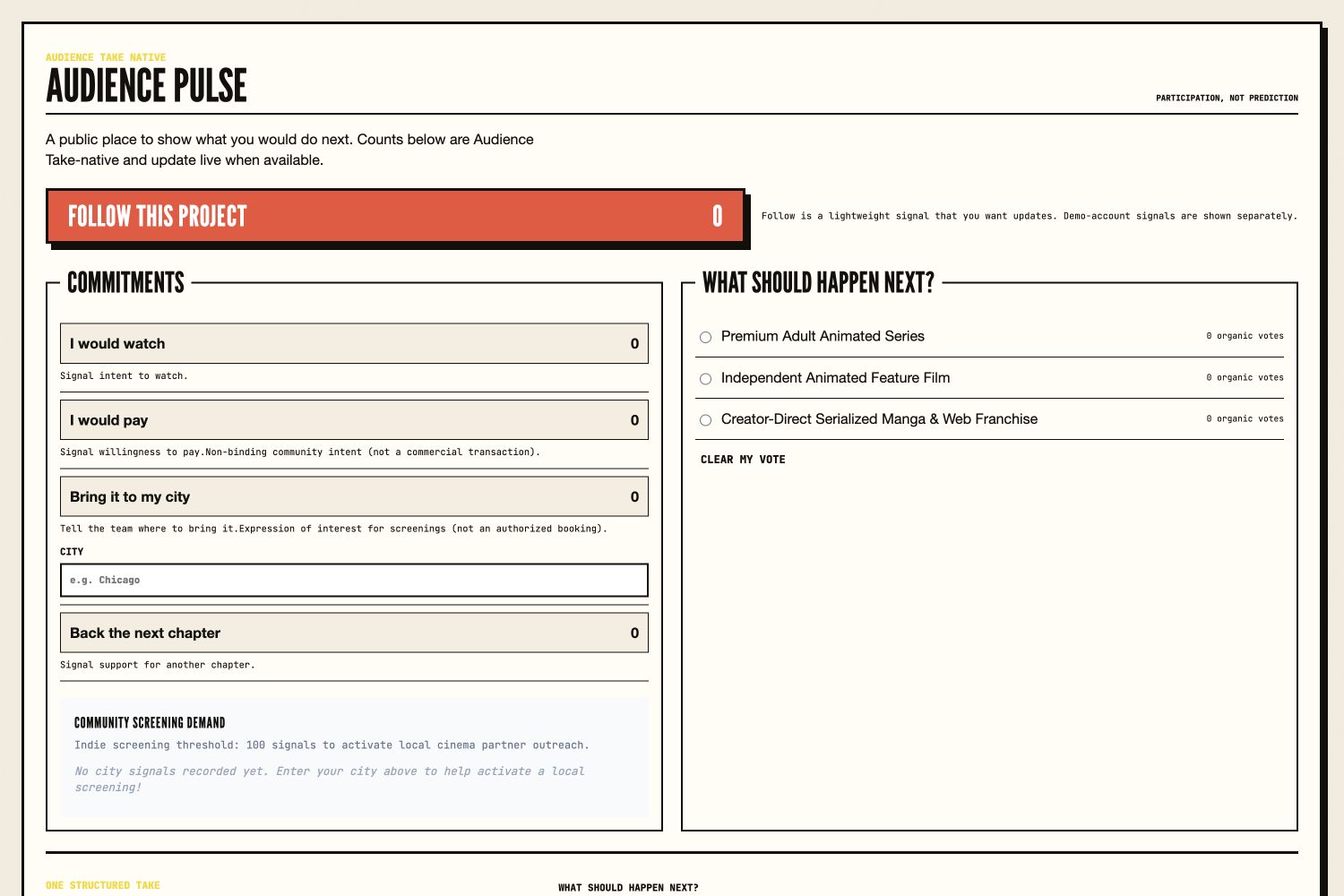
- Express a possible next step: indicate “would watch,” “would pay,” “bring to my city,” or interest in backing the next chapter, and vote on possible directions for the project.
- Stay connected: follow a project so interest can extend beyond the initial discovery.
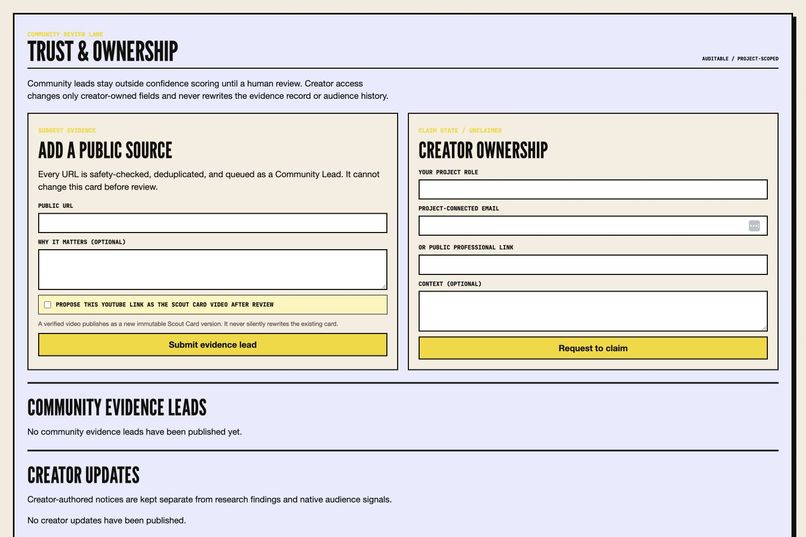
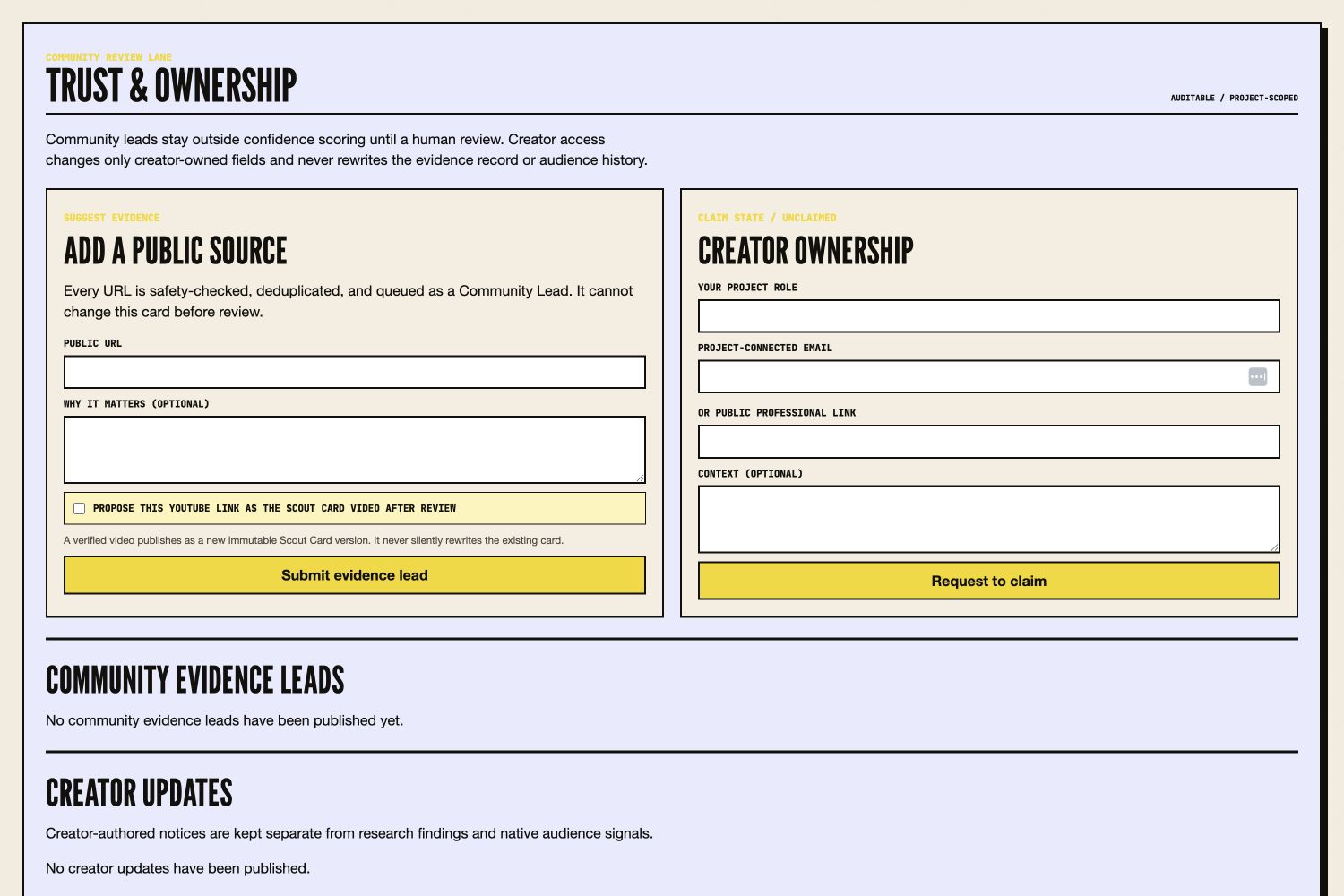
- Add creator context: use creator-claim and update workflows to contribute authorized information, alongside routes for suggesting evidence and requesting corrections.
This is how Audience Take aims to break the silo around a film project: a fan's enthusiasm, a creator's context, and a professional's research can meet on the same project record. Contributions remain attached to the work, giving the next person a starting point for understanding both the project and the conversation around it.
An optional generated audio Scout Brief offers another way to explore the project. Research progress and tool receipts make parts of the process visible, while source links let readers inspect the material behind the result.
Community interest adds perspective; it does not establish ticket sales, financing, or available rights. A fan nomination also does not imply the creator's endorsement. Audience Take provides a starting point for discovery and diligence, with creative and professional decisions left to people.
How we built it
We built the experience around a connected workflow: nomination → research → synthesis → validation → Scout Card.
The web application uses Next.js, React, and TypeScript, with Tailwind CSS for the interface and Firebase Authentication for account-based participation. The fan and professional views organize the same project for different reading needs.
We built the social layer with authenticated, Firestore-backed records for Takes, replies, upvotes, follows, audience-interest signals, and pathway votes. These contributions attach to a shared project identity, connecting community participation to the Scout Card's research while keeping user opinions distinct from sourced findings.
Parallel Search finds public information beyond the submitted link, and Parallel Extract retrieves content from those pages. Gemini turns that research into structured project information and briefing content. Targeted follow-up research helps the workflow investigate missing information instead of relying entirely on its first search results.
Google Cloud supports the work behind the interface. Cloud Tasks delivers research jobs to a Cloud Run worker, and Firestore persists the run state and published results. This separates the longer research process from the initial submission request and gives the interface a durable record of progress.
We also built evidence records and validation checks around the generated output, so sources, claims, and unresolved questions can be represented alongside the narrative. The written card and generated audio are different presentations of the same project, making consistency between them a central engineering concern.
The audio workflow uses Gemini text-to-speech to produce a two-speaker Scout Brief, giving users an alternative to reading the card.
Challenges we ran into
Finding the correct project was harder than finding a matching title. Films can share names, and search results can mix a pilot, a franchise, and unrelated work. Research quality depends on matching sources to the specific project and distinguishing existing work from proposed next steps.
A citation is only useful when it supports the statement. Retrieved pages can contain navigation text, campaign boilerplate, or passing references that do not establish a project fact. Our testing exposed cases where a relevant-looking source was insufficient evidence for the generated claim.
Uncertainty has to survive every presentation. A claim marked unknown in an evidence panel should not become a confident statement in the professional summary or audio brief. Keeping those qualifications consistent remains an area we are improving.
The interface has to describe what the system actually did. Text-based research about a trailer is different from inspecting its video and audio. We learned to scrutinize progress messages as carefully as final summaries, and to test the full path from submission through publication and playback.
Accomplishments that we're proud of
- Completing real deployed nominations. Live testing demonstrated public submissions progressing through cloud research jobs to persisted, publicly accessible Scout Cards.
- Connecting community participation with project research. Takes, replies, follows, and specific interest signals give people ways to contribute around the same work. The fan and professional views provide different ways into that shared record, with creator workflows for adding authorized context.
- Connecting research to an agent decision. Recorded runs included targeted follow-up searches, showing the workflow investigating a gap beyond the original nomination link.
- Making the result available in audio. A live test confirmed that a generated Scout Brief loaded and played alongside the published card.
- Testing the substance of the output. We examined source relevance, evidence qualifications, and agreement across views, which revealed concrete improvements beyond whether the workflow simply completed.
What we learned
The most useful AI output is not necessarily the longest or most confident. For this problem, a concise brief with inspectable sources and an honest unanswered question can be more useful than an elaborate recommendation.
We also learned that breaking silos requires more than collecting links. People need ways to contribute something useful: why a story resonates, whether they would attend a local screening, what the creator intends, or which question still needs evidence. Audience enthusiasm, creator intent, and professional assessment contribute different kinds of information; a shared project record can bring them together while preserving those distinctions.
Finally, reliability extends beyond a successful model response. The research job must finish, the result must remain accessible, and the interface and audio must communicate the same evidence with the same limitations. Building the full experience made those connections tangible.
What's next for Audience Take
Our first priority is stronger evidence consistency: better project matching, cleaner supporting passages, and qualifications that carry through every summary and audio brief.
We also want to:
- Keep Scout Cards current through reliable monitoring of public developments, with clear explanations of what changed.
- Strengthen creator participation so creators can add authorized context, clarify their ambitions, and request corrections.
- Develop the community around each project by learning which Takes, local screening signals, and follow-up conversations help fans, creators, and professionals find useful next steps together.
- Test with fans, independent filmmakers, and film professionals to learn which information helps them decide what to watch, share, or investigate—and measure whether the workflow saves research time.
- Deepen media analysis where actual video and audio inputs can support specific observations, with transparent limits on what was examined.
Our ambition is to make more distinctive screen stories easier to discover and understand, whether their next step is a screening, another independent episode, a wider audience, or a professional partnership.
Built With
- artifact-registry
- cloud-build
- cloud-firestore
- cloud-run
- cloud-storage
- cloud-tasks
- docker
- firebase
- firebase-authentication
- gemini-api
- github
- google-cloud
- google-gen-ai-sdk
- next.js
- node.js
- parallel
- playwright
- react
- secret-manager
- tailwind-css
- typescript
- vitest
- youtube-data-api
- zod
Log in or sign up for Devpost to join the conversation.