-
-

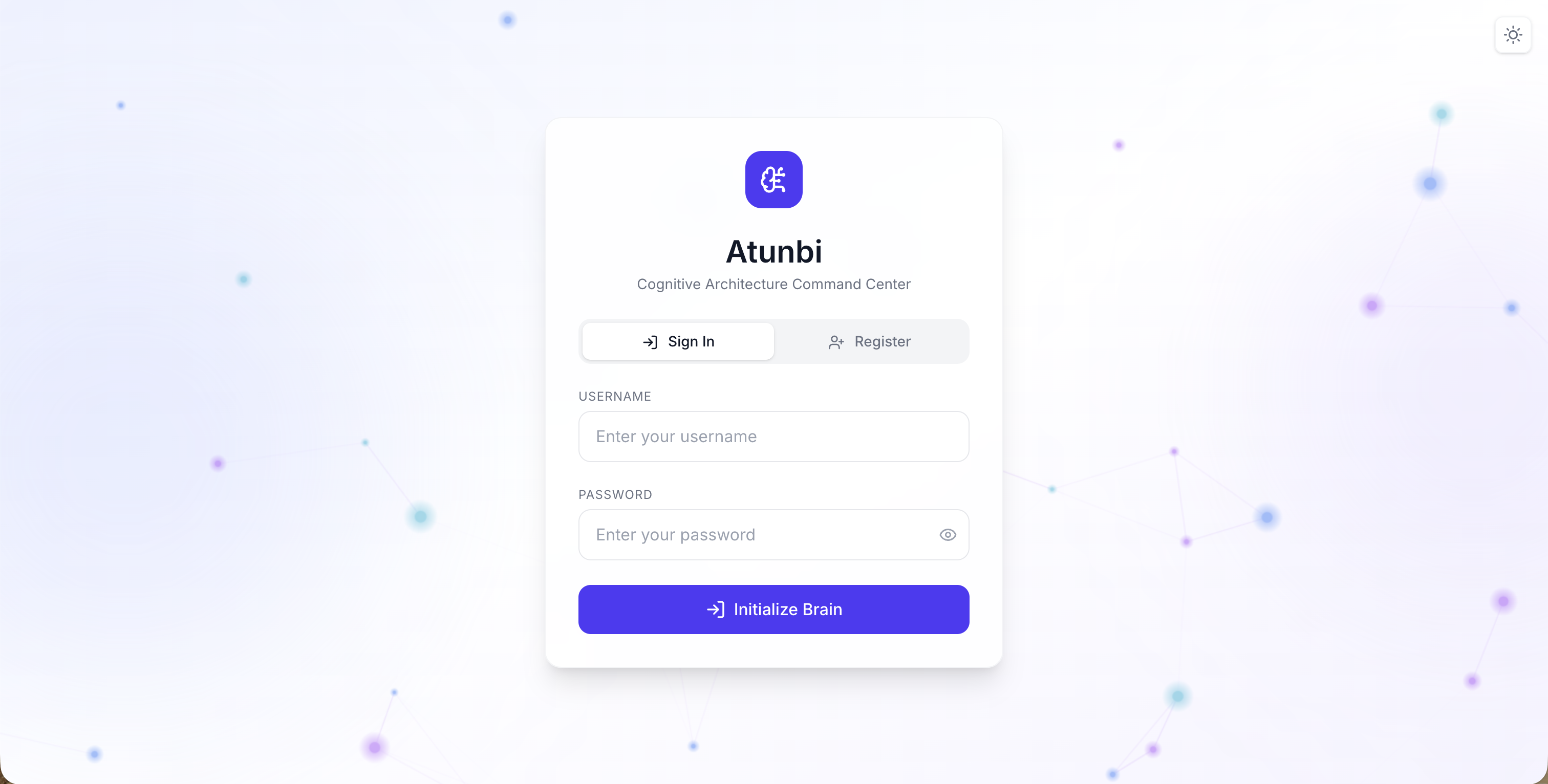
Login and Registration Page
-
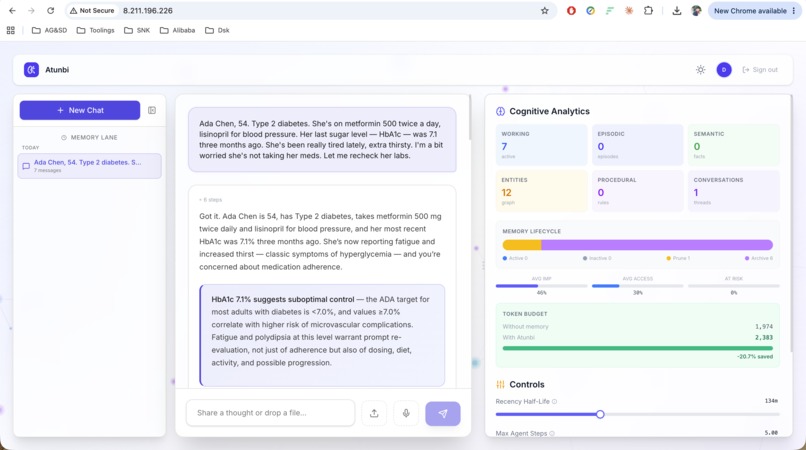
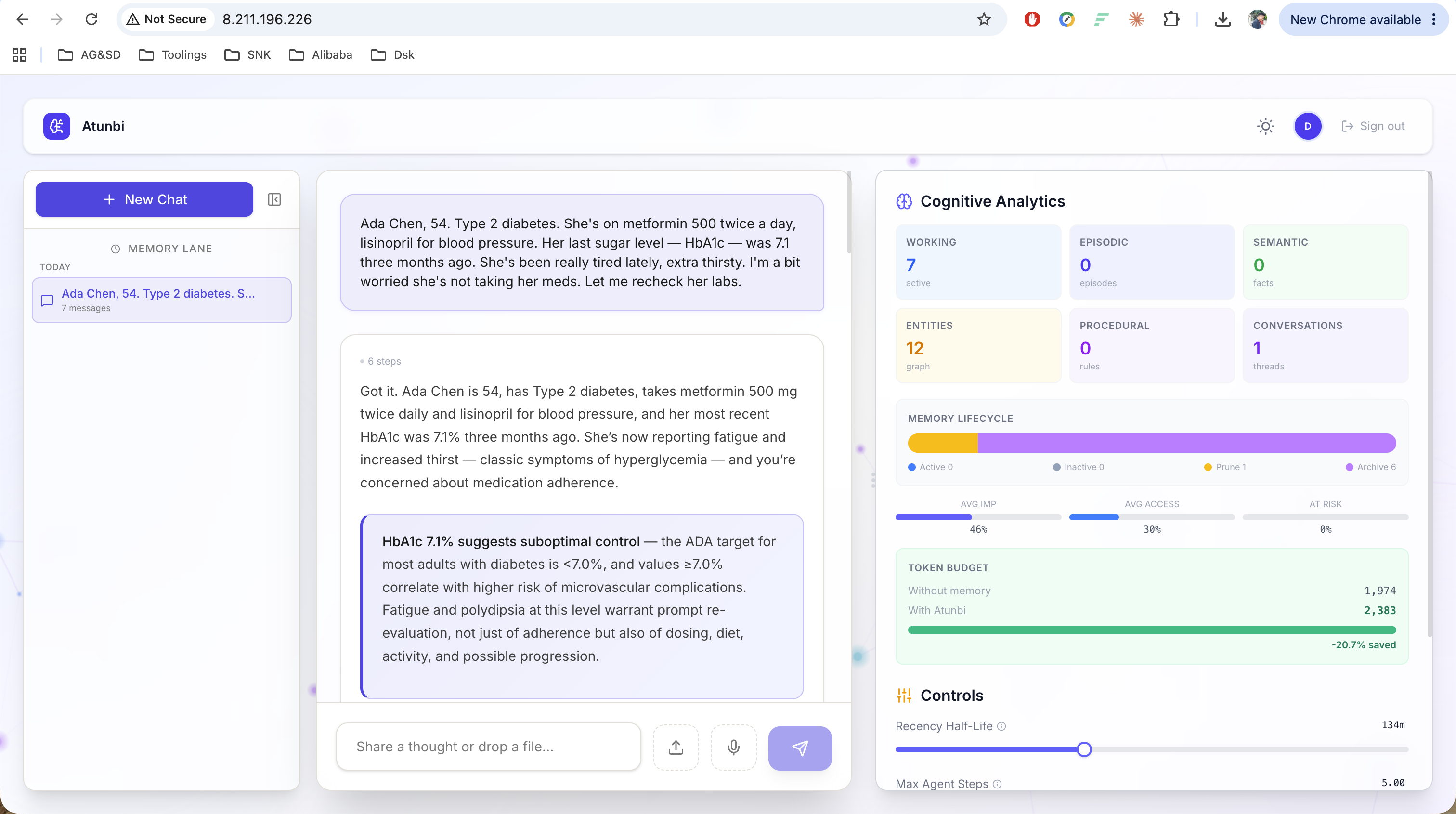
Chat Interface with conversation history and cognitive analytics for tracking
-
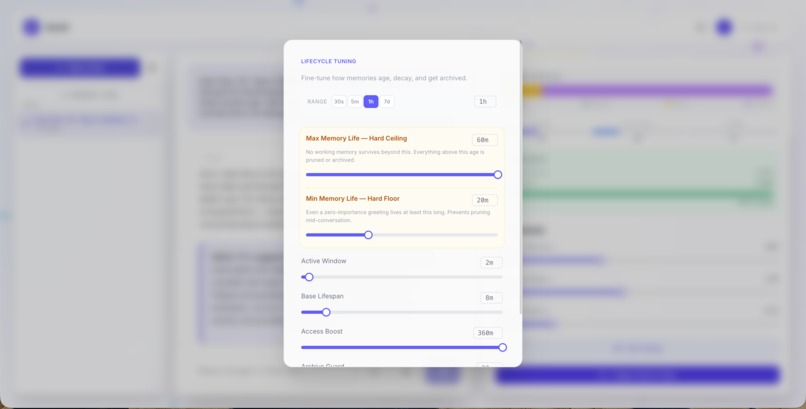
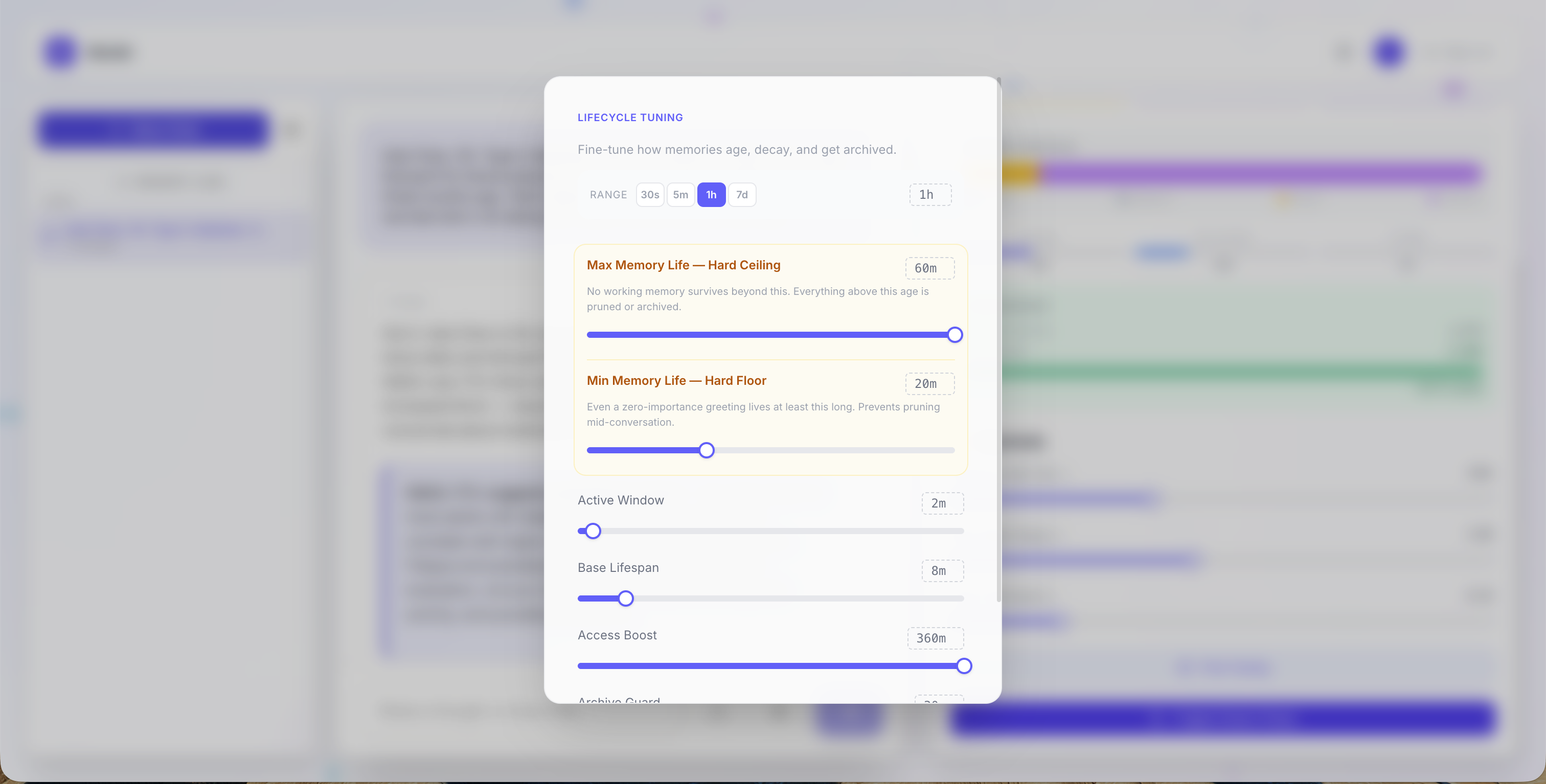
Control to tune how memories get prunned or retained
-
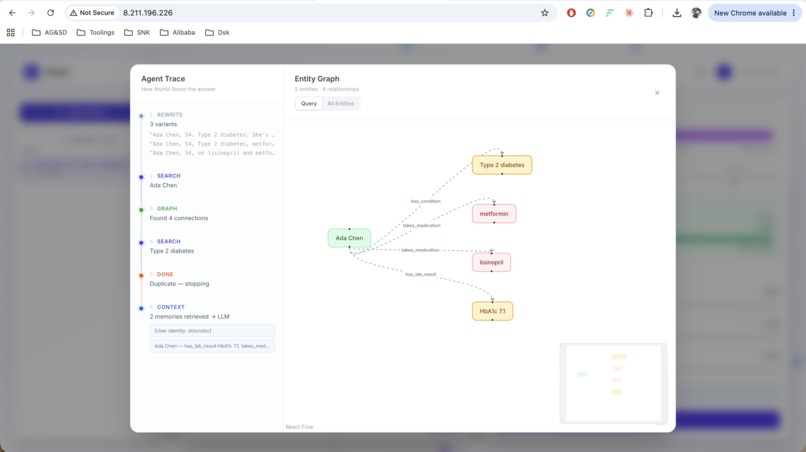
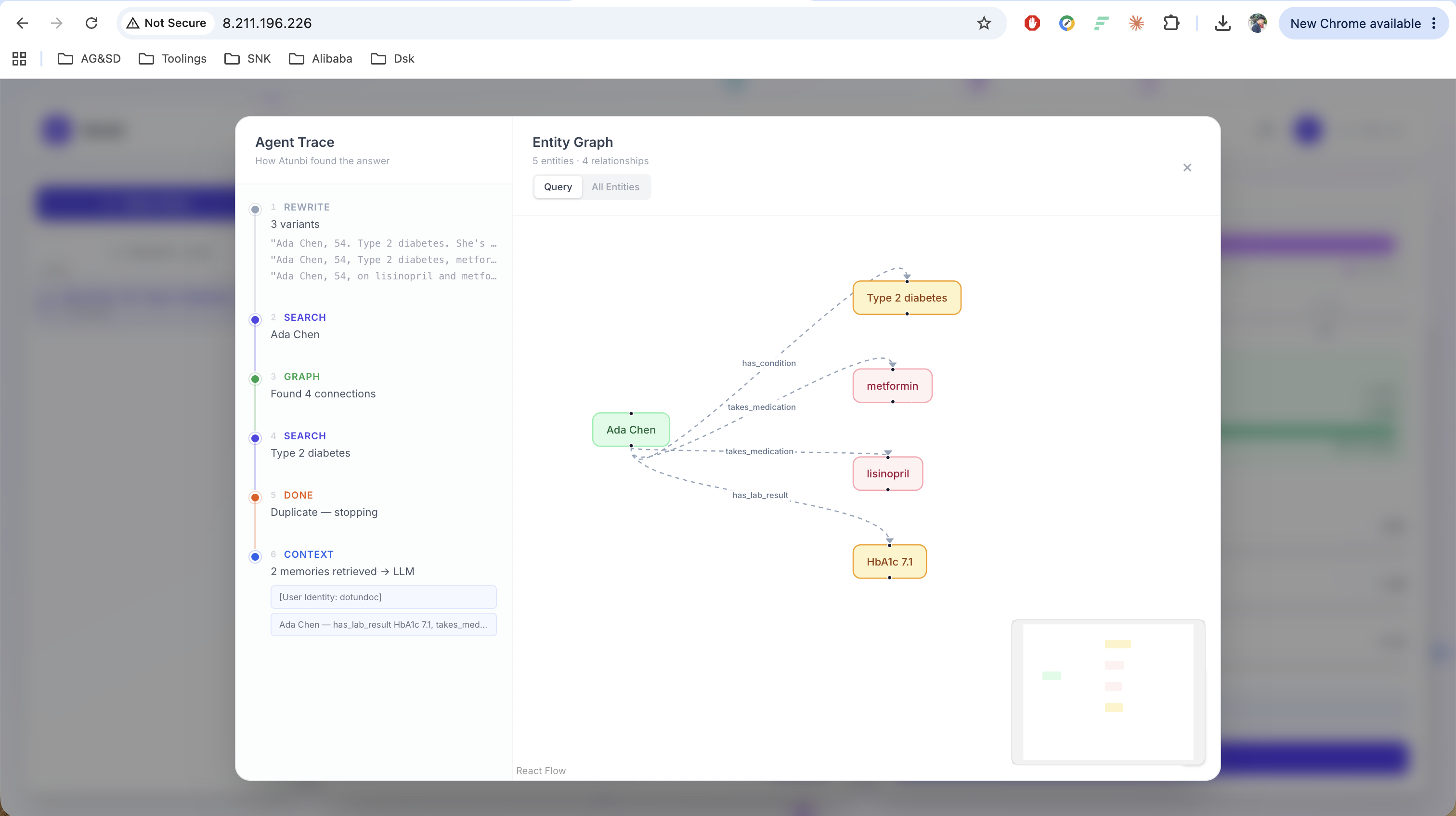
A single graph representation based on the current qwery
-
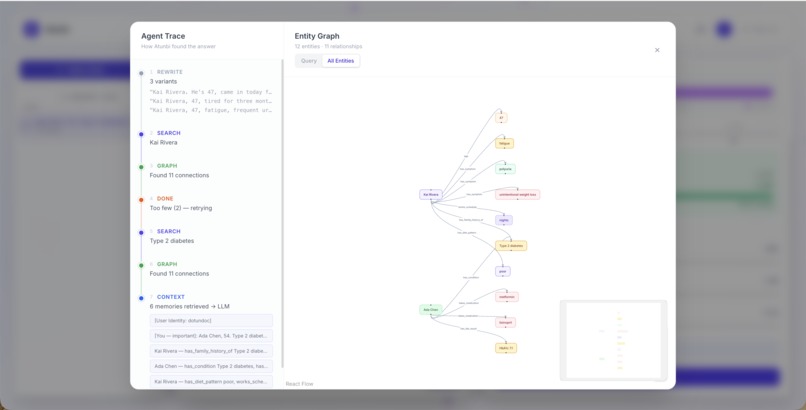
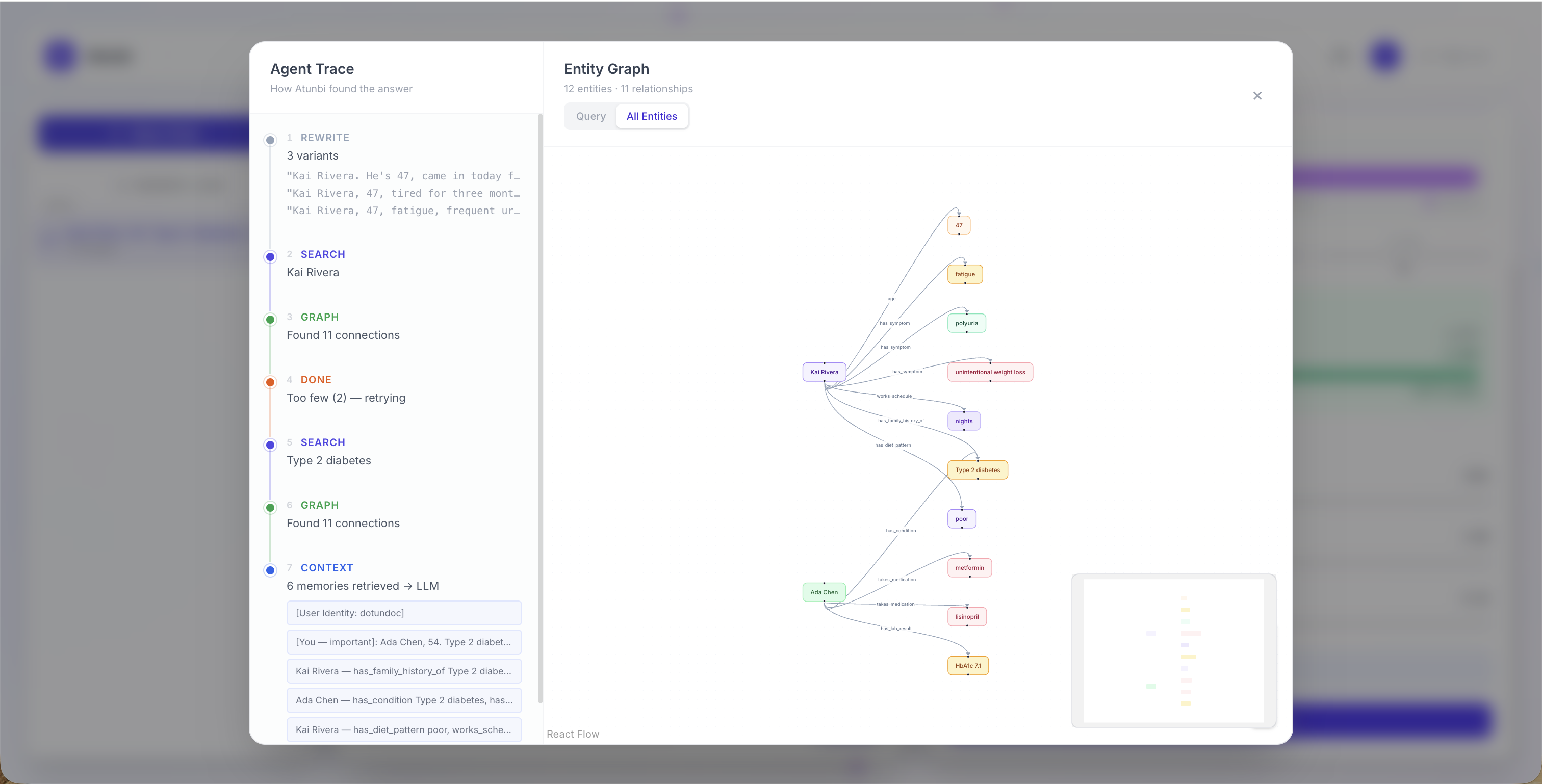
All memories in the system represented as a graph
-
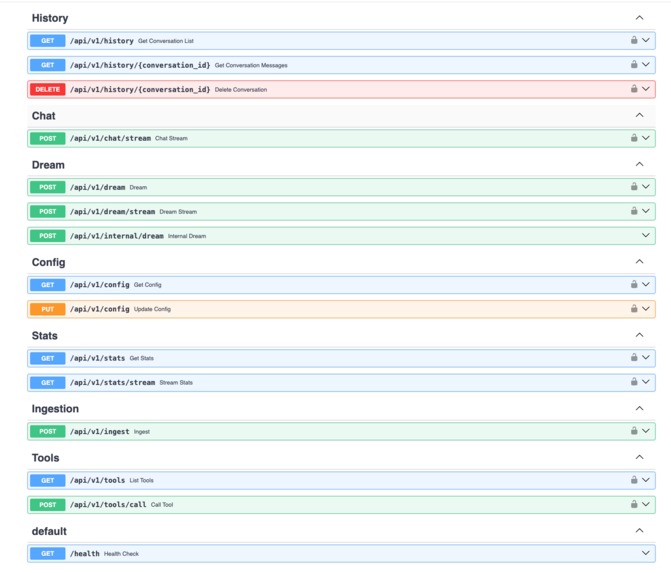
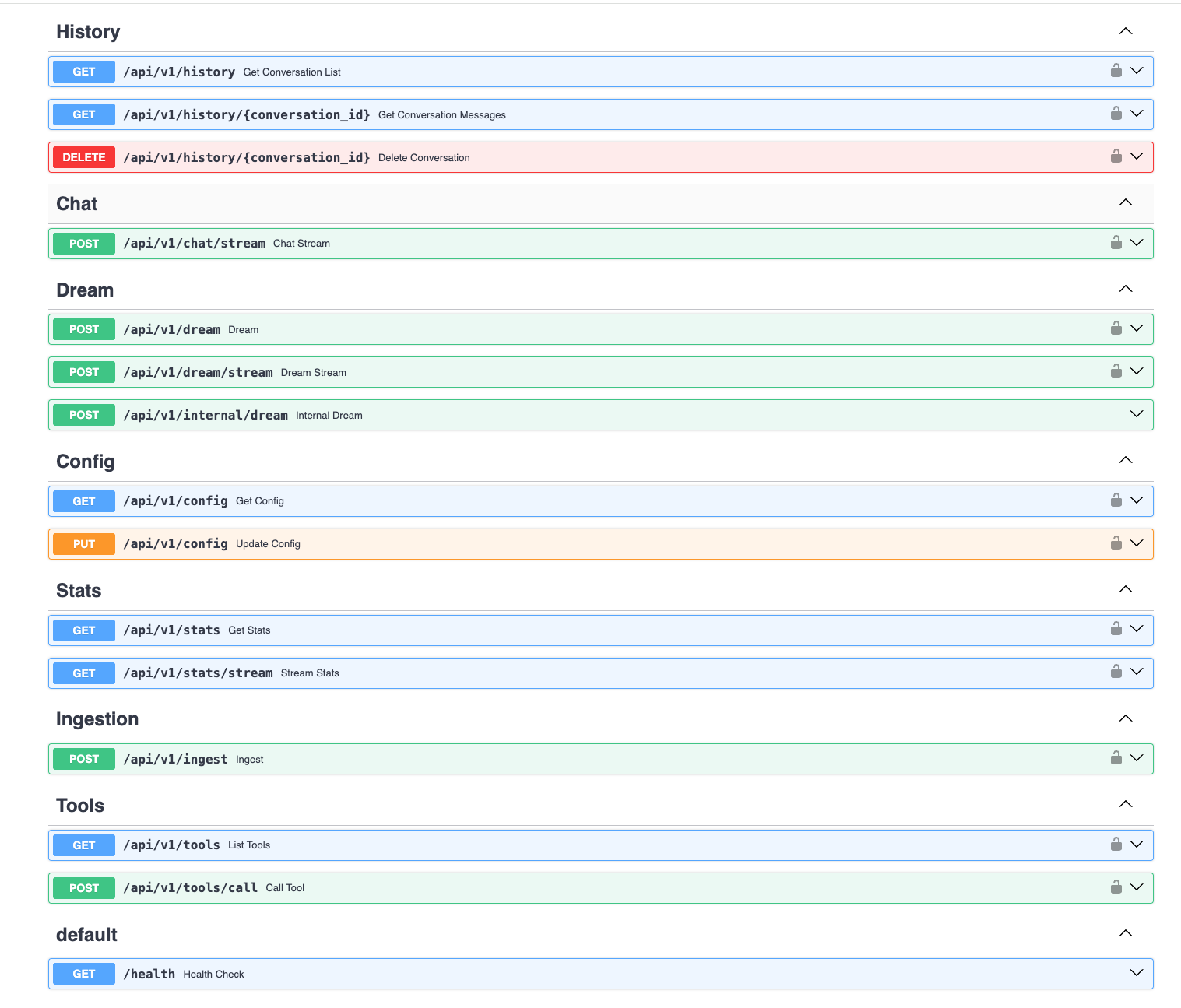
Backend APIs
Inspiration
Every conversation with modern AI feels like starting from zero. It doesn’t remember what I mentioned yesterday, can’t connect facts across sessions, and treats a casual “good morning” exactly the same as a critical lab result. For a long time I thought the fix was to store more data—until I realized the real problem is that AI has no sense of what matters.
I wanted to build a system where information earns its place, just like human memory: useful things stick around, trivial things fade away. The name Àtúnbí, meaning “reborn” in Yoruba, captures this perfectly: raw memory is transient, but the knowledge distilled from it persists.
What it does
Àtúnbí is a cognitive memory system that balances fast, real-time responses with slow, deliberate learning, with intentional forgetting built into its core.
It has two complementary execution paths:
- Serving Path (Real-Time): Responds to user queries in under a second. It ingests any input (audio, PDFs, images, text), processes it into embeddings/entities/scores, stores raw data in Working Memory, then runs an agentic retrieval loop to generate accurate, context-aware responses.
- Learning Path (Nightly Dream Phase): Runs once every 24 hours. It consolidates old Working Memory entries into structured conversation summaries and standalone verified facts, updates an entity relationship graph, and prunes low-value, unused entries.
At its heart are five specialized memory tiers, each with a dynamic lifespan governed by this retention rule: $$ \text{Lifespan} = \text{clamp}\left(I \times 24\text{h} + A \times 6\text{h} + |E| \times 4\text{h},\ 1\text{h},\ 168\text{h}\right) $$ Where $I$ = importance score (0–1), $A$ = access count, and $E$ = emotional valence (-1 to +1).
I tested it with a medical scenario tracking two diabetic patients across visits, medication changes, and lab results—but it works just as well for codebases, legal cases, research papers, or personal notes.
How I built it
I built it around specialized model routing and reliable, low-complexity infrastructure:
- Architecture: Split cleanly into the Serving and Learning paths, with five memory tiers (Working, Episodic, Semantic, Entity + Procedural) that share data across both paths.
- Model stack: Used seven specialized Qwen models instead of one general LLM:
- Serving path:
qwen3-asr-flash(transcription),qwen3.5-omni-flash(vision),text-embedding-v4(semantic vectors),qwen-flash(scoring),qwen-plus-latest(extraction/response generation),qwen-turbo(relevance filtering) - Learning path:
qwen-max(heavy summarization/fact extraction)
- Serving path:
- Deployment: Hosted on Alibaba Cloud, kept simple and maintainable:
- ECS: Single Docker container (FastAPI + Nginx) for the Serving Path, deployed via GitHub Actions
- ApsaraDB RDS: PostgreSQL +
pgvectorto store all memory tiers - OSS: Raw file storage for uploads
- EventBridge: Cron trigger for the nightly Dream Phase, which scales to zero when complete
Challenges I ran into
Most of my debugging time went to a single insidious issue: three silent failures, each masking the next.
In a demo, a doctor uploaded a blood work PDF showing a patient’s HbA1c was 8.2%, but the system confidently replied “7.1%” and doubled down when questioned:
- Vision hallucination: I initially sent rendered PDF images to the vision model, which invented plausible-sounding but wrong numbers. Fix: Extract raw text with
pymupdffirst, then send to a text-only model. - Poisoned cache: That first wrong answer got stored in Working Memory, and every subsequent query pulled the cached mistake instead of re-reading the file. Fix: Manually clear the bad entry, and rely on Working Memory’s short expiration to flush future errors automatically.
- Silent truncation: Even after fixing the above, the system still gave wrong values. I finally checked the database and found my ingestion pipeline cut every chunk at 500 characters—the HbA1c row sat at position 600, so it never made it to disk. Fix: Store full documents whole; only chunk short chat messages.
A smaller but frustrating challenge: pymupdf was once missing from requirements.txt, crashing the container on deploy and taking an hour to track down.
Accomplishments I'm proud of
- The two-path design works seamlessly: real-time responses stay snappy, while nightly consolidation builds durable, useful long-term memory without cluttering the user experience.
- The dynamic retention system actually behaves like intended: frequently accessed, high-importance memories stick around, while trivial entries fade away automatically.
- Specialized model routing eliminated most hallucinations for structured data tasks, far more reliably than using a single large model for everything.
- The deployment stayed intentionally simple—no over-engineering, just reliable services that work together with minimal maintenance.
What I learned
- Routing beats raw model size: Specialized tools for specific tasks prevent errors and improve reliability far more than upgrading to a bigger general-purpose model.
- Always check the source of truth: Never trust just the chat response—verify model output, then verify the database. I saved days of debugging once I stopped guessing and started querying PostgreSQL directly.
- Background jobs are just as critical as real-time paths: I polished the Serving Path thoroughly but barely tested the Dream Phase cron at first—always verify the parts that run when you’re asleep.
- Forgetting is a feature, not a bug: Intentional pruning keeps memory relevant, reduces noise, and even helps flush bad entries automatically.
What's next for Àtúnbí
- Expand the Entity + Procedural Memory tier to learn user preferences and workflows over time, so responses adapt more naturally to individual needs.
- Add support for more input types, like handwritten notes and live meeting transcripts, to make the system useful in more scenarios.
- Improve the Dream Phase with clustering and topic modeling to build richer, more connected summaries and facts.
- Test the system across more use cases—legal case tracking, research paper management, and personal knowledge bases—to refine the retention formula for different domains.
- Open source the core memory engine so other developers can build their own “forgetful” AI systems.
Built With
- alibabacloud
- asparadb
- docker
- ecs
- eventbridge
- fastapi
- ffmpeg
- functioncompute
- githubactions
- mcp
- mermaid
- networkx
- nextjs
- nginx
- oss
- pgvector
- pymupdf
- python
- qwencloudapi
- typescript


Log in or sign up for Devpost to join the conversation.