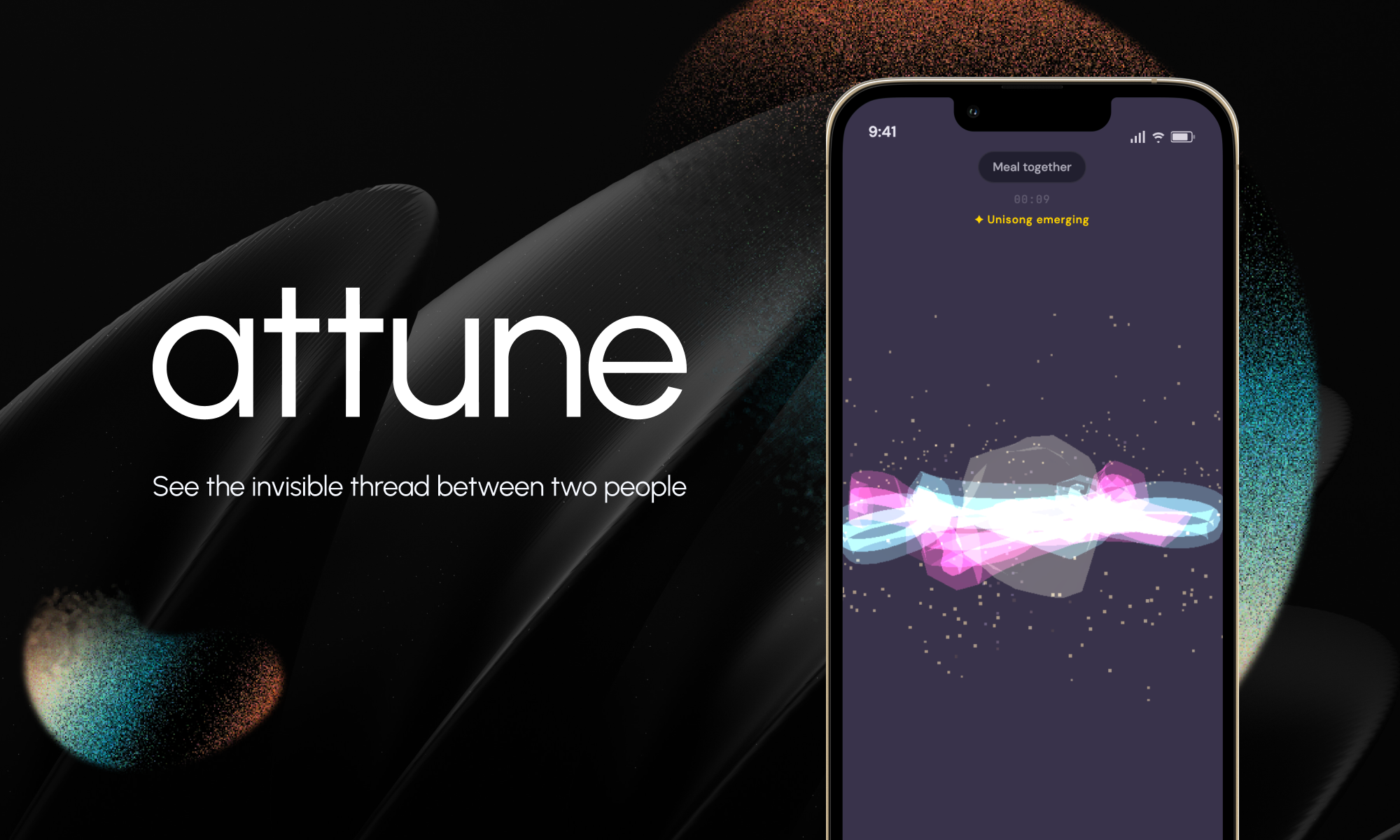
Attune — Hear the invisible thread between two people.
We track everything about ourselves. Steps, sleep, heart rate, calories. We have dashboards for productivity and screen time. But the single greatest predictor of health and happiness isn't any of those things — it's the quality of our relationships. And we have no tool to understand it.
Attune started from a simple observation: your body already knows how a conversation is going, even when your words don't. When you sit across from someone you care about, your heart rates begin to align. Your breathing synchronizes. Your skin conductance mirrors theirs. Neuroscience calls this interpersonal physiological synchrony. It happens beneath conscious awareness, and until now, it's been completely invisible.
We wanted to change that.
What it does
Attune is a paired wearable and companion app that captures the physiological resonance between two people in real time. It passively tracks heart rate variability, galvanic skin response, respiratory rhythm, and bioacoustic signals from both wearers — then translates that data into a shared visual language called the Wave Archive.
After a session, you see both waveforms rendered as a radial loop. Where they converge, Unisong emerges: a visual record of the moments you were genuinely in sync.
Why it matters across three real contexts
We built Attune around three use cases that reflect where this technology could genuinely help people.
For couples in therapy, therapists currently rely on self-report and observation alone. Unisong gives them a physiological layer — a way to show partners the exact moment their body language said something their words couldn't. Research consistently links nonverbal synchrony to relationship satisfaction and better therapeutic outcomes.
For new parents, particularly those navigating postpartum mood changes, the invisible bond with an infant can feel impossibly hard to perceive. Ruth Feldman's foundational research identifies parent-infant synchrony as the strongest predictor of a child's future self-regulation and secure attachment. Unisong makes that bond visible, and that visibility is itself therapeutic.
For neurodivergent individuals, particularly those on the autism spectrum, social interactions often require enormous cognitive overhead to interpret signals that neurotypical people read automatically. Unisong doesn't try to fix anything. It simply gives people an objective mirror for something their body already knows — that the conversation went well, even when the conscious mind is uncertain.
How we built it
We designed the full product experience in Figma Make, prompt by prompt to coversthe complete user journey from device pairing through live session to Wave Archive and longitudinal history.
The conceptual hardware, a minimal behind-the-ear wearable is grounded in sensing technologies that already exist in consumer devices today.
HRV, GSR, and breathing rhythm are all measurable with current-generation wearables like Airpods 3. We're proposing the layer that interprets those signals relationally, not just individually.
What we're proud of
The restraint. It would have been easy to build something that scores your relationship, sends you notifications, or ranks your sync against other couples. We made the deliberate choice not to do any of that. No push notifications during a session. No gamified streaks. No judgments.
We're also proud of the safeguards. Mutual consent is required to start every session. Your waveform belongs to you. Deletion is permanent and immediate. The app never tells you your relationship is good or bad.
Built With
- claude
- figma
- figmamake


Log in or sign up for Devpost to join the conversation.