-
-

Chase Center on October 23, 2026, before the Warriors game that inspired Attest. We came for basketball and left with a hackathon idea :)
-
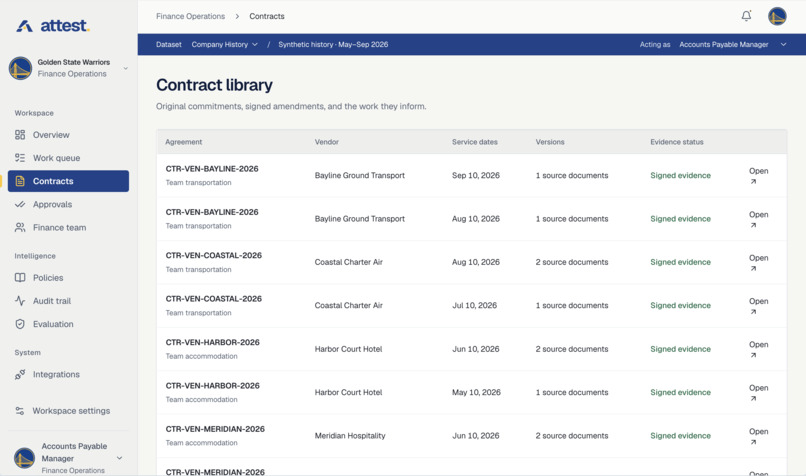
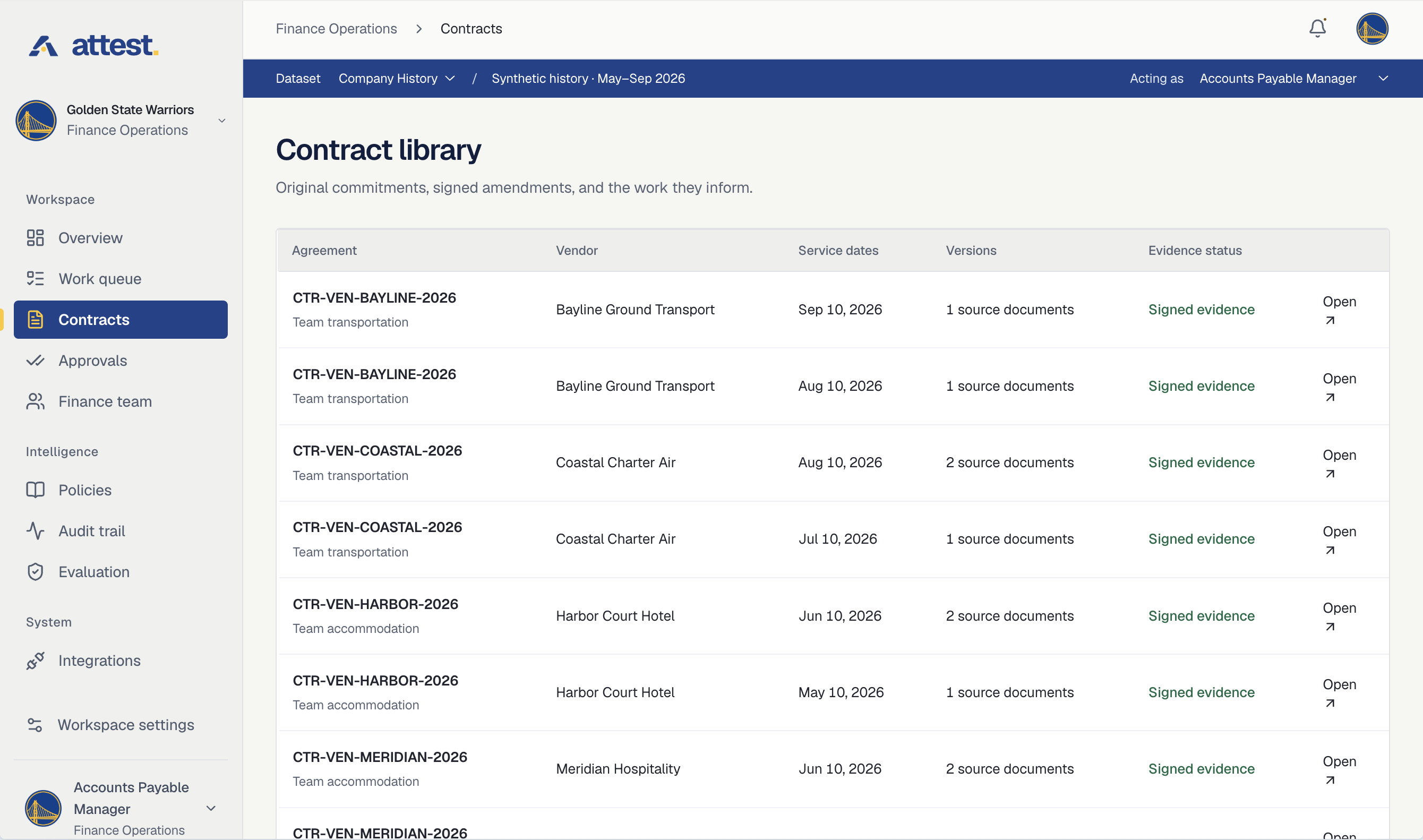
Historical agreements, signed amendments, and contract versions organized for traceable financial investigations
-
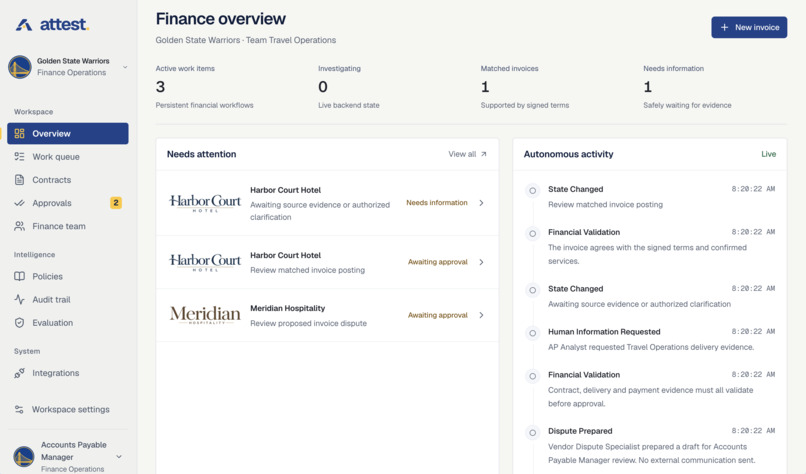
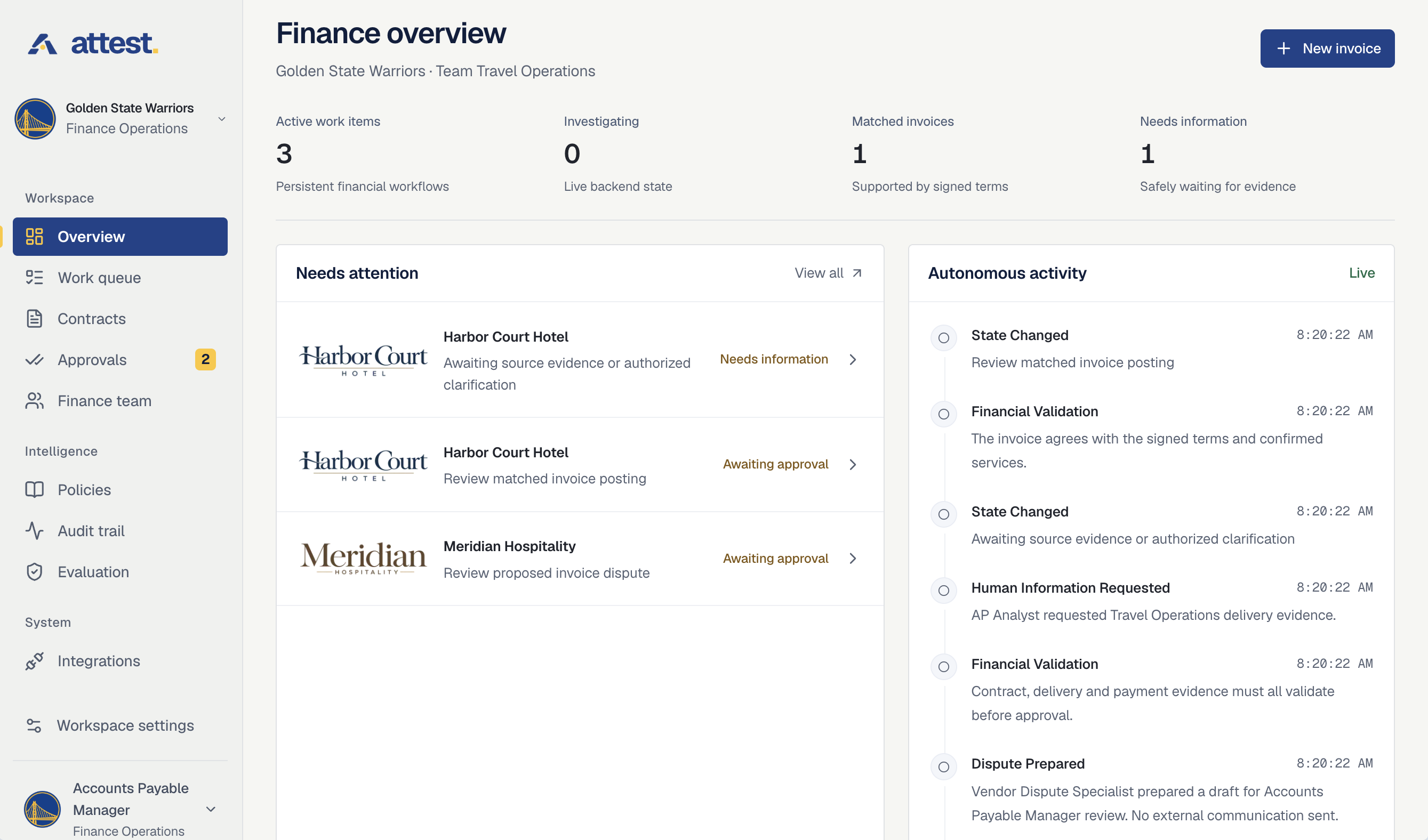
A real-time view of active investigations, invoices requiring attention, and autonomous finance activity
-
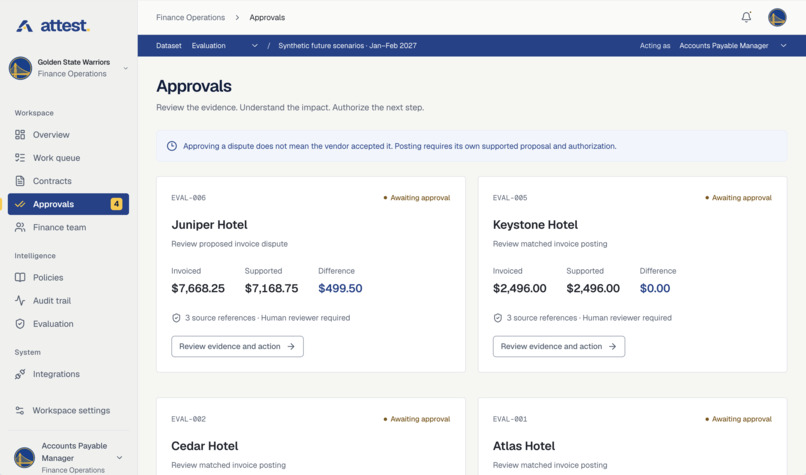
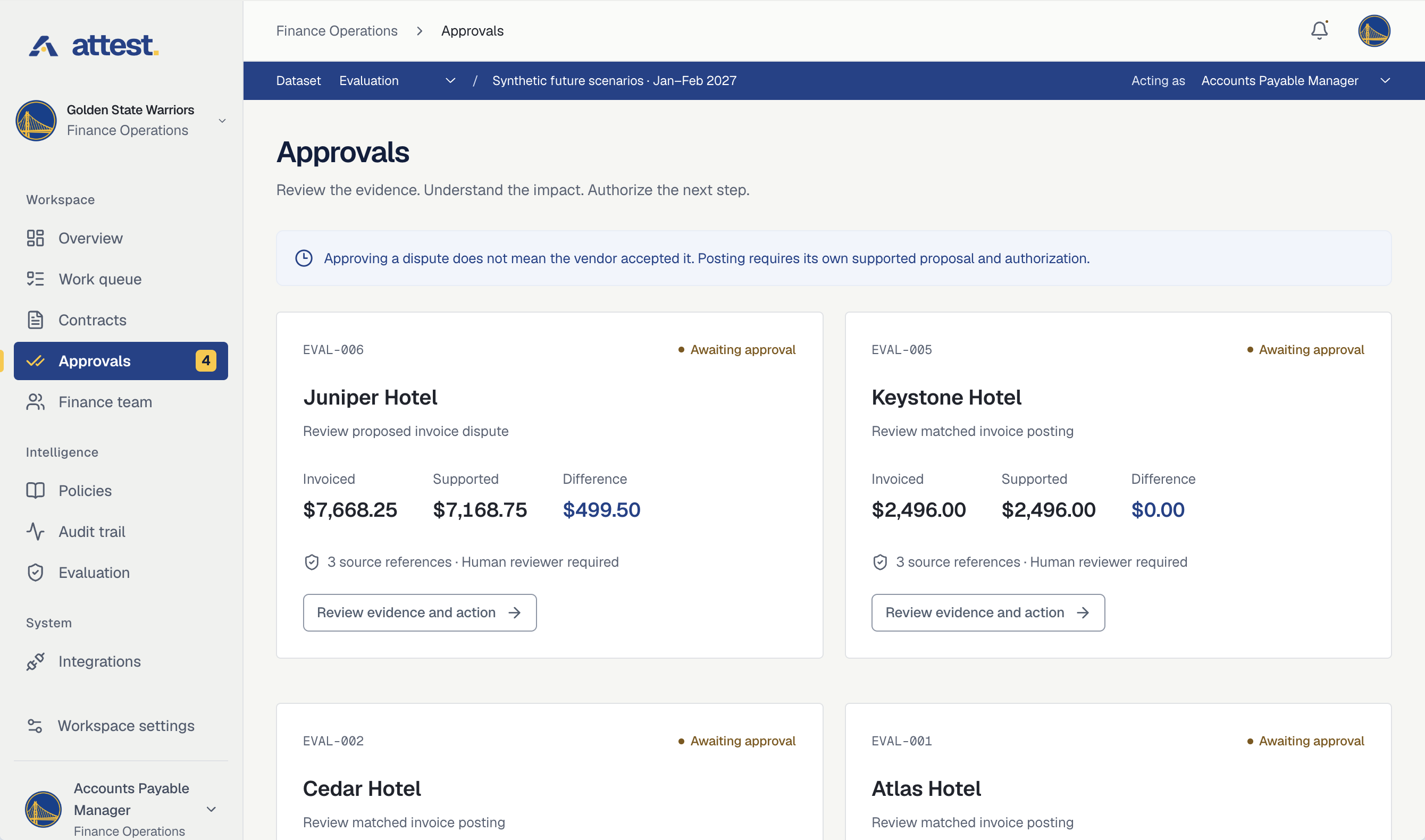
Evidence-backed financial proposals routed for independent human review, with clear amounts, discrepancies, and authorization requirements
-
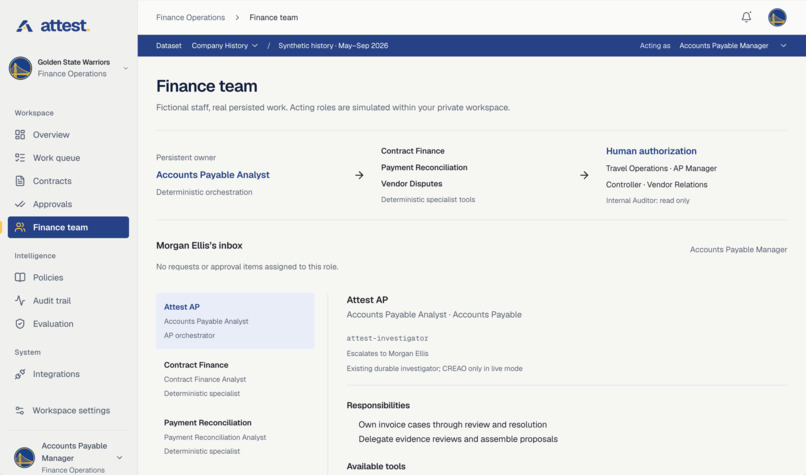
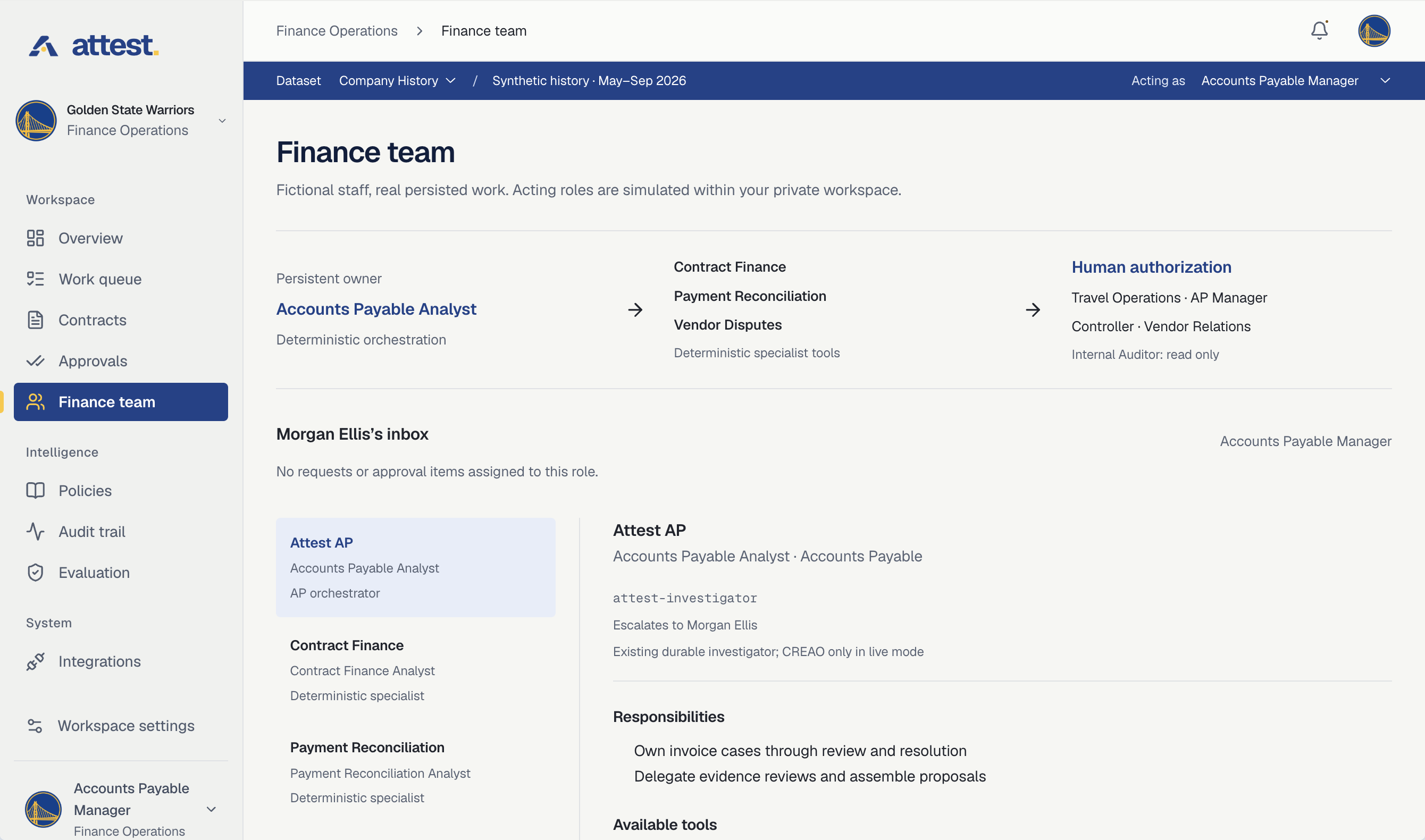
Finance roles coordinate invoice investigations, contract analysis, payment reconciliation, and disputes while preserving human oversight
-
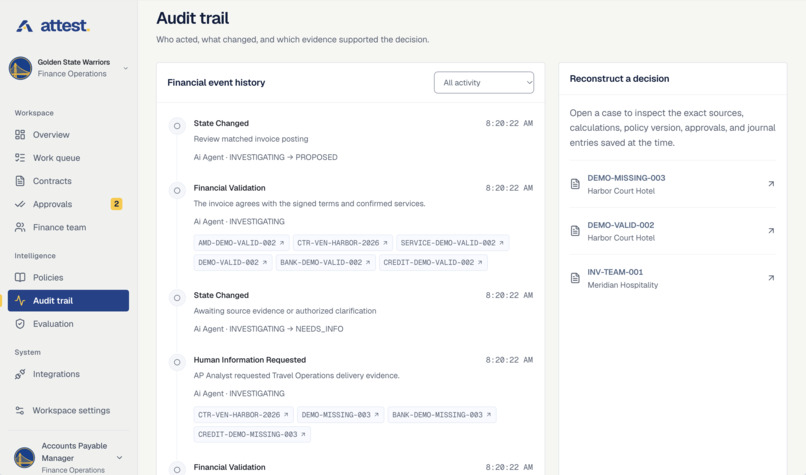
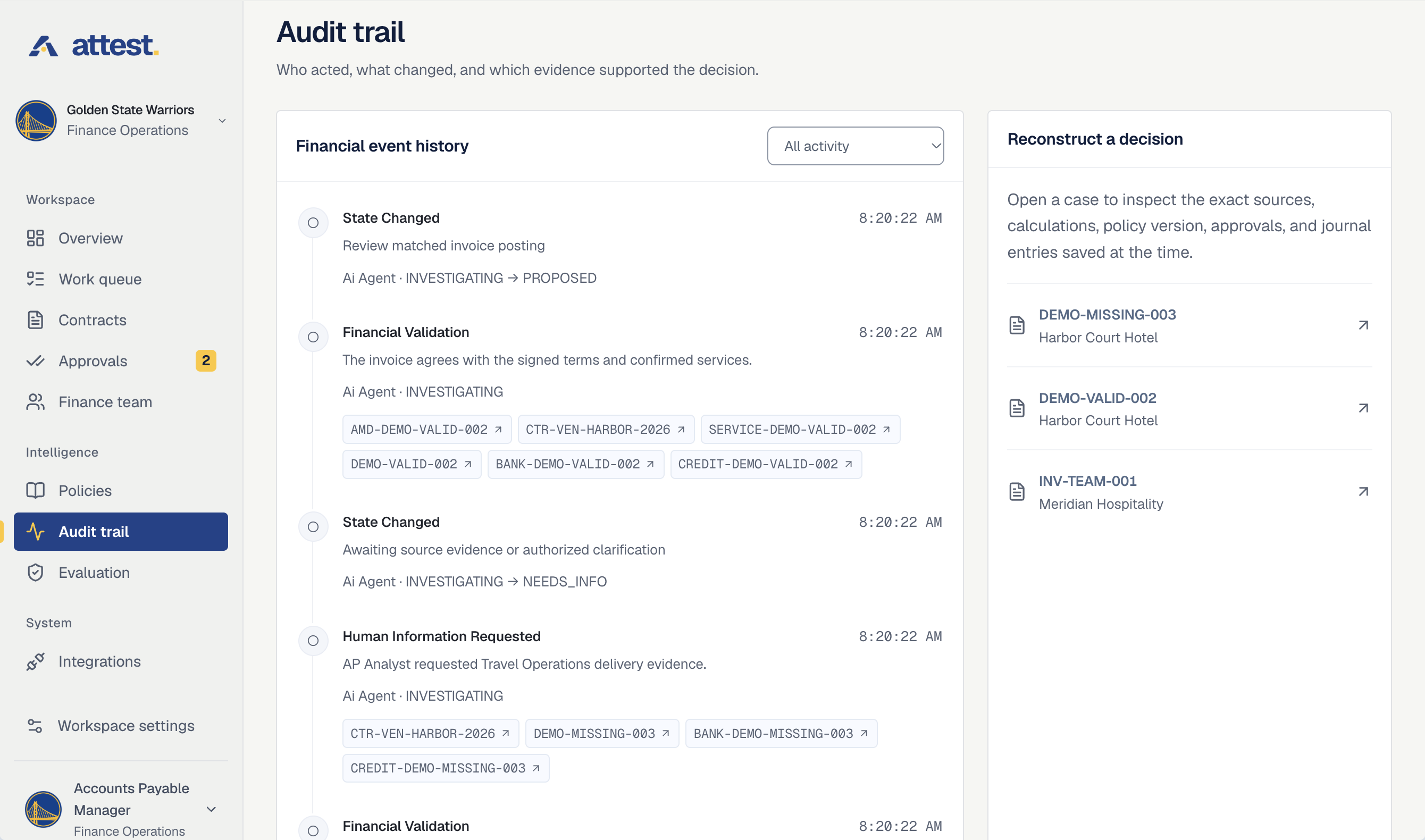
A complete, source-linked history of financial decisions, state changes, human requests, and supporting evidence

🏀 Inspiration
We missed the first day of Cal Hacks to watch the Golden State Warriors lose after giving up 17 straight points... So we figured the least we could do was help them stop losing money off the court.
Professional basketball teams negotiate hotels, transportation, and vendor contracts months in advance, but arrangements constantly change. Finance teams must reconcile what was agreed to, what changed, what was delivered, and what was billed.
The problem? That information is scattered across contracts, payment systems, operational records, and accounting software.
Companies have spent decades building software to store financial information. Yet humans still have to piece that information together and do the work.
We wanted to change that.
🤖 What it does
Attest is an autonomous accounts payable platform that investigates financial exceptions across systems of record.
Its specialized finance roles include:
- Accounts Payable Analyst: Owns investigations and coordinates resolutions
- Contract Finance Analyst: Interprets agreements, amendments, and applicable terms
- Payment Reconciliation Analyst: Verifies deposits, credits, and outstanding balances
- Vendor Dispute Specialist: Prepares evidence-backed disputes and tracks resolutions
These autonomous roles collaborate with human colleagues and controllers.
Attest reconstructs financial obligations, identifies discrepancies, prepares appropriate actions, and maintains a complete audit trail.
Autonomy doesn't mean unlimited authority. Restricted financial decisions still require independent human approval.
🔍 The demo: One invoice, months of history
Our fictional, Warriors-inspired finance team signs a hotel agreement in October for 50 room-nights at $300 each, paying a $3,000 deposit.
In January, it negotiates 20 additional room-nights at $250 each. The original 50 retain their $300 rate.
In February, the hotel incorrectly bills all 70 at $300.
| Financial reconciliation | Amount |
|---|---|
| Vendor invoice | $21,000 |
| Correct contractual total | $20,000 |
| Deposit already paid | $3,000 |
| Correct outstanding balance | $17,000 |
| Discrepancy | $1,000 |
The hard part isn't the math. It's reconstructing months of agreements, amendments, payments, and service records to determine which terms apply.
Attest investigates across those records, identifies the overcharge, prepares an evidence-backed dispute, and routes it through the appropriate approval workflow.
Every decision remains traceable to its supporting evidence and authorized actors.
🫡 A realistic financial environment
We built three complementary synthetic datasets to simulate and evaluate real-world finance operations:
- Demo scenarios: Interconnected cases demonstrating end-to-end workflows
- Company history: Contracts, amendments, payments, vendor relationships, and historical decisions
- Evaluation scenarios: Independent cases with known outcomes testing financial reasoning, exceptions, and authorization controls
Rather than generating unrelated invoices, we created a connected financial environment where Attest must navigate changing agreements, conflicting information, and unfamiliar situations.
🛠️ How we built it
Attest is a system of work across existing systems of record.
- Next.js, React, TypeScript, Tailwind CSS: Interactive investigation workspace
- Convex: Persistent financial records, work items, and workflow state
- CREAO AI: Contract Investigator and Policy Learner agents
- Moss: Retrieval of historical contracts, amendments, and organizational context
- Apify: Retrieves structured public NBA schedule and event data to enrich Attest's travel operations context, connecting real-world events with financial investigations
- Deterministic TypeScript: Financial calculations separate from AI interpretation
- Authorization and audit controls: Independent approvals and traceable financial decisions
Our interface connects three views: agreement lineage (showing how contracts evolve), financial proof (linking calculations to evidence), and decision control (showing proposed actions, approvals, and audit history).
🧩 Challenges we ran into
Changing contracts: The newest rate isn't always the applicable rate. Amendments may affect only certain services, quantities, or periods.
Fragmented knowledge: A single invoice can depend on records created months apart across several systems.
Financial correctness: Plausible AI responses aren't enough. We separated contractual reasoning from deterministic calculations and designed for uncertainty and escalation.
Controlled autonomy: Agents must collaborate and complete work without bypassing authorization or accountability.
🥳 Accomplishments we're proud of
We built a multi-role autonomous finance environment with Moss-backed historical retrieval, interconnected synthetic financial records, source-backed reconciliation, controlled approvals, and reconstructable audit history.
Most importantly, Attest goes beyond identifying discrepancies to coordinating the work required to investigate and act on them.
💡 What we learned
Autonomous finance is much more than invoice extraction. Building an AI employee requires organizational context, specialized responsibilities, persistent workflows, deterministic financial controls, and accountability.
We also learned that realistic synthetic environments are essential for testing whether agents can handle unfamiliar cases rather than simply reproduce expected answers.
🚀 What's next
We're expanding Attest into additional finance functions, including prepaid expenses, accruals, procurement compliance, and financial close.
We're also developing deeper organizational learning, allowing approved corrections and historical decisions to inform future investigations.
The opportunity isn't automating thousands of identical invoices. It's handling thousands of different cases, each with unique contracts, exceptions, people, and systems.
Traditional software records what happened. Attest takes responsibility for what happens next.
Built With
- ai
- apify
- convex
- creao
- css
- figma
- moss
- next.js
- react
- tailwind
- typescript

Log in or sign up for Devpost to join the conversation.