Inspiration
An agent reports "refund issued." The payment gateway left it pending. The run counts as a success, the board stays green, and the customer never gets their money.
Nobody sees that. Not the agent, not the dashboard, not the person on call at 2am. The agent isn't lying either. It read a tool response that said success and believed it. It genuinely can't tell.
I kept looking for the number. How often does an enterprise agent fleet say "done" about something that didn't happen? Every framework I checked computes its success rate from the agent's own self-report, which means when the agent is wrong about itself, the dashboard is wrong with it. So I built the thing that measures it.
What it does
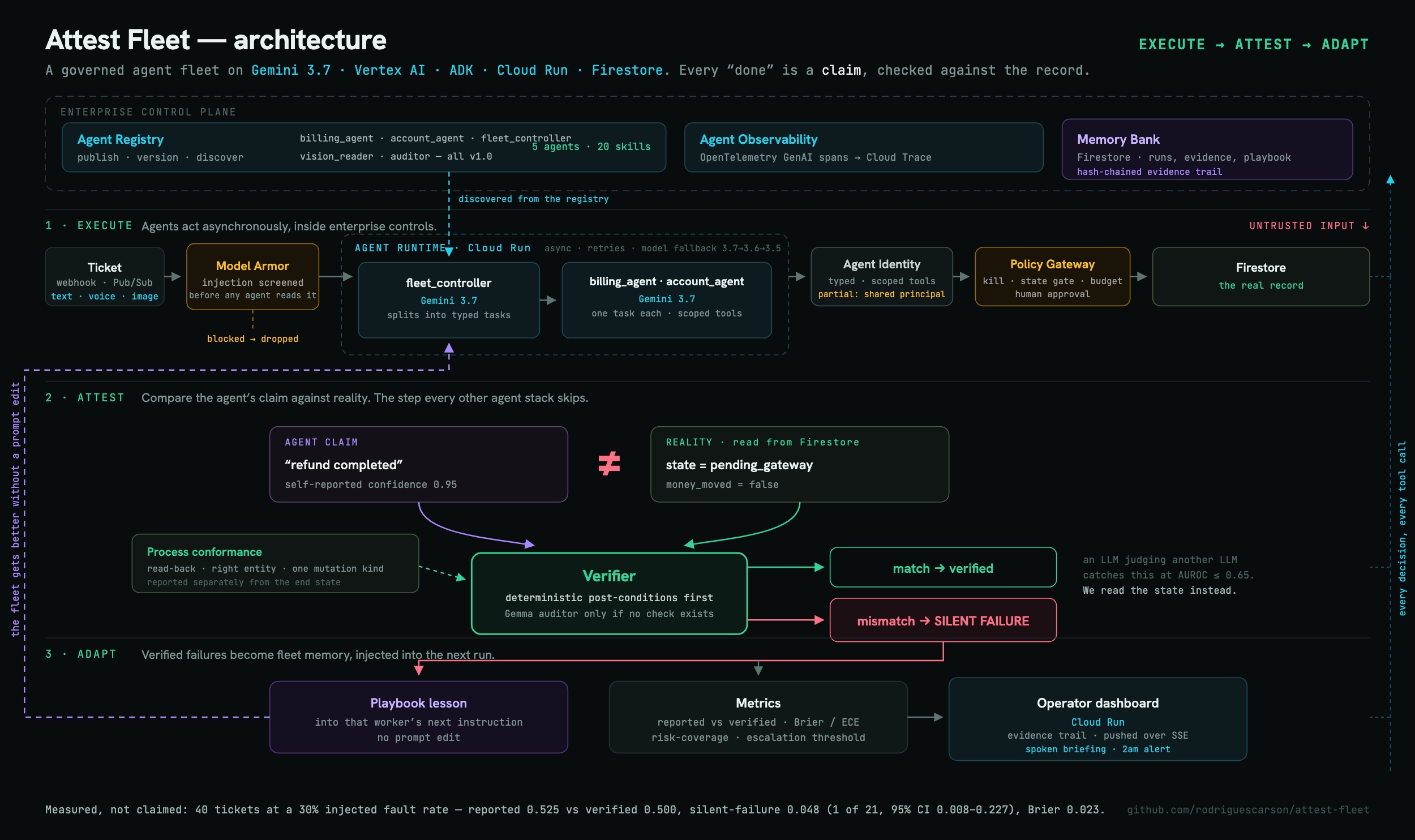
Attest Fleet runs five governed agents on a customer support workload: a controller that splits a ticket into typed tasks, a billing agent, an account agent, a vision reader for attachments, and a Gemma auditor. Every worker sees only its own task, never the whole ticket. That isolation is the point. It's what makes each claim checkable on its own.
Then every claim gets checked against Firestore, the actual system of record. Deterministic post-conditions first, the LLM auditor only where no post-condition exists. If the agent said "done" and the record disagrees, that's a silent failure, and it gets counted.
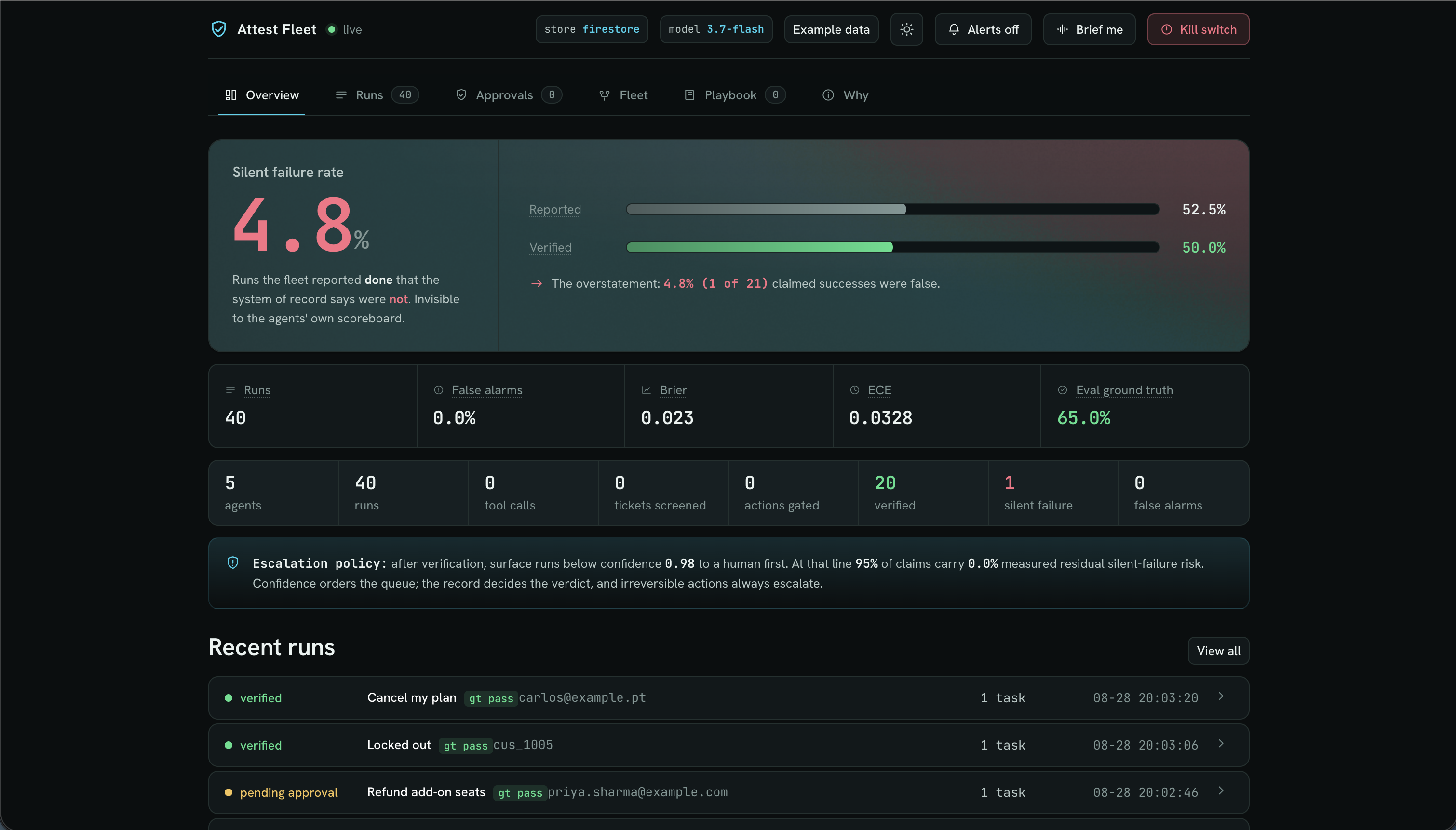
Across 40 tickets with a 30% injected fault rate:
- reported success 52.5%, verified success 50.0%
- silent-failure rate 4.8%, which is 1 of 21 done-claims, 95% CI 0.008 to 0.227
- false alarms 0%
- Brier 0.023, ECE 0.033
That interval is wide because it's one event. I'd rather publish the interval than a clean number that reads more certain than it is.
A note on the demo video: it was recorded against the live board mid-session, when a later process-conformance run sat alongside the 40-ticket sweep, so it reads 4.3% (1 of 23). Every figure on this page, in the README and on /metrics is the reproducible sweep alone: 4.8% (1 of 21). Same measurement, different population, and the sweep is the one you can re-run.
The rest is the governance a fleet like this needs to be allowed near real money. A policy gate stops an over-limit refund before it runs and routes it to a human, and the limit is cumulative per order so five refunds of 98 can't walk through a 100 limit. Model Armor screens ticket text before any agent reads a word. Agent cards are published to Google's Agent Registry and read back live, each carrying a contract derived from its real tool bindings, so widening an agent's authority fails the build. The evidence trail is hash-chained, tamper-evident rather than tamper-proof, and the README says exactly why the difference matters.
There's also a second check that I haven't seen elsewhere. Post-conditions tell you the end state is right. They don't tell you it was reached legitimately. So the route gets checked too: did the worker read the record back after writing, did every write name the customer the ticket named. That's reported separately from the verdict, because an end-state pass with a process failure isn't a silent failure, and calling it one would be its own kind of wrong.
How I built it
Google ADK 2.7 for the agents. Gemini 3.7 Flash on Vertex AI for the controller and workers, Gemma 4 for the auditor, Cloud Run for the service, Firestore as the system of record, Model Armor on the input boundary, Agent Registry for identity, OpenTelemetry into Cloud Trace.
The model routing ended up hybrid, and not by choice. Gemini goes to Vertex, and global is the only location serving 3.7 right now. Gemma isn't a Vertex publisher model, so the auditor keeps the Developer API key. Text-to-speech went the same way, because Vertex rejects the AUDIO response modality outright. Two clients, one fleet.
The evaluation harness is the part I care about. 40 tickets, faults injected at a known rate, hidden ground truth on the ones that carry it, and metrics computed over a single consistent denominator so the reported-versus-verified gap is like for like.
How it fits the Google stack (composes, not competes)
We use Google's safety and eval stack and slot into the one gap it leaves. Model Armor screens malicious input; Vertex Gen AI Evaluation scores agents offline against a golden dataset; OpenTelemetry GenAI records the spans. None of them verify, at runtime in production, that the agent's claimed outcome matches the live system of record. Attest adds exactly that layer and composes on top: Model Armor guards the input, ADK agents act on Cloud Run, Attest verifies against Firestore, and OTel or Vertex eval observe. We did not reinvent verification; agent frameworks simply dropped the reconciliation check every other critical system keeps, and we made it a live, calibrated, per-action governance metric.
Read as the Fortified Enterprise Fleet track's own vocabulary: an identity registry (each agent has a typed identity and scoped tools), a memory bank (the Firestore evidence store plus playbook lessons injected into the next run), a gateway with guardrails (the deterministic pre-execution policy gate, the human-approval hold, and the kill switch), and observability (the operator dashboard). Attest adds the piece the track implies but nobody ships: proof the outcome was real.
Grounding in current research
The design choices are the same conclusions five recent papers reached, and we cite them in the repo (docs/RESEARCH.md):
- Independent state verification beats self-report, and deterministic checks beat LLM judges (Advani, 2606.09863).
- Deterministic pre-execution gates recover silent policy-violations, a +12 point lift (Reddy et al., 2607.07405). We implemented this.
- Calibration for agents must be trajectory-level, measured by ECE (Zhang et al., 2601.15778).
- Correctness should be judged by end-state, under injected faults (Gupta, ReliabilityBench, 2601.06112). Our eval harness injects tool faults.
- Escalation should be a cascaded, selective decision with a coverage guarantee (Jung, Brahman & Choi, 2407.18370). That is what our escalation threshold computes.
Challenges I ran into
The calibration was wrong and it took me too long to see it. I was scoring the agent's stated confidence as if it were P(verified = true). It isn't. It's the agent's confidence in its own claim, so when a worker says "blocked" at 0.9 it is confidently claiming failure. Fixing that one line moved Brier from 0.3806 to 0.1806. The bug made my agents look badly calibrated when the harness was the thing that was broken.
A retry double-spent a refund. 40 went out, the run retried, another 40 went out, and both verified clean because the end state looked right each time. I added an idempotency guard and a cumulative threshold. That one bothered me, because it's exactly the failure the project exists to catch and my own system produced it.
The interpretability probe I'd built didn't survive review. It looked like a strong result, a linear probe recovering the label from activations at 1.00 AUROC while surface text sat at chance. Then I read my own generator and found it drew confidence from the same distribution for both labels. The controls were uninformative by construction. The contrast I was proud of was an artifact of how I made the data. I retracted it in the README, the results file, and the dashboard, and moved it to a roadmap section where it belongs.
Smaller ones: Firestore's 1 MiB document limit versus inline audio, an admin token that made it into a public repo and had to be rotated, and the default compute service account holding roles/editor on a shared project, which is now a dedicated one.
Accomplishments I'm proud of
The number exists and it's checkable. /metrics is live, computed from real runs, and every figure in the README, the architecture diagram and the demo comes from it. If a judge disagrees with my arithmetic they can hit the endpoint.
I also measure the checker. On those 40 runs the verifier disagreed with hidden ground truth twice, both on a ticket where two customers share a name. The write landed, the post-condition passed, and nothing confirmed it was the right person. A verification layer that hides its own error rate is asking for exactly the trust it tells you not to give an agent, so that goes in the README too.
What I learned
Never trust a declared shape. Read it from the file. Half the bugs above came from believing a number that looked right instead of checking where it came from, and I did that in a project whose entire argument is that you shouldn't.
The other thing: a retraction is cheaper than a defense. Pulling the probe result cost me a good-looking chart. Keeping it would have cost the credibility of everything next to it.
What's next
Per-agent calibration instead of fleet-wide, so a badly calibrated worker can't hide behind the average. More verifier coverage on the ambiguous-entity case that produced both blind spots. And running the sweep at a few thousand tickets, because a rate over 21 claims has an interval wide enough to drive a truck through, and I'd like to narrow it.
Built with
Google ADK 2.7, Gemini 3.7 Flash, Gemma 4, Vertex AI, Google Agent Registry (A2A), Model Armor, Cloud Run, Firestore, OpenTelemetry, Cloud Trace, Python, FastAPI.

Log in or sign up for Devpost to join the conversation.