-
-
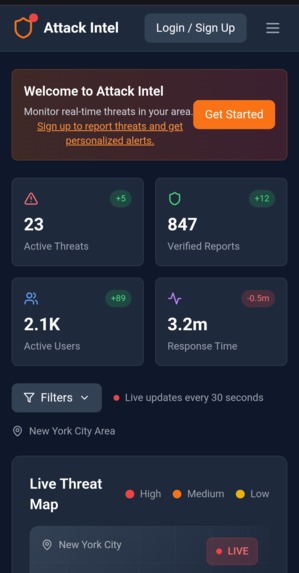
Homepage
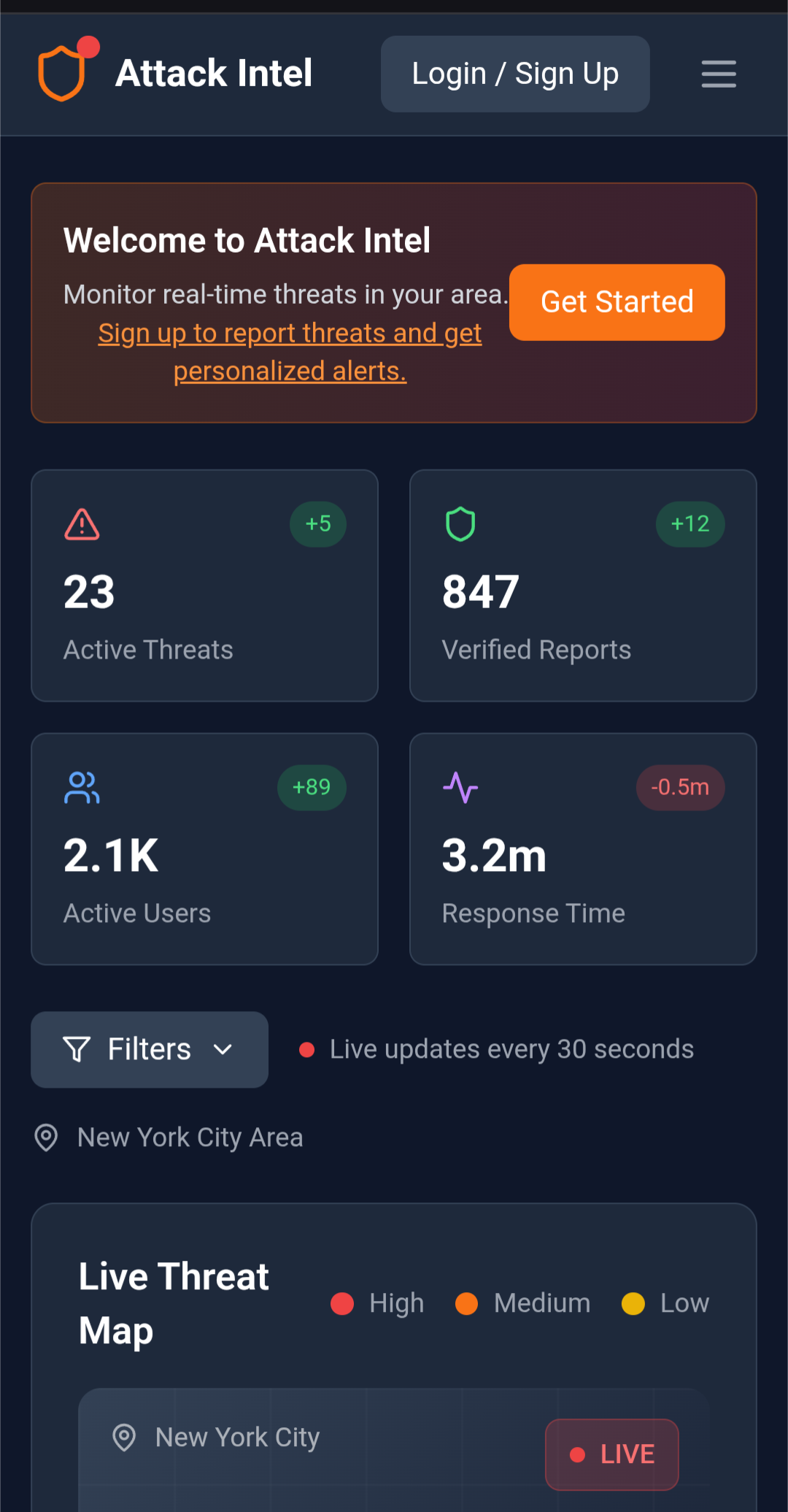
🚨 Attack Intel – Real-Time Threat Reporting Platform
💡 Inspiration
We were inspired by the growing frequency of cyber crimes, street violence, and misinformation — and the lack of a unified platform to alert the public and authorities in real-time. The idea behind Attack Intel was born from the need for faster awareness, safer communities, and a way for citizens to be part of the solution through responsible reporting.
🛡️ What it does
Attack Intel is a real-time, crowd-powered platform that:
- Allows users to report all kinds of attacks (cyber, physical, social) near them.
- Sends location-based alerts to people nearby.
- Maps incidents in real time using Google Maps.
- Offers a threat dashboard for government/official monitoring.
- Filters and verifies reports using basic NLP and manual review (in MVP).
🛠️ How we built it
- Frontend: React Native for cross-platform mobile support.
- Backend: Node.js + Express.js for REST APIs.
- Database & Real-time: Firebase for live syncing and push notifications.
- Maps Integration: Google Maps API to visualize incidents.
- Threat Verification: Integrated a basic NLP layer to detect keywords and flag suspicious/false reports.
🧱 Challenges we ran into
- Ensuring false reports don't overwhelm the system.
- Designing a clean, intuitive UI that works for both tech-savvy and general users.
- Managing real-time performance under concurrent user activity.
- Balancing user anonymity with responsible reporting.
- Integrating mapping and geolocation data accurately and securely.
🏆 Accomplishments that we're proud of
- Built a working, cross-platform MVP within the hackathon time limit.
- Integrated real-time alerts and geolocation in a seamless way.
- Created a dual-purpose tool for public safety and government response.
- Designed with scalability, ethical use, and impact in mind.
📚 What we learned
- How to handle real-time data flow using Firebase.
- Importance of UI/UX in safety-first apps.
- Tradeoffs in data privacy vs. public interest.
- Techniques for validating and moderating user-generated content.
- Effective team collaboration under tight deadlines.
🚀 What's next for Attack Intel
- Implement advanced AI-based threat validation (e.g., text + image analysis).
- Add crowd-trust scores and community moderation.
- Partner with local authorities for verified channels.
- Expand to web and progressive web app (PWA) versions.
- Enable incident history, analytics, and safer route suggestions.
Attack Intel — Real-time threats. Real-world safety.
Built With
- bolt-ai-(low-code-ai-workflow-builder)-hosting-netlify-?-for-static-site-deployment-and-ci/cd-authentication-supabase-auth-?-for-user-sign-in/sign-up-flow-apis-openai-api
- environment
- frontend-react.js
- javascript-/-typescript-backend-serverless-functions-(via-netlify-or-bolt-ai-framework)
- netlify-cli-(optional)
- restful-api-architecture-database-supabase-?-postgresql-+-real-time-listeners-ai-&-nlp-openai-(gpt-4-/-gpt-3.5)
- supabase-api-dev-tools-github-(repo-management)
- tailwind-css-(or-your-chosen-css-framework)

Log in or sign up for Devpost to join the conversation.