-
-
Tools that help you take back your time.
Inspiration
The goal of ATSCrusher is to provide tools for job searching that are so radically useful that the ATS industry finds itself unable to provide value to their companies. The reason behind this goal comes from the fact that the ATSIndustry has created a backward culture for the job search. Applicants are expected to reply to countless emails, job board postings, and wishy-washy recruiters so that they may get a 1 in 100 chance of being selected for an interview and then a 1 in 10 chance of being hired. To make things worse, the amount of work that should go into an application is ambiguous. Should you create a highly customized resume for the role you're applying for along with a one-page cover letter that explains why you are the perfect fit for the role? Should you do this for all 1,000 applications you're expected to send? “Well, if you're truly hungry for the role, you’ll do those things”, says the hiring manager at WasteYourTimeCorp. At ATSCrusher, our response is “Ok, I’ll send you 1,000 applications with highly customized resumes with perfect 1-page cover letters explaining why I’m the perfect fit. And so will all 30,000 of my peers looking for a job in the industry” Where ATSCrusher differs from the ATS industry is that we will provide the tools needed that will allow users to create 1,000 applications with highly customized resumes and cover letters that explain why you're the perfect fit for the position and send them within the click of a button.
Extention Install Link
What it does
The end goal of ATSCrusher is to factor out as much of the job search as physically possible and to disrupt the ATS industry out of the market. ATS crusher provides a suite of APIs and extensions that will allow users to minimize wasted effort on the job search. The core of our product line is our API saas. In the end, we are trying to save the users time. If someone can use our API to create a better time saving extension than we can, we will be more than happy to help them do so.
How we built it
This app was mainly developed by Anthony Cavuoti and Renan Barbosa along with Kento and [email protected]. We used GCP to create a Jupyterhub server that served as our workspace and prototyped methods for creating a cover letter generation tool there as well. When we liked our results on Jupyterhub, we packaged our python code up and deployed it to PyPi, from there, we created a flask restful API that calls our PyPi package and deployed it to the internet so that the world can more easily use our package. From here, we started work on a front end for chrome extension and had that front end call our deployed Flask API endpoint.
Challenges we ran into
There were two sources of headache that were present while building this App. Firstly, actually learning how to use OpenAI. The website and the docs do a good job in showing off its capabilities but at the same time, it's all overwhelming. It was hard to tell where to start and I struggled to create something useful at first. We got over this by basically taking a good amount of time to research how OpenAI actually works and how to get good results from it. Another headache came from having to deal with DevOps. After this hackathon, I can understand why Dev op developers get paid so much. Deploying python code required knowledge about deploying packages that were new to most of us javascript developers and served as a tough obstacle to get past and as a good learning opportunity.
How does this application work
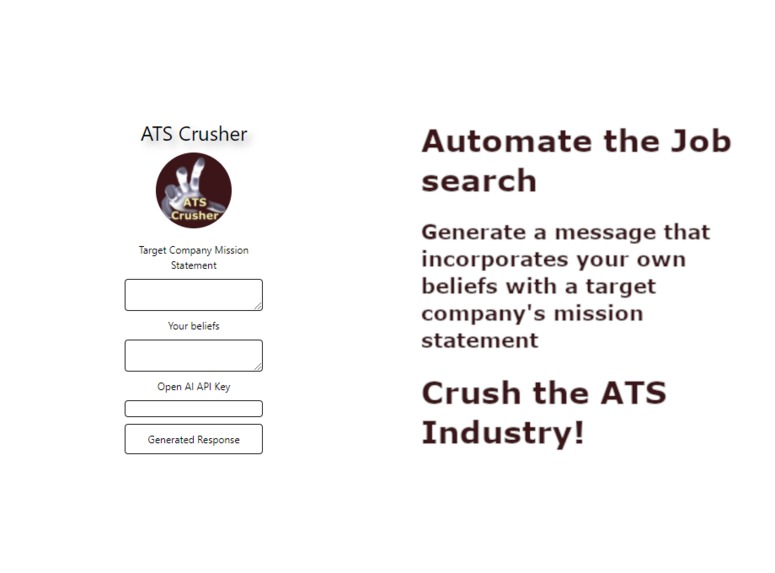
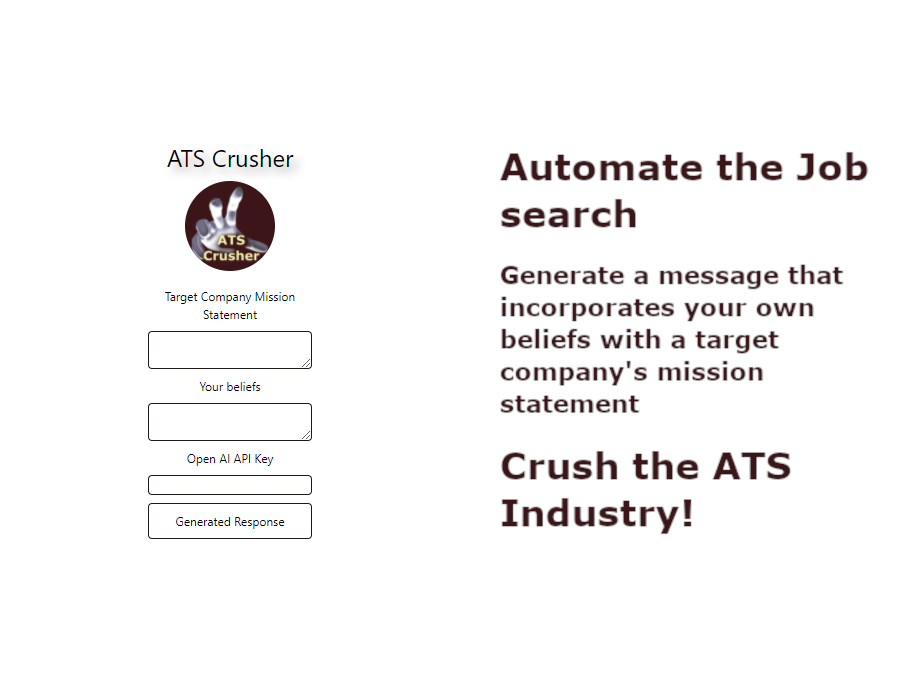
Firstly, install the chrome extension. Then, when the extension is clicked, fill out the form. You must provide your own OpenAI API key. When you click the generate button, the text will appear below and you can use that for any purpose you would like.
Accomplishments that we're proud of
Being able to deploy this application using such a large variety of technologies and frameworks that were new to all of us.
What we learned
Deploying an application to a production environment is a demanding, time-consuming, and challenging task.
What's next for ATS Crusher
In the market, the API will pay based on how much they use. The main priority for making this project sustainable will be to have users pay for what they use. When it comes to scaling this App, we plan to do that by deploying our Apps and APIs using Docker Containers and Kubernetes.
Built With
- codex
- css
- docker
- express.js
- flask
- gcp
- git
- github
- google-cloud
- gpt3
- html
- javascript
- jupyerhub
- jupyter
- jupyternotebook
- kubernetes
- node.js
- npm
- openai
- pypi
- python
- react
- ubuntu

Log in or sign up for Devpost to join the conversation.