-
-
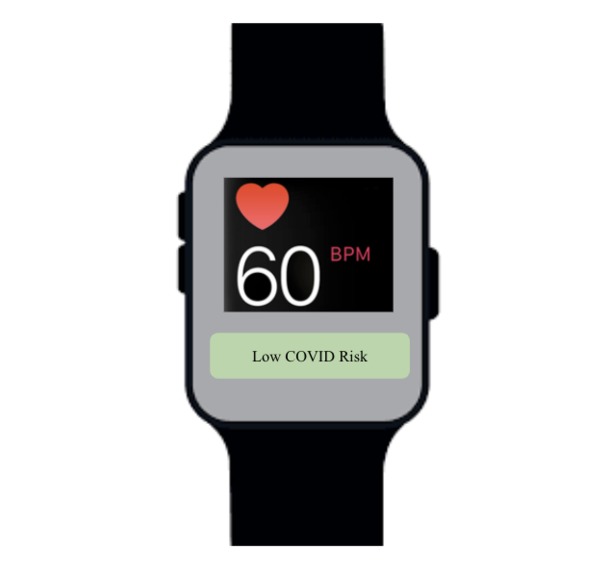
Mock use case of system
-

Our model pipeline

Inspiration
The global pandemic COVID-19 has profoundly impacted all of our lives. Testing infrastructure, techniques, and protocols have all developed quickly as the pandemic has progressed, but there is still a need for a wider screening system for COVID-19 and future respiratory diseases. We have aimed to alleviate this deficiency with a web-based app for COVID screening, with algorithms based on link that can alert to the possibility of COVID before individuals display symptoms and get tested.
What it does
Users can submit their smart wearable data (with daily steps and heart rate) as CSV files to our web app. The algorithm gives a "green", "yellow", or "red" alert based on the hourly resting heart rate (RHR) from the last day, with the 20 days before that as a healthy baseline. We also alert the user to which hours of the day their RHR was anomalous, so that they can screen out false positives, e.g. an anomalous hour was because they were weightlifting at 5PM.
How we built it
We adopted the online RHR anomaly detection algorithm from the Nature paper, redesigning and restructuring it in Python to support the needs and limitations of our web app. Our web app interfaces with the algorithm script and the user through APIs, and itself is built on React and Flask.
Challenges we ran into
We started in the direction of a deep learning-based algorithm for time series prediction (using 1D-CNN), but we found the data from the paper to be insufficient as it only contained ~25 COVID-positive patients. It is also necessary in the future to evaluate other data preprocessing techniques and model architectures to arrive at the most optimal system.
Accomplishments that we're proud of
We brought to life an effective system for COVID-19 screening that can be used by anyone with a smart wearable that has heart rate and steps data! While our web app is not yet connected with third-party smartwatch APIs, when we complete this step users will easily be able to sync with their watch and receive daily health alerts.
What we learned
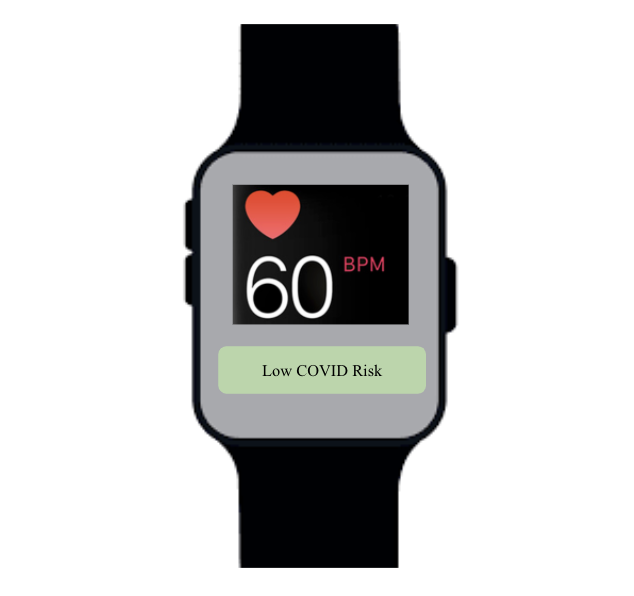
Time series data is difficult to work with compared to other modalities. There are many choices to be made such as the baseline window size, prediction window size, and how to preprocess the data. There is also the question of presenting the alerts to the user—we decided the best and most intuitive approach was to present the alert color and a simple advisory message, along with a graph of their heart rate from the last 15 hours.
What's next for Atrium Technologies: COVID-19 Detection via Smart Wearables
Next, we will be pushing to gather more data and apply more complex ML/DL techniques. We will also be looking to create a mobile application that can connect with Fitbit, Garmin, Apple, etc. Further, we will examine the possibility of generalizing our approach to other diseases, population subgroups, or measures of wellbeing.

Log in or sign up for Devpost to join the conversation.