-
-
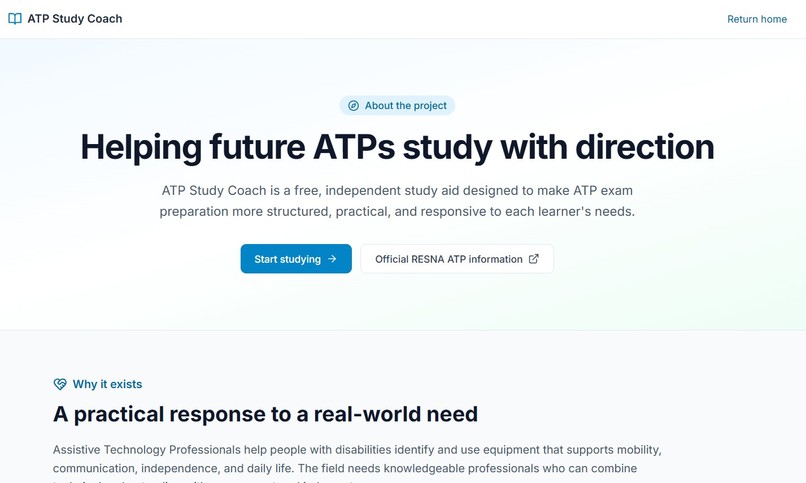
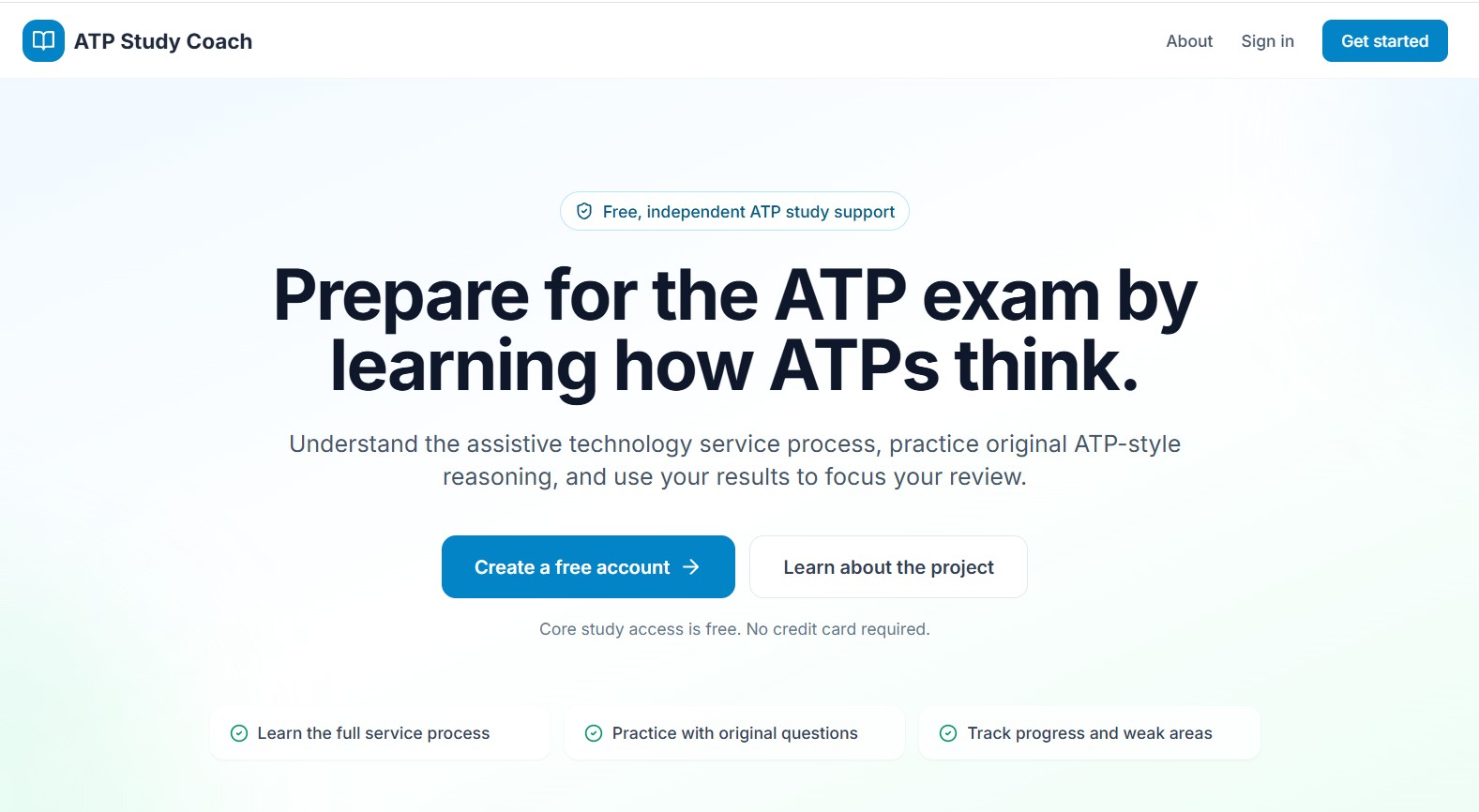
Home Screen
-
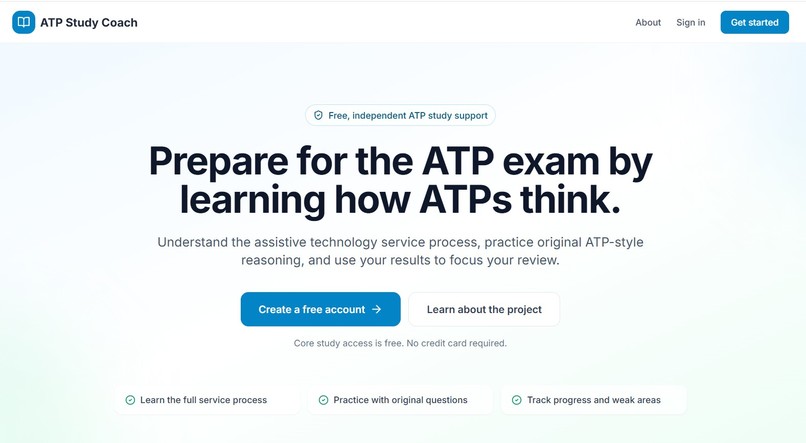
About Page
-
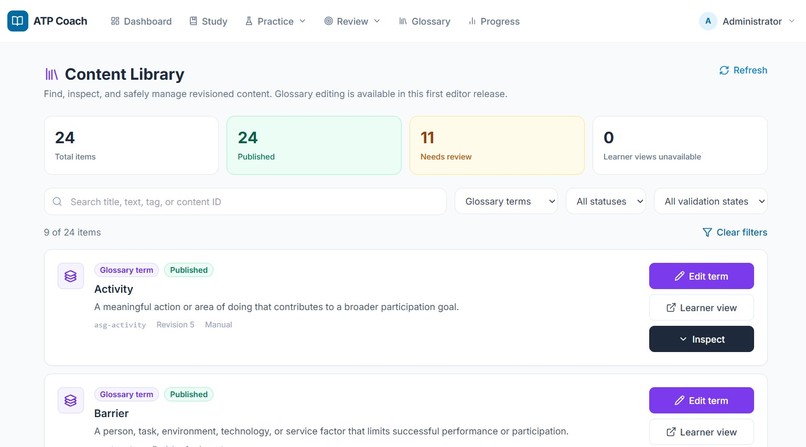
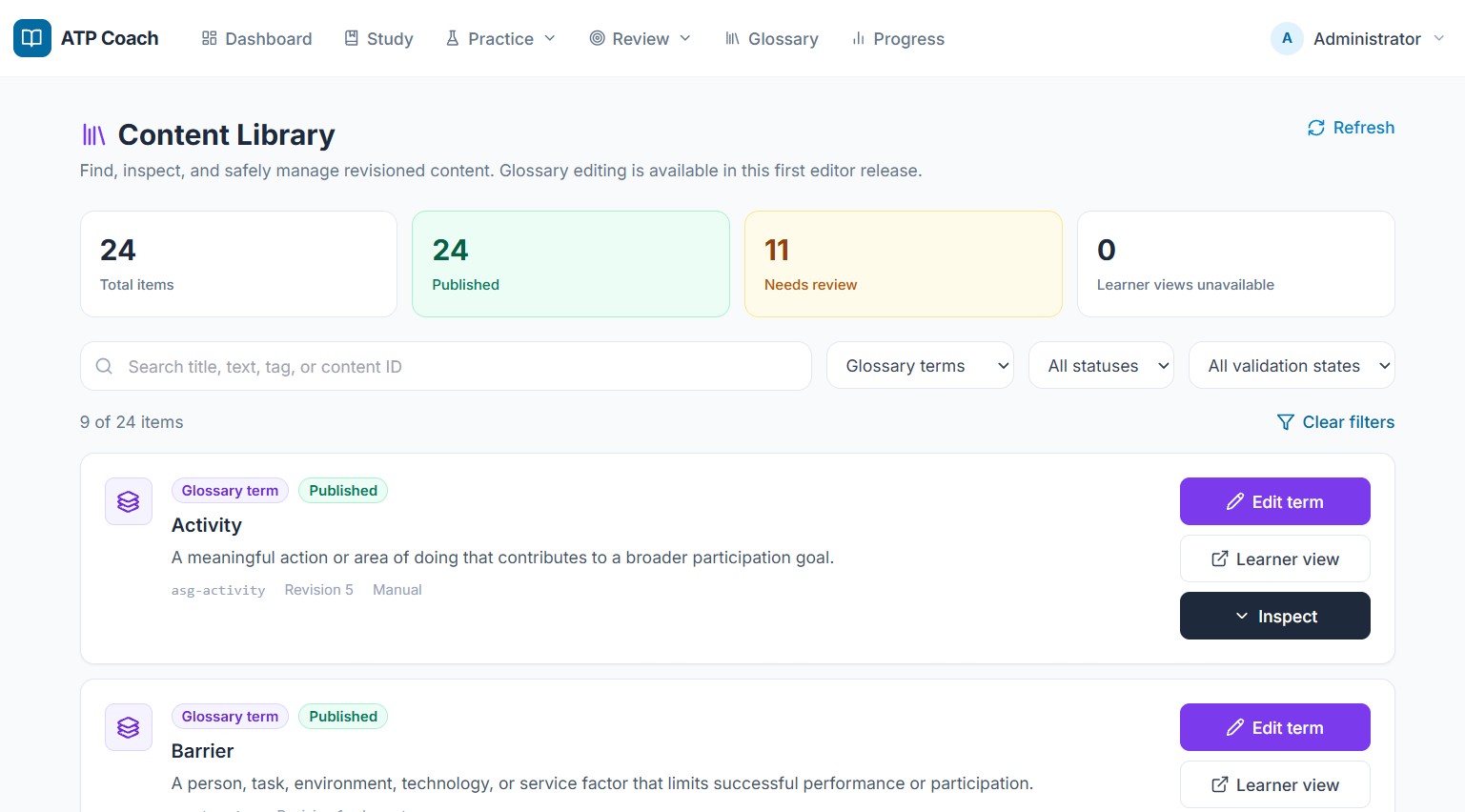
Admin Content Library Management
-
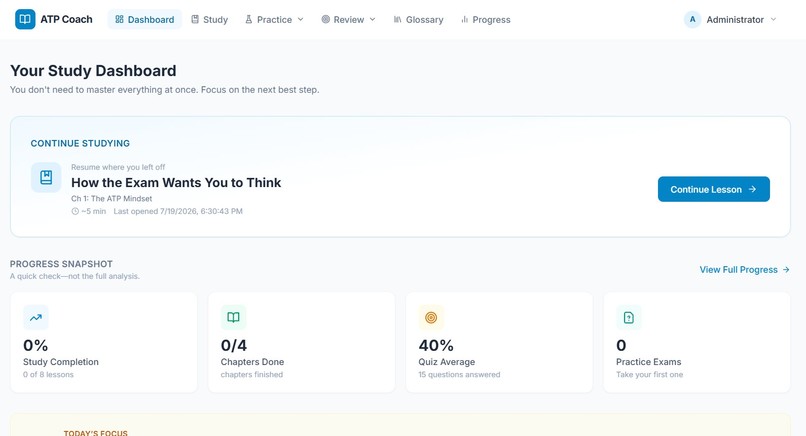
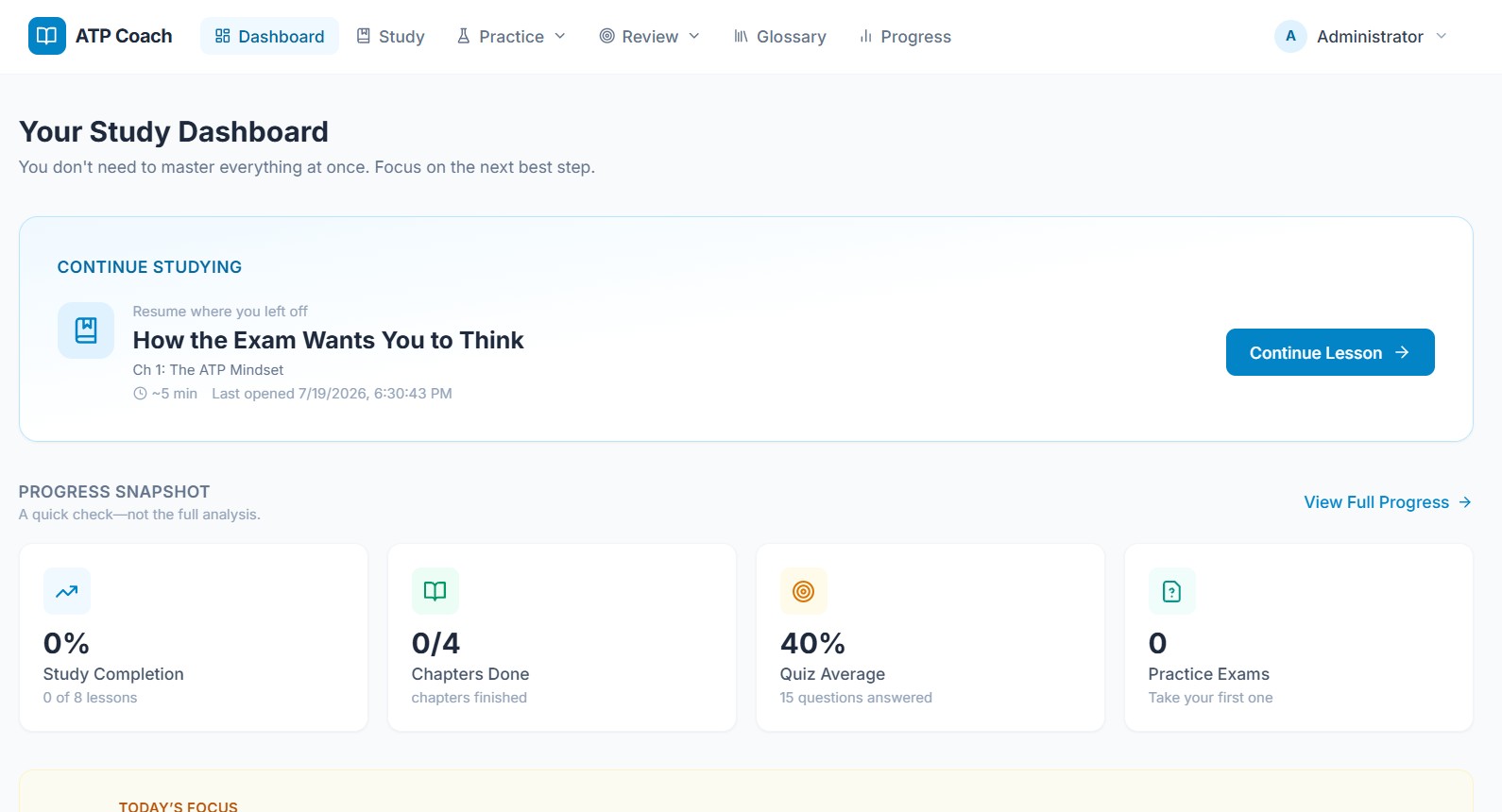
User Dashboard
-
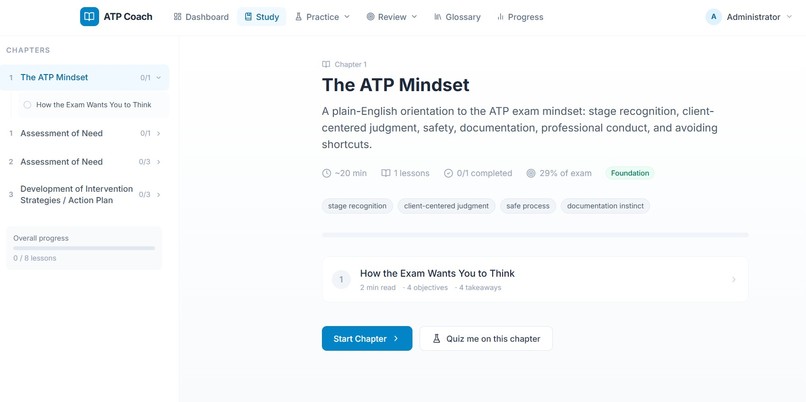
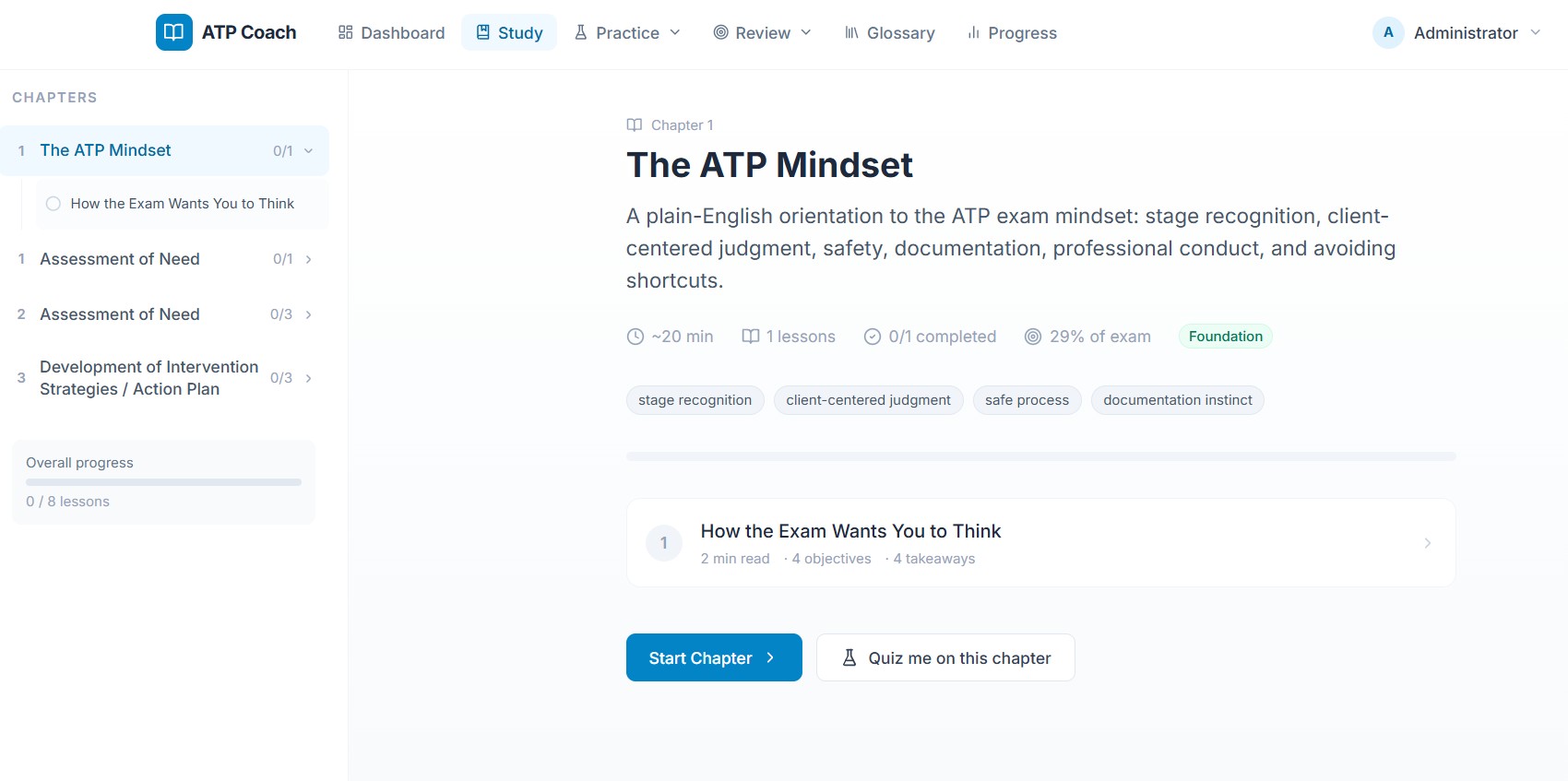
Study Lessons
-
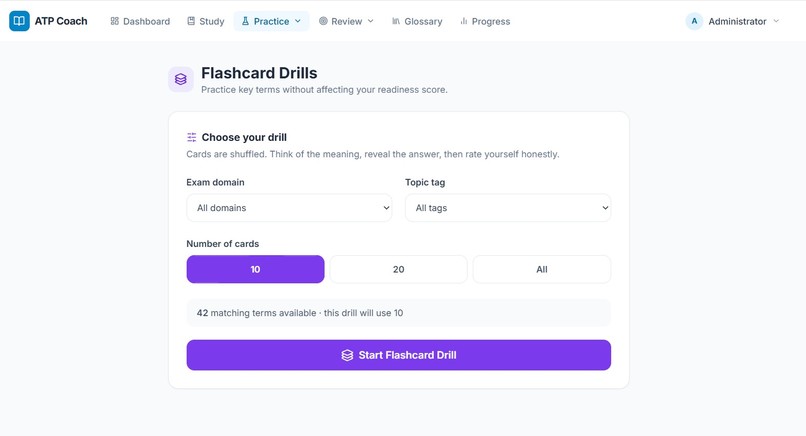
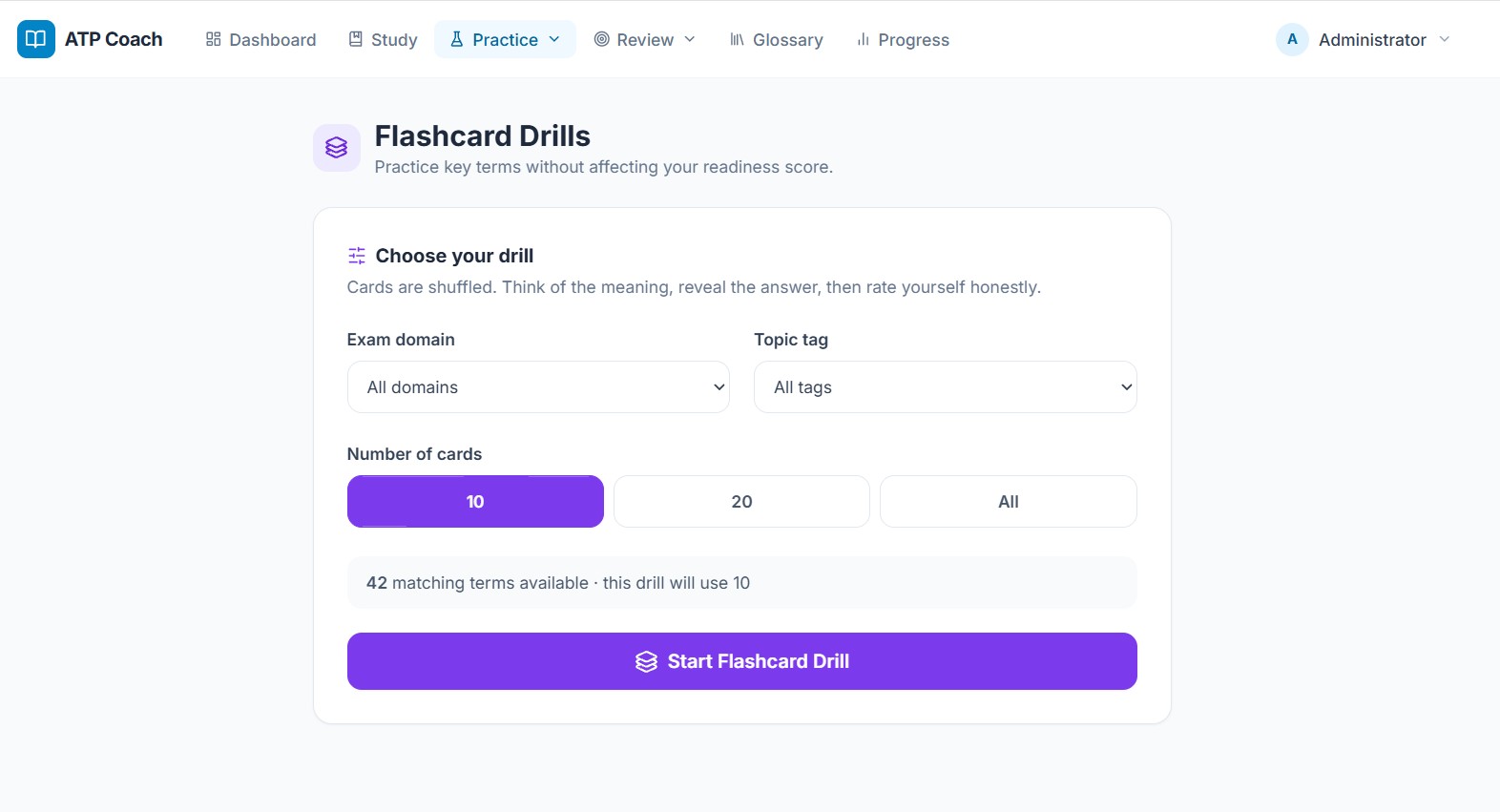
Flashcard Drill Creation
-
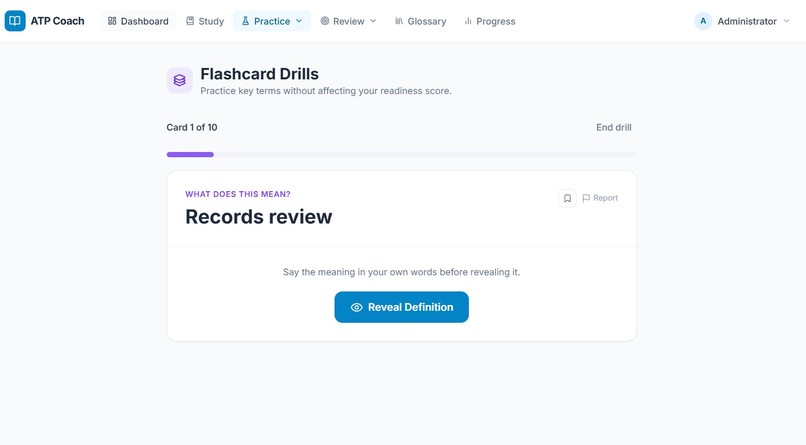
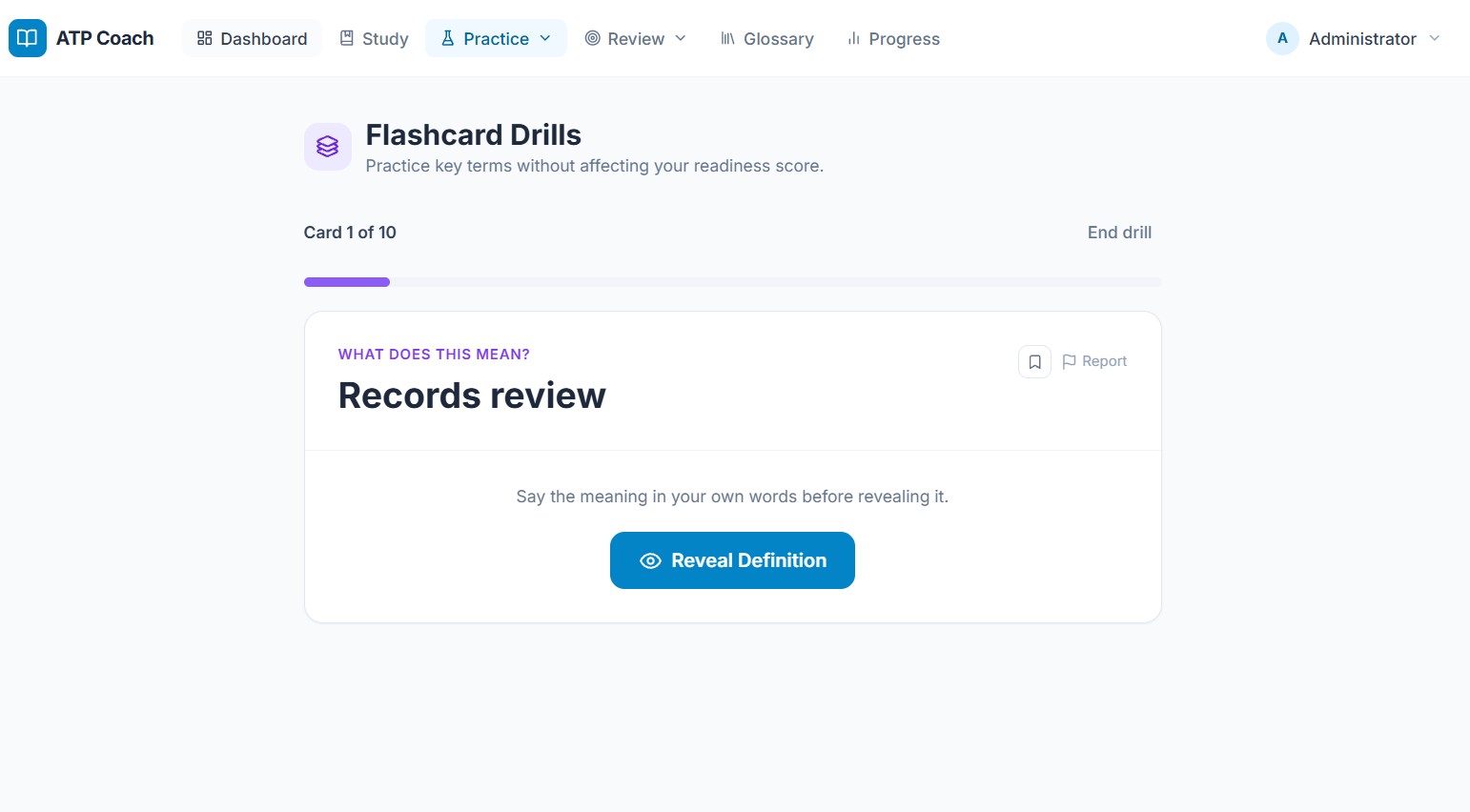
Flashcard Drill Tracking
-
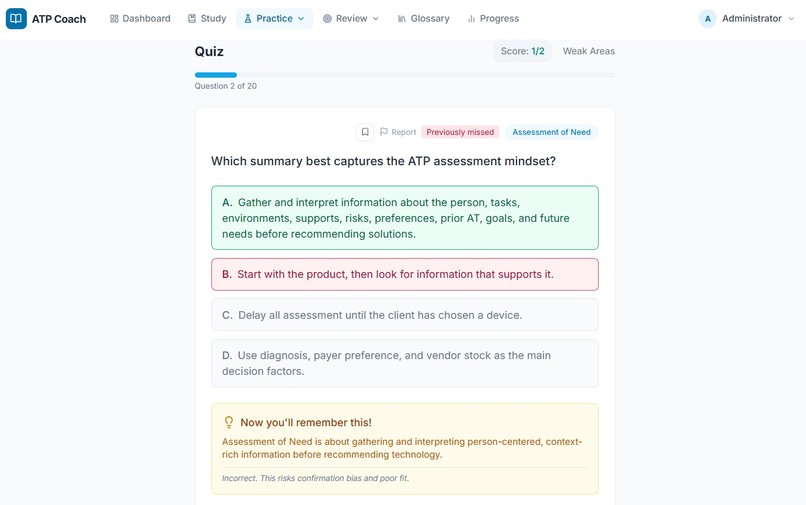
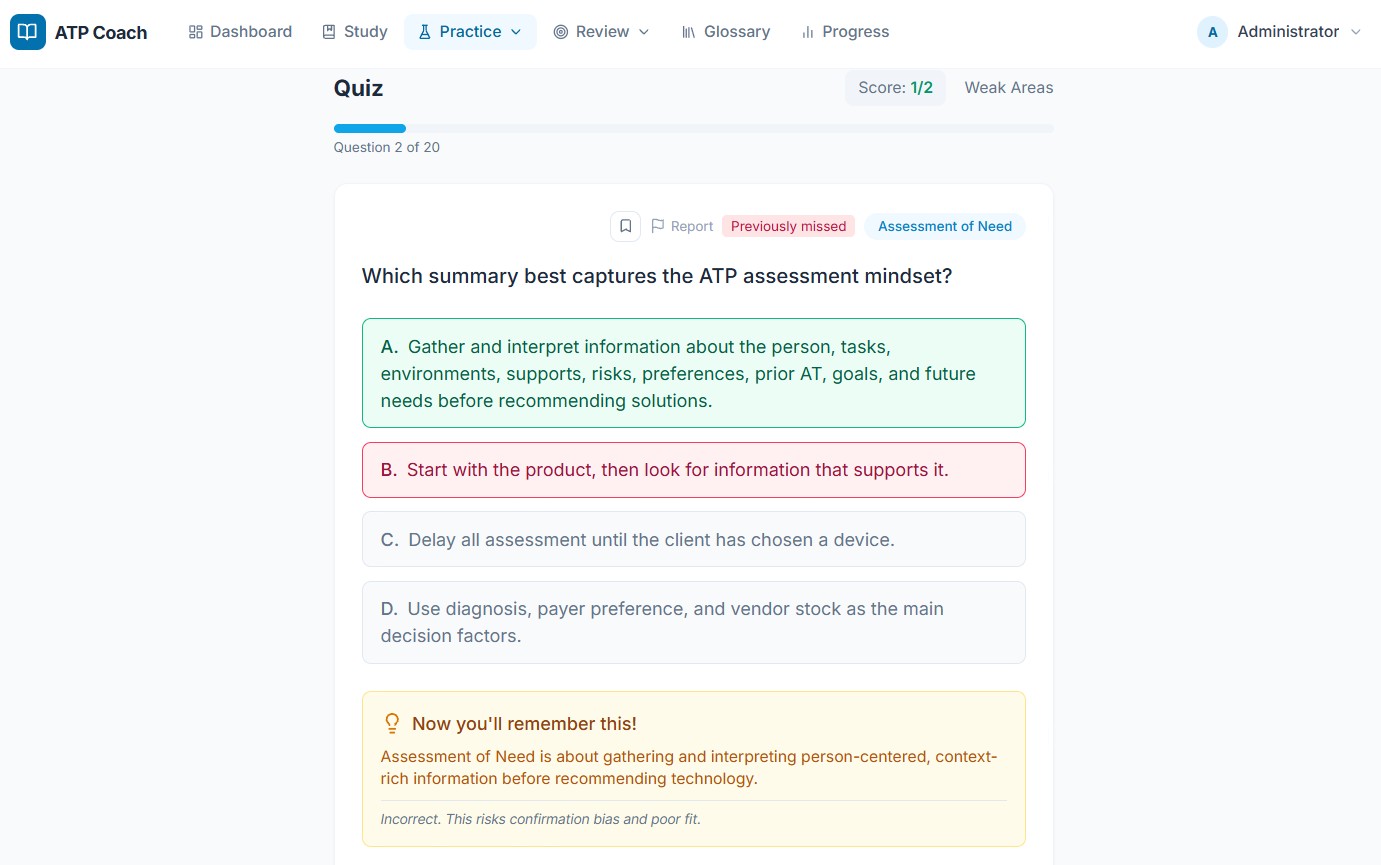
Answer Explanation and Tracking
-
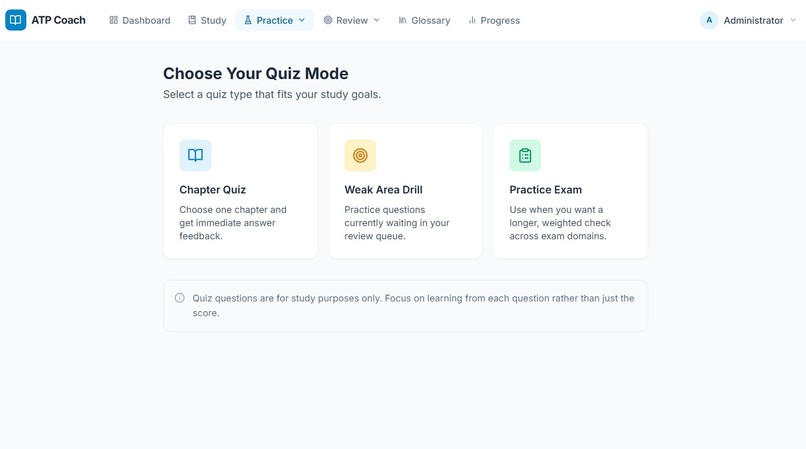
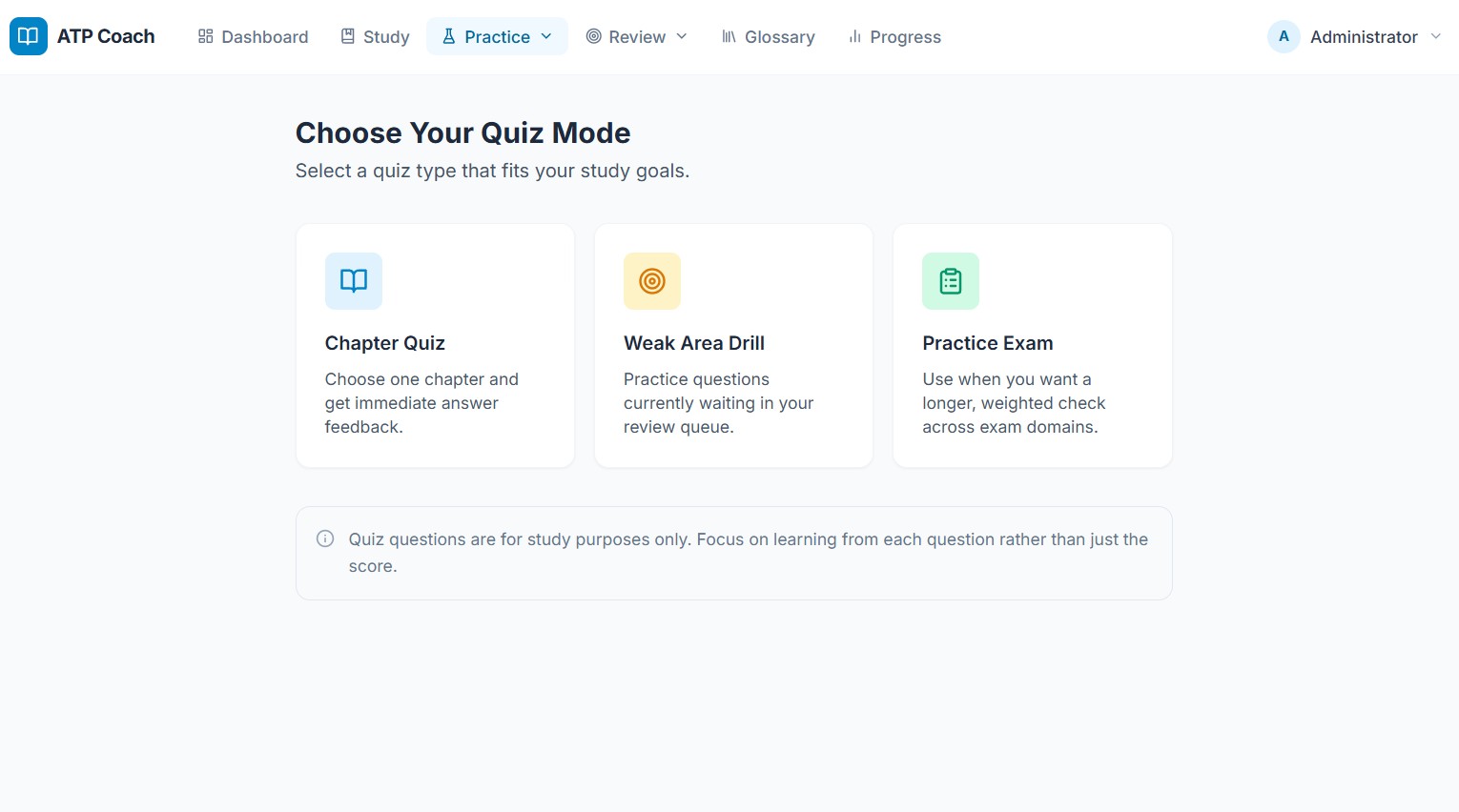
Quiz Modes
-
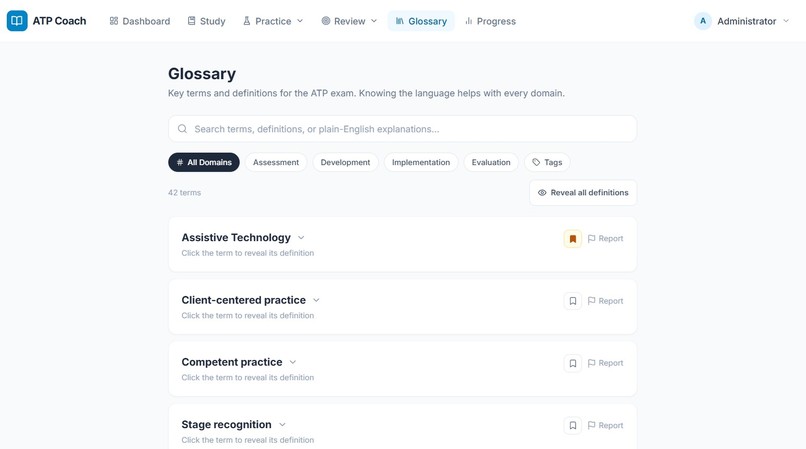
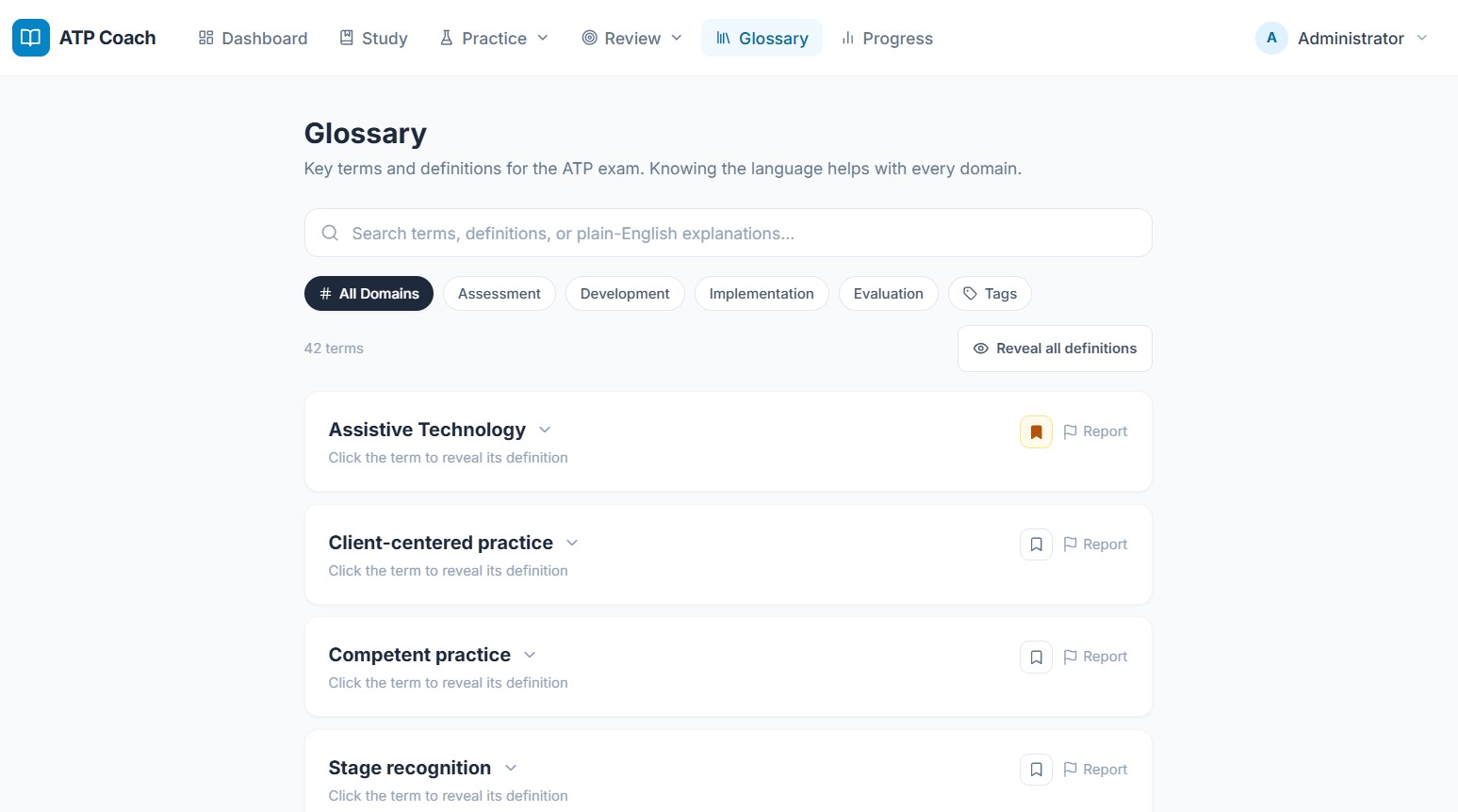
Glossary of Industry Terms
-
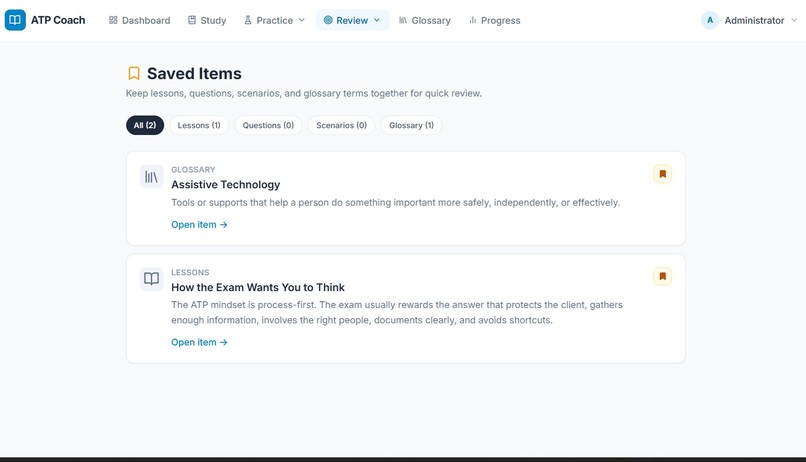
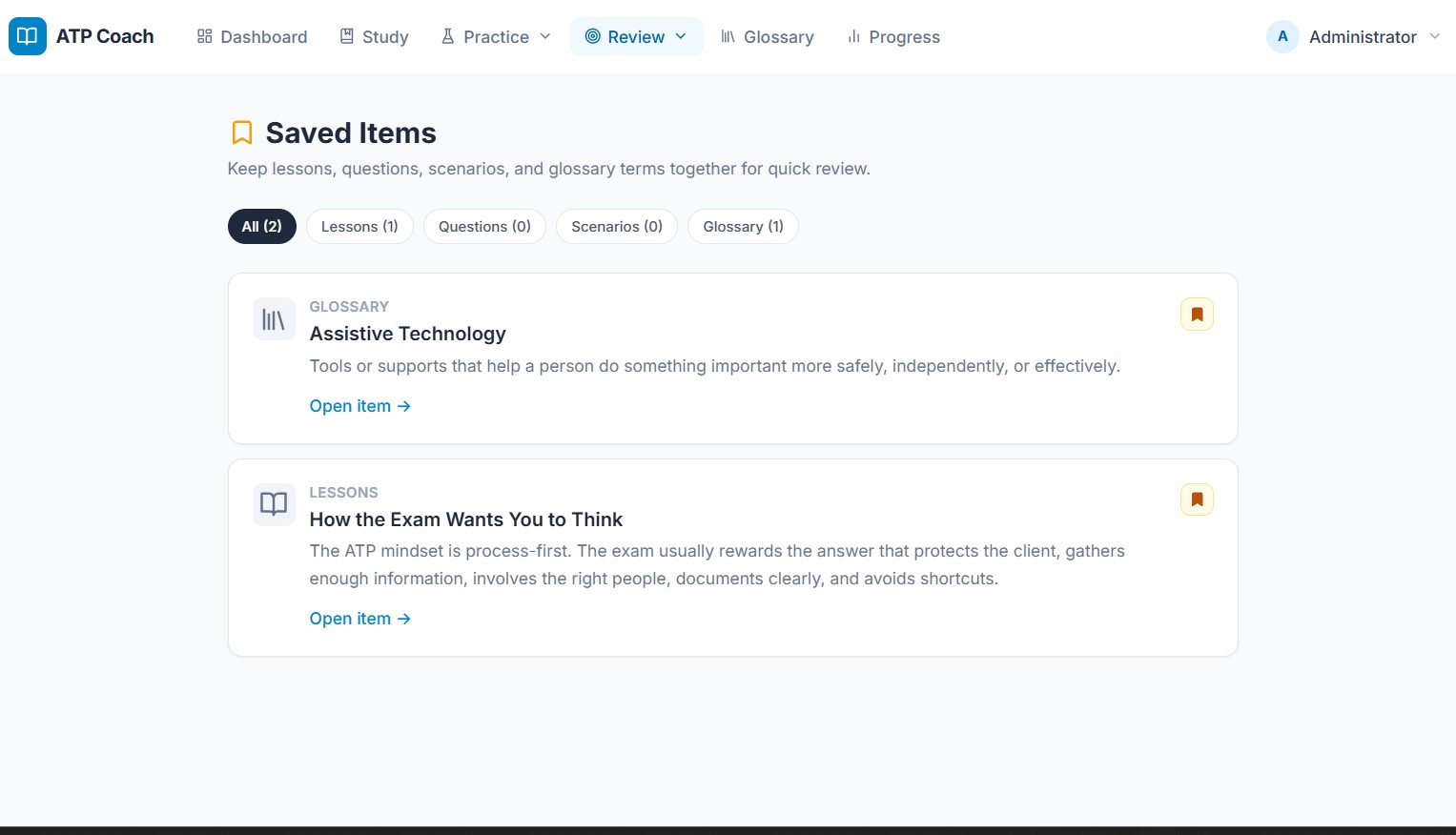
Saved Bookmarks
-
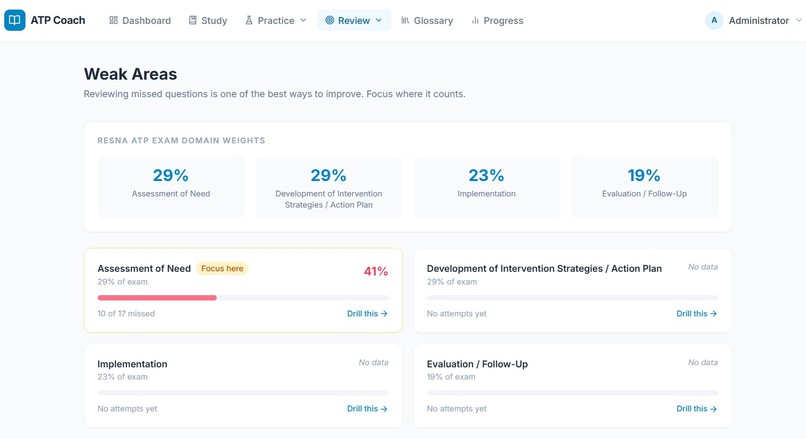
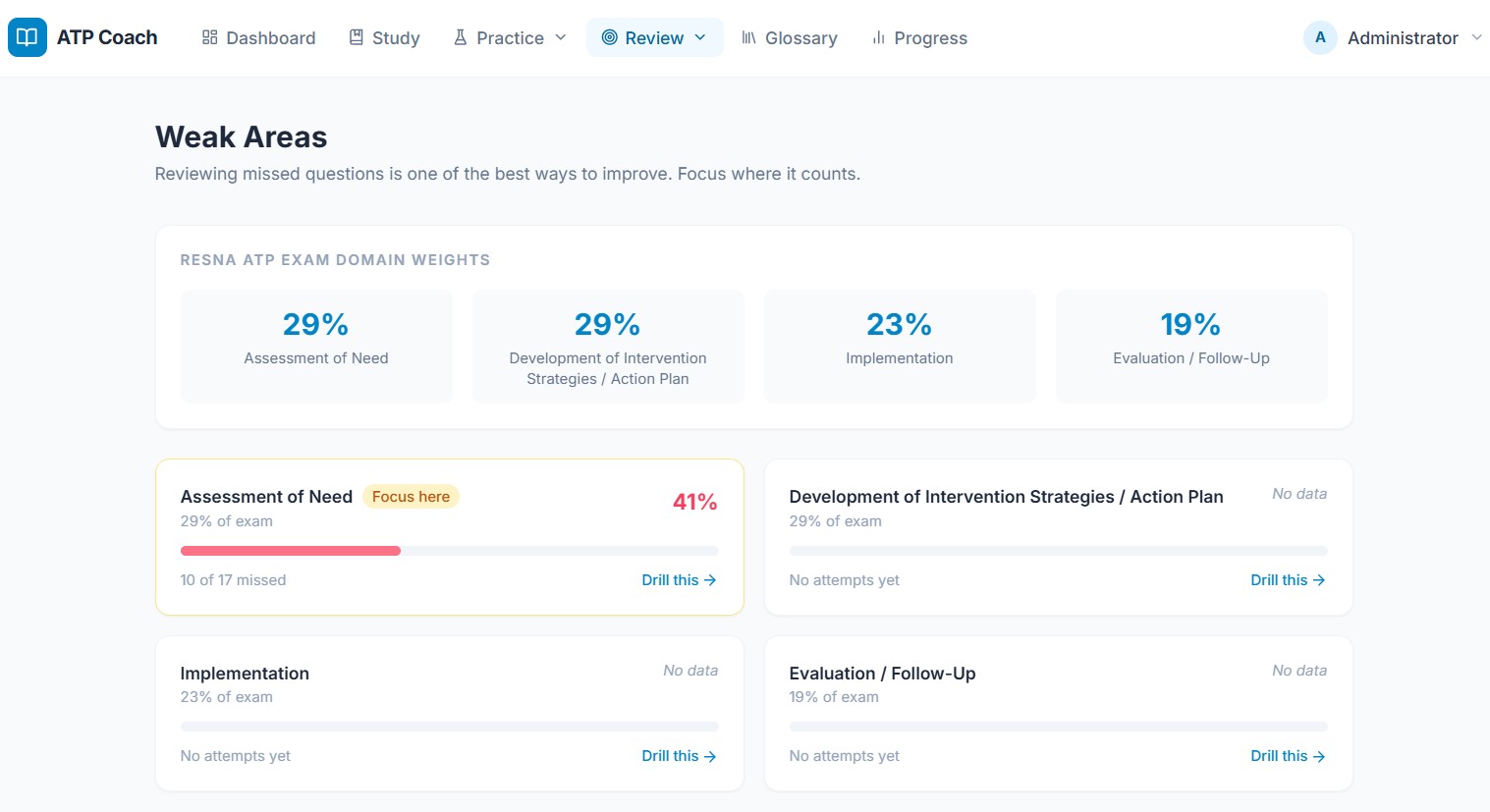
Weak Areas
-
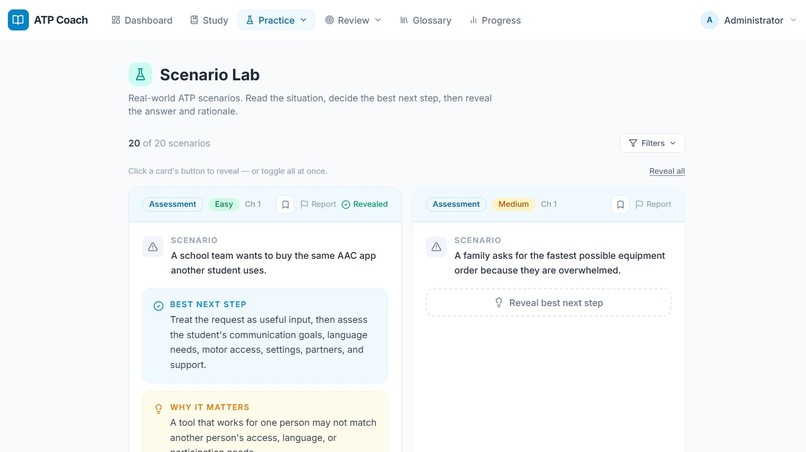
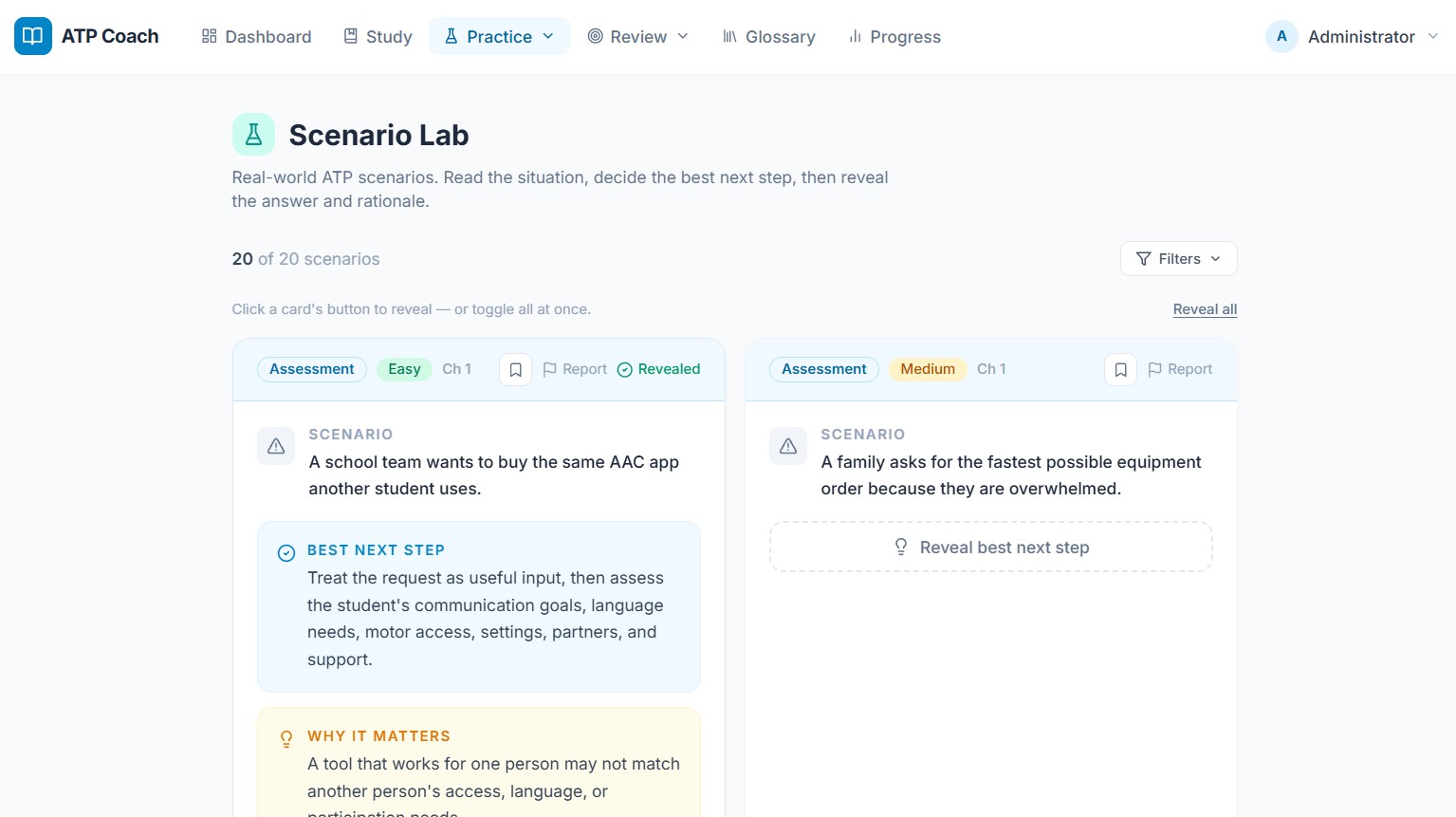
Scenario Lab
-
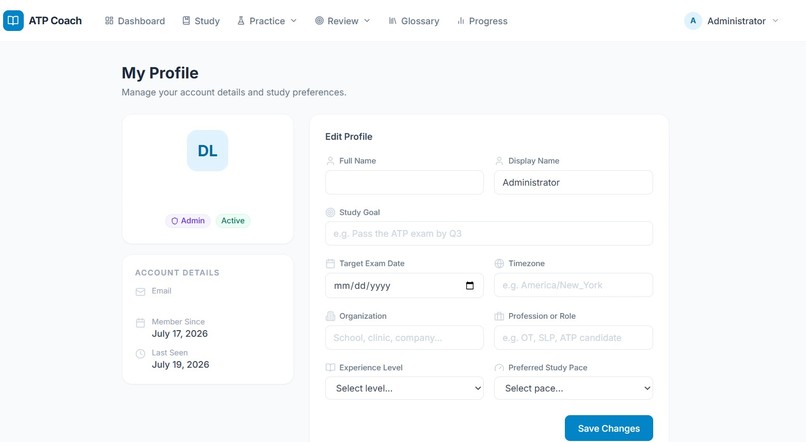
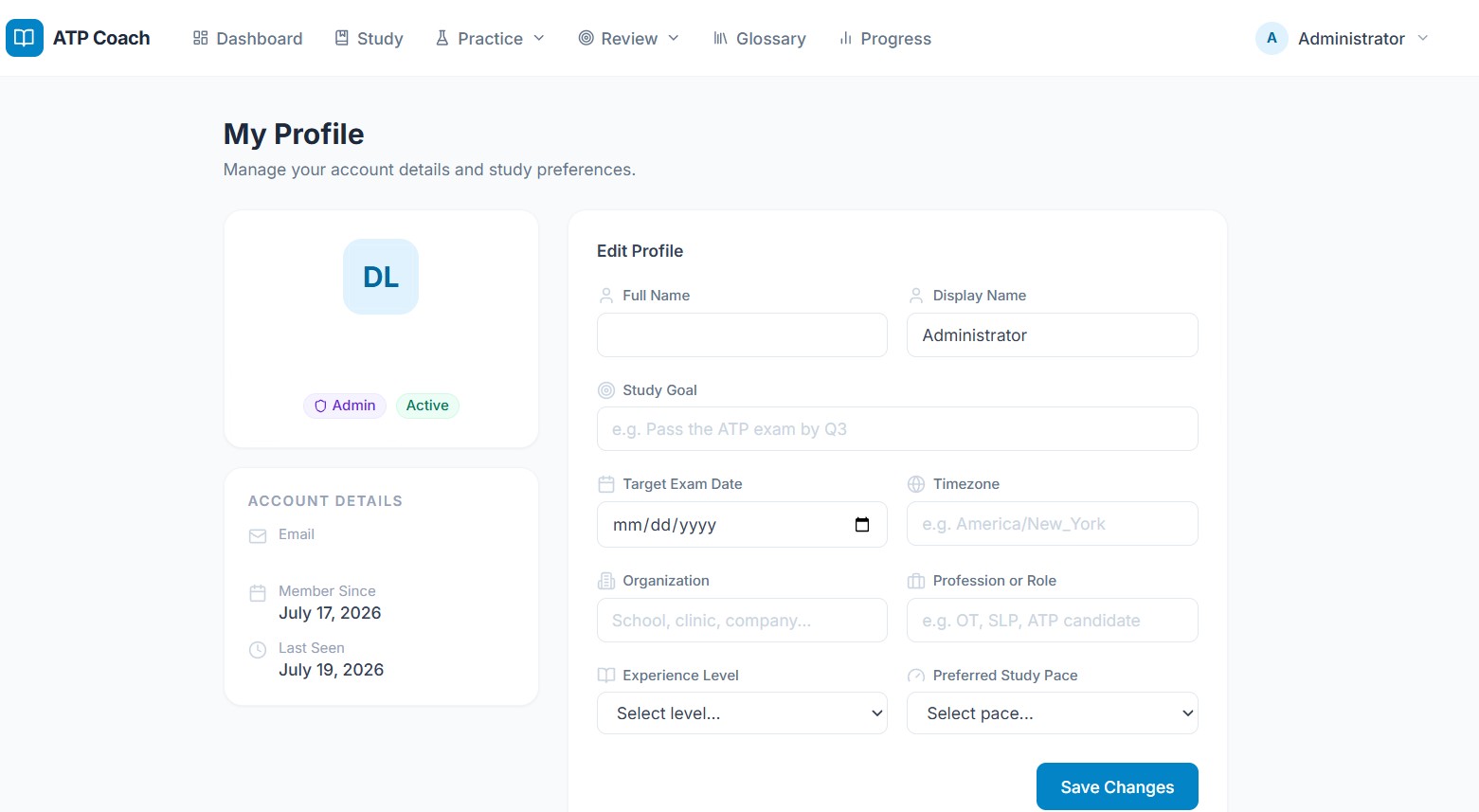
Personal User Profile Management
-
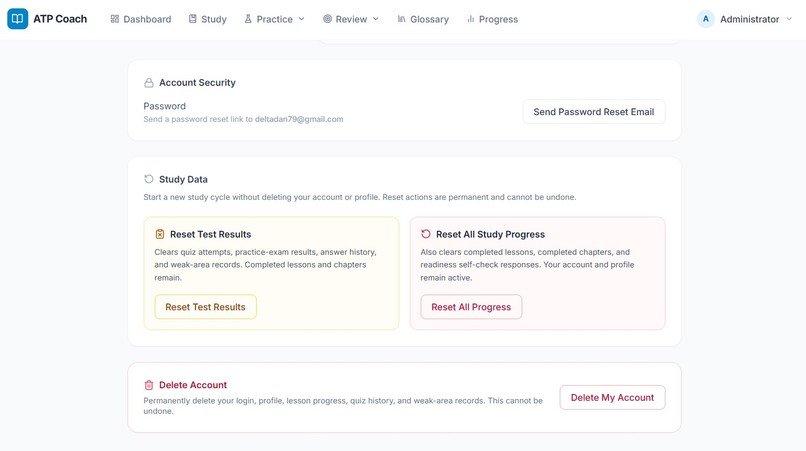
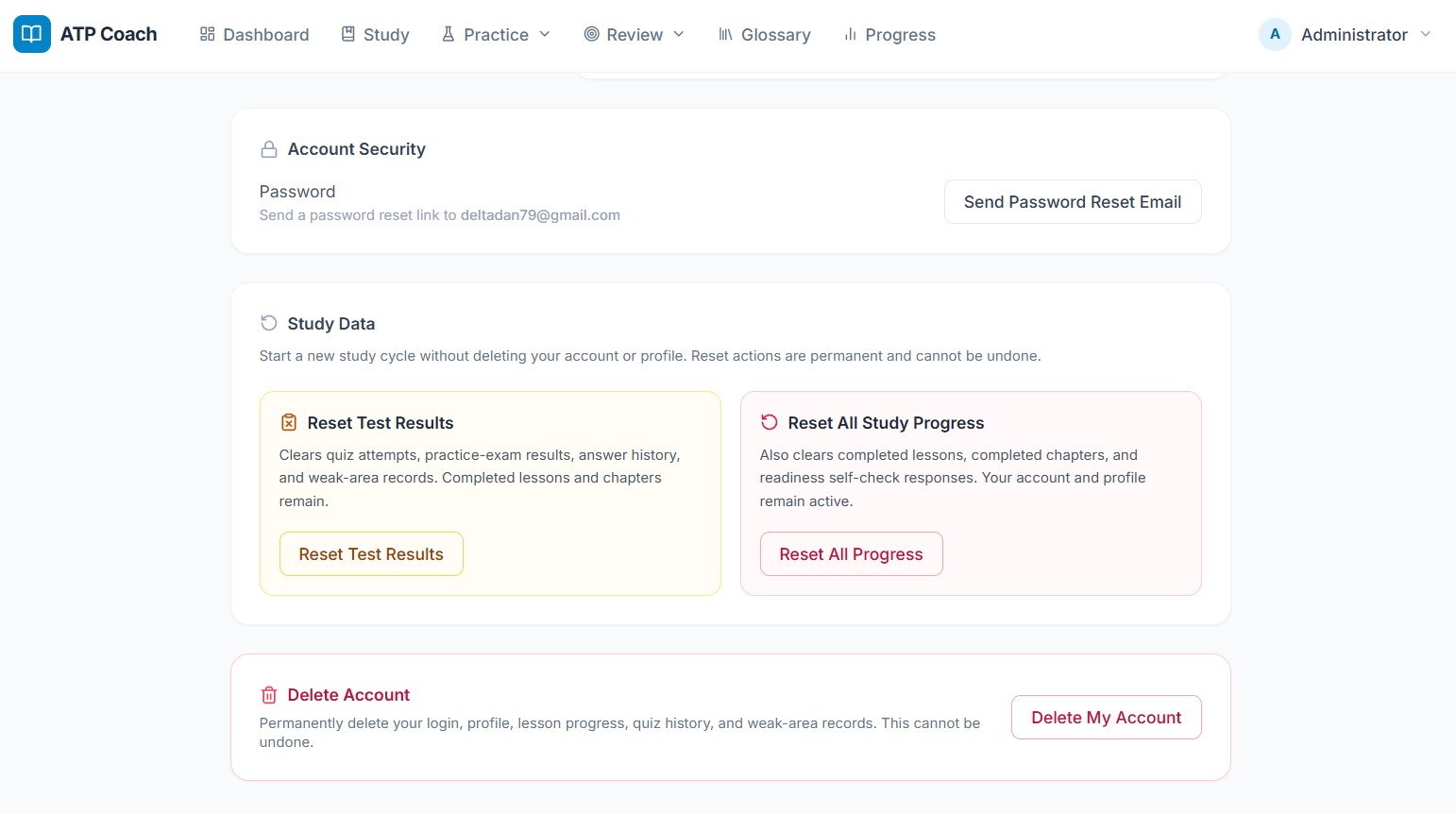
Personal User Data Reset / Removal
Inspiration
People with disabilities often depend on assistive technology to communicate, move safely, attend school, work, and live more independently. Choosing the right technology, however, requires much more than selecting a device.
Assistive Technology Professionals, or ATPs, evaluate a person’s goals, abilities, environment, support system, and daily activities so that technology can work successfully in real life.
ATP Study Coach grew out of my professional experience. I work as a wheelchair case coordinator, helping ATPs and patients navigate insurance prequalification for complex rehabilitation equipment. I am also completing a degree in computer science and cybersecurity, so this project gave me an opportunity to bring those two parts of my background together.
I see how important knowledgeable ATPs are. I also see the large caseloads many carry and the need for more qualified professionals. At the same time, the ATP certification exam covers a very broad range of knowledge. A candidate may have extensive experience in one specialty but much less exposure to other areas of assistive technology and service delivery.
That made me wonder: Could a structured, interactive learning platform help candidates prepare—not only by reviewing facts, but by practicing the client-centered judgment and professional reasoning expected of an ATP?
That question became ATP Study Coach.
What it does
ATP Study Coach is an interactive learning and exam-preparation application for RESNA ATP candidates.
It gives learners a structured place to:
- Work through lessons and chapters
- Practice with realistic scenarios
- Take chapter quizzes and customizable practice exams
- Review missed or marked questions
- Identify weaker knowledge areas
- Track lesson, quiz, and overall study progress
- Practice terminology with a connected glossary and flashcards
- Save lesson notes and resume studying later
- Receive readiness feedback as the curriculum expands
The learning experience is designed to go beyond memorizing definitions. Questions and scenarios ask learners to consider the entire service-delivery process: client goals, functional abilities, environments, safety, stakeholders, trials, documentation, implementation, and follow-up.
Questions can include an overall explanation as well as a rationale for every answer choice. This helps learners understand not only why one answer is best, but why the alternatives reflect weaker reasoning.
Behind the learner experience is an administrative content-management system. Authorized administrators can validate structured content, save it as a draft, review relationships, and publish it without modifying the application’s source code.
ATP Study Coach is already a working application, but the curriculum is still growing. My goal is to build a maintainable learning platform—not merely a static collection of study notes or practice questions.
How I built it
ATP Study Coach existed before Build Week. I originally used Bolt to create a prototype of the application foundation and many of its core learning features, including lessons, quizzes, practice exams, progress tracking, administrative tools, and its first Supabase integration.
During Build Week, I moved the project into a GitHub-based development workflow and used Codex with GPT-5.6 to meaningfully extend it. This was a game changer. It helped me build something that previously felt impossible for me to accomplish on my own. With Codex and GPT-5.6, I was able to expand the application, test and debug real production behavior, and understand parts of software development that I had never worked with before.
I exported the application to GitHub and worked with Codex to understand the codebase, diagnose production problems, rebuild important parts of the database configuration, add tests and security controls, develop the content-management workflow, and safely move improvements into production on Vercel.
Codex with GPT-5.6 also helped me establish a controlled development workflow in which major changes move through a dedicated branch, local validation, automated checks, a Vercel preview deployment, pull-request review, and finally a controlled production merge.
Some of the most important Build Week improvements I completed with Codex and GPT-5.6 included:
- Finding and correcting hidden progress- and quiz-saving failures
- Adding visible error handling instead of silently reporting failed saves as successful
- Rebuilding Supabase configuration through reproducible migrations
- Strengthening permissions and row-level security
- Adding automated tests for important learner workflows
- Adding GitHub Actions checks for pull requests
- Implementing secure self-service account deletion
- Improving navigation, glossary tools, learner notes, missed-question review, and resume behavior
- Building a structured CMS with revisions, draft batches, validation, publishing controls, and safeguards
- Developing a repeatable workflow for creating, validating, and importing educational content
The application uses React, TypeScript, Vite, Supabase, GitHub, and Vercel.
I made the product decisions, supplied the professional context, selected the educational direction and public sources, tested the application, reviewed the results, and decided which changes were ready for production. Codex with GPT-5.6 helped me inspect unfamiliar parts of the system, trace failures across the interface and database, implement changes, write tests and verification checks, and evaluate safer technical approaches.
The result was not simply more generated code. It was a much more reliable and maintainable development process.
Challenges I ran into
One of the biggest challenges was discovering the difference between an application that appeared to work and one that could be trusted.
The original interface could tell learners that their lesson progress or quiz answers had been saved even when Supabase had rejected the database operation. Because those errors were silently ignored, a learner might not discover the problem until refreshing the page.
Once we added better error reporting, it exposed another issue. Newer quiz questions used descriptive IDs, while an older database foreign-key constraint only accepted legacy question IDs. The questions worked on screen, but valid answers could fail when the application tried to save them.
Codex helped me trace the problem from the learner interface to the database constraint. We corrected the design, made the migration reproducible, and added visible error handling and tests so similar failures would not remain hidden.
Content development created another major challenge. My first structured lesson package made sense educationally, but it did not match the application’s real importer contract. When I tested it against the live validator, it returned 94 errors and 80 warnings.
Instead of bypassing the validator, we treated its output as evidence. We compared the errors with the importer code, identified the required field names, answer structure, enums, content relationships, and persistence behavior, and corrected the package. We also added rationales for all 44 answer choices.
The revised A1 lesson package passed the live validator with zero errors and zero warnings.
Other challenges included protecting production data while testing, preserving relationships among lessons and glossary terms, making manually configured database permissions reproducible, and designing a CMS that is extensible without making everyday content entry unnecessarily difficult.
The biggest lesson was that making an application look functional is very different from making it reliable, secure, testable, and maintainable.
Accomplishments I’m proud of
I am proud that ATP Study Coach progressed from an experimental prototype into a working production application with a real software-development and content-management workflow.
During Build Week, I was able to:
- Stabilize the application’s learner-progress and quiz-saving systems
- Rebuild and secure its Supabase configuration
- Add reproducible migrations and database verification checks
- Add automated tests and GitHub Actions quality checks
- Implement privacy, legal, and self-service account-deletion features
- Complete numerous branch-to-preview-to-production development cycles
- Add learner features such as notes, missed-question review, marked questions, flashcard drills, and resume support
- Build a CMS with content revisions, draft review, publishing controls, and relationship safeguards
- Create a structured bulk-import and validation process
- Develop detailed Assessment topic briefs and a seven-lesson learning sequence
- Build a controlled glossary and original scenarios, questions, explanations, and answer-choice rationales
- Produce a pilot lesson package that passed the production validator cleanly
I am especially proud that the project connects my computer science and cybersecurity education with a real need I have observed professionally.
What I learned
Before this project, I often thought about AI coding tools mainly as a way to help generate or explain code. Build Week showed me what it looks like to collaborate with an AI coding agent across the full software-development lifecycle.
I learned how to use Codex to help audit an unfamiliar codebase, trace interface failures into database constraints, plan migrations, write automated tests, review security boundaries, and verify changes before putting them into production.
I also learned that the quality of the collaboration depends heavily on the human side.
I supplied the mission, professional experience, product decisions, source-selection principles, testing feedback, and final approval decisions. Codex with GPT-5.6 accelerated investigation and implementation, but I still needed to understand the proposed changes, question assumptions, test actual behavior, and decide what was appropriate for the people the application is intended to serve.
The strongest results came from combining AI capability with human judgment, domain context, deliberate testing, and controlled review.
What’s next for ATP Study Coach
The application now has a much stronger technical and content-management foundation. The next phase is to expand the curriculum while continuing to improve the learner experience.
The educational workflow begins with authoritative public resources, including the public RESNA ATP exam outline, Job Task Analysis, Exam Readiness Tool, ethics and professional standards, service-provision guidance, and other appropriate public frameworks.
From those sources, I build a Body of Knowledge, detailed topic briefs, a learner-facing lesson map, original lesson manuscripts, controlled terminology, scenarios, and questions. The material is then audited and converted into validated application packages.
The next steps are to:
- Convert and publish the remaining Assessment lessons
- Expand the other ATP service-delivery domains
- Build larger original quiz and practice-exam banks
- Add more realistic scenario labs
- Strengthen source traceability and content-version history
- Review content for accuracy, accessibility, scope, and difficulty
- Improve spaced review, weak-area targeting, and readiness feedback
- Continue refining the CMS so the curriculum can be maintained without changing source code
The long-term goal is to create a sustainable learning platform that can evolve as assistive technology, professional practice, and public certification guidance change.
All lessons, scenarios, questions, explanations, and rationales are original educational content informed by publicly available sources. ATP Study Coach does not reproduce official exam questions, proprietary preparation materials, or restricted content.
ATP Study Coach is an independent educational project. It is not affiliated with, endorsed by, or officially approved by RESNA, and it does not guarantee that a learner will pass the ATP examination.
The mission is simple: help more candidates prepare thoughtfully, strengthen their professional judgment, and become better equipped to serve people who depend on assistive technology.
Built With
- bolt.new
- github
- github-actions
- insights
- openai-codex
- postgresql
- react
- react-router
- react-testing-library
- row-level-security
- speed
- supabase
- tailwind-css
- typescript
- vercel
- vite
- vitest


Log in or sign up for Devpost to join the conversation.