-
-
-
-
-
-
-
-
-
-
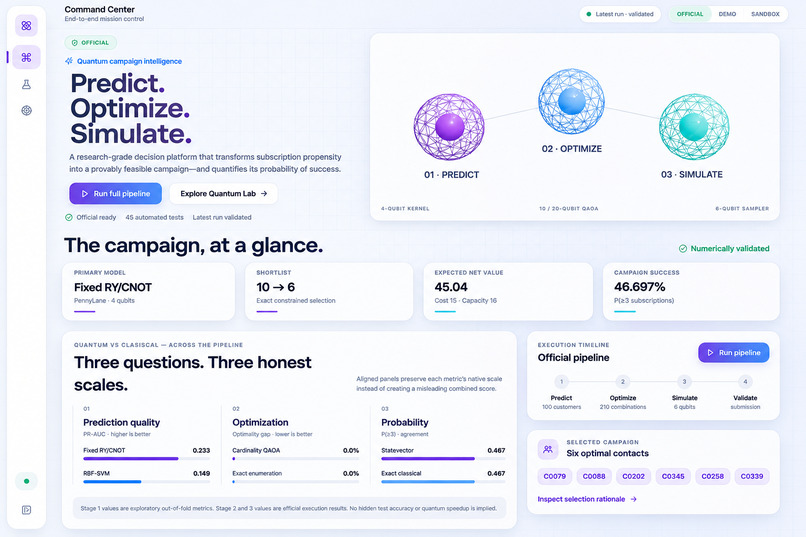
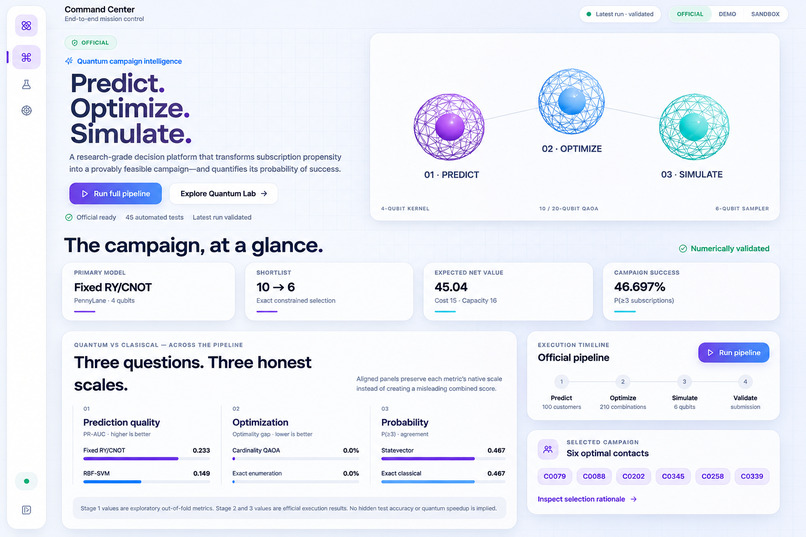
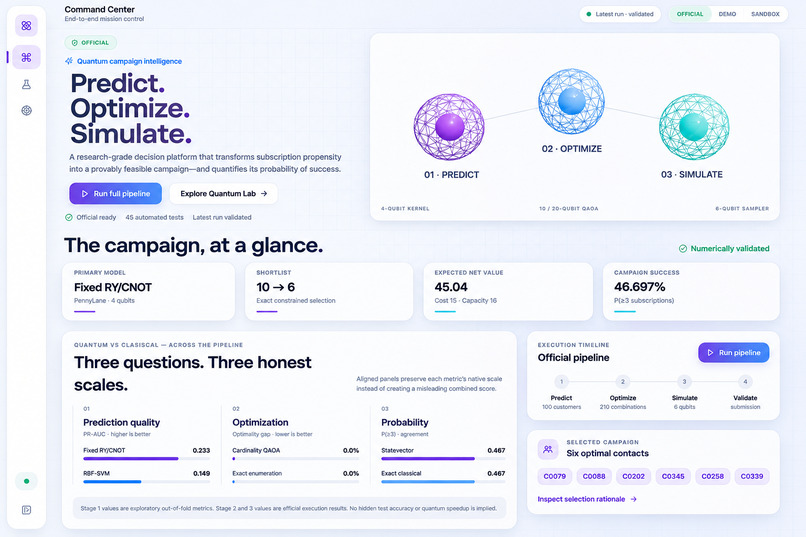
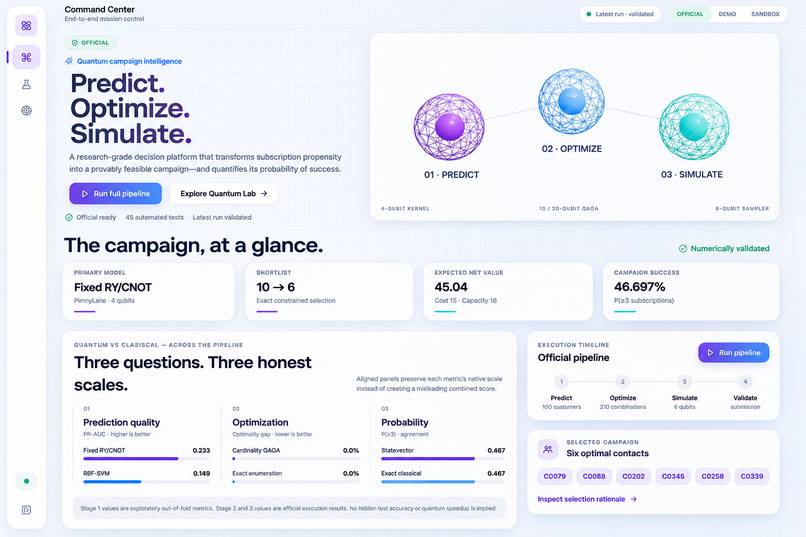
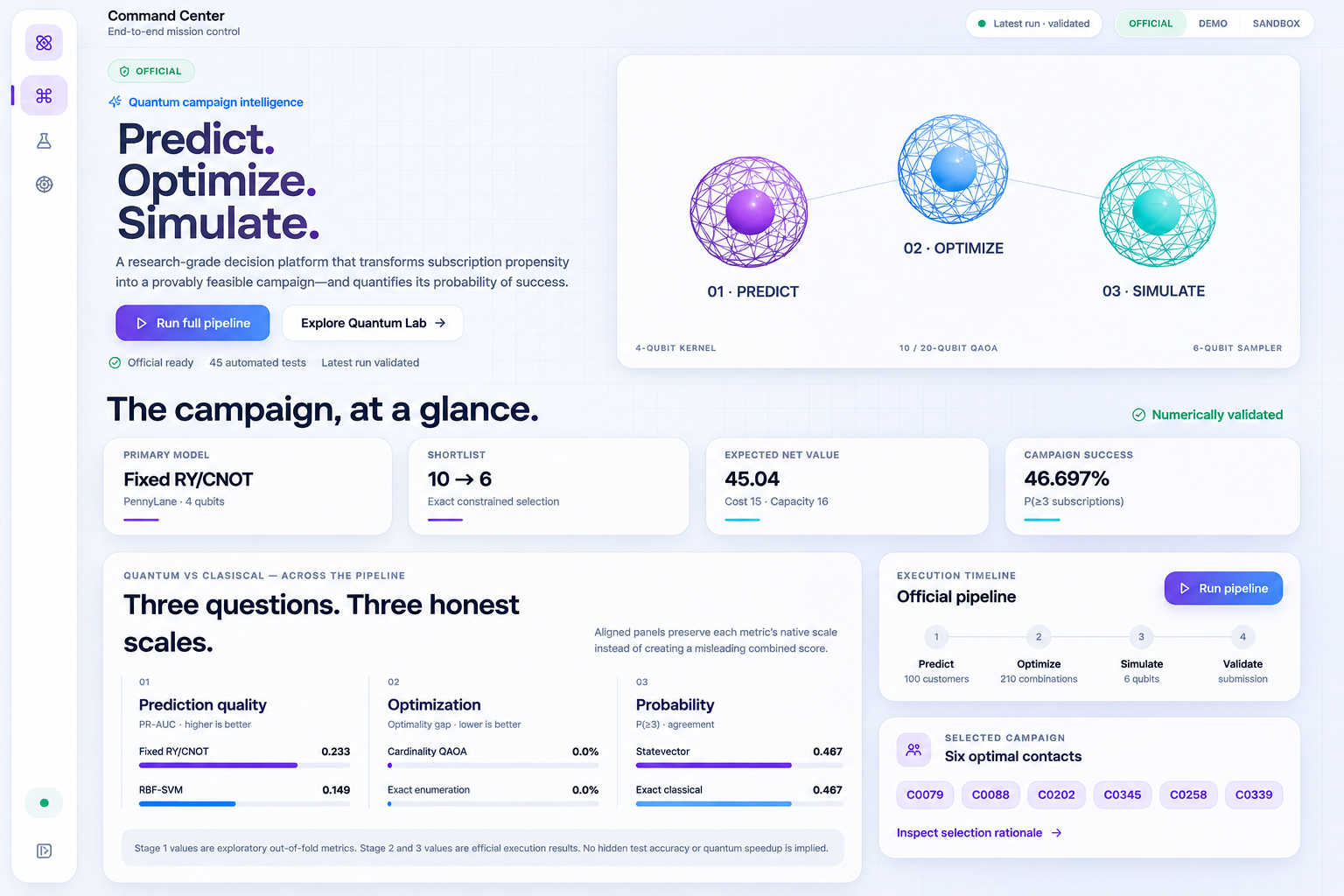
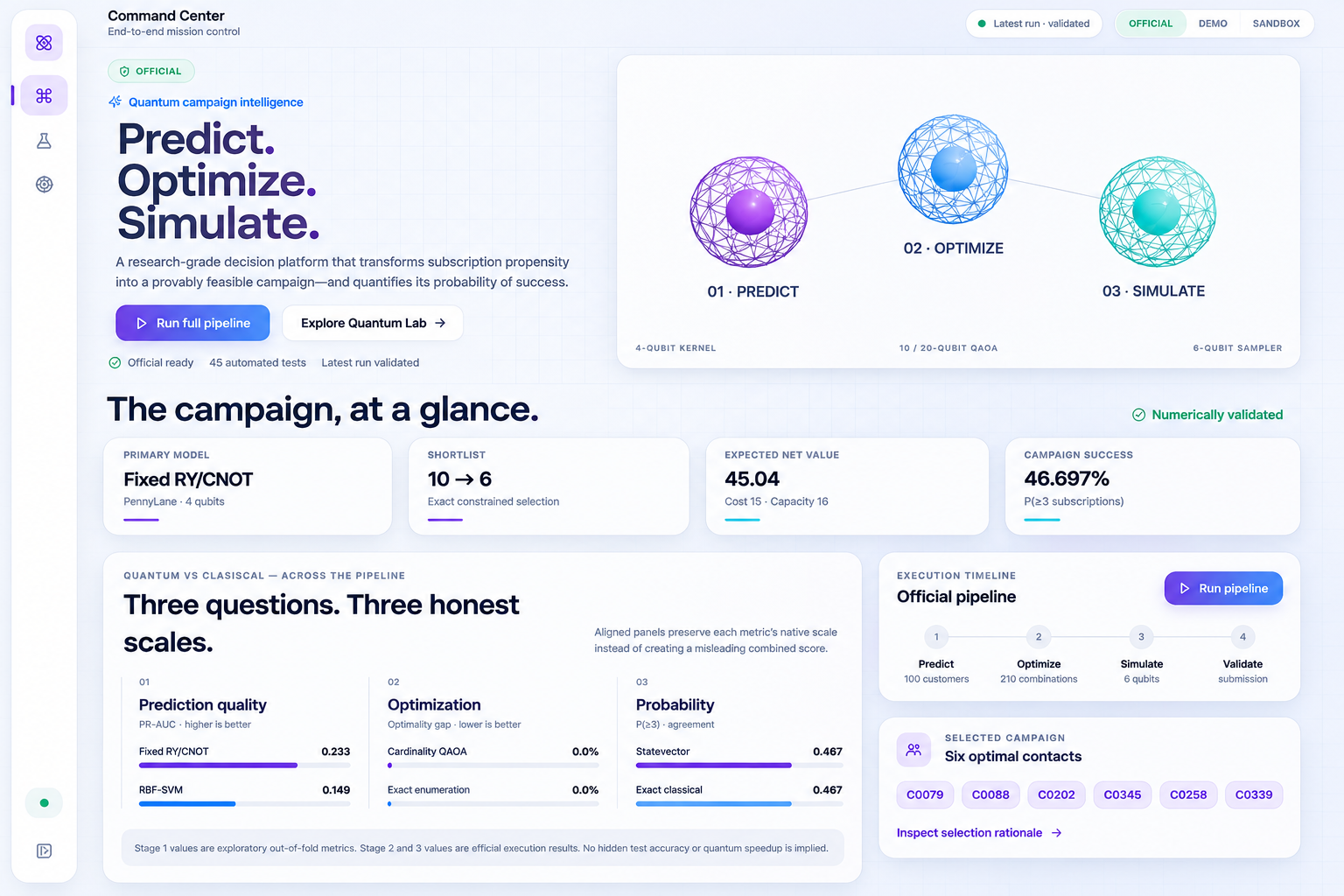
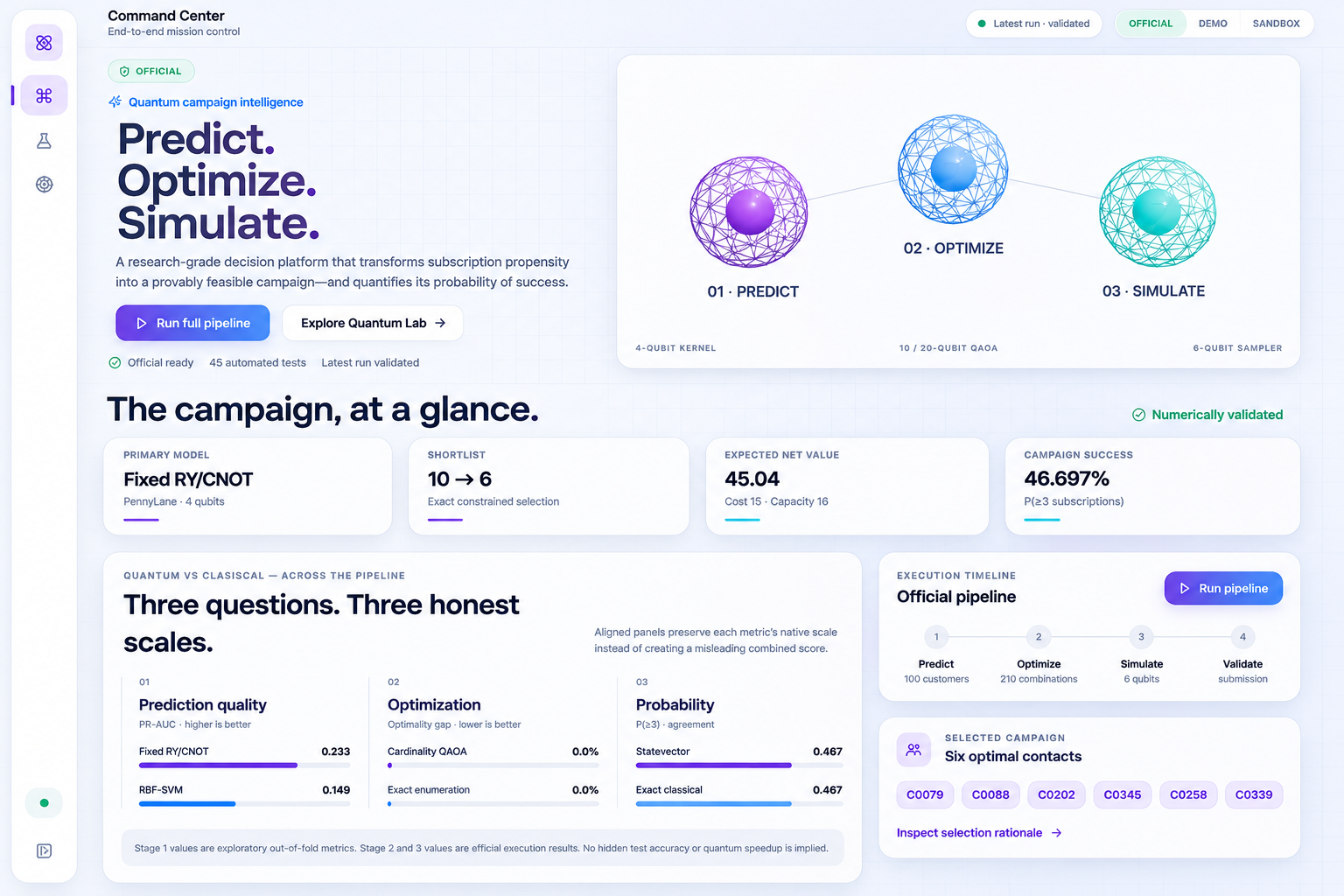
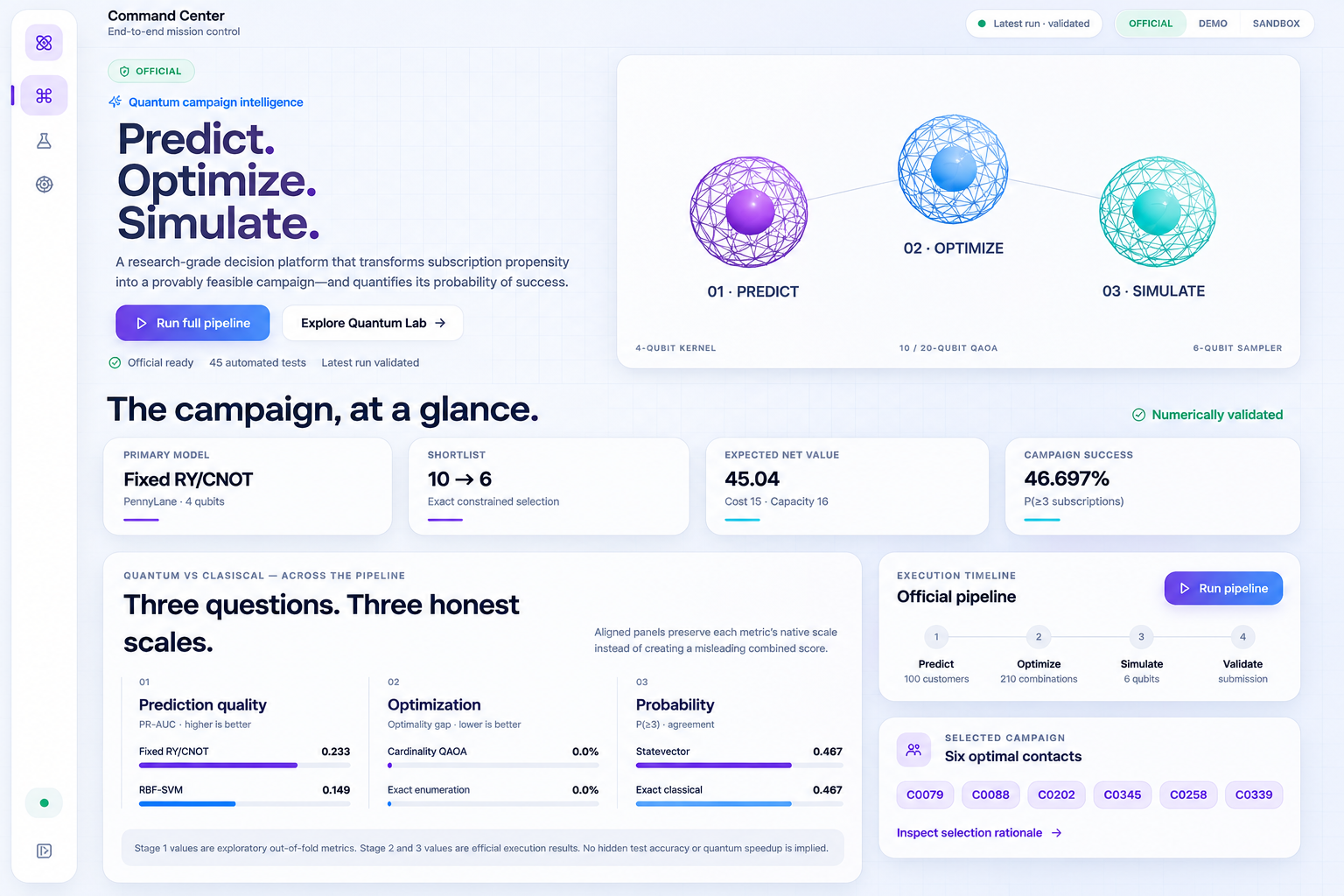
AtomiQ Command Center: An interactive quantum-classical dashboard connecting customer prediction, QAOA optimization, and success simulation.
-
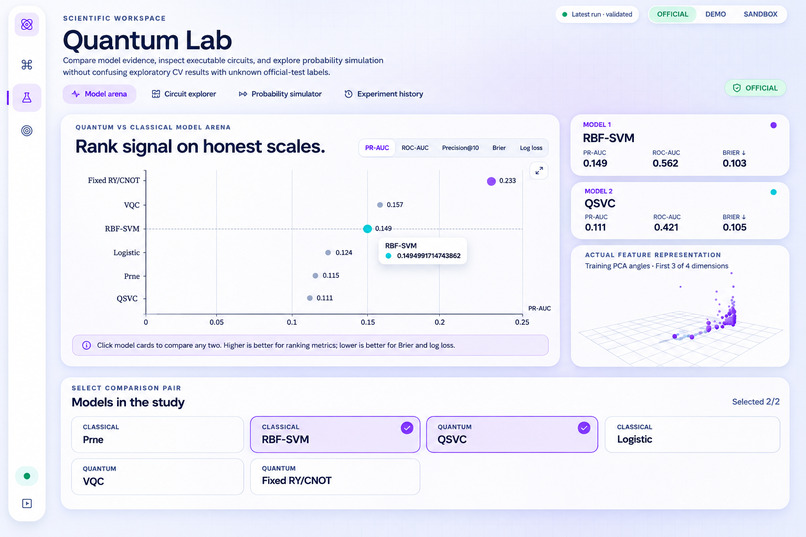
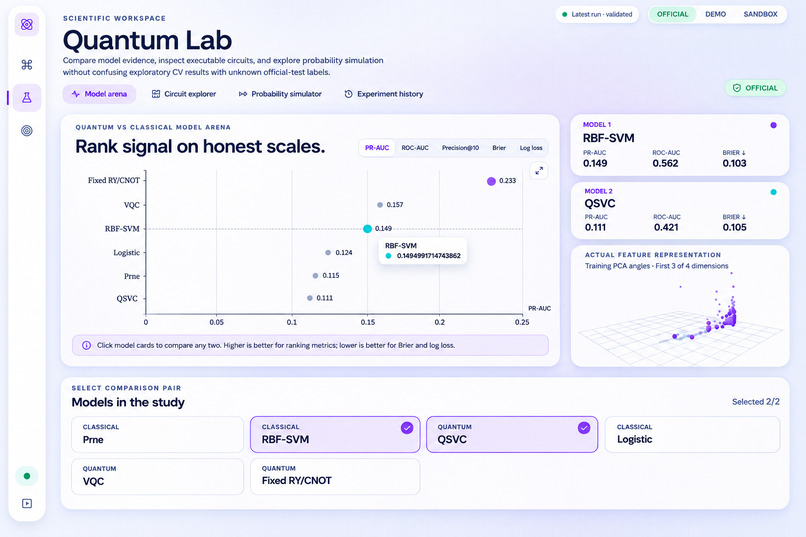
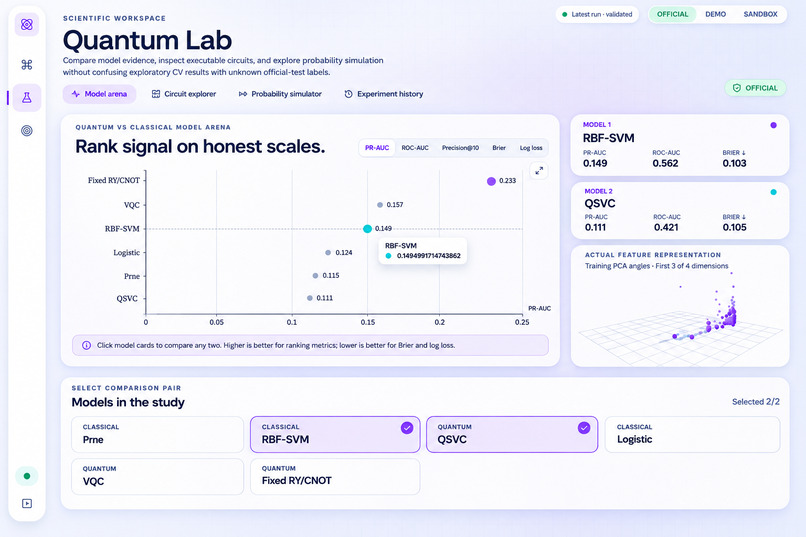
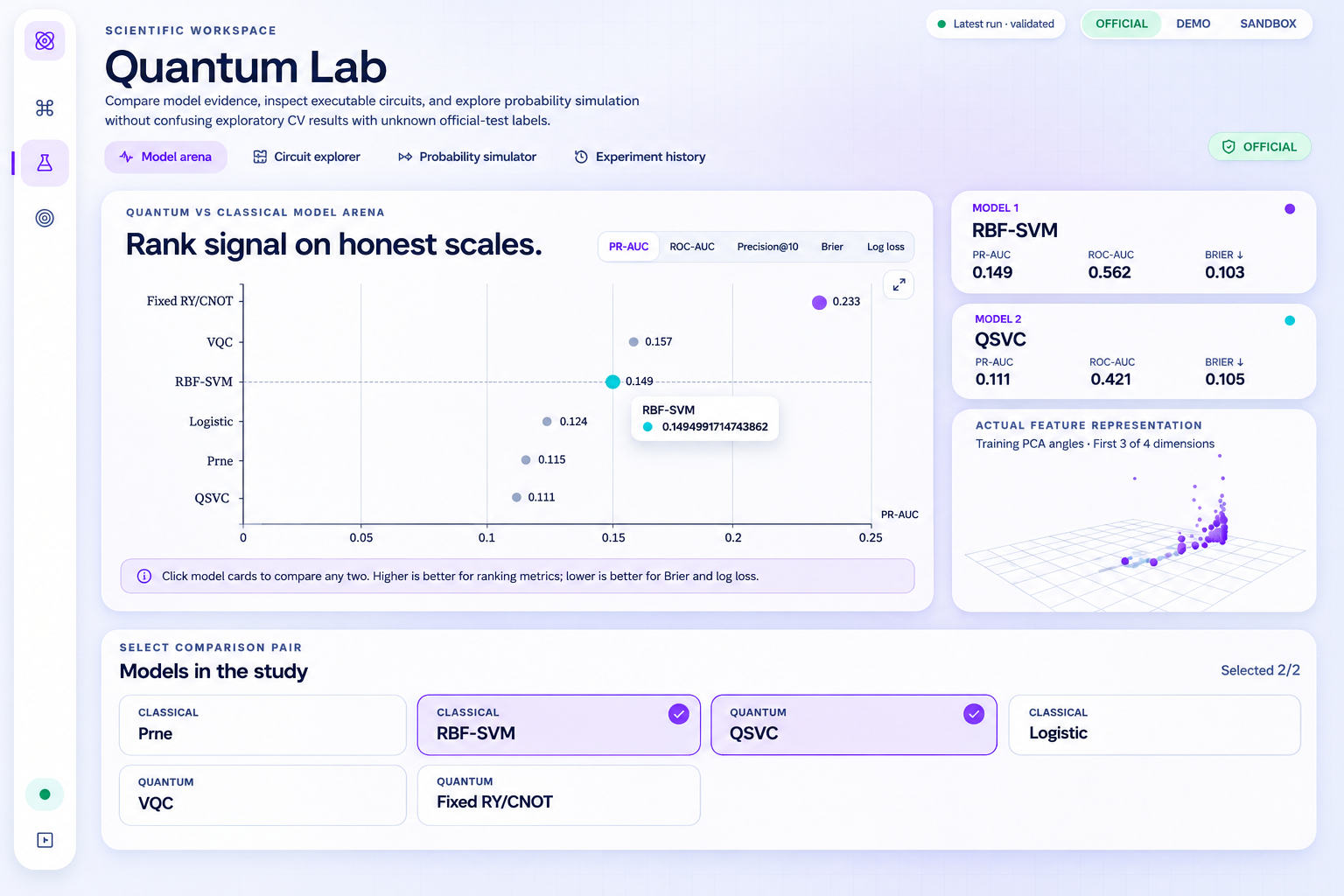
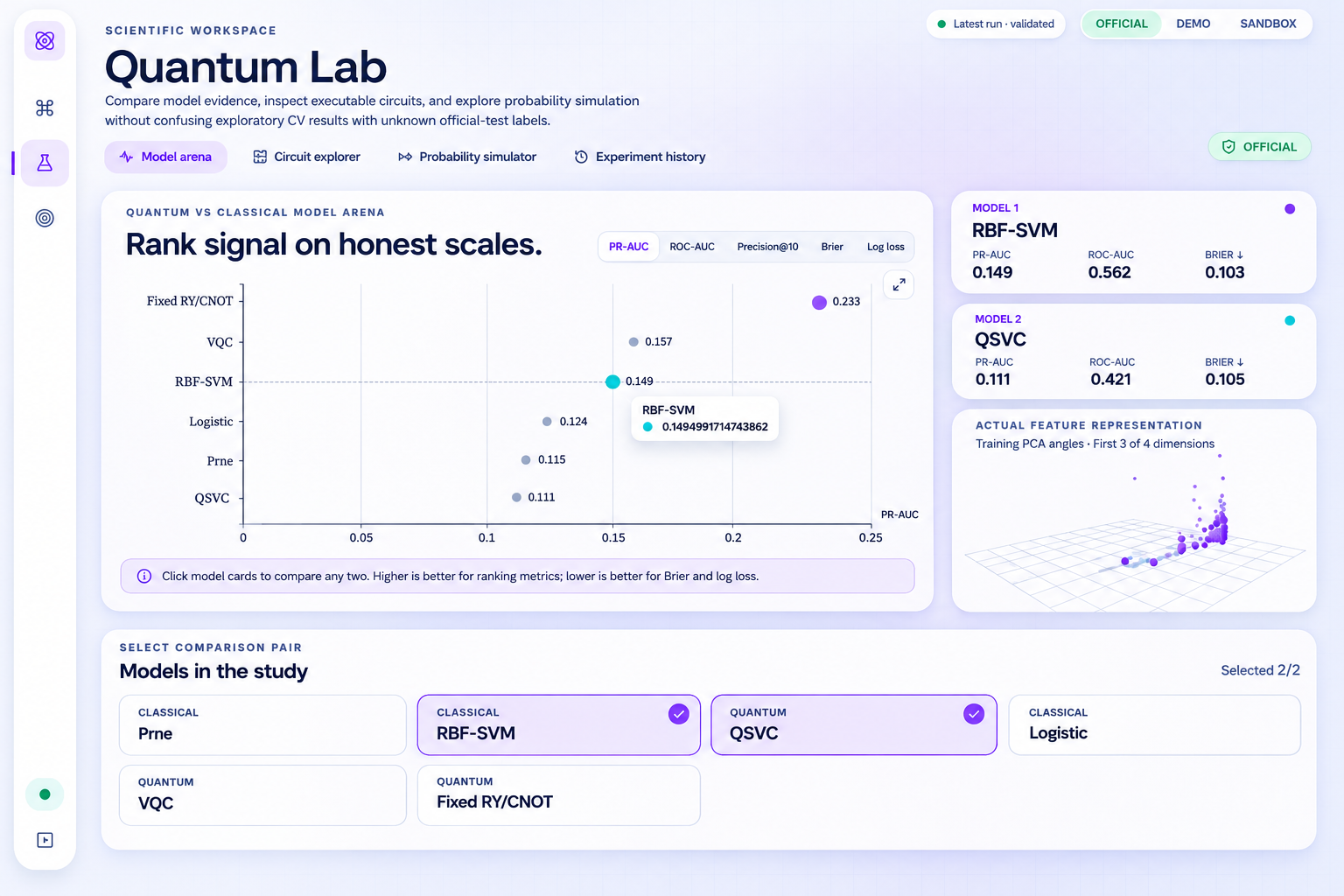
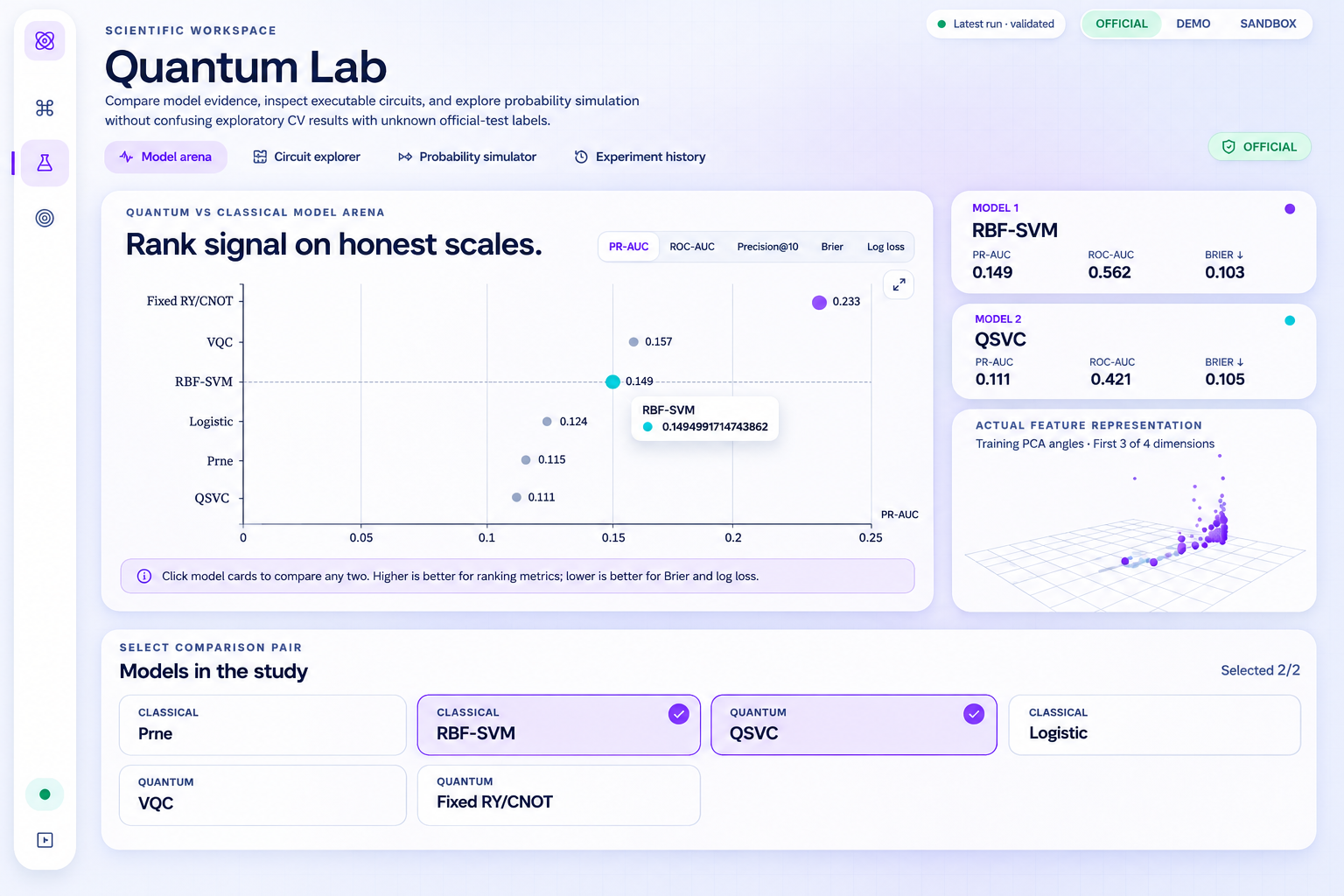
Quantum Lab: Explore quantum vs classical model performance, compare predictions, and visualize customer data in quantum feature space.
-
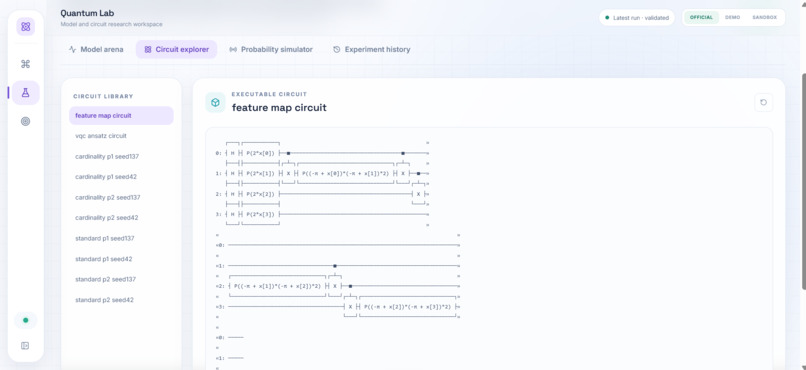
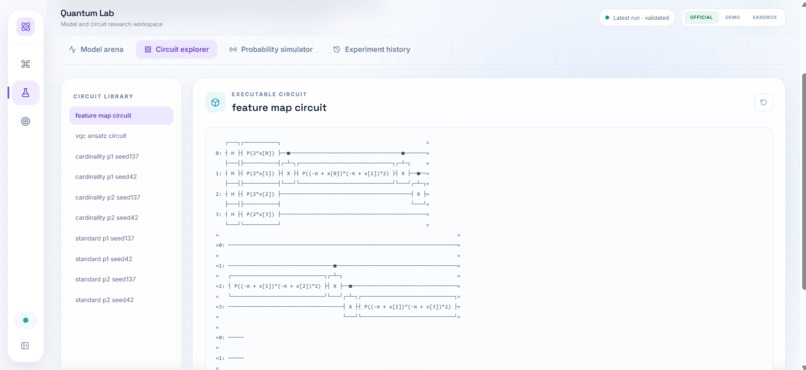
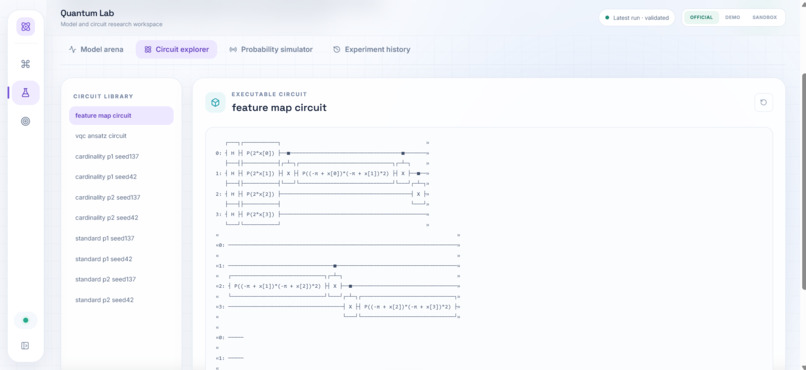
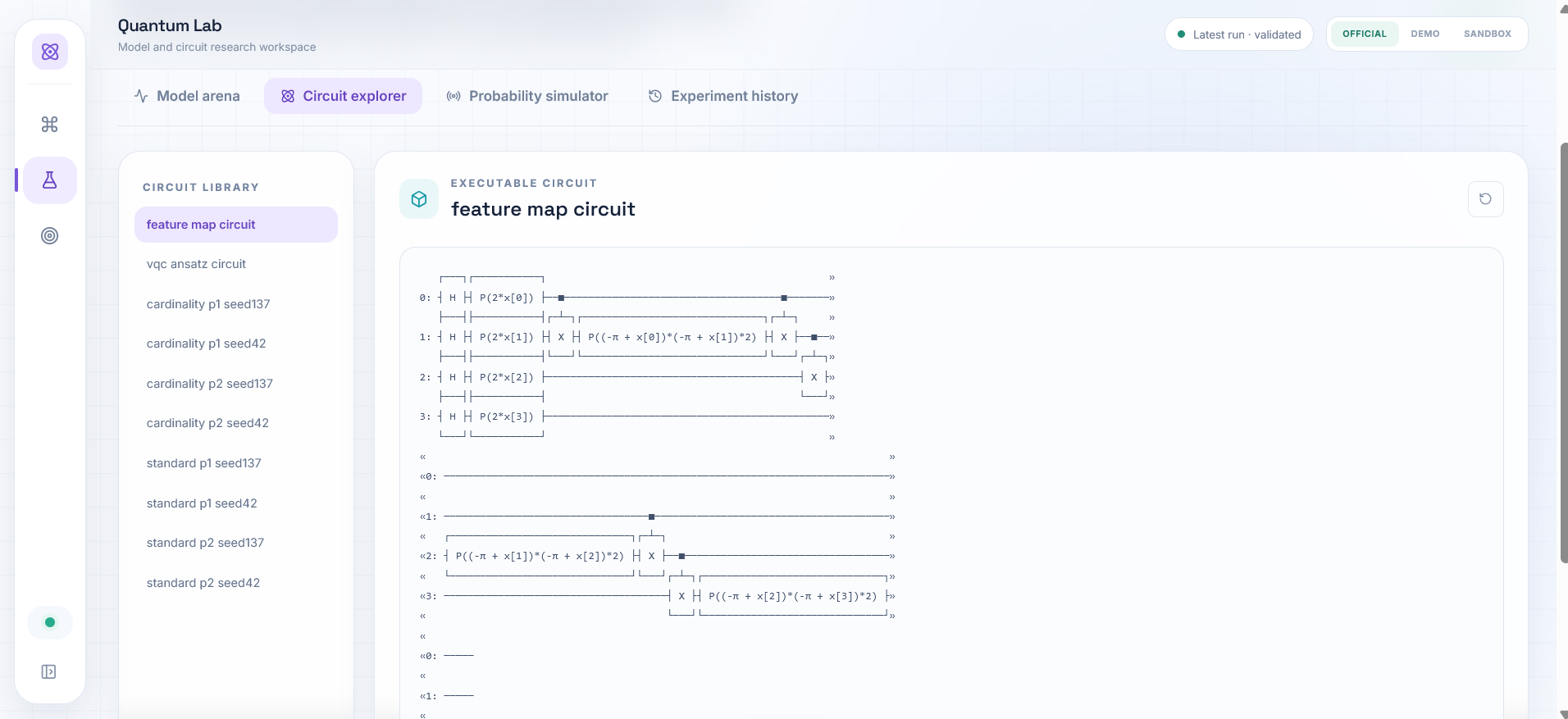
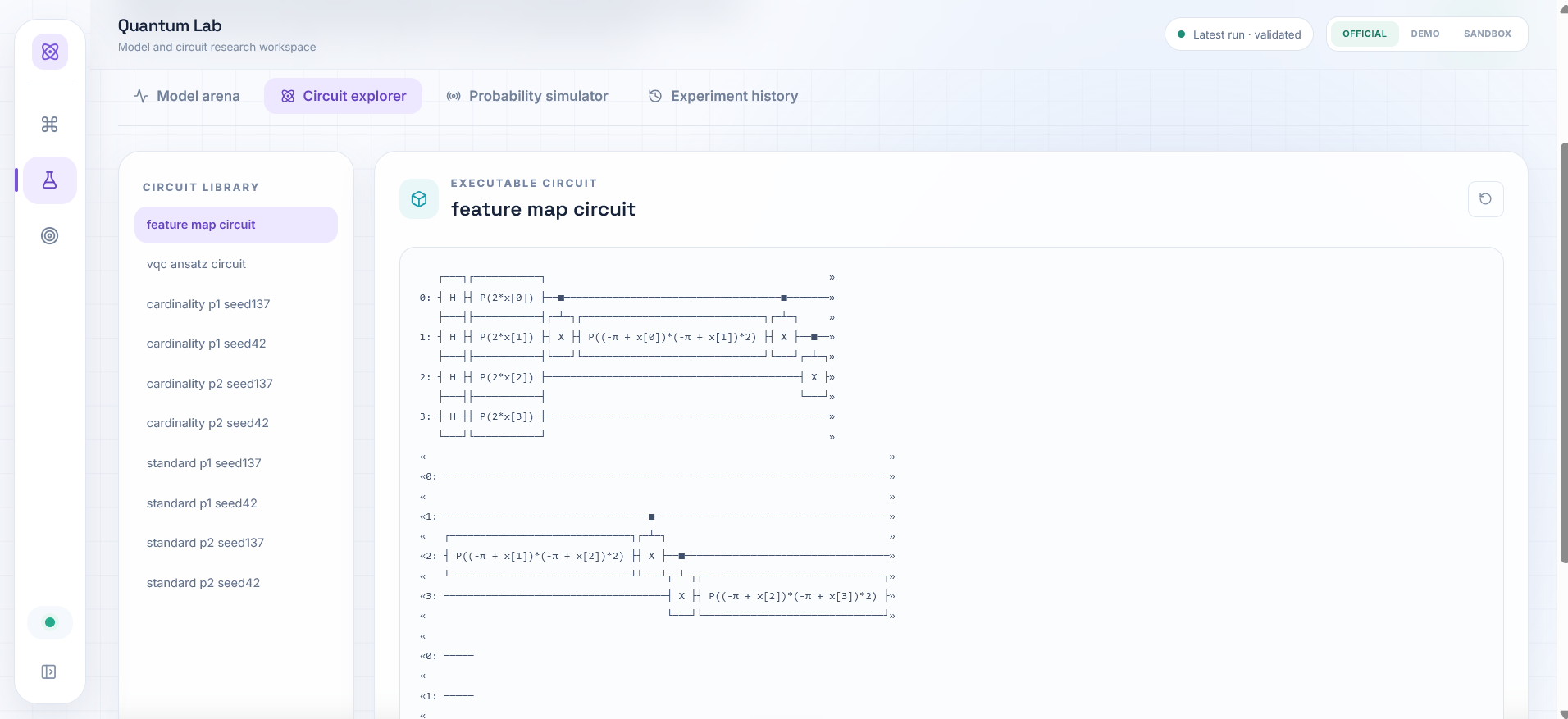
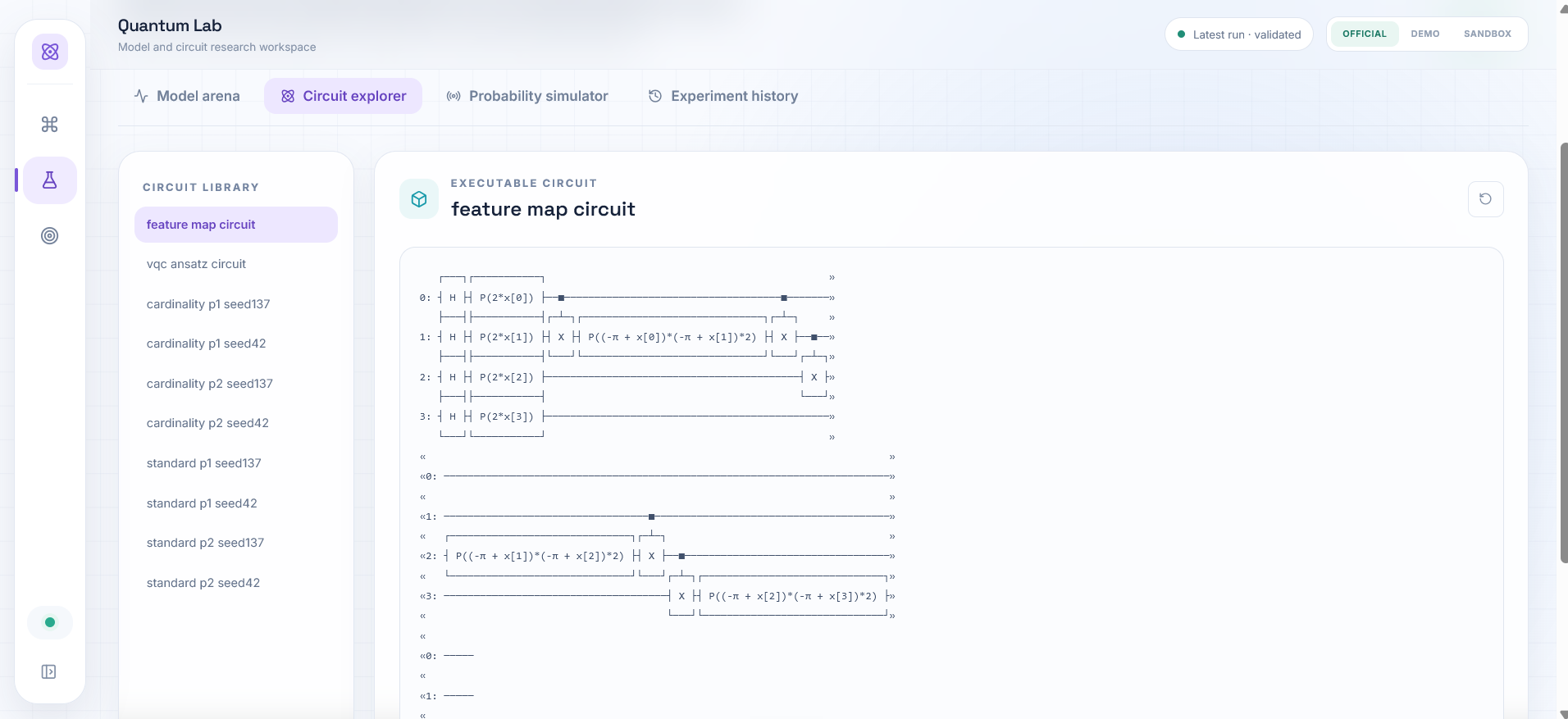
Step inside the quantum circuits! Explore the gates and clever designs behind quantum feature maps, VQC, and QAOA.
-
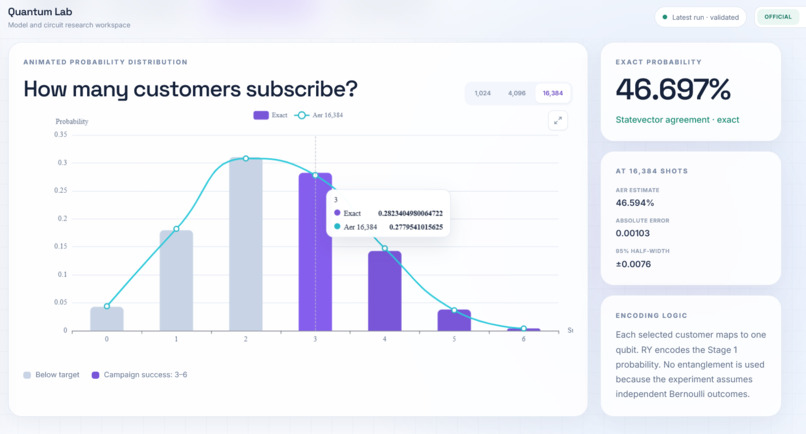
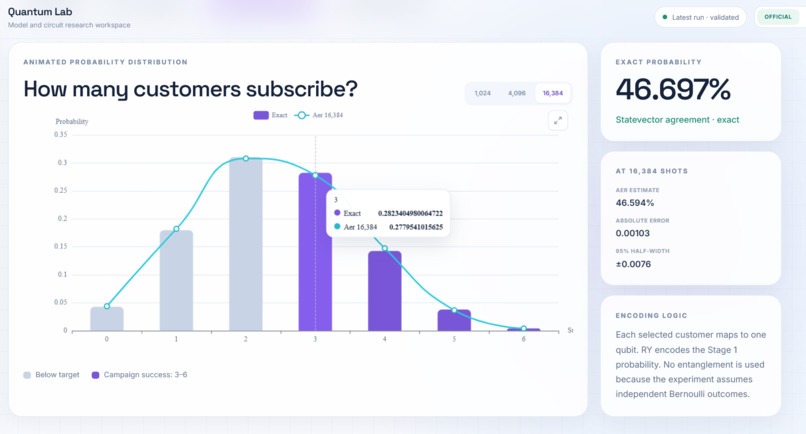
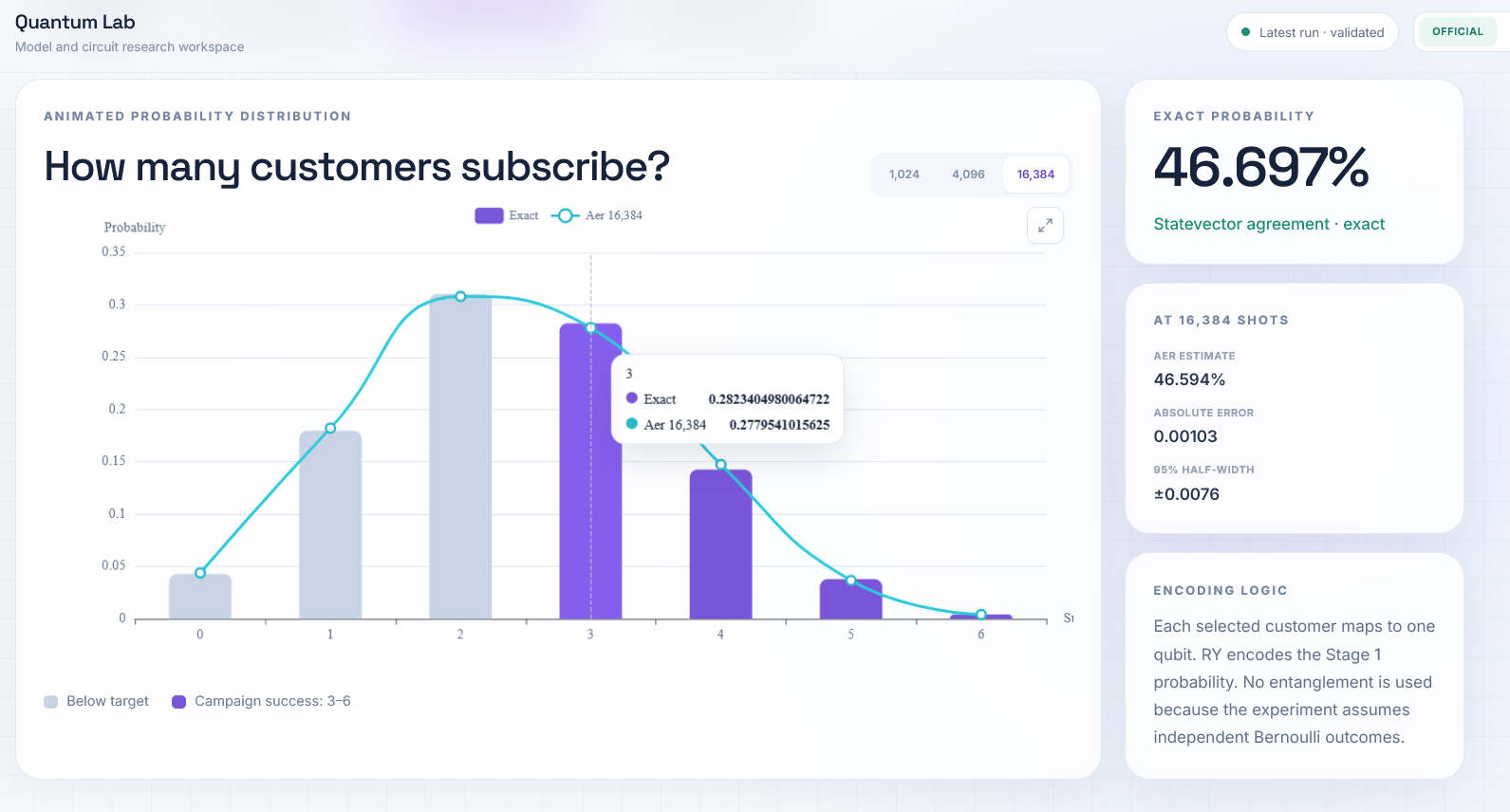
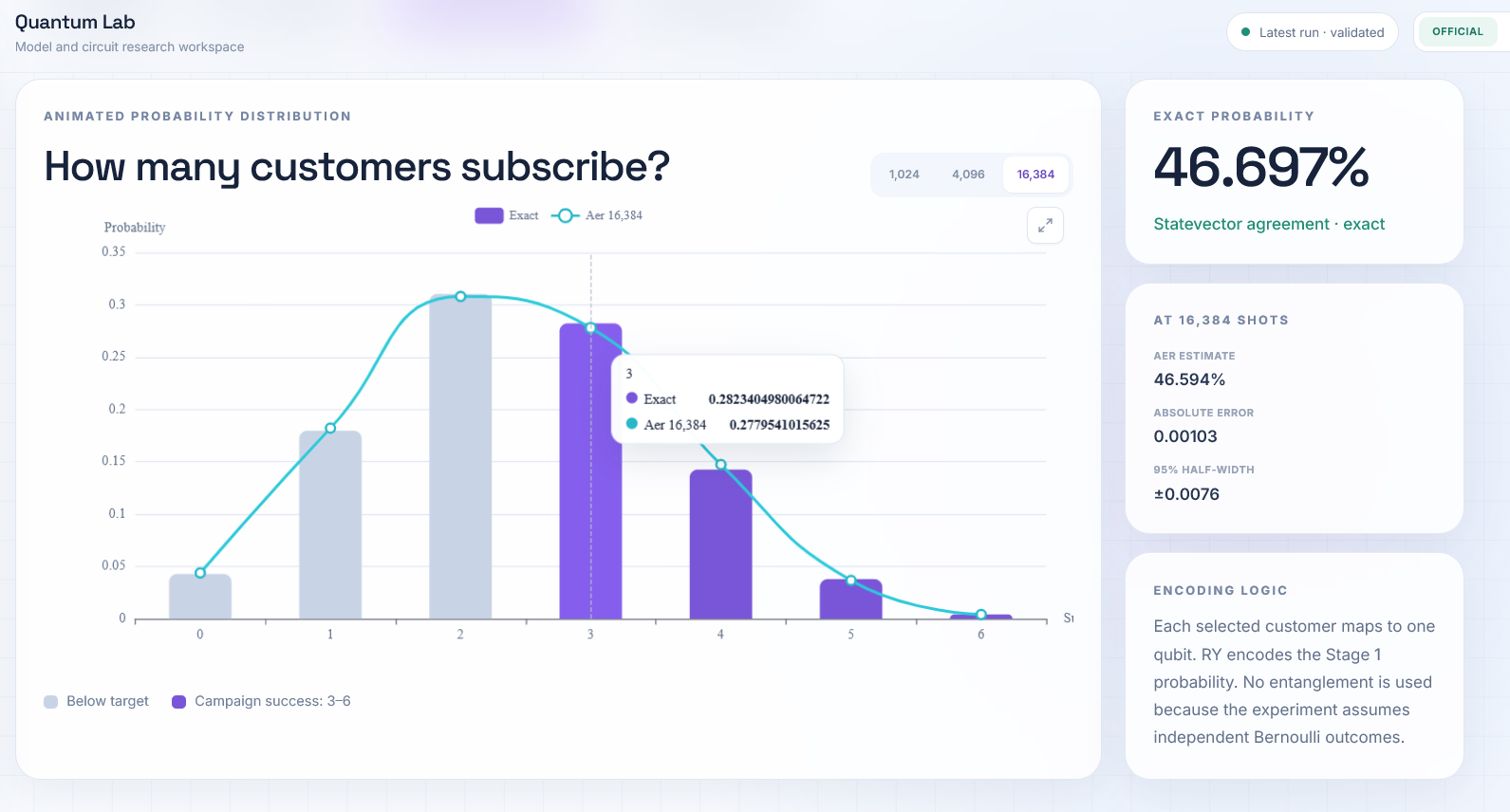
Probability Simulator: Six-qubit simulation estimates a 46.70% campaign success probability, validated against exact and classical results.
-
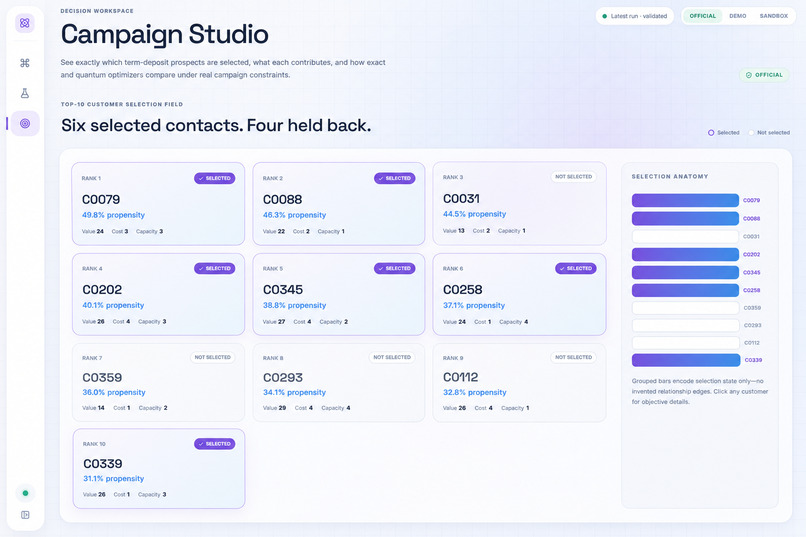
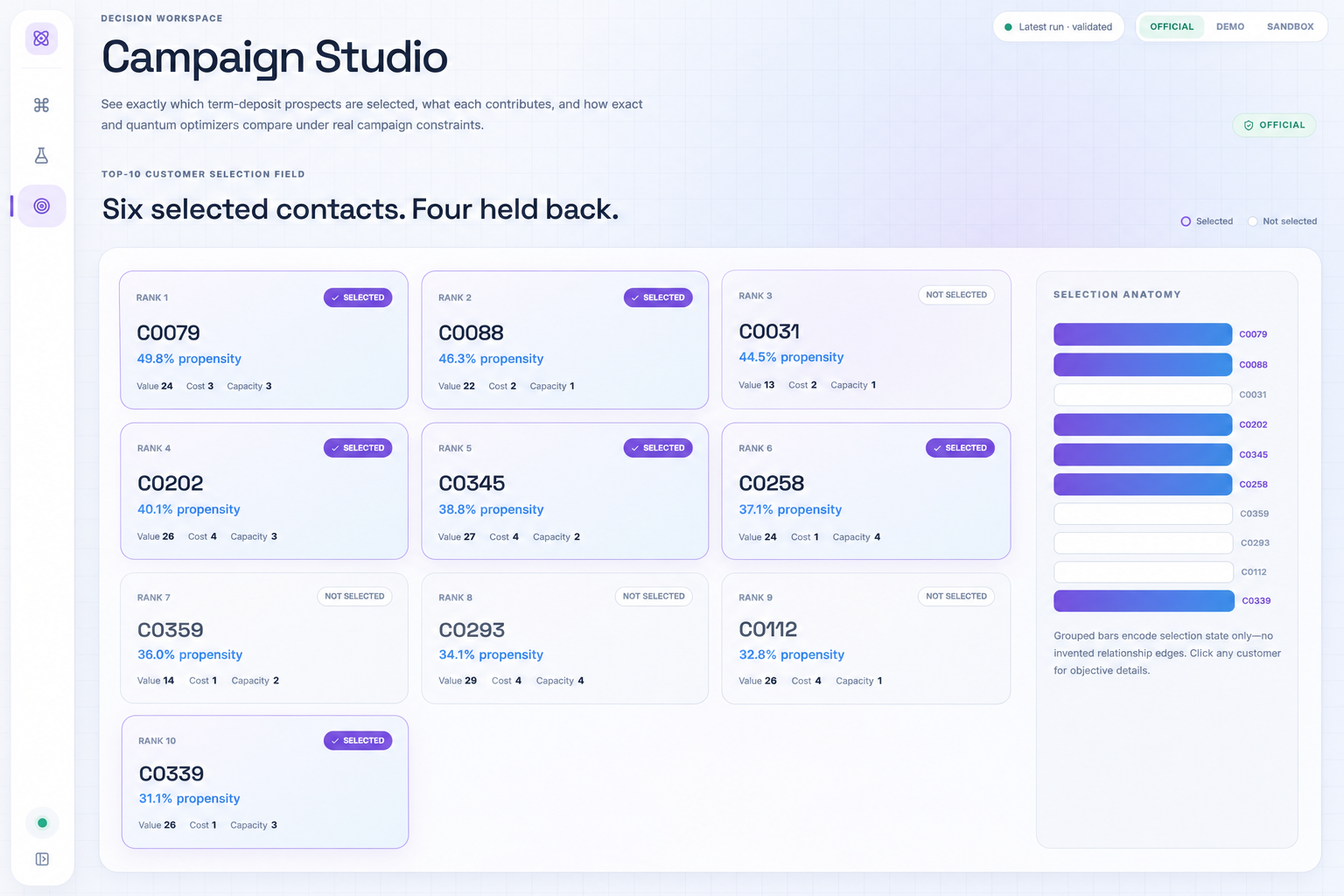
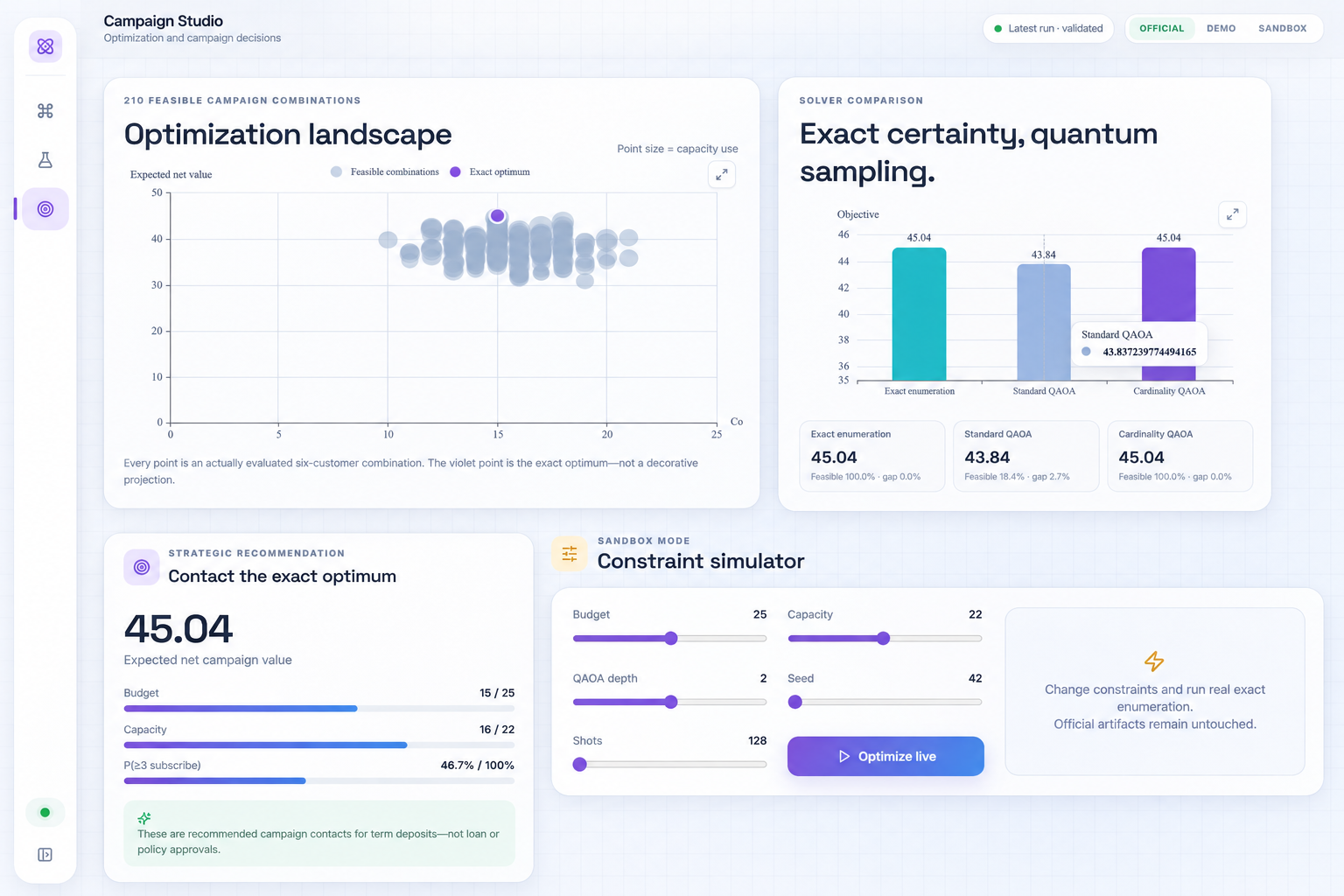
Campaign Studio: Optimal selection of six customers from ten prospects using QAOA under budget and capacity constraints.
-
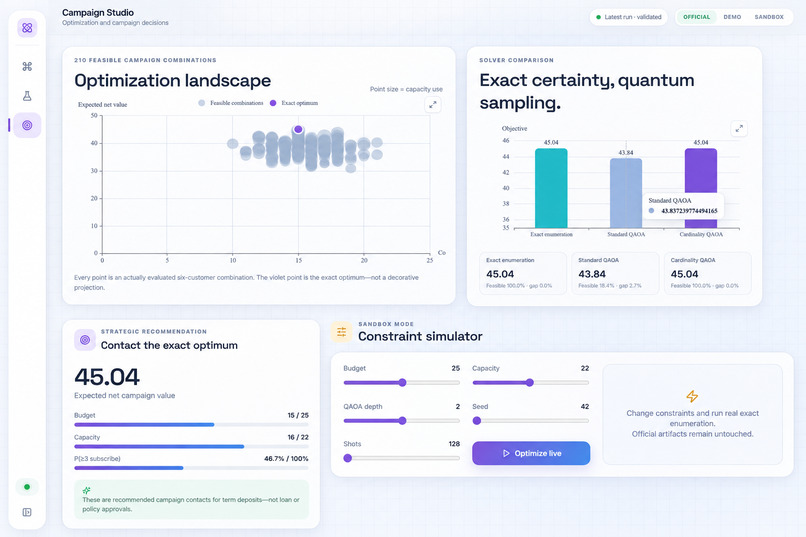
210 possible combinations. Only one best choice! Watch QAOA challenge classical optimization and experiment with campaign constraints.
-
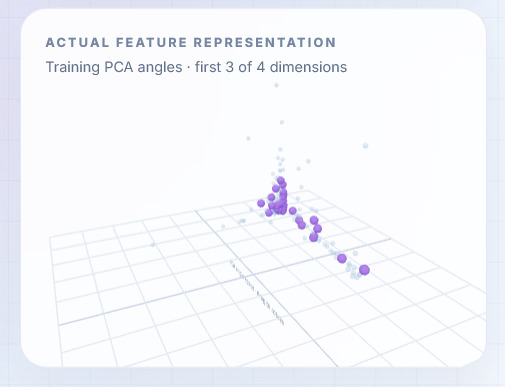
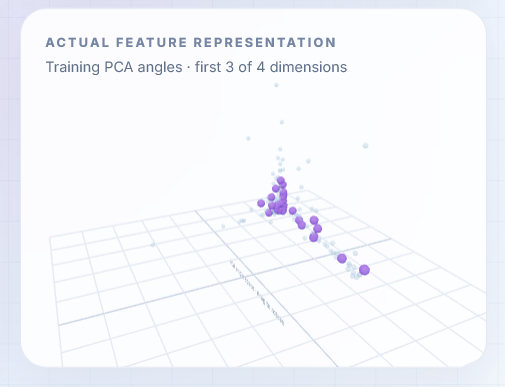
Every dot tells a story! Rotate and explore how customer data transforms into a 3D feature space for quantum learning.
Inspiration
We have always been interested in the quantum physics field. Being computer science engineering students it was interesting to see how quantum concepts could be applied to software. This interest was sparked further when we had the opportunity to speak to the CEO of the Foundation for Quantum Computing Innovation associated with India’s National Quantum Mission. He inspired us to keep exploring the quantum space and help India’s quantum future.
We were excited to find out about the AtomiQ Hackathon.
Our aim was to not only demonstrate quantum circuits but to understand how quantum computing could be used to help solve a real life problem.
What We Built
AtomiQ is a quantum and classical hybrid banking intelligence platform. It helps to make decisions using a pipeline consisting of:
Predict → Optimize → Simulate
Predict: Using quantum machine learning to predict who is most likely to sign up to a term deposit.
Optimize: Choosing the 6 best customers to target, whilst taking into consideration budget and capacity constraints using QAOA.
Simulate: Calculating an estimate for the success rate of the campaign using a 6 qubit quantum circuit.
We developed an interactive website which enables users to view the models, circuits, optimization decisions and results.
How We Built It
1. Quantum Machine Learning
We started off researching using Qiskit and PennyLane. We implemented several quantum machine learning models including QSVC, VQC and various quantum feature maps. We also included classical models such as Logistic Regression and RBF-SVM.
Unfortunately our results were not great with several quantum models performing worse than the classical model.
However we tried many variations of feature encodings and circuits to gain an understanding of why some models performed better than others.
Our best result was using a PennyLane model with a quantum fidelity kernel and classical SVM.
We encoded the 4 processed customer features into quantum states using RY rotations and CNOT gates. The customers are compared by calculating the fidelity between quantum states:
$$ K(x_i,x_j)=|\langle\phi(x_i)|\phi(x_j)\rangle|^2 $$
We then use the similarities to train a classical SVM.
Our model performed well on the training data provided:
| Metric | Quantum Kernel | Classical RBF-SVM |
|---|---|---|
| PR-AUC | 0.233 | 0.149 |
| ROC-AUC | 0.677 | 0.562 |
These are exploratory results so cannot say that quantum always performs better, however, since we had some unsuccessful attempts at the beginning it was a good achievement to find a quantum based model that performed better on this dataset.
2. Quantum Optimization
We wanted to optimize the selection of 6 customers out of the top 10 to target. We implemented the Quantum Approximate Optimization Algorithm (QAOA). This algorithm uses parameterised quantum circuits to explore potential solutions using superposition and interference.
We tried several variations of QAOA and a cardinality preserving XY mixer. This ensures that we explore combinations containing exactly 6 selected customers.
We compared the results to an exact classical solver.
We found that using a depth 2 cardinality preserving QAOA allowed us to sample the exact optimal solution. In our experiment we had a 0% optimality gap.
3. Quantum Simulation
We created a 6 qubit circuit to calculate the probability of 3 or more customers being selected to subscribe.
Each qubit represents a customer. We encode the predicted probability of subscription using:
$$ RY(2\arcsin\sqrt{p_i}) $$
We perform measurements to get an estimate of the distribution of successful subscriptions. We compared our results to exact Poisson binomial calculations and classical Monte Carlo. We found an estimated 46.70% chance of 3 or more customers subscribing in the final campaign. This helped us understand how to encode probabilities in quantum and how to measure them.
Challenges
We had to find a quantum model that worked. Our initial attempt at QSVC and VQC did not perform well. We spent a lot of time researching quantum kernels, feature maps, calibration and limitations of our small dataset.
We had to ensure that the quantum optimization took into consideration real life constraints. It was important that our solution respected the exact number of customers and budget of contacting them. We compared our QAOA solution to an exact optimization.
We wanted our website to be easy to understand. We did not want our frontend to just display numerical results from previous training. We wanted users to interact with our pipeline to see which customers were chosen, what circuits were used and visualise results.
We decided to create 3 interactive spaces to show our results. The Command Center, Quantum Lab and Campaign Studio. This allowed us to have real calculations happening in the backend with visualisations.
All of this had to be done in 24 hours.
What We Learnt
The main thing we learnt is that quantum computing is not about replacing classical computing. It is about knowing when to combine the two.
We learnt how to use quantum feature maps to create alternative representations for machine learning problems. We also learnt how to use QAOA to explore constrained optimization problems and how to encode and sample probability distributions using quantum circuits.
We also learnt how to question our results. We compared them to classical baselines and ensured our models were not just performing well in experiments but had true quantum advantage.
Creating AtomiQ pushed us outside of just algorithms and into software engineering, backend integration, reproducibility and scientific visualisation.
Things We Are Proud Of
In 24 hours we created a full 3 stage solution. We used PennyLane, Qiskit, QAOA, classical benchmarks, FastAPI backend and interactive next.js frontend.
Our pipeline passed official validation with 46 automated tests passing.
Although AtomiQ is using quantum simulators and we cannot claim any speed up in computation, we have created a working example of how quantum algorithms can be used to help with real decision making processes.
What's next for AtomiQ
We see AtomiQ as a starting point for exploring practical quantum-classical applications. Our next steps would be to experiment with larger datasets, improve our quantum models, study how noise affects circuit performance, and eventually test suitable algorithms on real quantum hardware.
We also want to explore how this three-stage approach could be applied to other decision-making problems beyond banking.
Our goal is to keep learning, experimenting, and turning quantum computing concepts into practical solutions.
Overall AtomiQ has given us a step closer to what initially drew us to quantum computing. Team Astrax — Exploring quantum possibilities and creating practical solutions.
Built With
- fastapi
- github
- next.js
- numpy
- pandas
- pennylane
- python
- qaoa
- qiskit
- qiskit-aer
- qsvc
- quantum-circuits
- quantum-computing
- quantum-kernels
- quantum-machine-learning
- quantum-simulation
- react
- react-three-fiber
- scikit-learn
- scipy
- tailwind-css
- three.js
- typescript
- uvicorn
- vqc


