-
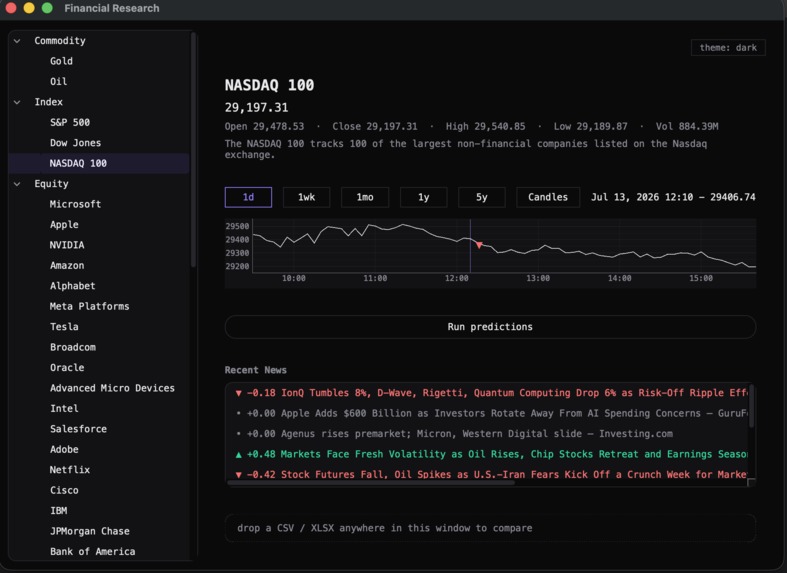
Initial Platform
-
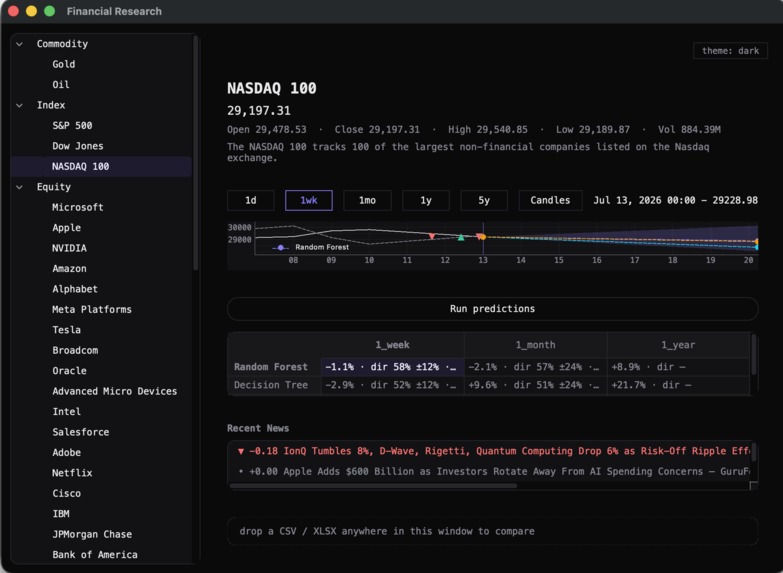
Running Predictions
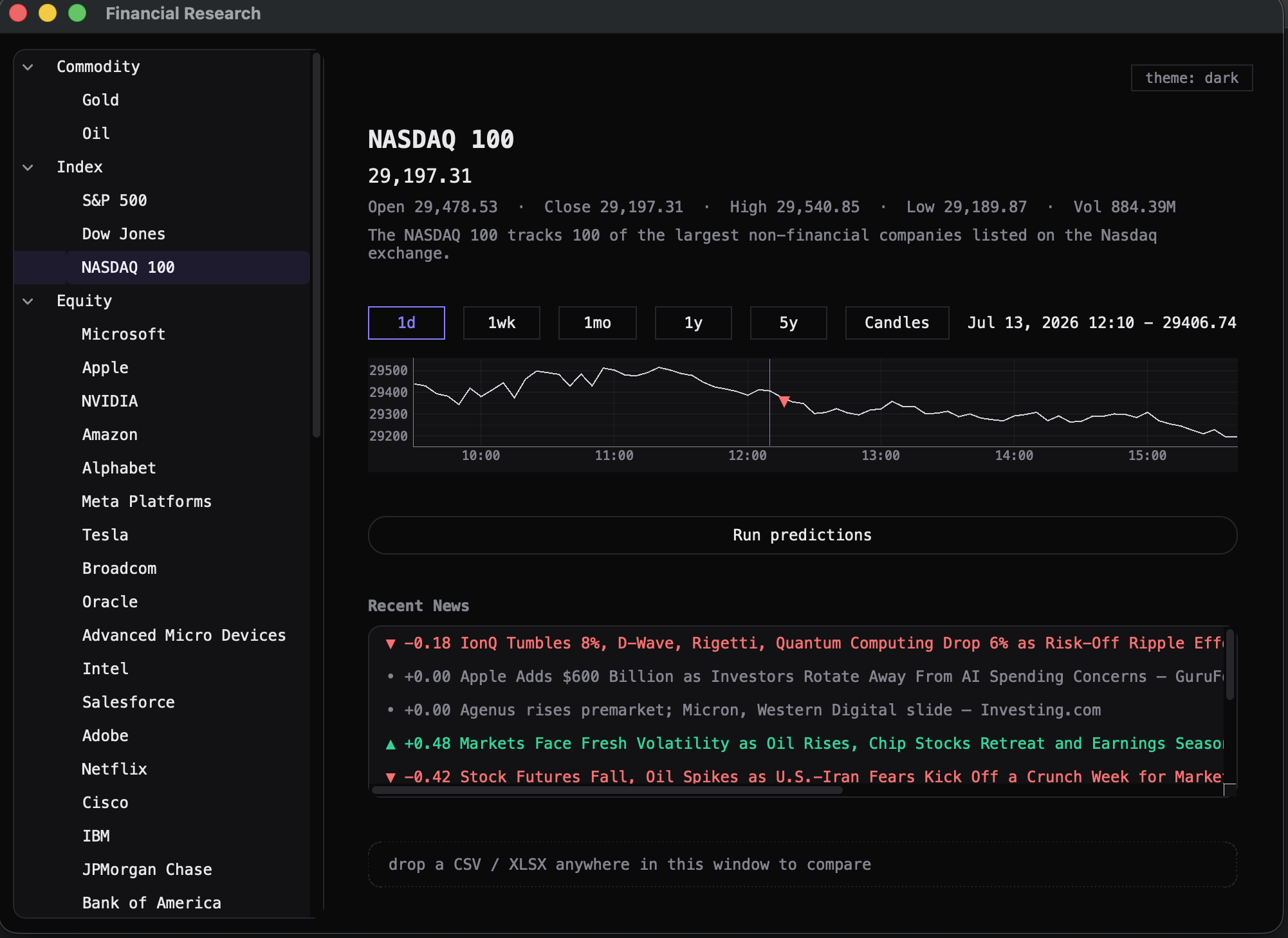
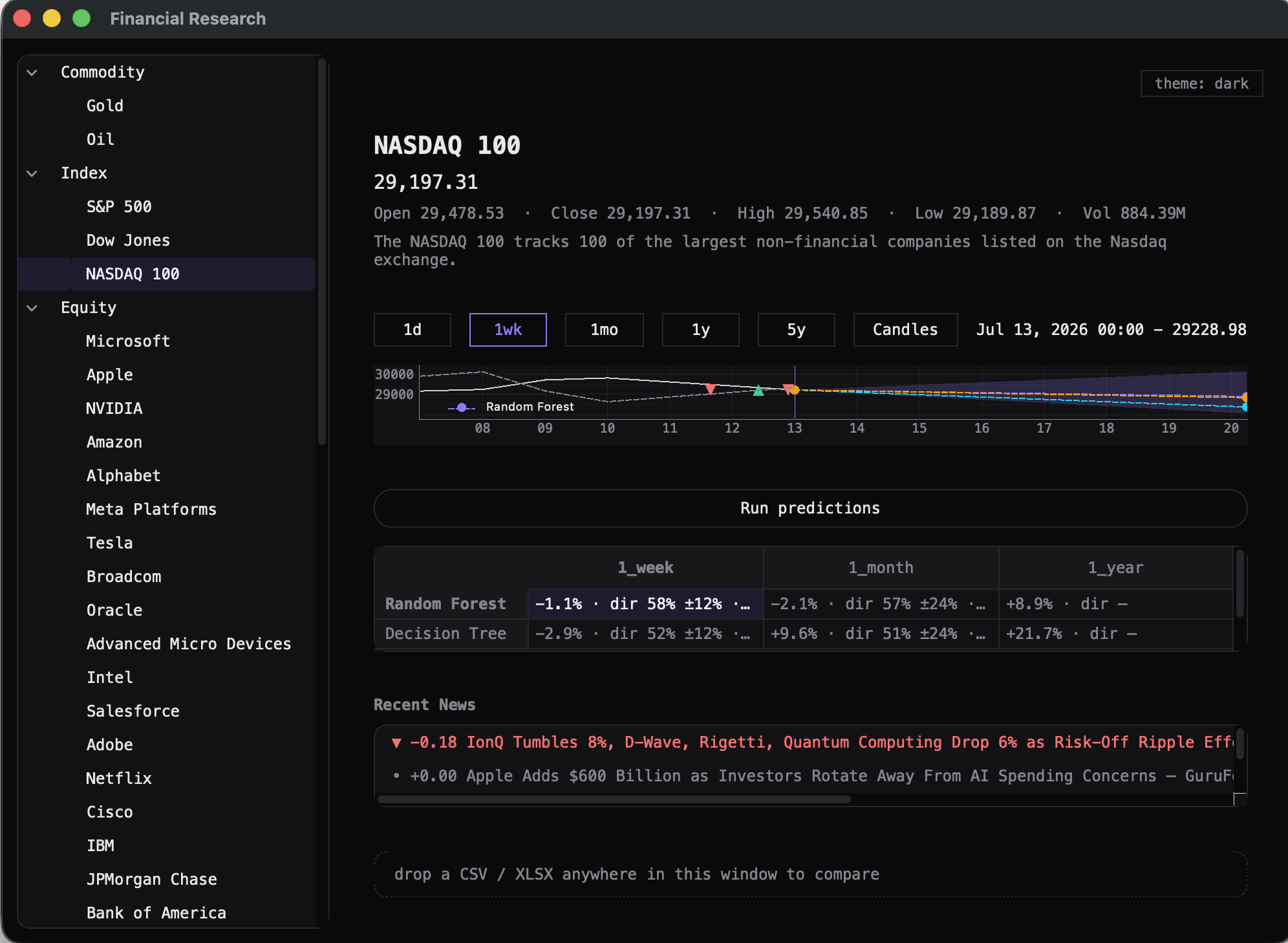
The Genesis: What Inspired Atomica
Atomica began its life during my research internship at Stanford University as a high schooler. Originating as a Python-based research project and visualizer, the goal was simple: visualize complex macroeconomic data streams. However, as LLM-centric workflows emerged along with "vibe-focused" projects like TauricAgents and rigorous backtesters like NautilusTrader that started to shift the paradigm, I realized there was a massive gap in the ecosystem.
Traditional quantitative platforms are rigid and purely deterministic.
On the flip side, AI agent frameworks are fluid but lack financial guardrails. Atomica was built to bridge these two worlds—a multi-language sandbox where quantitative strategy deployment meets the adaptive, reasoning-driven world of LLMs.
Architecture: How It Was Built
To scale Atomica from a simple Python visualizer into a multi-language platform, we had to rethink the core stack:The Multi-Language Core: While Python remains the king for data science and LLM orchestration, we offloaded low-latency execution and data ingestion to systems languages (like Rust or C++) to ensure thread safety and speed.
The LLM Strategy Sandbox:
We integrated prompt-vector routing directly into the execution loop. Instead of hardcoding macro rules, traders can deploy agents that read global sentiment, parse central bank speeches, and dynamically adjust portfolio weights.
The Mathematical Framework:
To ground the "vibe-based" trading in reality, every LLM-generated strategy is strictly bound by traditional portfolio mathematics. For example, the agent's performance and risk exposure are constantly validated by calculating the dynamic
Sharpe Ratio:$$SR = \frac{\mathbb{E}[R_p - R_f]}{\sigma_p}$$
Where $R_p$ represents the LLM-managed portfolio return, $R_f$ is the risk-free rate, and $\sigma_p$ is the standard deviation of the portfolio's excess return. If an agent's "vibe" violates the risk thresholds established by this formula, the sandbox automatically throttles its execution.
The Hurdles: Challenges Faced
Building a hybrid system like this wasn't exactly smooth sailing. We ran into two major roadblocks:
The Determinism Dilemma:
Quantitative finance demands 100% reproducibility. LLMs, by nature, are non-deterministic. Forcing an LLM agent to output consistent, structured trading signals without destroying its creative macro-reasoning capabilities required intense prompt-engineering and strict JSON-schema enforcement.
State Synchronization: Keeping state synchronized across the Python visualizer, the multi-language backend, and the asynchronous LLM API calls created severe latency bottlenecks early on. We had to build a custom shared-memory architecture to prevent the visualizer from lagging behind real-time market data.
Key Takeaways: What Was Learned
The biggest lesson learned from Atomica is that "vibe-centric" trading isn't just a meme—it's a powerful overlay when paired with rigid risk parameters.
By treating the LLM as a macro-research partner rather than just a code generator, Atomica allows traders to backtest abstract thesis statements ("How does the market react when Federal Reserve rhetoric sounds subtly anxious?") alongside hard quantitative data.