-
-

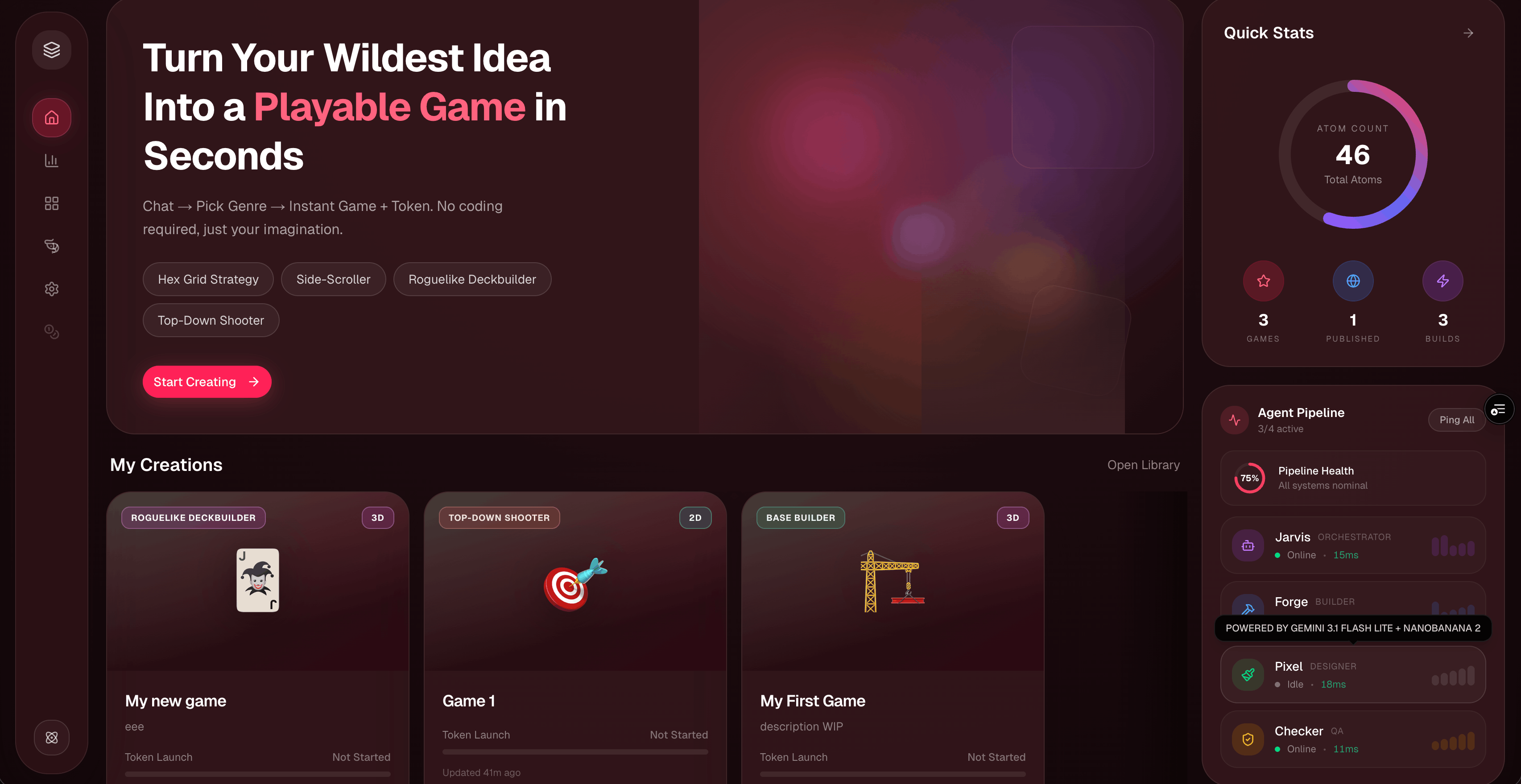
Dashboard Page
-
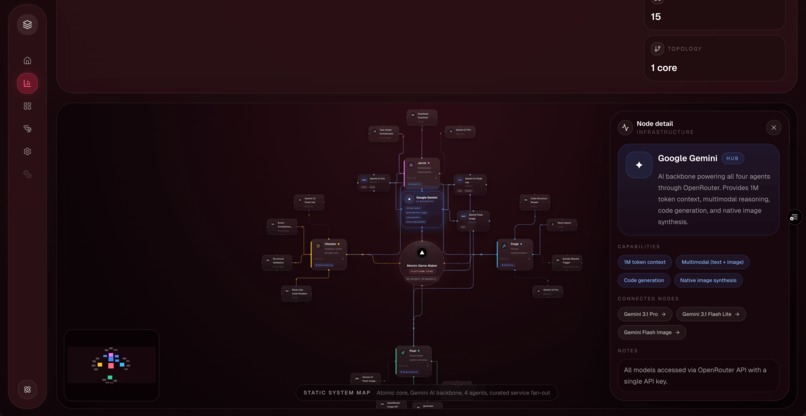
Architecture Page
-
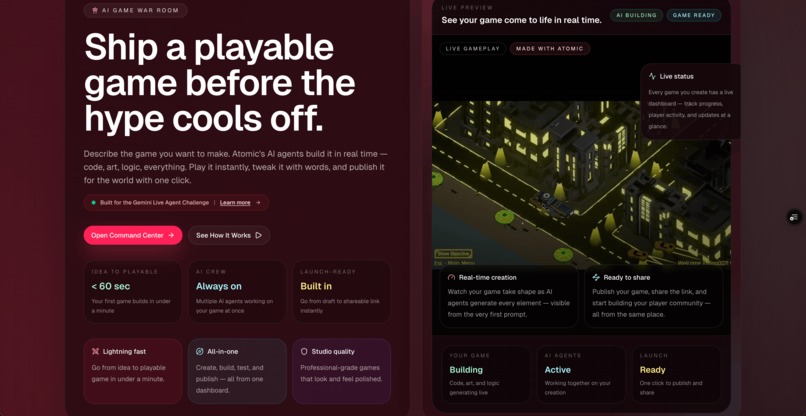
Features Page
-
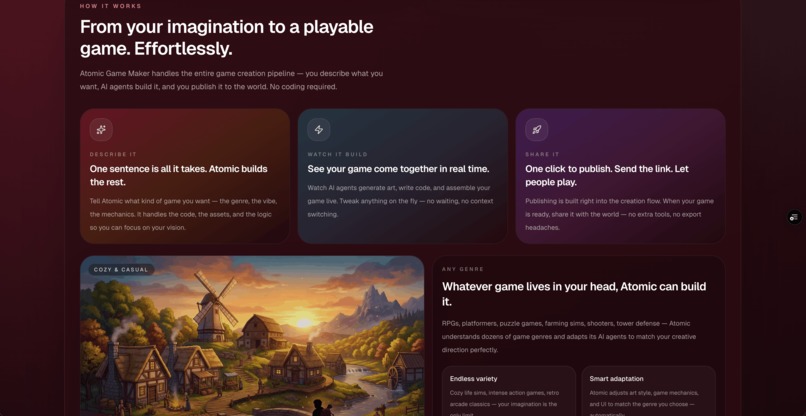
How It Works Page
-
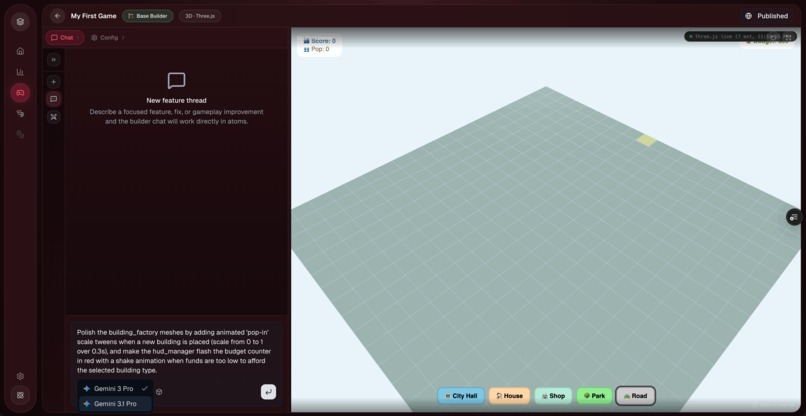
Game Maker Page
-
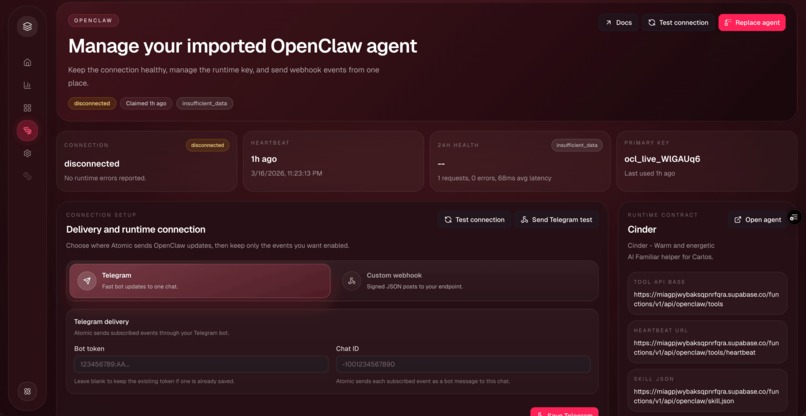
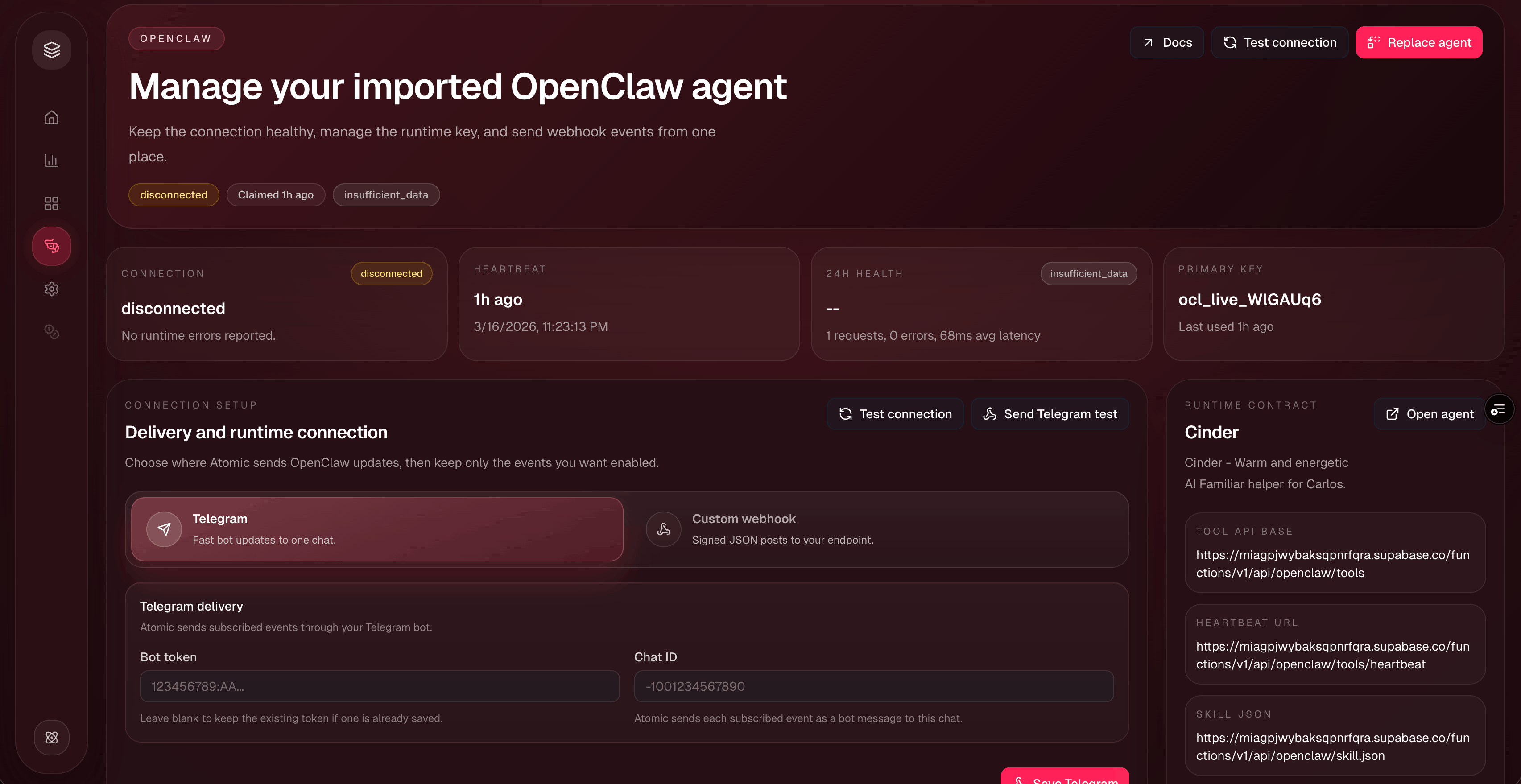
OpenClaw Import Aganet Handshake
-
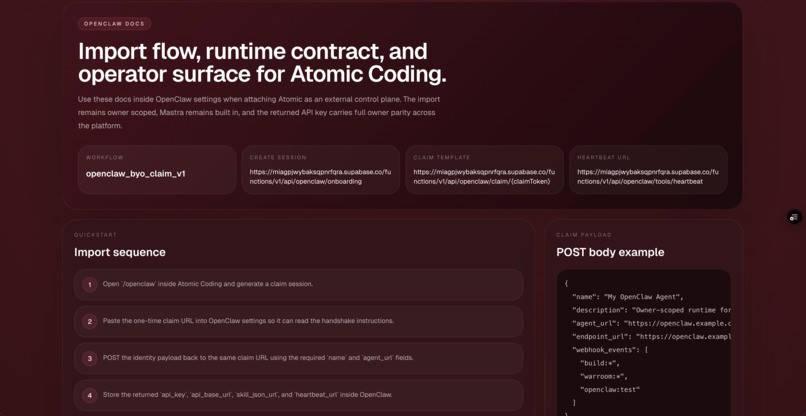
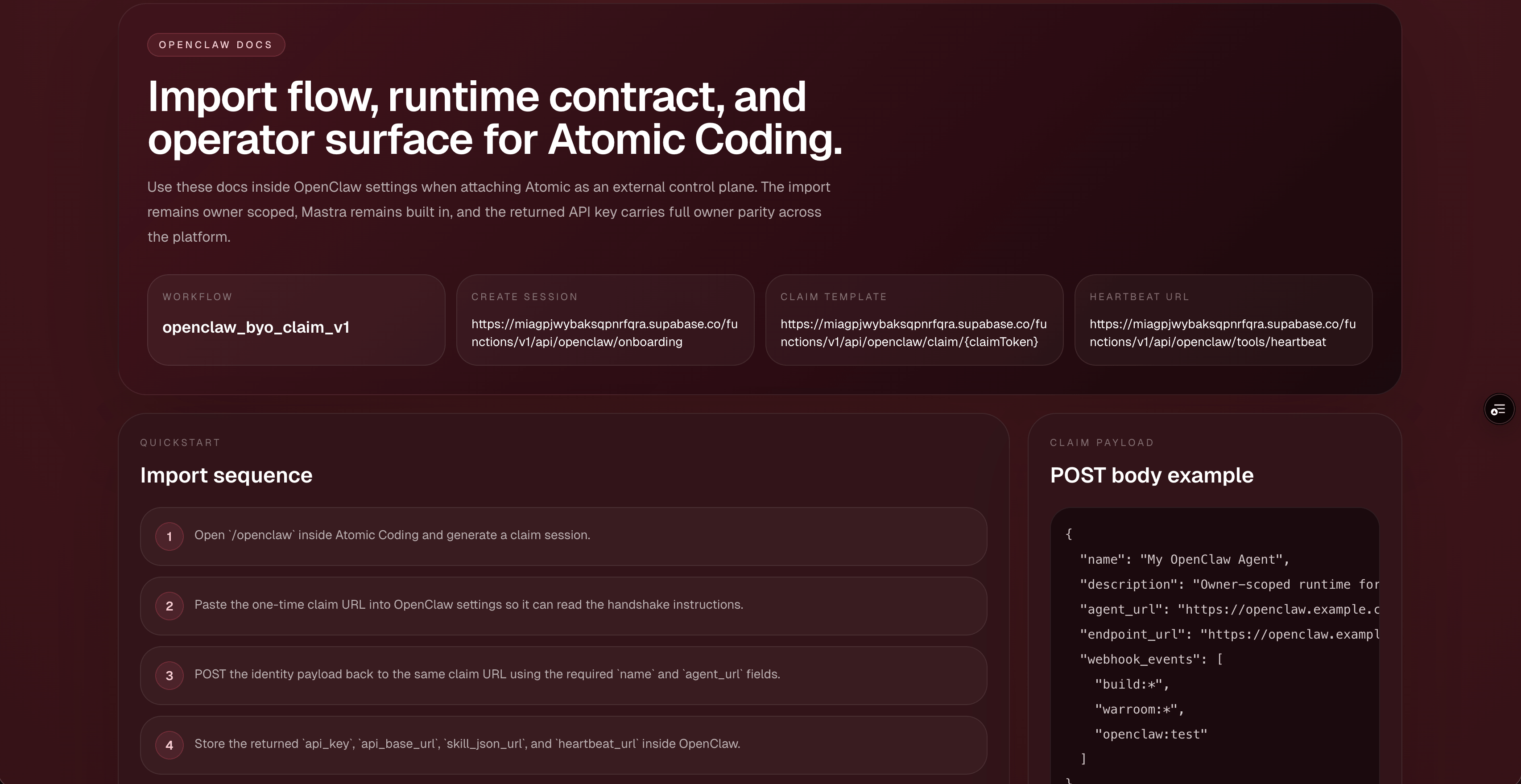
OpenClaw Skill.md
-
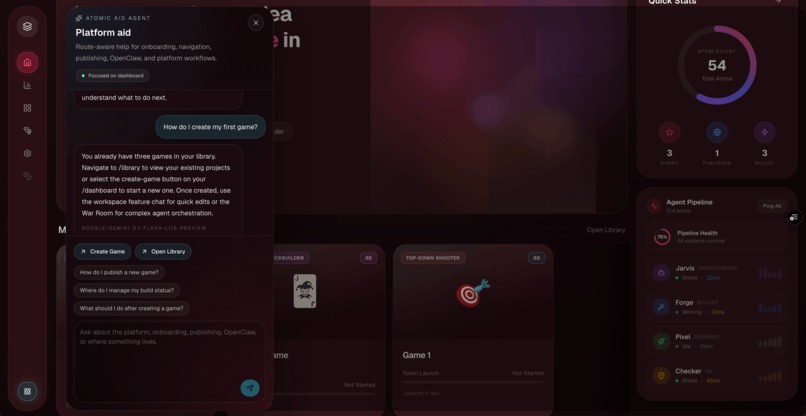
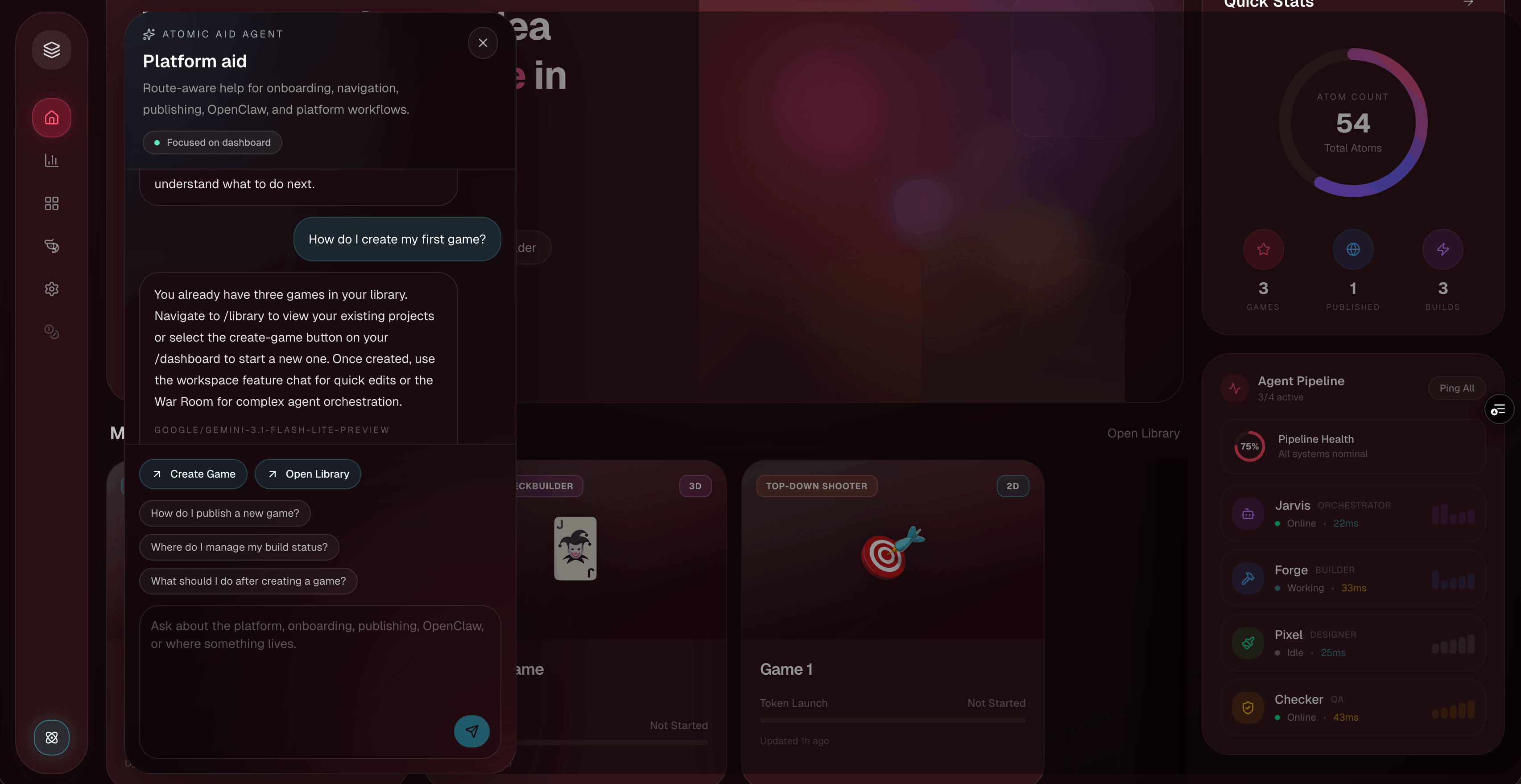
AI Agent Help Aid gemini-3.1-flash-lite-preview
-

Create a Game Page MCPs selector page
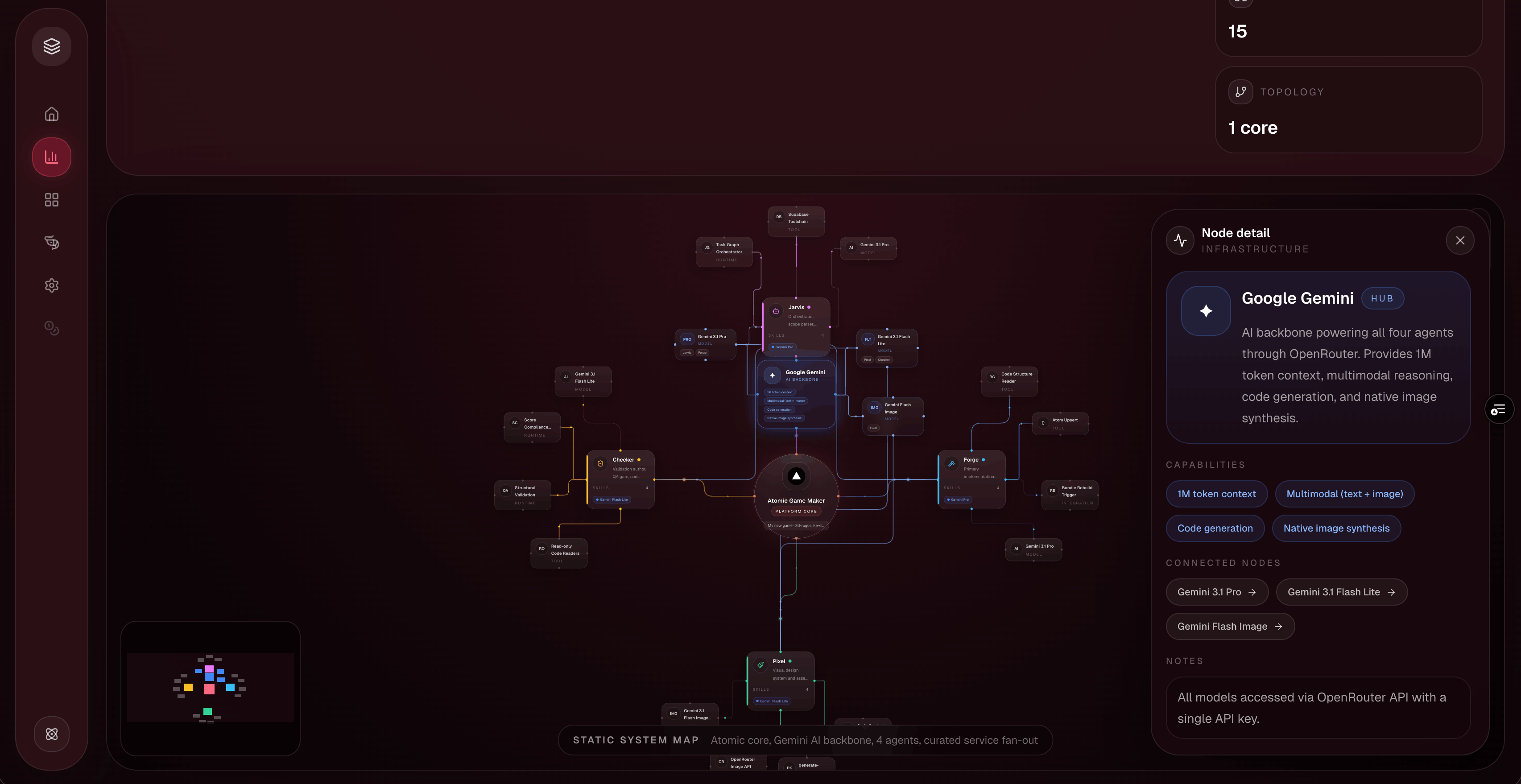
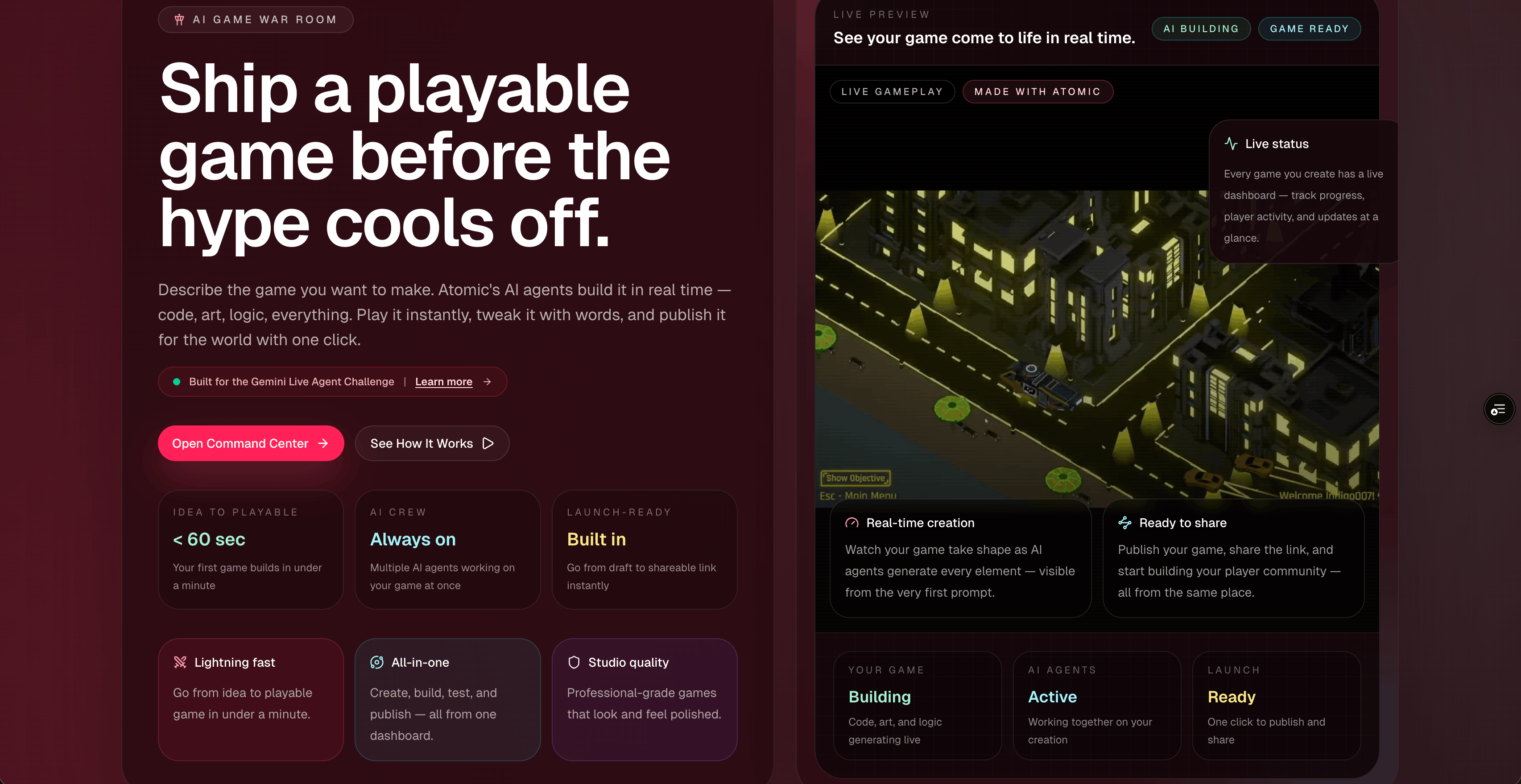
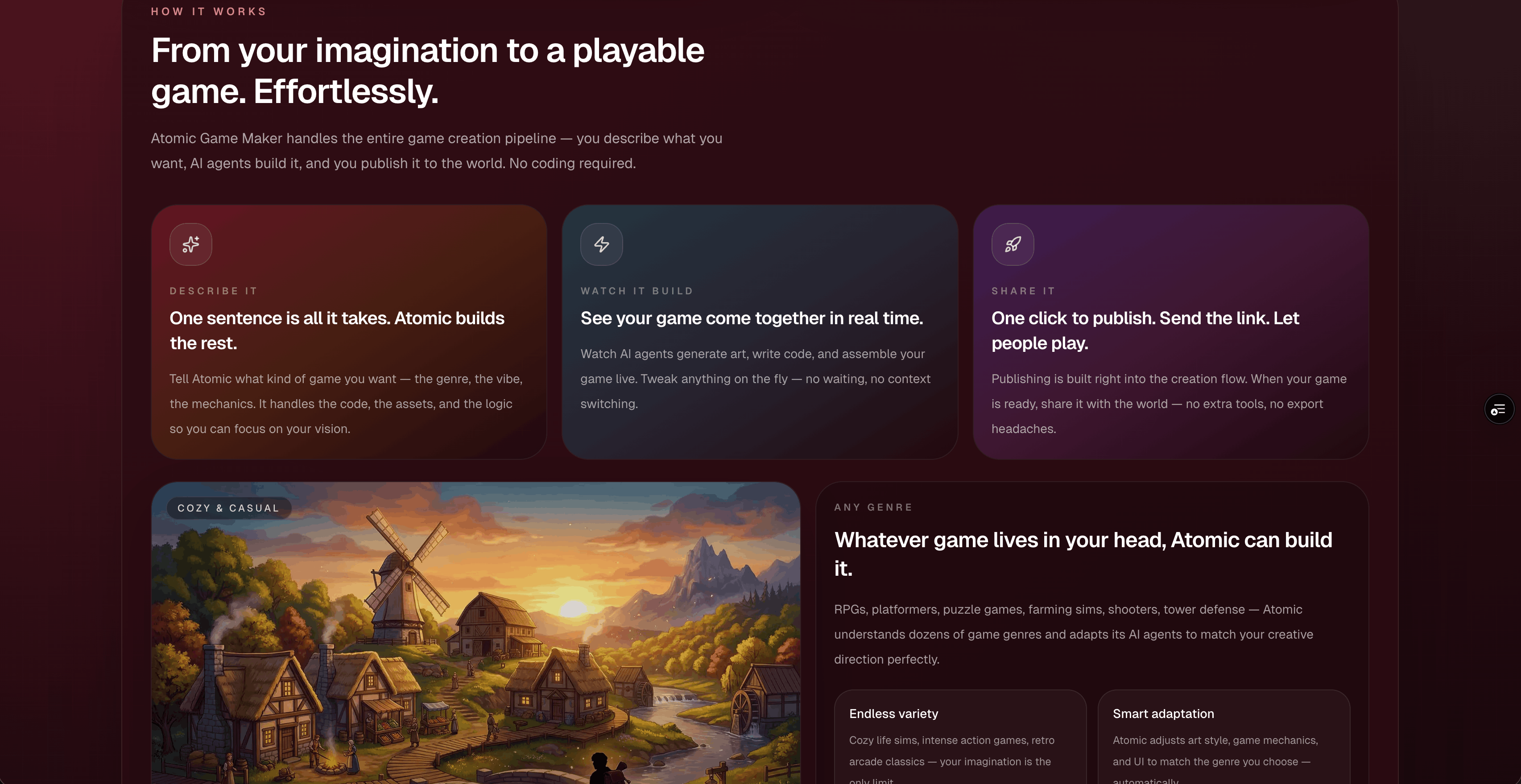
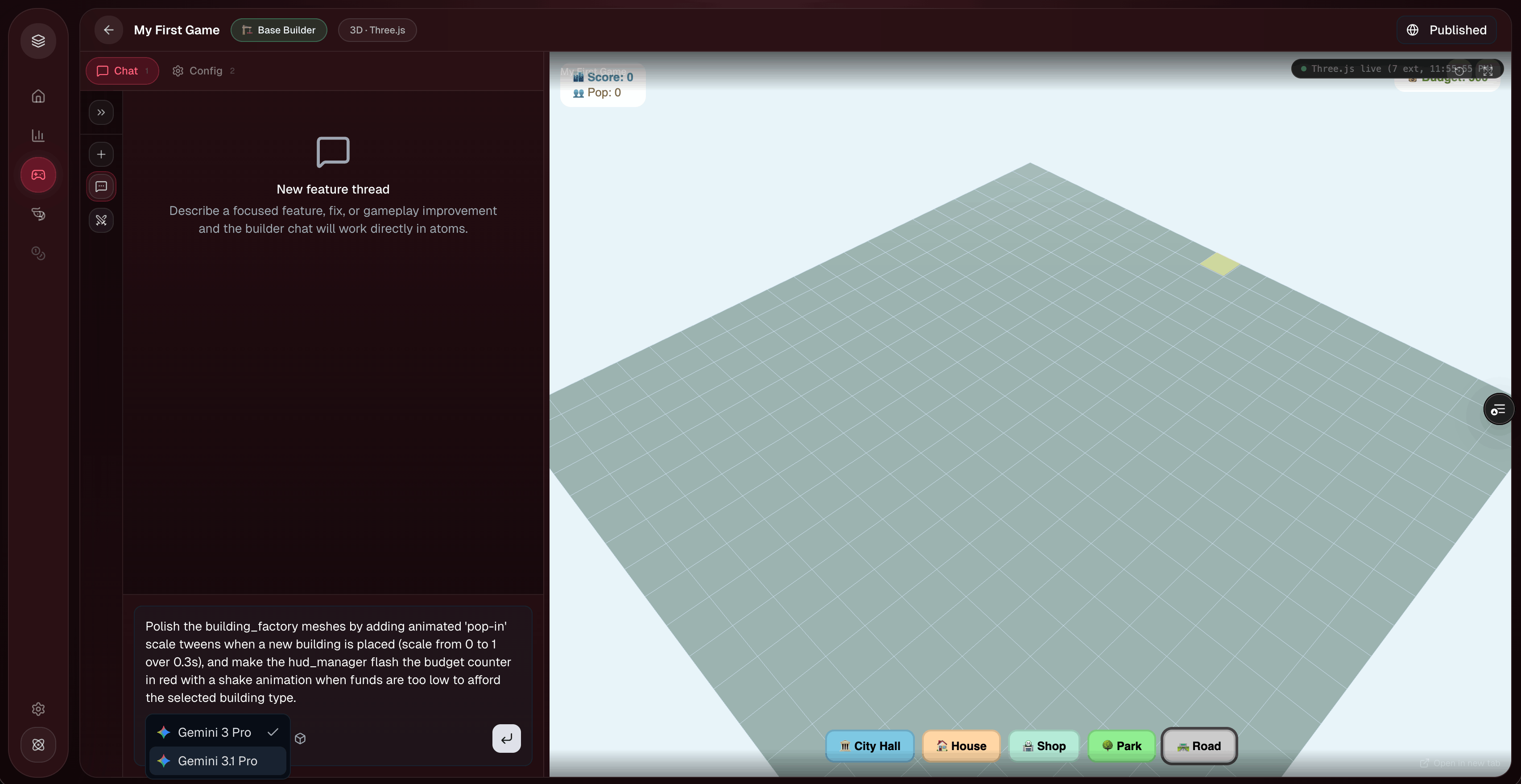

About ATOMIC
ATOMIC is the first intelligent, agentic no-code game engine that decomposes natural language into fully playable 2D and 3D games in minutes — not through monolithic code generation, but through a novel atomic decomposition architecture that has no precedent in AI-assisted game creation.
Powered by Gemini 3.1 Pro (1M-token context), ATOMIC introduces a fundamentally new paradigm: games are not "generated" — they are composed from validated, semantically indexed, reusable atomic units orchestrated by four specialized AI agents operating in closed-loop collaboration. No existing system — academic or commercial — achieves this level of structured, multi-agent game synthesis.
Inspiration
During my time building Elixir Games, I repeatedly saw incredibly creative people — artists, educators, indie storytellers, and web3 builders — abandon amazing game ideas because they lacked coding skills or technical resources. Every existing "AI game maker" generates code as a single blob: fragile, uneditable, and impossible to iterate on. I realized the problem wasn't generation — it was architecture. The rapid advancement of multimodal AI gave me the opening to solve it. ATOMIC isn't just another AI wrapper; it's a true AI game studio in your browser that removes every technical barrier by solving the hardest unsolved problem in AI-assisted development: coherent multi-agent decomposition with structural guarantees.
What I Learned
I discovered something no existing framework addresses: agentic atomic decomposition. By enforcing that every game must be expressed as small, single-responsibility atoms (max 2KB each, primitives-only interfaces, strict DAG dependencies), I created a system where AI agents can reason about, validate, and repair game logic at a granular level that monolithic generation simply cannot achieve.
$$\alpha_i = \langle n_i, \tau_i, c_i, I_i, O_i, \delta_i, D_i \rangle, \quad \tau_i \in {\texttt{util}, \texttt{feature}, \texttt{core}}, \quad |c_i| \leq 2048\text{B}$$
$$\text{rank}(\texttt{util}) = 0 ;\rightarrow; \text{rank}(\texttt{feature}) = 1 ;\rightarrow; \text{rank}(\texttt{core}) = 2$$ Formalizes the atom as a typed tuple with enforced dependency direction.
Each atom has a type hierarchy — util (pure helpers), feature (gameplay systems), core (orchestration) — with enforced dependency direction (util → feature → core). This isn't just code organization; it's a formal constraint system that makes AI-generated games structurally sound by construction. Combined with semantic embeddings that index every atom by its signature, description, and implementation, atoms become reusable across projects — a capability no other AI game engine offers.
I also pioneered the War Room planning mode: before a single line of code is written, four agents swarm collaborate through a 12-task pipeline with explicit dependency chains, validation gates, and automated repair cycles. This orchestration pattern — where agents don't just generate but validate, critique, and fix each other's work — represents a step-change in agentic AI reliability.
How I Built It
The system architecture is built around three innovations that, together, constitute a state-of-the-art approach to AI game creation:
- Atomic Game Architecture (the core breakthrough)
User prompts enter the War Room, where Jarvis (orchestrator agent, Gemini 3.1 Pro) decomposes the game into atomic modules with explicit dependency graphs, typed primitive interfaces, and strict size constraints. Each atom is validated against six rule categories: structural integrity, score system compliance, interface compatibility, reachability (BFS from entry points), code quality, and game-specific contract adherence. This isn't prompt engineering — it's a formal verification layer on top of generative AI.
$$G = (A, E), \quad \nexists \text{ cycle in } G, \quad V(G) = \bigwedge_{f \in \mathcal{F}} f(G)$$
$$\mathcal{F} = {v_{\text{struct}},; v_{\text{score}},; v_{\text{iface}},; v_{\text{reach}},; v_{\text{game}},; v_{\text{quality}}}$$
The game is a DAG; validity requires all six verification functions to pass.
- Four-Agent Closed-Loop Pipeline
The 12-task pipeline enforces a build order where no agent proceeds without its dependencies completing:
- Jarvis (Planner): parses scope, plans the atom graph, and delivers the final build
- Forge (Engineer): implements atoms bottom-up (utilities → features → core) with runtime-aware code generation for Phaser.js (2D) and Three.js (3D)
- Pixel (Artist): establishes a unified design system before generating any asset, ensuring visual coherence
- Checker (QA): writes validation specs before implementation, runs them after, and triggers up to 3 automated repair cycles
- Jarvis (Planner): parses scope, plans the atom graph, and delivers the final build
No existing system achieves this level of agent specialization with structural guarantees between stages.
- Semantic Reuse via Embeddings
Every atom is embedded using its full signature, description, and code. Semantic search (cosine similarity, threshold 0.3) enables cross-project atom discovery and reuse. Genre-specific boilerplates (10+ genres) provide idempotent seed atoms that preserve manual customizations.
Challenges Faced
- Multi-agent coherence: Solved with validation-driven development loop (Checker writes specs first) + six independent validation functions + targeted fix hints.
- Context explosion: Built dependency-aware context trimming with per-task field allowlists and intelligent token budgeting.
- 3D generation latency: Solved via BUU integration pipeline (caching, progressive loading, hybrid inference).
- Balancing freedom & safety: Refined War Room questioning through 12-task pipeline with scope-first approach.
$$F_0 = V(G_0), \quad G_{t+1} = \text{Forge}(G_t, F_t), \quad \exists, t^* \leq 3 : F_{t^*} = \emptyset$$
The system self-heals: validate, repair, re-validate — guaranteed to converge or fail explicitly within 3 iterations.
Why This Matters
ATOMIC introduces a new computational paradigm for game creation: formally constrained atomic decomposition with multi-agent validation loops. Every game it produces is structurally verified, semantically indexed, and composed from reusable primitives — properties that no monolithic AI generator can offer.
This represents a fundamental leap toward truly democratized game creation.
Built With
- gemini
- hono
- mastra
- node.js
- phaser.js
- postgresql
- supabase
- tailwind
- three.js


Log in or sign up for Devpost to join the conversation.